Showing posts with label Wittmann (Chardon). Show all posts

Tuesday, 5 April 2022

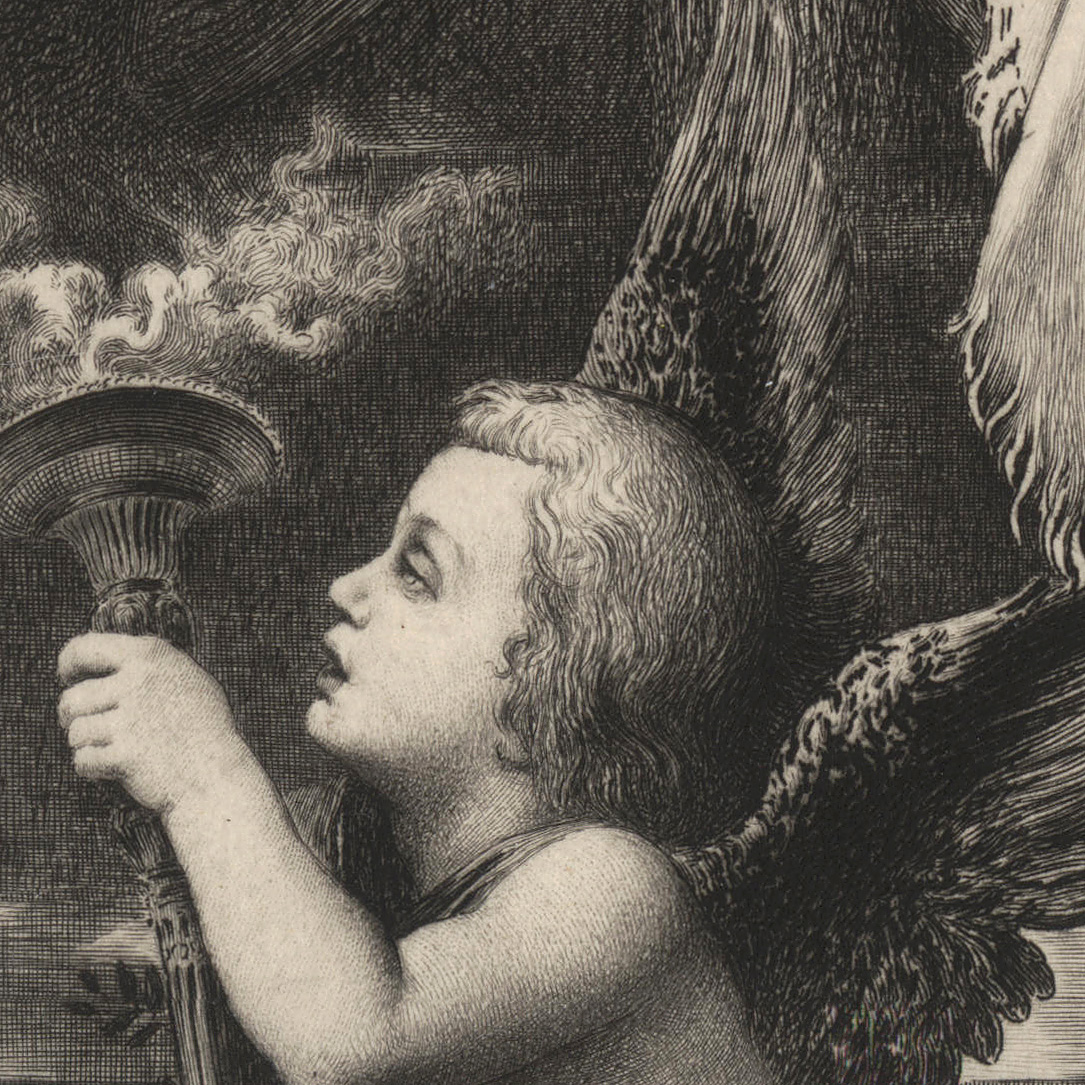
Jean Patricot’s engraving, “Le Jeune Homme et La Mort”, c1899, after Gustave Moreau


Jean Patricot (aka François Auguste Jean Patricot) (1865–1928)

Le Jeune Homme et La Mort” (aka “A la Memoire de Theodore” [as inscribed below the cupid’s hand at lower right}), c1899, after Gustave Moreau’s (1826–1898) painting, “The Young Man and Death”, 1856–1865, in the collection of the Harvard Art Museums (see: https://hvrd.art/o/230409), printed by Ch. Wittmann (fl. 1891–1907) and published in Paris, in the art periodical, “Gazette des Beaux Arts”, in 1900, as illustration (facing p. 54) to Ary Renan’s article, “Gustave Moreau” (see https://archive.org/details/bnf-bpt6k6355961n/page/n72/mode/2up).

Engraving on cream wove paper, trimmed with a small margin around the image borderline and backed with a support sheet.

Size: (sheet) 26.6 x 15.9 cm; (image borderline) 23.2 x 13.1 cm.

Lettered in plate below the image borderline: (left) “Gustave Morceau pinxt./ Gazette des Beaux-Arts”; (centre) “LE JEUNE HOMME ET LA MORT”/ (appartenant à M.r Albert Cahen d’Anvers)”; (right) “J. Patricot sc./ Imp. Ch. Wittmann”.

Condition: a very strong and well-printed impression with small margins around the image borderline and laid upon an archival support sheet of millennium quality washi paper. The sheet is in a near pristine condition with no tears, holes, folds, abrasions, stains or foxing.

I am selling this magnificent engraving for the total cost of AU$233 (currently US$177.31/EUR161.56/GBP135.12 at the time of posting this listing) including postage and handling to anywhere in the world, but not (of course) any import duties/taxes imposed by some countries.

If you are interested in purchasing this amazing engraving that is so finely treated that the delicately engraved strokes need magnification to see them, please contact me (oz_jim@printsandprinciples.com) and I will send you a PayPal invoice to make the payment easy.




Sunday, 18 April 2021

James McNeill Whistler’s lithograph, “Stéphane Mallarmé”, 1892

James McNeill Whistler (aka James Abbott McNeill Whistler) (1834–1903)

Stéphane Mallarmé”—French Symbolist poet (1842–1898), 1892, printed by Ch Wittmann (fl1891–1907) in Paris—(later 1894 impressions were printed by Henri Belfond (1834–1903) (see http://hdl.handle.net/10934/RM0001.COLLECT.42629)—signed in the stone with the artist’s butterfly monogram, published in "Vers et Prose" by Perrin et Cie (Imprimerie Deslis Frères) in Paris, 1893.

Maggs Bros. Ltd offers the following interesting exchanges between Mallarmé and Whistler regarding this print and an excellent description of it:

“Mallarmé writing to Whistler in November 1892, ’this portrait is a marvel, the best thing that’s ever been done of me, and I am delighted with it’ (5 Nov. 1892). The artist himself later wrote that ’it is very beautiful - and as a portrait of the poet extraordinary’ (Whistler’s letter to T. Way, 15 Oct. 1894)” (https://www.maggs.com/vers-et-prose-morceaux-choisis-avec-un-portrait-par-james-mn-whistler_228494.htm).

Transfer lithograph on cream chine collé on heavy wove paper backed with a support sheet.

Size: (sheet) 17.2 x 10.9 cm; (chine collé) 11.5 x 8.7 cm.

Inscribed on plate: (lower right) [artist’s butterfly monogram]; (lower edge at centre) “Imp Ch. Wittmann”.

State i (of i)

Levy 101 (“The Lithographs of James McNeill Whistler”, first published in 1998—note that this two-volume catalogue raisonné is available for online viewing at the Art Institute of Chicago: https://www.artic.edu/digital-publications/33/the-lithographs-of-james-mcneill-whistler-the-digital-edition).

The Art Institute of Chicago offers a description of this print and the following insight about Whistler and Stéphane Mallarmé:

“Introduced by Claude Monet, the poet Mallarmé and Whistler became friends in 1887 and remained close until Mallarmé’s death in 1898. Each man played a role in the other’s publishing projects; Mallarmé translated the “Ten O’Clock” lecture into French, and Whistler produced this lithographic portrait for Mallarmé’s 1893 book of poems, Vers et prose” (https://www.artic.edu/artworks/73797/stephane-mallarme).

See also the description of this print at the Metropolitan Museum of Art: https://www.metmuseum.org/art/collection/search/339426#.

Condition: a well-printed impression laid upon a support sheet of fine archival/millennium quality washi paper in a near pristine (museum quality) condition with no tears, holes, folds, abrasions, significant stains or foxing.

I am selling this small portrait study of the famous French Symbolist poet Mallarmé, who was a close friend of Whistler and of many other artists of the time like Gauguin—see Gauguin’s etched portrait of the poet:  https://www.britishmuseum.org/collection/object/P_1949-0411-2463—for AU$349 (currently US$270.12/EUR225.47/GBP195.17 at the time of posting this print) including Express Mail (EMS) postage and handling to anywhere in the world (but not, of course, any import duties/taxes imposed by some countries).

If you are interested in purchasing this acknowledged very close likeness to the poet—and a print that both artist and sitter exchanged correspondence that it was “a marvel” and “very beautiful”, please contact me (oz_jim@printsandprinciples.com) and I will send you a PayPal invoice to make the payment easy.

This print has been sold 


Wednesday, 25 March 2020

Léopold Flameng’s etching, “The Blue Boy”, 1862, after Gainsborough


Léopold Flameng (aka Léopold Joseph Flameng) (1831–1911)

“The Blue Boy” (aka “L'enfant bleu”), 1862, after Thomas Gainsborough’s (1727 - 1788) famous portrait of the same name (c.1770) in the Huntington Library, San Marino (California), first published in “La Gazette des Beaux Arts”, 1867, vol. 13, p. 113 (see https://archive.org/details/gazettedesbeauxa13pari/page/112/) and republished in c.1890 by Imprimerie Charaire et Cie and printed by Chardon-Wittmann (fl.c.1884–1890) in Paris, in Teodor de Wyzewa’s “Les chefs-d'oeuvre de l'art au XIXe siècle”, p. 120 (see https://archive.org/details/leschefsdoeuvred04michuoft/page/120/). This impression is from the later edition.

The fame of Gainsborough’s painting, reputed to be a portrait of Jonathan Buttall (1752–1805) dressed in a manner similar to Van Dyck's portrait of Charles II as a boy in “The Children of King Charles I of England”, 1637, rests to a large part on it representing a refutal of advice (shown below) advocated by his rival Sir Joshua Reynolds (1723–1792)—founder and first president of the Royal Academy of Arts:

“It ought, in my opinion, to be indispensably observed, that the masses of light in a picture be always of a warm, mellow colour, yellow, red, or a yellowish white, and that the blue, the grey, or the green colours be kept almost entirely out of these masses, and be used only to support or set off these warm colours; and for this purpose, a small proportion of cold colour will be sufficient. Let this conduct be reversed; let the light be cold, and the surrounding colour warm, as we often see in the works of the Roman and Florentine painters, and it will be out of the power of art, even in the hands of Rubens and Titian, to make a picture splendid and harmonious” (see Ronald Sutherland Gower 1903, “Thomas Gainsborough”, G. Bell and Sons. pp. 77–78).

Etching on buff coloured chine collé (China) on heavy wove paper with margins as published.
Size: (sheet) 31.5 x 20.9 cm; (plate) 22.8 x 11.9 cm; (chine collé) 22.4 x 11.7 cm; (image borderline) 19.5 x 11.1 cm.
Inscribed on plate within the image borderline: (lower right) “Flameng. S.”
Lettered on plate below the image borderline: (left) “Gainsboroug[h] pinx./ Les chefs-d’œuvre _ 75”; (centre) “THE BLUE BOY”; (right) "L. Flameng sc./ “Imp. Chardon-Wittmann.”

Beraldi 102 (Henri Beraldi 1885, “Les Graveurs du dix-neuvième siècle”, vol. 11, p. 162, cat. no. 102); IFF 104 (“Inventaire du Fonds Français: Bibliothèque Nationale, Département des Estampes”, Paris, 1930).


Condition: richly inked and well-printed impression with margins as published. The sheet is in excellent condition but the are faint marks verso.

I am selling this etching by one of the major printmakers of the 19th century of one of Gainsborough’s most famous portraits for [deleted] including postage and handling to anywhere in the world.

If you are interested in purchasing this superbly executed black and white etching of Gainsborough’s famously blue painting—note how Flameng has shaded the boy’s further back leg with horizontal strokes to set it into shadow—please contact me (oz_jim@printsandprinciples.com) and I will send you a PayPal invoice to make the payment easy.

This print has been sold