Showing posts with label Dujardin. Show all posts

Monday, 30 October 2017

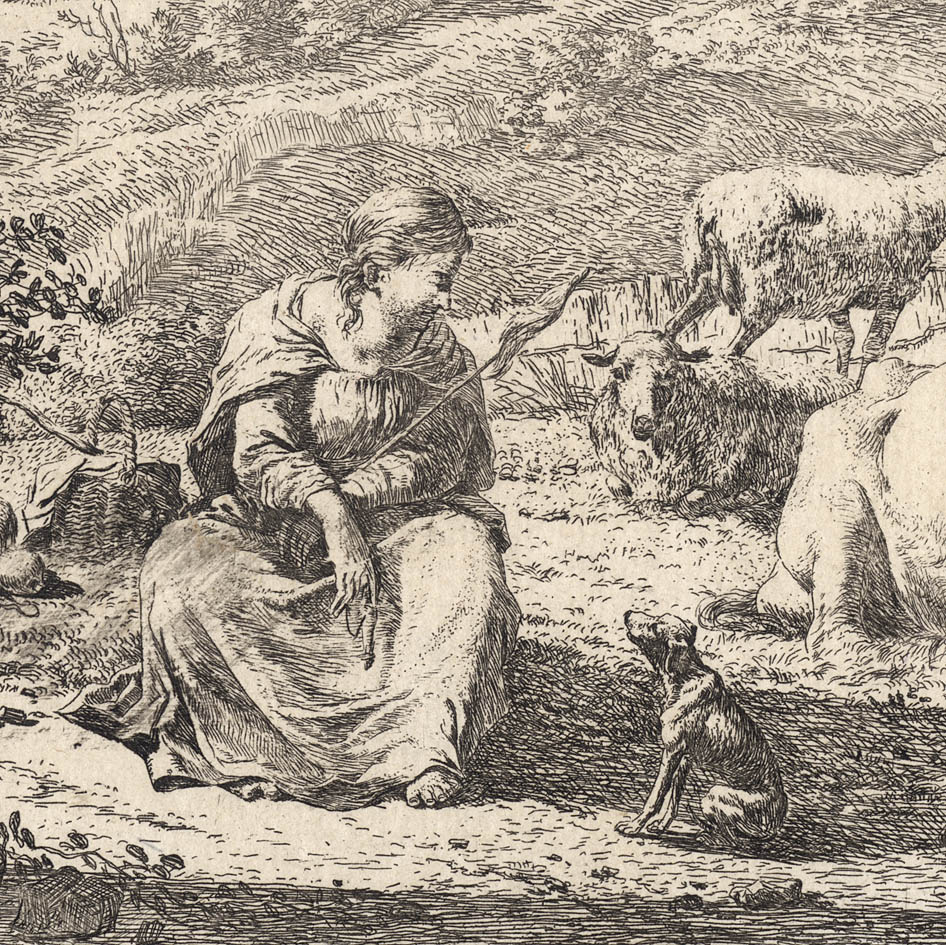
Karel Dujardin’s etching, “Shepherdess Speaking to Her Dog”, 1653


Karel Dujardin (aka Karel Du Jardin; Carel Dujardin; Carel du Jardin; Bokkebaart) (1626–1678)
“Shepherdess Speaking to Her Dog” [La Bergère Parlant à son chien] (TIB title), 1653.

Etching on laid paper trimmed along the image borderline on the sides and bottom and well within the borderline at the top edge.
Size: (sheet) 16.2 x 21.9 cm
The state number of this impression is difficult to determine as the plate inscriptions which would help in the determination have been removed. Nevertheless, based on the quality of the impression this is not an early state, but the impression is better than some of the later states held by the BM; see: http://www.britishmuseum.org/research/collection_online/search.aspx?searchText=J,28.54.

Hollstein 31.III (Hollstein, F W H, “Dutch and Flemish etchings, engravings and woodcuts c.1450-1700”, Amsterdam, 1949); Bartsch 1.183.31 (Bartsch, Adam, “Le Peintre graveur”, 21 vols, Vienna, 1803); TIB 1.31-1(183) (Walter L Strauss & Leonard J Slatles [eds.] 1978, “The Illustrated Bartsch: Netherlandish Artists”, vol.1, p.176)

The British Museum offers the following description of this print:
“Landscape with a seated shepherdess and her dog, facing front and looking down at the dog, a tree in shadow at left, a resting cow and three sheep at right, behind a fence the ground rises into the distance, the slope is dotted with groups of trees and shrubs, a large house on the hilltop at right”

Condition: crisp and well-printed impression, trimmed along the image borderline on the sides and bottom and well within the borderline at the top edge. There are replenished losses at the upper corners and the lower right corner. The sheet is laid upon a conservator’s support sheet of fine washi paper.

I am selling this quietly beautiful etching of a shepherdess having a deep and meaningful chat with her dog for AU$132 (currently US$101.34/EUR87.04/GBP76.96 at the time of this listing) including postage and handling to anywhere in the world.

If you are interested in purchasing this rarely seen print in today’s art market, please contact me (oz_jim@printsandprinciples.com) and I will send you a PayPal invoice to make the payment easy.


There are so many features in this print that could be discussed. See, for example, the amazing treatment of foliage in the distant trees or the empathy that Dujardin must have felt with rural folk to portray a shepherdess absently talking with her dog. Rather than the clearly very special features such as these, I have decided to discuss something that to me is the hallmark of a great artist: the insightful way that Dujardin employs contour strokes to render the form of the tree on the far left.

What I find very revealing about Dujardin’s contour strokes on this tree is not just that the lines pictorially “wrap” around the tree trunk in elliptical curves to “explain” the girth of the trunk, but that the lines are arranged in changing elliptical patterns matching the changing viewpoint in which the trunk is seen; viz, “downward” curved elliptical contours at the base; almost horizontal contours at eye-level; “upward” curved elliptical contours at the top.


Saturday, 28 October 2017

Karel Dujardin’s etching, “Two Donkeys”, 1652


Karel Dujardin (aka Karel Du Jardin; Carel Dujardin; Carel du Jardin; Bokkebaart) (1626–1678)
“Two Donkeys” (Les deux ȃnes) (TIB title), 1652

Etching on laid paper with small margins lined onto a conservator’s support sheet.
Size: (sheet) 15.4 x 13.8 cm; (plate) 14.8 x 13.3 cm
Inscribed at top right: "K. D [reversed]. I. f / 1652" with the number “6” at lower-right corner

Hollstein 6.IV (Hollstein, F W H, “Dutch and Flemish etchings, engravings and woodcuts c.1450-1700”, Amsterdam, 1949); Bartsch I.167.6 (Bartsch, Adam, “Le Peintre graveur”, 21 vols, Vienna, 1803); TIB 1.6-1(167) (Walter L Strauss & Leonard J Slatkes [eds.] 1978, “The Illustrated Bartsch: Netherlandish Artists”, vol. 1, p. 176)

The British Museum offers the following description of this print:
“Two asses, the first standing in profile facing right, the second seen head-on standing at right, a house with chimney in background; fourth state with number. 1652”

Condition: delicate, crisp impression—a stronger impression than the state iv impression held by the British Museum (see BM no. S.824)—with replenished losses (see the upper corners) and tears (now virtually invisible) and laid upon a conservator’s support sheet of fine washi paper. There is a significant patina of handling marks and age toning. This “patina” of the print’s history has been retained rather than being addressed by restoration as the colour and tone acquired over the centuries is beautifully subtle and would be a shame to lose.

I am selling this insightfully drawn etching of two donkeys/mules with their ears alert to the sounds around them—note how the foreground donkey is listening to the roaming dog in the distance—for AU$132 (currently US$101.46/EUR87.37/GBP77.28 at the time of this listing) including postage and handling to anywhere in the world.

If you are interested in purchasing this small etching revealing Dujardin’s delicacy of touch when drawing and his understanding of the mercurial elements that make animals appear to be living and “real”, please contact me (oz_jim@printsandprinciples.com) and I will send you a PayPal invoice to make the payment easy.


This print has been sold


Like his contemporary, Rembrandt, Dujardin had the same remarkable gift to metaphorically breathe “life” into his portrayed subjects. For instance, Dujardin is able to instil a living spirit into his representation of these donkeys by suggesting with just the single raised back leg of the foreground donkey that the animal has been standing for too long in the same position and is taking pressure of its legs. Dujardin is even able to suggest that the same donkey is thinking by angling its ears in the direction of the wandering dog in the distance.

What makes Dujardin’s etchings very different to those of Rembrandt, however, is the way that light is expressed. For example, Rembrandt is famous for his use of theatrical lighting—termed chiaroscuro—where strong light and equally strong shadow create meaningful tensions in a scene. By contrast, Dujardin uses ambient light (i.e. scattered light) to pervade a scene with a feeling of endless space and warmth.


Wednesday, 28 December 2016

Giovanni Cesare Testa’s etching, “The Body of Christ Mourned by Angels” after Pietro Testa and Karel Dujardin's "The Battlefield"


Giovanni Cesare Testa (1630–55, Parma)
“The Body of Christ Mourned by Angels”, c.1650, after Pietro Testa (1612–50)
Etching on heavy laid paper with narrow margins.
Size: (sheet) 19.7 x 25.7 cm; (plate) 19.2 x 25.3 cm; (image borderline) 18.6 x 24.5 cm
State ii (of ii)
Inscribed in the image in the lower right corner “[entwined letters] PTL Lo: Ces: Testa Inc."; below, in a different script: “Gio Jacomo de Rossi formis Romae alla Pace”; above: “Pietro Testa Inv.”

The National Gallery of Scotland offers a description of this print and advises that the copy in their collection was purchased “July 1979 from Christopher Mendez for £15,500” (https://art.nationalgalleries.org/art-and-artists/134477/dead-christ-mourned-angels?page=1&artists[21380]=21380&search_set_offset=79)
The British Museum holds one of the original drawings by Pietro Testa used for this print. The curator’s discussion about this drawing and its extension into other artworks is very interesting; see http://www.britishmuseum.org/research/collection_online/collection_object_details.aspx?objectId=714150&partId=1&searchText=cesare+testa&view=list&sortBy=objectTitleSort&page=1

Provenance: collection of Conrad Baumann v. Tischendorf
Nagler 5 II

Condition: crisp and well-printed impression with narrow margins in very good condition. The print is affixed to a support sheet at the upper corners (verso). There is a light stain slightly to the left of centre on the lower edge and there are other areas of minor toning.

I am selling this exceptionally rare print for a total cost of AU$437 (currently US$314.71/EUR301.18/GBP256.78 at the time of this listing) including postage and handling to anywhere in the world.
If you are interested in purchasing this startling and anatomically fine portrayal of Christ, please contact me (oz_jim@printsandprinciples.com) and I will send you a PayPal invoice to make the payment easy.

This print has been sold


Giovanni Cesare Testa’s printmaking career is somewhat shrouded in mystery. One thing is certain, however, his prints are rare and seldom found on the market and they command high prices (for example the National Gallery of Scotland acquired their copy of this print in “July 1979 from Christopher Mendez for £15,500” according to the gallery’s website). A part of the mystery surrounding GC Testa is that the main source of documentation about him is written by Filippo Baldinucci “(1847) in “Notizie dei professori del disegno da Cimabue in qua …” (reprinted in 1974) which Elizabeth Cropper (1988) in “Pietro Testa 1512–1650: Prints and Drawings” advises is “not especially accurate” (p. 240). Nevertheless, from what I understand, GC Testa was P Testa’s nephew on his father’s side. The details that I am choosing to ignore is the claim that GC Testra was born in 1640 and that his printmaking career was condensed to just the five years after the death of P Testa. One intriguing glimpse into GC Testa’s life is made by Giovanni Battista Passeri (1679) in “Die Künstlerbiographien” (Ed. Jacob Hess, 1934) with the curious comment that GC Testa’s “death was not so worthy of compassion.” (p. 188; see also Cropper [1988] p. 240).

If I may leave the mire of information and misinformation surrounding GC Testa for the others to ponder, what I love about this print is how well the figure of the dead Christ is drawn. Indeed, the drawing of this figure is so confidently handled—apart from the torso that may be a little too schematic in the delineation of musculature—that it compares very favourably with the dead figure portrayed in Karl Dujardin’s (1622–78) “The Battlefield” (1652) that the great master, Walter Sickert, proposed: “Enlarged photographs of the naked corpse should be in every art school as a standard of drawing from the nude” (Clifford S Ackley 1981, “Printmaking in the Age of Rembrandt”, Museum of Fine Arts, Boston, pp. 214–5).


Karel Dujardin (aka Carel Dujardin) (1622–78)
“The Battlefield” [La champ de bataille], 1652
Etching and drypoint on fine laid paper
State II (of II)
(sheet) 16.2 x 19.3 cm
Bartsch 1.28 (181); Hollstein 28.ii
See descriptions of this print at Auckland Art Gallery
Condition: Marvellous impression in excellent condition trimmed on, or within, the platemark. There are conservator hinges attached verso from previous mounting.
I am selling this very famous original etching by Dujardin for a total cost of AU$206 (currently US$147.82/EUR142.06/GBP120.86 at the time of this listing) including postage and handling to anywhere in the world.
If you are interested in purchasing this print, please contact me (oz_jim@printsandprinciples.com) and I will send you a PayPal invoice to make the payment easy.


This print has been sold 

Friday, 28 October 2016

Karel Dujardin’s etching of two sleeping hunting dogs


Karel Dujardin (aka Karel Du Jardin; Carel Dujardin; Carel du Jardin; Bokkebaart) (1626–78)
“Les Chiens” (sleeping dogs), 1641–78
Etching on fine laid paper signed in the plate (upper right) with small margins.
Size: (sheet) 15.9 x 15.9 cm; (plate) 14.9 x 13.5 cm; (image borderline) 14.5 x 13.2 cm
State iii (of iii)
Inscribed at top right: "K. D.V. I. fe" with the number “5” at lower-right corner
Hollstein 5.III (Hollstein, F W H, “Dutch and Flemish etchings, engravings and woodcuts c.1450-1700”, Amsterdam, 1949); Bartsch I.167.5 (Bartsch, Adam, “Le Peintre graveur”, 21 vols, Vienna, 1803); Bartsch 5.1, (1978, p. 175)
The British Museum offers the following description of this print:
“Two hunting dogs asleep, one with legs extended, the other curled up, a fence behind them, hunting gear including a decoy bird in a cage in right background” (http://www.britishmuseum.org/research/collection_online/collection_object_details.aspx?objectId=1615047&partId=1&searchText=dujardin+dogs&page=1)

Condition: delicate, crisp impression (a slightly stronger impression than that held by the British Museum) in near pristine condition (i.e. there are no tears, holes, abrasions, folds, foxing or stains) with small margins. This is a superb print on exceptionally fine laid paper.

I am selling this beautiful etching in a remarkable state of preservation for AU$158 (currently US$119.66/EUR109.62/GBP98.29 at the time of this listing) including postage and handling to anywhere in the world. If you are interested in purchasing this small etching revealing the outstanding draughtsmanship of Dujardin, please contact me (oz_jim@printsandprinciples.com) and I will send you a PayPal invoice to make the payment easy.

This print has been sold


What I love about this print is the same attribute that I love about Lucian Freud’s etchings: the use of line to visually “feel” the form of the subject.

For instance, when I look at the use of line to render the foreground dog, I can see how Dujardin has softened the silhouette edge of the dog’s neck in a haptic response to the abundant hair in this area; whereas Dujardin has reduced the detail of the silhouette edge around the dog’s hips to a single extraordinarily sensitive and insightful line. There is deep knowledge about dogs and how to draw them in a meaningful way expressed in this print. 


Friday, 26 August 2016

Dujardin’s etching, “Les deux chevaux”


Karel Dujardin (aka Carel Dujardin; Carel du Jardin; Karel Du Jardin; Bokkebaart) (1626 –78)
“Les deux chevaux” (Two Horses), 1652
Size: (sheet) 15.9 x 16.2 cm
Etching on fine laid paper trimmed on the platemark with thread margins
Inscribed within the image: (upper left) "K. D. I. fe"; (lower right corner) “4”.
Bartsch 4-II (166); Hollstein VI (“Dutch and Flemish Etchings, Engravings and Woodcuts ca. 1450-1700”, vol. VI [Amsterdam, 1952]).

The British Museum does not have this rare print in its collection, but the BM has a copy of it in reverse by the famous French printmaker, Charles Meryon (1821–68) (see http://www.britishmuseum.org/research/collection_online/collection_object_details.aspx?objectId=1441972&partId=1&searchText=Dujardin+Les+deux+chevaux&page=1)
Fine Arts Museums of San Francisco has a copy of this print and offers details and description it, but the quality of their impression is comparatively poor (see https://art.famsf.org/karel-dujardin/les-deux-chevaux-19633012118). The Metropolitan Museum of Art also has a copy, but again their impression has noticeable flaws (see http://www.metmuseum.org/art/collection/search/399291).
Condition. A superb, museum quality, impression in faultless condition (i.e. there are no stains, foxing, tears, holes or folds).

I am selling this rare, high quality impression for AU$161 in total (currently US$123.33/EUR109.21/GBP93.25 at the time of posting this listing) including postage and handling to anywhere in the world.
If you are interested in purchasing this superb impression that really should be in a museum, please contact me (oz_jim@printsandprinciples.com) and I will send you a PayPal invoice to make the payment easy.

This print has been sold


About ten years ago when I purchased this print, I was deeply fascinated by images of cows and horses and the plight of the rural poor. If I were asked—which I never was—why I had an interest in such scenes, I would have stumbled for rational words, as my world was far removed from the images that I loved to contemplate. To be honest, the more flies that an artist portrayed and the more muck, piss and poop that was portrayed, the happier I was.

Interestingly, I asked my best pal—a wonderful lady with whom I have gone out painting every Saturday morning for the last fifteen years—for a “proper” answer as to why anyone, including artists, would be captivated by bucolic images and I had a reply that I wasn’t expecting: “Did you know that years ago, jockeys in Ireland who needed to lose weight would immerse themselves in manure?” Well … I didn’t. Then our live-in polymath Googled this practice and discovered that the joy of being thoroughly bedded down in poop was not limited to Irish jockeys. Isaac Ling, for instance, advises that when “… riders at Tijuana racetrack in the 1920s … saw the fermenting mountain of horse manure out the back of the racetrack that was ‘as big as a grandstand’ (the proceeds of year upon year of mucked-out stables being dumped in the one spot), they didn't just see a big pile of horse shit, but instead their own private sauna” (https://www.punters.com.au/news/Extreme-jockey-weight-loss-tactics_140371/). Fascinating stuff what some artists, jockeys and viewers love!


Monday, 25 July 2016

Karel Dujardin’s etching, “Mule with a Bell”


-->
Karel Dujardin  (aka Carel Dujardin,; Carel du Jardin; Karel Du Jardin; Bokkebaart) (1626 –78)
“Le Mulet aux Clochettes” [Mule with a Bell], 1653
Size: (sheet) 19.7 x 16.2 cm
Etching on laid paper trimmed on, or within, the platemark
Lettered in lower margin: "K. DV. IARDIN.1653 fe". With the number 29 in the lower right corner.
Bartsch 1.182.29; Hollstein 29.II
The British Museum offers the following description of this print:
The hinny with the little bell. Landscape with a mule standing at centre, in profile to right, wearing a halter from which two bells hang, two other asses resting in right background, trees enclosed within a straw fence beyond; second state with number. 1653” (http://www.britishmuseum.org/research/collection_online/collection_object_details.aspx?objectId=1617819&partId=1&searchText=Dujardin+mule&page=1)

Condition: crisp impression trimmed on, or within, the platemark. The sheet is in very good condition for its age (i.e. there are no tears, folds or holes), but there are a few scattered dots and there are remnants of mounting hinges (verso).

I am selling this well-preserved original Dujardin etching for the total cost of AU$164 (currently US$122.76/EUR111.67/GBP93.48 at the time of posting this print) including postage and handling to anywhere in the world.
If you are interested in purchasing this remarkable print showcasing Dujardin’s skill in representing light, space and subtle differences of texture, please contact me (oz_jim@printsandprinciples.com) and I will send you a PayPal invoice to make the payment easy.

This print has been sold


-->
Dujardin is famous for his “warts and all” representations of rural life—sheep and cows pissing and pooping accompanied by flies—he is also remembered as a true master of suggesting light, space and mimetic treatments of a full range of textures. For example, note how Dujardin describes the contours of the mule in the foreground (actually a hinny rather than a mule) using only line while simultaneously expressing the surface textures of the mule’s hair. Note also how Dujardin’s treatment of the foreground mule is quite different from his rendering of the mules further back and how well he suggests the spatial distance separating them. Such skill is rare and is the hallmark of great artist.