Showing posts with label Mander I (Karel van). Show all posts

Monday, 30 July 2018

Zacharias Dolendo’s engraving, “Christ before Caiaphas”, c1597


Zacharias Dolendo (aka Zacharias Dolen) (1561–c1600)

“Christ before Caiaphas”, 1596–98, after Karel van Mander I (1548–1606), plate 4 from the series of 14 plates (including the title print [New Hollstein 36-49]), “The Passion”, published by Jacques de Gheyn II (aka Jacob de Geyn) (1565–1629).

Engraving on fine laid paper trimmed with thread margins around the image borderline (except for the lower margin which retains the inscribed number “4”) and backed with a support sheet.
Size: (sheet) 14.5 x 10.4 cm
Inscribed on plate along the lower edge within the image borderline: (left) "KVMandere inuen, Z, Do, scul,"; (left of centre) "DGheÿn exc".
Numbered on plate below the image borderline: (left) "4".
State ii (of ii) My attribution of this impression to the second state is based on comparison of the BM’s first state impression (1868,0612.444) with the second state impression held by the Rijksmuseum (RP-P-BI-7129). There doesn’t seems to be any difference in the inscribed lettering but I see a difference in the treatment of the distance wall as in the second state the vertical lines appear to be redrawn with greater strength.

New Hollstein (Dutch & Flemish) 40.I (The De Gheyn family); New Hollstein (Dutch & Flemish) 60 (Karel van Mander)

The British Museum offers the following description of this print:
“Christ before Caiaphas; Christ is presented by a group of soldiers to five priests in full regalia, including Caiaphas; one of the soldiers draws back his arm to hit Christ; after Karel van Mander”
See also the description of this print at the Rijksmuseum:

Condition: crisp and well-printed impression with restored light abrasions, trimmed to the image borderline and backed with a support sheet of archival (millennium quality) washi paper. The sheet is in good condition (i.e. there are no tears, holes, folds, significant stains or foxing). There are ink notes by an old hand below the image borderline (recto).

I am selling this exquisitely rendered and graphically strong engraving, for the total cost of AU$268 (currently US$198.14/EUR169.57/GBP151.05 at the time of this listing) including postage and handling to anywhere in the world (but not, of course, any import duties/taxes imposed by some countries).

If you are interested in purchasing this very beautiful oldmaster engaraving executed before the time of Rembrandt, please contact me (oz_jim@printsandprinciples.com) and I will send you a PayPal invoice to make the payment easy.

This print has been sold


For those who like to know the nitty gritty detail about artists’ personal lives, the British Museum offers the following insight—a little unexciting I have to admit—about Zacharias Dolendo (who engraved this plate) based on the account offered by van Mander (whose design Dolendo employed for its composition): “he made a good living, but died young after leading a riotous life, with too much drinking.” (http://www.britishmuseum.org/research/search_the_collection_database/term_details.aspx?bioId=126867). To be honest, I wish I knew more about his “riotous life” but … I don’t.

What interests me about artists who live riotous lives is that their artworks, like this beautiful engraving, are invariably emotionally charged, but are also inexplicably rendered with delicate detail—here I am thinking about one of the most important of the early engravers, Hieronymus Wierix (purportedly a woman killer), Cornelis Schut (another old master with a proclivity for murder) and not to forget the exploits of the great Caravaggio.

Certainly, from my way of looking at the finely rendered details in this scene from Christ’s passion (John 18:13, 18:19–24), the artist’s hand was not concerned with “neatness”—to borrow Michael Bryan’s (1886) phrase in describing Dolento’s style in “Bryan's Dictionary of Painters and Engravers” (3rd edition, p. 417). Instead, I see the portrayed figures' forms as highly expressive in the way they are drawn. Note, for example, how the almost mechanical vertical lines describing the architecture—especially the distant arched wall—contrast with and give meaning to the emotionally charged interactions of the figures. In short, what Dolento has achieved with his exceptionally fine rendering style is to portray latent violence by contrast of juxtaposed treatments.


Friday, 16 June 2017

Jacob Matham’s series of four engravings, “The Parable of the Prodigal Son”


Jacob Matham (1571–1631)
“The Parable of the Prodigal Son”, 1592, series of four engravings after Karel van Mander I (1548–1606)

Upper left
Plate 1: “The Prodigal Son Receives His Birthright”
Upper right
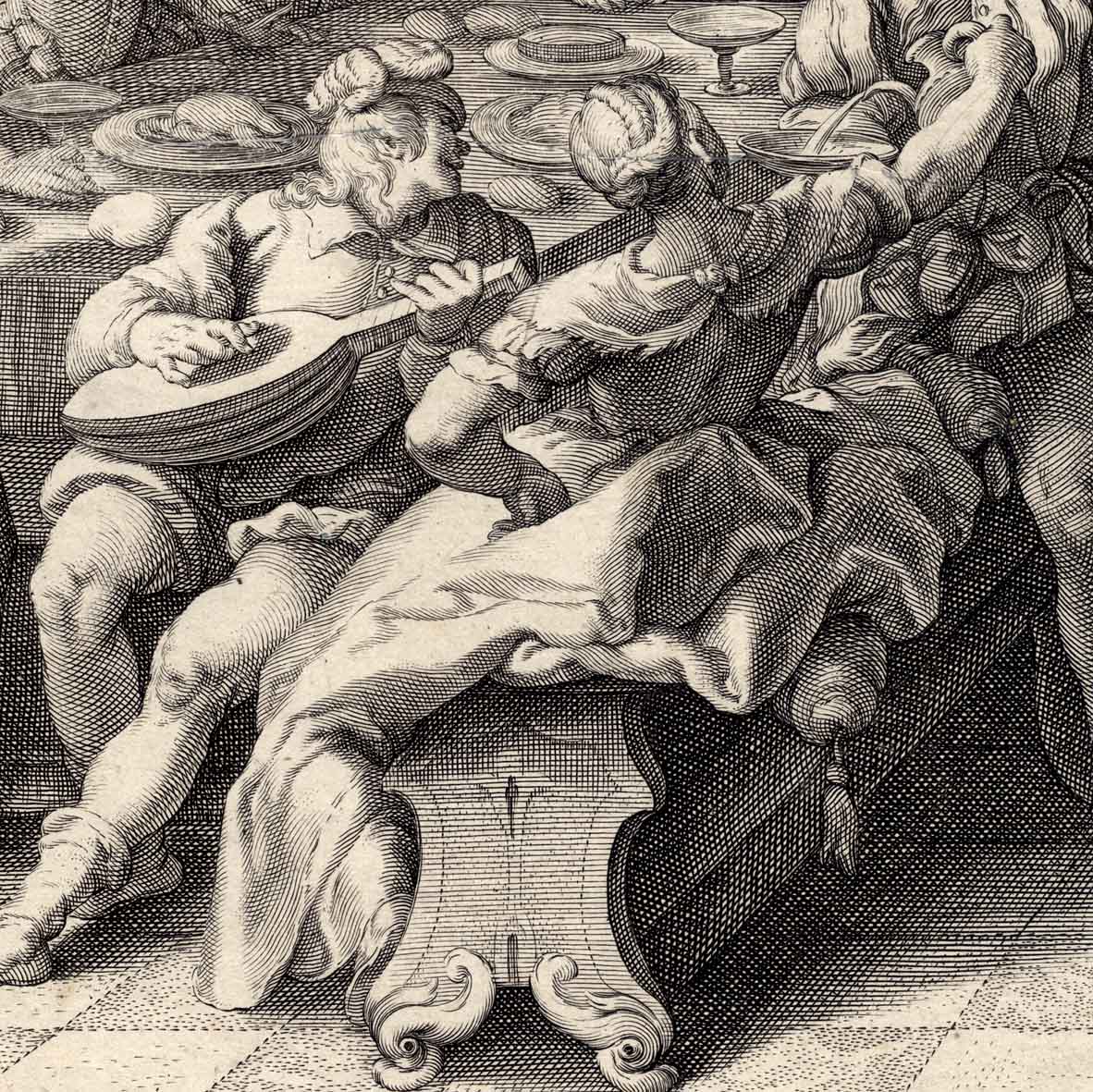
Plate 2: “He Dissipates His Wealth on Pleasures of the Table”
Lower left
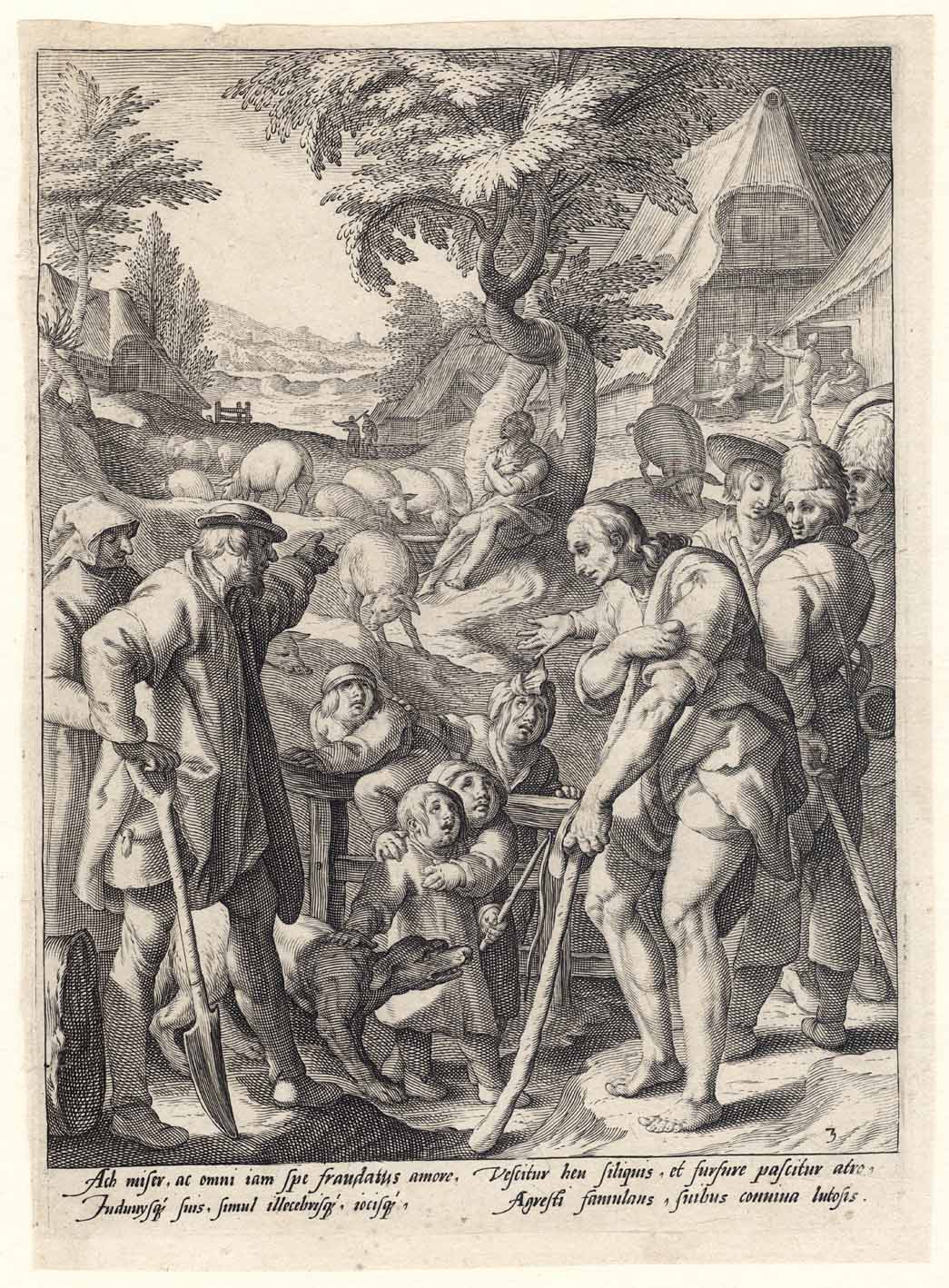
Plate 3: “He is Reduced to a Swineherd”
Lower right
Plate 4: “The Return of the Prodigal Son”

I am selling this complete set of four prints for the total cost of AU$740 (currently US$560.87/EUR502.39/GBP238.89 at the time of posting this listing) including postage and handling to anywhere in the world.
If you are interested in purchasing this important and COMPLETE set of prints from the Renaissance era, please contact me (oz_jim@printsandprinciples.com) and I will send you a PayPal invoice to make the payment easy.


This set of prints has been sold


“The Prodigal Son Receives His Birthright”, 1592, after Karel van Mander I (1548–1606), plate 1 from the series of four plates, “The Parable of the Prodigal Son” (Luke 15: 11-32).

Engraving on fine laid paper
Size: (sheet cut irregularly) 25 x 18.2 cm; (plate) 23.8 x 17.4 cm; (image borderline) 22.3 x 16.9 cm
Lettered in lower left corner "KVM. Inuent. / IMaetham. schulp.". Numbered in lower left corner "1" and dated "1592". With two columns of text, each two lines "Prodigus ... futuri" by "FE" (Franco Estius).

TIB 4(3).172(173) (Walter L Strauss & Robert A Koch [Eds.] 1980, “The Illustrated Bartsch”, vol. 4, p. 157); Bartsch III.173.172; New Hollstein (Dutch & Flemish) 26.I (Jacob Matham); New Hollstein (Dutch & Flemish) 52.I (Karel van Mander); Hollstein 64

The British Museum offers the following description of the print:
“The prodigal son receiving his inheritance; the son, with a sword, stands before a table listening to his father (wearing a skullcap), who sits at a table with an open chest and reading from a piece of paper.” (http://www.britishmuseum.org/research/collection_online/collection_object_details.aspx?objectId=1480942&partId=1&searchText=1928,1212.49&page=1)

Condition: strong impression with a printer’s crease (i.e. a fine fold created during the printing process) but this crease has been touched with tone to hide the defect. There are replenished losses at the top left corner and margin. Beyond this issue the sheet is in very good condition and laid upon a conservator’s support sheet. 


“He Dissipates His Wealth on Pleasures of the Table”, 1592, after Karel van Mander I (1548–1606), plate 2 from the series of four plates, “The Parable of the Prodigal Son” (Luke 15: 11-32).

Engraving on fine laid paper
Size: (sheet cut irregularly) 25.8 x 19.7 cm; (plate) 23.8 x 17.4 cm; (image borderline) 22.2 x 16.9 cm
Numbered in lower left corner "2". With two columns of text, each two lines "Ille iugo ... perundant".

TIB 4(3).173(174) (Walter L Strauss & Robert A Koch [Eds.] 1980, “The Illustrated Bartsch”, vol. 4, p. 158); Bartsch III.174.173; New Hollstein (Dutch & Flemish) 27.I (Jacob Matham); New Hollstein (Dutch & Flemish) 53.I (Karel van Mander); Hollstein 65

The British Museum offers the following description of the print:
“The prodigal son wasting his substance; the son sits at a lavish table, laden with food, flanked by two courtesans; there are two musicians at right sitting on a bench, a boy standing at the table holding a jug and a maid marking a board with the tab in the background.” (http://www.britishmuseum.org/research/collection_online/collection_object_details.aspx?objectId=1480936&partId=1&searchText=Jacob+Matham+prodigal&page=1)

Condition: strong impression with a printer’s crease (i.e. a fine fold created during the printing process) but this crease has been touched with tone to hide the defect. There sheet is in excellent condition generally. There are, nevertheless, a few spots (visible verso) and a piece of tape supporting the printer’s crease (verso). The sheet has been trimmed unevenly with larger margins on the sides and bottom and a thread margin at the top. 


“He is Reduced to a Swineherd”, 1592, after Karel van Mander I (1548–1606), plate 3 from the series of four plates, “The Parable of the Prodigal Son” (Luke 15: 11-32).

Engraving on fine laid paper
Size: (sheet cut irregularly) 25 x 18.2 cm; (plate) 24 x 17.4 cm; (image borderline) 22.3 x 17 cm
Numbered in lower right corner "3". With two columns of text, each two lines "Ach miser ... conuiua lutofis".

TIB 4(3).174(174) (Walter L Strauss & Robert A Koch [Eds.] 1980, “The Illustrated Bartsch”, vol. 4, p. 159); Bartsch III.174.174; New Hollstein (Dutch & Flemish) 28 (Jacob Matham); New Hollstein (Dutch & Flemish) 54.I (Karel van Mander); Hollstein 66

The British Museum offers the following description of the print:
“The prodigal son receiving his inheritance; the son, with a sword, stands before a table listening to his father (wearing a skullcap), who sits at a table with an open chest and reading from a piece of paper.” (http://www.britishmuseum.org/research/collection_online/collection_object_details.aspx?objectId=1480942&partId=1&searchText=1928,1212.49&page=1)

Condition: strong impression in excellent condition and laid upon a conservator’s support sheet. 


“The Return of the Prodigal Son”, 1592, after Karel van Mander I (1548–1606), plate 4 from the series of four plates, “The Parable of the Prodigal Son” (Luke 15: 11-32).

Engraving on fine laid paper trimmed on or within the platemark with replenished losses.
Size: (sheet cut irregularly) 23.7 x 17.4 cm; (image borderline) 22.3 x 17 cm
Lettered below centre "KVM. Inuent. / IMaetham. schulp.". Numbered in lower right corner "4". With two columns of text, each two lines "Hinc patrias ... parantur" by "F.E." (Franco Estius).

TIB 4(3).175(174) (Walter L Strauss & Robert A Koch [Eds.] 1980, “The Illustrated Bartsch”, vol. 4, p. 160); Bartsch III.174.175; New Hollstein (Dutch & Flemish) 29.I (Jacob Matham); New Hollstein (Dutch & Flemish) 55.I (Karel van Mander); Hollstein 67

The British Museum offers the following description of the print:
“The return of the prodigal son; the son, reduced to wearing rags and carrying a staff, kneels before his father who embraces him and holds his hand; a group of people stand by and the scene takes place under a bridge with stairs at r.” (http://www.britishmuseum.org/research/collection_online/collection_object_details.aspx?objectId=1480954&partId=1&searchText=1928,1212.49&page=1)

Condition: strong impression in poor (but restored) condition with replenished losses, printer’s creases and brown spots laid upon a conservator’s support sheet.