Showing posts with label Groeningen (Gerard van). Show all posts

Saturday, 21 March 2026

Harmen Jansz. Muller, “The Servant Buries his Talent”, c.1570, after Gerard van Groeningen (2nd copy)

Harmen Jansz. Muller (1540–1617)

“The Servant Buries his Talent” (aka “Dienaar begraaft zijn talent”), c.1570 (1565–72)

Technical Details & Condition:

Engraving on fine laid paper with the Arms of Amsterdam watermark, with a small margin around the platemark and backed with a support sheet of tissue-thin (Kozo) washi paper. 

This is plate 3 from the series of six engravings, “The Parable of the Talents,” after the design by Gerard van Groeningen (also known as Gerard van Groenning, Gerard P Groenning, Gerard Groenning, Gerardum Groeninghen, Gerrit van Groenwegen, Gerardo a Gruningen) (fl. 1550–1599). 

The print was first published in Antwerp in its initial state by Gerard de Jode (1509/17–1591) in “Thesaurus novi Testamenti elegantissimis iconibus expressus continens historias atque miracula doni nostri Iesu Christi” (1579–85). It was later reissued in Amsterdam in its second and final state by Claes Jansz. Visscher II (1587–1652) in “Theatrum Biblicum Hoc Est Historiae Sacrae Veteris et Novi Testamenti Tabulis Aeneis Expressae” (1646). 

This impression is from Visscher’s second state, with the addition of the biblical reference (“Matt. 25.18.”) and the number “3” below the image at the lower right corner. 

This is a strong impression. Aside from a closed tear in the upper margin, the sheet is in excellent condition for its age—free of holes, folds, abrasions, or significant stains.

Dimensions:

• Sheet: 22.5 x 31.2 cm
• Platemark: 20.3 x 29.2 cm

Plate Numbering and Lettering:

• Within the image at lower right: “3”
• On column base at lower right: “[Artist’s monogram] F”
• Below image: “Qui vero unum acceperat abiens fodit in terram et abscondit pecuniam Domini sui. Matt. 25. 18. 3”

References:

• New Hollstein Dutch (Harmen Jansz. Muller) 51 (Ger Luijten [ed.], “The New Hollstein: Dutch and Flemish Etchings, Engravings and Woodcuts 1450–1700: The Muller Dynasty”, 1999, vol. 1, Rotterdam, Rijksprentenkabinet, p. 134, cat. no. 51)
• New Hollstein Dutch (Gerard van Groeningen) 110 (Christiaan Schuckman [comp.] 1997, “The New Hollstein: Dutch and Flemish Etchings, Engravings and Woodcuts 1450–1700: Gerard van Groeningen”, vol. 1, Rotterdam, Rijksprentenkabinet Sound and Vision Interactive, p. 146, cat. no. 110)
• Mielke 49 (H. Mielke, “Antwerpener Graphik in der 2. Hälfte des 16. Jahrhunderts. Der Thesaurus veteris et novi Testamenti des Gerard de Jode (1585) und seine Künstler,” in: Zeitschrift für Kunstgeschichte, vol. 38, no. 1, 1975, p. 82, cat. no. 49)
• Rijksmuseum: https://id.rijksmuseum.nl/200564850

Price & Shipping:

AU$310 (approximately US$217.74 / €188.10/ £163.16), including worldwide express shipping. Import duties and taxes (if any) are the buyer’s responsibility.

If you’re interested in acquiring this superb engraving illustrating the biblical parable from Matthew 25:18—depicting the “neglectful” servant burying a stash of money, a “talent” worth the equivalent of 16 years of labour—please contact me at oz_jim@printsandprinciples.com. I will gladly send you a PayPal invoice to make the purchase seamless.


Sunday, 12 February 2023

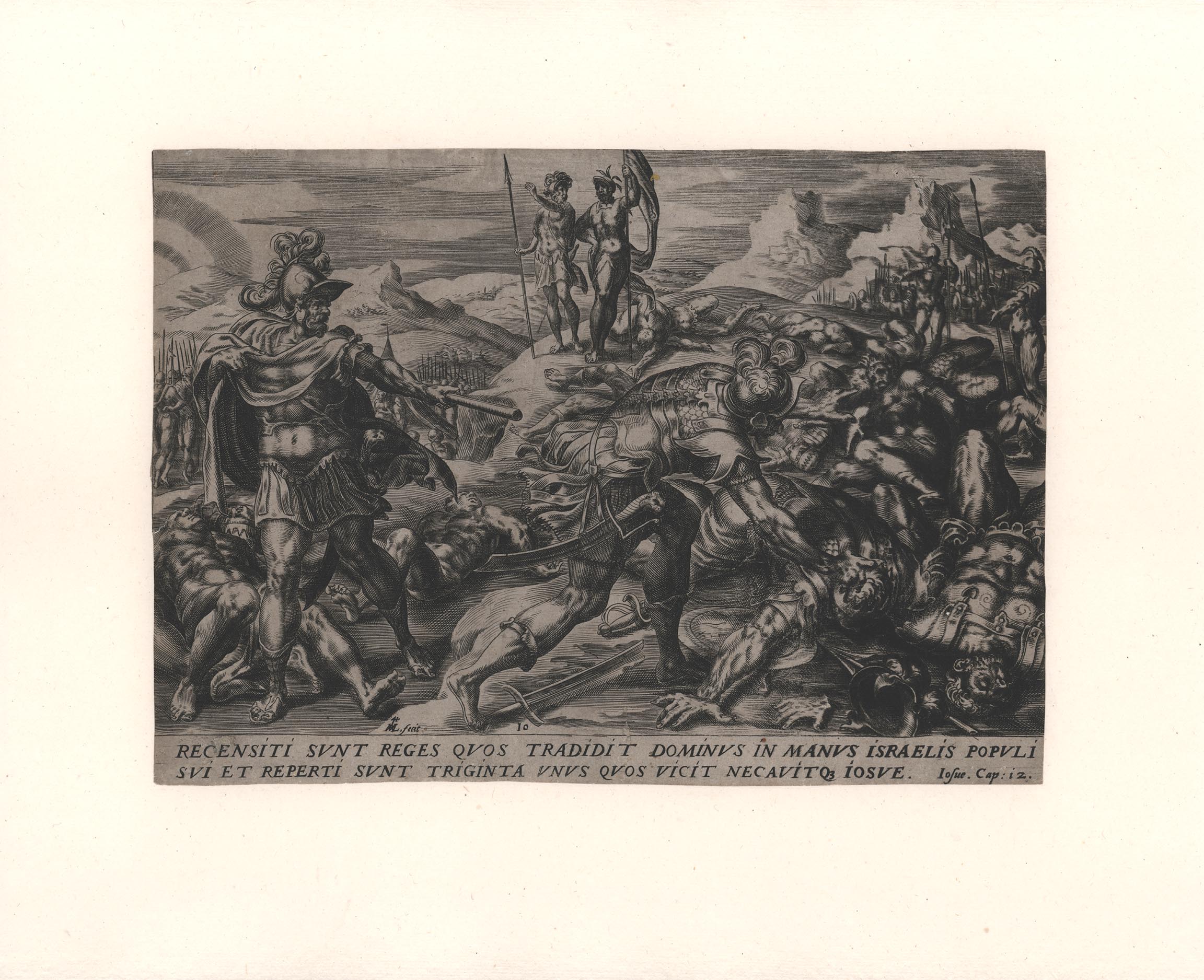
Harmen Jansz. Muller’s engraving, “Joshua Defeating the Thirty-One Kings”, 1586

Harmen Jansz. Muller (1540–1617)

“Joshua Defeating the Thirty-One Kings”, 1585, plate 10 from the series, “Thesaurus sacrarum historiarum veteris testament …” (“A treasure of the sacred histories of the Old Testament, expressed in the most elegant images, by the works of the most excellent men in this art: now published for the first time”), after Gerard van Groeningen (aka Gerard Groenning; Gerardum Groeninghen; Gerard P Groenning; Gerrit van Groenwegen; Gerardo a Gruningen) (fl. 1550–1599), published in Antwerp by Gerard de Jode (aka Geeraert de Jode; Geerart de Jode; Gerardo de Jode; Gheerde de Jode; Gheraerde de Jode; Girard de Jode; Gerard de Jode (1516/17–1591). There is a later edition (c1600) also published in Amsterdam by Claes Janszoon Visscher showing the addition of a comma after “SVI” and repetition of the plate number at the lower far right. This lifetime impression is from the earlier edition and still retains traces of guide lines for the lower lettering.

Engraving on fine laid paper trimmed around the image borderline, but retaining the writing edge, and backed with a support sheet.

Size: (support sheet) 32.3 x 39.3 cm; (sheet) 20.6 x 28.6 cm; (image borderline) 19 x 28.6 cm.

Inscribed in plate within the image borderline along the lower edge: (left of centre with artist’s monogram) “[HML], fecit”; (near centre) “10”.

Lettered in plate below the image borderline with two lines in Latin: “RECENSITI SVNT REGES QVOS TRADIDIT DOMINVS IN MANVS ISRAELIS POPVLI/ SVI ET REPERTI SVNT TRIGINTA VNVS QVOS VICIT NECAVITO[QUE] IOSVE. Iosue. Cap: 12.”

State ii (of iii)

New Hollstein Dutch 28–2(3) (Harmen Jansz. Muller) (Ger Luijten [ed.] 1999, “The New Hollstein: Dutch and Flemish Etchings, Engravings and Woodcuts 1450–1700: The Muller Dynasty”, vol. 1, Amsterdam, Sound and Vision, cat. no. 28); New Hollstein Dutch 50–2(3) (Gerard van Groeningen) (Christiaan Schuckman [comp.] 1997, “The New Hollstein: Dutch and Flemish Etchings, Engravings and Woodcuts 1450–1700: Gerard van Groeningen”, vol. 1, Amsterdam, Sound and Vision, p. 76, cat. no. 50); Michael 14–1(2).

The British Museum offers the following description of this print: “The thirty-one kings defeated by Joshua. Joshua, holding a [baton], subduing thirty-one kings from the lands he conquered with the Israelites; the kings seen on the ground, defeated as the sun sets (Joshua 12:7-24)” (https://www.britishmuseum.org/collection/object/P_1968-1018-1-85).

See also the description of this print offered by the Rijksmuseum: http://hdl.handle.net/10934/RM0001.COLLECT.530182.

Condition: a richly inked and well-printed, near faultless, impression trimmed around the image borderline, but retaining the text lines, and laid onto a sheet of archival (millennium quality) washi paper. The sheet has age toning, otherwise it is in a very good condition for its considerable age with no tears, folds, significant stains or foxing.

I am selling this magnificently rich, museum–quality impression exemplifying the period style of mannerism—viz. the use of theatrical gestures, dramatic lighting and flattening of pictorial space—for AU$304 (currently US$210.40/EUR196.97/GBP174.48 at the time of posting this listing), including postage and handling to anywhere in the world, but not (of course) any import duties/taxes imposed by some countries.

If you are interested in purchasing this exceptionally fine engraving, please contact me (oz_jim@printsandprinciples.com) and I will send you a PayPal invoice to make the payment easy.

This print has been sold


Sunday, 30 May 2021

Harmen Jansz. Muller’s engraving, “Fall of Jericho”, c1569, after Gerard van Groeningen

Harmen Jansz. Muller (1540–1617)

“Fall of Jericho” (aka “Val van Jericho”), c1569 (1568–1570), after Gerard van Groeningen (aka Gerard Groenning; Gerardum Groeninghen; Gerard P Groenning; Gerrit van Groenwegen; Gerardo a Gruningen) (fl. 1550–1599), plate 5 from the series, “The History of Joshua” (aka “De geschiedenis van Jozua”), possibly published in Antwerp in 1579 and 1585 by Gerard de Jode (aka Geeraert de Jode; Geerart de Jode; Gerardo de Jode; Gheerde de Jode; Gheraerde de Jode; Girard de Jode; Gerard de Jode (1516/17–1591) in “Thesaurus Sacrarum historiarum Veteris et Novi Testamenti”.

Engraving on fine laid paper with a small margin around the platemark and backed with a support sheet.

Size: (sheet) 27.8 x 29.2 cm; (plate) 21.3 x 25.4 cm; (image borderline) 19.8 x 25 cm.

Numbered and inscribed on plate within the image borderline: (lower left) “HMuller fecit." (HM intertwined); (lower right) “.5.”

Lettered on plate below the image borderline: “AD ARCÆ DOMINI PRÆSENTIAM. BVCCINARVMQ[ue] SONITVM CORRVVNT/ MVRI IERICHO. TRADENTE EAM DOMINO IN MANVS IOSVE. Iosue Cap: 6.”

State ii (of iii)

New Hollstein Dutch 23-2(3) (Harmen Jansz. Muller) (Ger Luijten [ed.] 1999, “The New Hollstein: Dutch and Flemish Etchings, Engravings and Woodcuts 1450–1700: The Muller Dynasty”, vol. 1, Amsterdam, Sound and Vision. pp. 100–101, cat. no. 23); New Hollstein Dutch 45-2(3) (Gerard van Groeningen) (Christiaan Schuckman [comp.] 1997, “The New Hollstein: Dutch and Flemish Etchings, Engravings and Woodcuts 1450–1700: Gerard van Groeningen”, vol. 1, Amsterdam, Sound and Vision. pp. 74–75, cat. no. 45).

The Rijksmuseum offers the following description of this print:

“Seven priests blow their trumpets as they walk in front of the ark of the covenant. The walls of the city of Jericho fall and the people storm the city. At the bottom in the margin a reference to the Bible text in Latin” (http://hdl.handle.net/10934/RM0001.COLLECT.157015).

Condition: a richly inked and well-printed, near faultless impression with a small margin around the platemark laid onto a sheet of archival (millennium quality) washi paper. Beyond a few marks in the margin, the sheet is in a very good condition for its considerable age with no tears, holes, folds, significant stains or foxing.

I am selling this magnificent engraving, showing a dramatic scene of priests blowing shofars at the front of a procession followed by two priests carrying the Ark of the Covenant with soldiers behind them, while in the distance the walls of Jericho tumble and burn, for AU$288 (currently US$222.26/EUR182.27/GBP156.64 at the time of posting this listing), including postage and handling to anywhere in the world (but not, of course, any import duties/taxes imposed by some countries).

If you are interested in purchasing this Renaissance period engraving of superb quality—note that the British Museum does not hold a copy of this rare print—please contact me (oz_jim@printsandprinciples.com) and I will send you a PayPal invoice to make the payment easy.

This print has been sold


Monday, 4 May 2020

Harmen Jansz. Muller’s, “The Servant Buries his Talent”, c.1570


Harmen Jansz. Muller (1540–1617)

“The Servant Buries his Talent” (aka “Dienaar begraaft zijn talent”), c.1570 (1565–72), plate 3 from the series of six engravings, “The Parable of the Talents”, after the design by Gerard van Groeningen (aka Gerard van Groenning; Gerard P Groenning; Gerard Groenning; Gerardum Groeninghen; Gerrit van Groenwegen; Gerardo a Gruningen) (fl.1550–1599), initially published by Gerard de Jode (1509/17–1591) in “Thesaurus novi Testamenti elegantissimis iconibus expressus continens historias atque miracula doni nostri Iesu Christi” in 1579–85 in Antwerp and later by Claes Jansz. Visscher II (1587–1652) in “Theatrum Biblicum Hoc Est Historiae Sacrae Veteris et Novi Testamenti Tabulis Aeneis Expressae” in 1646 in Amsterdam. This impression is from Gerard de Jode’s edition (see http://hdl.handle.net/10934/RM0001.COLLECT.533187).

Engraving on watermarked laid paper with margins as published.
Size: (sheet) 24.3 x 34.8 cm; (plate) 20.1 x 28.8 cm; (image borderline) 19.1 x 28.6 cm.
Inscribed on plate within the image borderline: (lower right) “3/ [artist’s monogram]. F”.
Lettered on plate below the image borderline: “Qui vero unum acceperat abiens fodit in terram et abscondit pecuniam Domini sui” (He who had received only one went to dig in the ground, and hid his master's money).

State i (of ii); lifetime impression before the addition of the biblical reference (“Matt. 25.18.”) and second number (“3”) below the image borderline at right corner.

New Hollstein Dutch (Harmen Jansz. Muller) 51–1(2) (Ger Luijten [ed.] 1999, “The New Hollstein: Dutch and Flemish Etchings, Engravings and Woodcuts 1450–1700: The Muller Dynasty”, vol. 1, Rotterdam, Rijksprentenkabinet, p. 134, cat. no. 51); New Hollstein Dutch (Gerard van Groeningen) 110–1(2) (Christiaan Schuckman [comp.] 1997, “The New Hollstein: Dutch and Flemish Etchings, Engravings and Woodcuts 1450–1700: Gerard van Groeningen”, vol. 1, Rotterdam, Rijksprentenkabinet Sound and Vision Interactive, p. 146, cat. no. 110).

The Rijksmuseum offers the following description of this print:
(transl.) “The servant, who has received a talent from his master to manage, digs a hole to bury his talent. On the right a ruin and on the left in the background a harbor. At the bottom of the margin a reference to the Bible text in Latin.”

Condition: richly inked and well-printed lifetime impression in superb, museum-quality condition apart from a spot of archival reinforcing tape verso.

I am selling this amazing engraving full of dramatic energy and theatrical contrasts of light and dark exemplifying the period style of Mannerism, for AU$310 (currently US$198.39/EUR181.23/GBP159.20 at the time of posting this listing) including postage and handling to anywhere in the world (but not, of course, any import duties/taxes imposed by some countries).

If you are interested in purchasing this engraving illustrating the biblical parable given in Matthew's Gospel (25.18) of the “neglectful” servant burying a stash of money—an amount called a “talent” that is worth the equivalent of 16 years of labour—entrusted to him by his master to “take care of” (i.e. invest), please contact me (oz_jim@printsandprinciples.com) and I will send you a PayPal invoice to make the payment easy.

This print has been sold


Sunday, 7 January 2018

Pieter Jalhea Furnius’ engraving, “The Parable of the Sower and the Seed”, 1585


Pieter Jalhea Furnius (aka Pieter Jalhea Dufour; Petrus Furnius) (c.1545–c.1610)

“The Parable of the Sower and the Seed”, 1585, after Gerard van Groeningen (fl.1563–73), plate 2 from the series, “Thesaurus Sacrarum historiarum Veteris et Novi Testamenti” (aka Thesaurus Novi Testamenti elegantissimis iconibus expressus continens historias atque miracula do[mi] ni nostri Iesu Christi”), published by Gerard de Jode (1509/17–1591).

Engraving on fine laid paper with large margins lined with an archival support sheet.
Size: (sheet) 27.2 x 32.4 cm; (plate) 20.3 x 25 cm; (image borderline) 19 x 24.8 cm
Lettered below the image borderline: “DVM DORMIVNT HOMINES INIMICVS ZIZANIA INTERSERIT TRITICO.”
Inscribed below the image borderline: (right) “Matt. 13. 25.”
State ii (of ii) Note that my attribution of this print to the second state is based on the first state impression held by the Metropolitan Museum of Art having the letter “M” following the text line (see https://www.metmuseum.org/art/collection/search/654253) and this impression is inscribed with “Matt. 13. 25.”

New Hollstein (Dutch & Flemish) 93.I (Gerard van Groeningen) (F W H Hollstein 1993, “The New Hollstein: Dutch and Flemish etchings, engravings and woodcuts 1450-1700”, Amsterdam)

The British Museum offers the following description of this print (the BM print also features contemporary colour added to it which is interesting to see):
“Satan sowing darnel. A monstrous man with a wild boar's head sowing weeds at centre; various men and women seen asleep in the foreground and at middle distance; a cottage seen behind, to right; after Gerard van Groeningen. 1585”

Condition: a very crisp and well-printed impression with wide margins (presumably as published) and in very good condition for its age (i.e. there are no tears, holes, folds, abrasions, stains or foxing, nevertheless, there are handling marks on the lower and right margins and the right margin has a chipped edge with a slightly truncated top corner).

I am selling this early and very rare engraving from 1585 for AU$232 (currently US$182.69/EUR151.83/GBP134.65 at the time of this listing) including postage and handling to anywhere in the world.

If you are interested in purchasing this visually arresting illustration of a devil sowing demon seeds, please contact me (oz_jim@printsandprinciples.com) and I will send you a PayPal invoice to make the payment easy.

This print has been sold


This is a very interesting print as it references a parable from Matthew about a deadly weed called tares that can cause convolutions and even death if eaten.

The problem with this nasty plant is that it is virtually indistinguishable from young corn and can contaminate a crop of corn when the two plants are harvested together.

Like most parables there is complexity to the story illustrated here. For instance, a simple reading of this image might suggest a warning that farm-workers should be alert, rather than snoozing, to prevent the devil sowing the demon seed. This parable, however, is more subtle and complex than that ...

The parable (or at least my recollection of it) is NOT about rooting out the devil’s work but rather letting god take care of the harvest. This may sound odd, but the inference is that instead of rooting out evil—and here the “evil” is not really the poisonous tares but rather non-believers in the faith—the idea is to leave the tares in the corn rather than trying to extract the weed. Hopefully, by leaving the poisonous plant with the corn, when both are ultimately ready for harvesting the good is easily separated from the bad. In short, this illustration is all about tolerance and having faith … or, to set the illustration into a context that makes more sense to me—a chap that doesn’t have a religious bone in his body—I guess it means NOT honking the horn at bad drivers but letting the “law” take care of them.