Showing posts with label Buddeus (Julius). Show all posts

Wednesday, 3 August 2022

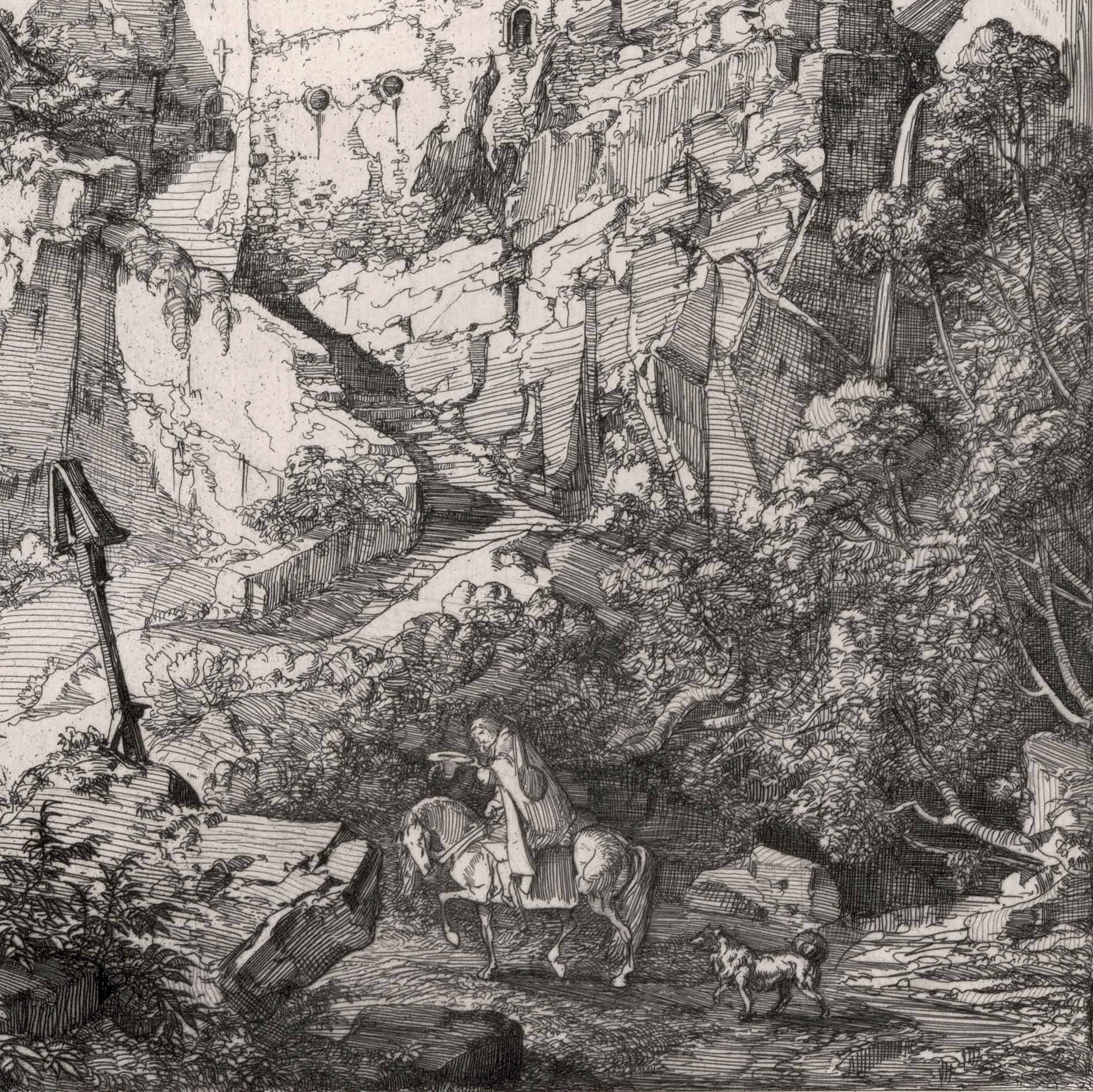
Caspar Johann Nepomuk Scheuren’s etching, “Monastery in the Mountains”, 1844


Caspar Johann Nepomuk Scheuren (aka Kaspar Johann Nepomuk Scheuren) (1810–1887)

Monastery in the Mountains”, 1844, plate 21 published in Düsseldorf in 1846 and 1850 by Julius Buddeus (fl.1830s–1852) as an illustration to “Deutsche Dichtungen mit Randzeichnungen Deutscher Künstler”, volume 2. 

Archive.org offer an online view of this publication and this featured print: https://archive.org/details/bub_gb_kwpQAAAAcAAJ/page/n56/mode/2up.

Etching on chine collé (China) on wove paper, backed with a support sheet providing wide margins.

Size: (sheet) 33.9 x 24.8 cm; (plate) 28.7 x 23 cm; (chine collé) 27.9 x 22.1 cm; (image borderline) 23.1 x 18.5 cm.

Inscribed in plate below the image borderline: (left) “C.Scheuren”; (centre) “–21–”; (right) “imJuli1844.”

The Moravská Galerie offers a brief description of this print: https://sbirky.moravska-galerie.cz/dielo/CZE:MG.MM_1328-b.

Condition: a strong and well-printed (near faultless) impression laid upon an archival support sheet of millennium quality washi paper providing wide margins. The sheet is in a near pristine condition with no tears, holes, folds, abrasions, significant stains, foxing or signs of handling.

I am selling this extraordinarily fine etching showing a curiously wonderful monastery built into the hillside and, arguably, expressing the artist’s romantic leaning to the work of Caspar David Friedrich (1774-1840)—see for example, “Hermit Reading in Mountain Valley” (https://collection.museum.virginia.edu/objects-1/info/12933)—for the total cost of AU$234 (currently US$161.92/EUR159.04/GBP133 at the time of this listing) including Express Mail (EMS) postage and handling to anywhere in the world, but not (of course) any import duties/taxes imposed by some countries.

If you are interested in purchasing this amazing etching showcasing the etcher’s breathtaking skill and discipline, please contact me (oz_jim@printsandprinciples.com) and I will send you a PayPal invoice to make the payment easy.


Thursday, 29 June 2017

Adolph Schrödter’s etching “Don Quixote's Adventure with the Herd of Sheep”, 1837


Adolph Schrödter (aka Adolph Schroedter) (1805–75)
“Don Quixote's Adventure with the Herd of Sheep” (“Don Quixote's Abentheuer mit der Schaafheerde [sic]”), 1839, from Miguel de Cervantes’ “Don Quixote De La Mancha” (Part 1, Chapter 18), published in Düsseldorf by Julius Buddeus (fl.1830s–1852), printed by Schulgen-Bettendorf (1822–1943)

Etching on chine collé with full margins and with the publisher’s octagonal blind-stamp at the lower-right corner: “Julius Buddeus Editeur Düsseldorf” (not in Lugt).
Size: (sheet) 22.9 x 30.8 cm; (plate) 19 x 21 cm; (chine collé) 17.8 x 20 cm
Dated on plate; lettered with artist's name and publication detail.

The British Museum offers the following description of this print:
“Ornamental scrollwork consisting of thorny tendrils; in the centre, Don Quijote on horseback with a lance; shepherd whose dog is biting into the horse's tail to left; flock of sheep to right.” (http://www.britishmuseum.org/research/collection_online/collection_object_details.aspx?objectId=1448230&partId=1&searchText=Schrodter&page=1)

For a description and analysis of this scene see http://www.litcharts.com/lit/don-quixote/part-1-chapter-18

Condition: crisp and beautifully printed impression with generous margins in excellent condition apart from minor age toning at the edges of the sheet.

I am selling this superb example of book illustration for the total cost of AU$93 (currently US$71.34/EUR62.53/GBP55.02 at the time of posting this listing) including postage and handling to anywhere in the world.
If you are interested in purchasing this marvellous etching, please contact me (oz_jim@printsandprinciples.com) and I will send you a PayPal invoice to make the payment easy.
This print has been sold


Some book illustrations portray scenes with very little creative invention, but this image showing Don Quixote attacking a herd of sheep in the mistaken belief that they are enemy soldiers is far from prosaic; it is a subtle and small masterpiece of illustration art.

My enthusiasm for this print is not just that it captures the essence of Don Quixote’s delusion that the cloud of swirling dust kicked up by the sheep is in fact the dust from armies of foes needing to be vanquished, but that it excites an almost full emotional response from me. For example, I sense Don Quixote’s experience of riding into an explosive vortex of energy where he doesn’t see the individual sheep but rather spiralling chaos of an imagined enemy. Going further, the motif of the thistle vine with all its sharp thorns entwined around Don Quixote excites feelings of prickliness, violence and even—but here I may be pushing credibility—the choking smell and taste of churned up dust.