Showing posts with label Bosse (Abraham). Show all posts

Tuesday, 20 February 2024

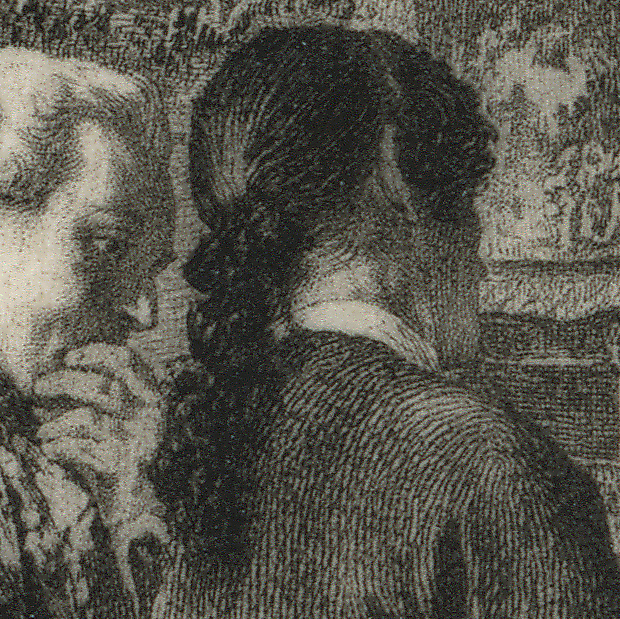
Louis Ruet’s etching, “An Artist Showing his Work”, c.1891, after Meissonier

Louis Ruet (1861–1951) 

“An Artist Showing his Work” (aka “The Print Collector”; “Twee Mannen Bekijken Prenten”; “Two Men Look at Pictures”), c.1891 (based on the proposed date of publication), a pencil-signed artist’s proof printed on parchment with a remarque featuring an image from Abraham Bosse’s (c.1604–1676) 1645 series, “Différentes Manières de Dessiner et Peindre” (Different Ways to Draw and Paint), printed in Paris by Charles Wittmann (1876–1953) and possibly published on page 193 in the journal, “Die Gartenlaube” (The Garden Arbor), in 1891 (see https://commons.wikimedia.org/wiki/File:Die_Gartenlaube_%281891%29_193.jpg), after Jean-Louis Ernest Meissonier’s (1815–1891) painting, “An Artist Showing his Work” (c.1850) in the Wallace Collection (see https://artuk.org/discover/artworks/an-artist-showing-his-work-209339). \

The Wallace Collection (Art UK) offers the following insights about this painting: “Exhibited at the Paris Salon of 1850–1851. The figures wear mid-eighteenth century costume, though several of the pictures on the back wall are by Meissonier himself (including a self-portrait above the visitor’s head), and the setting was identified by a contemporary as the artist’s Paris studio on the quai Bourbon” (op.cit.).

Note that the Rijksmuseum holds a very similar plate (with additional cross-hatching giving tone to the floor and other subtle variations) attributed to Jules Jacquet (1841–1913); see http://hdl.handle.net/10934/RM0001.COLLECT.627611.

Etching on parchment, proof before lettering for publication with remarque at lower centre, signed in pencil.

Size: (sheet) 30.5 x 21 cm; (plate) 20.7 x 15.7 cm; (image borderline) 14.7 x 11.1 cm.

Inscribed in plate within the image borderline: (upper left corner) “CHARLES WITTMANN/ 35 Rue Pourne […]”

Signed in pencil at right of remarque.

Condition: a strong and well-printed impression with generous margins in a very good condition with no tears, holes, folds (but there is unevenness intrinsic to the parchment), abrasions or significant stains (but, again, there is colour unevenness that is largely intrinsic to the parchment).

I am selling this exceptionally fine, pencil-signed and rare impression printed on parchment with a remarque before lettering for publication, for the total cost of AU$233 (currently US$152.73/EUR141.26/GBP120.98 at the time of posting this listing) including postage and handling to anywhere in the world, but not (of course) any import duties/taxes imposed by some countries.

If you are interested in purchasing this ultra-fine artist’s proof of the upmost rarity, please contact me (oz_jim@printsandprinciples.com) and I will send you a PayPal invoice to make the payment easy.

This print has been sold


Wednesday, 5 April 2023

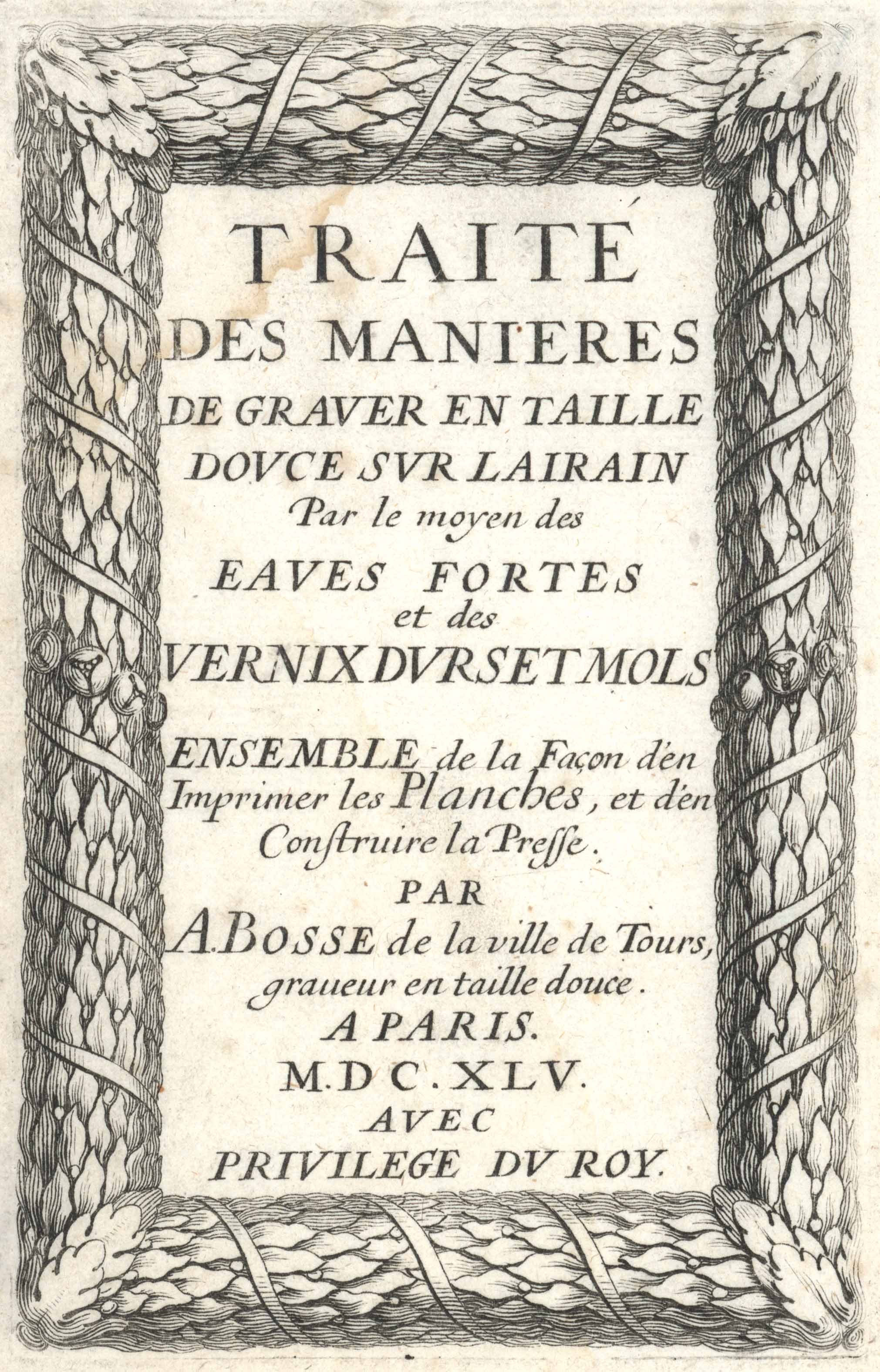
Three etchings by Abraham Bosse from the series, “Différentes manières de dessiner et peindre”, 1645

Instructional prints from the 1600s that are specifically designed for artists should, but do not alwaysand I can speak with authority about thisoffer insights about art practices that have evolved over the centuries. This is certainly a point that I had to ponder today when I was struggling with my etching press and using all my might to turn the wheel that squished paper onto the etching plate to make a print. (I will show the result in my next post.) I may not have used my leg as well as my arms (as shown in the centre image) to make the wheel turn, but I can confirm that this image is as true a practice in 1645 as it is today. Very little has evolved ... but perhaps when I invest in a press with beautiful gears and an electric motor to make the press turn without effort, I will revise this note.

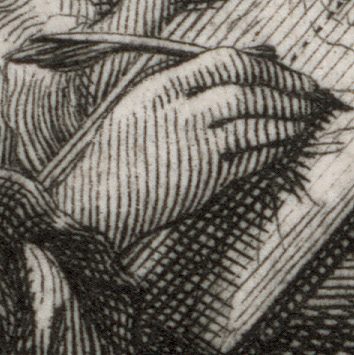
The image on the right showing an artist copying an image is fascinating. What is not very clear when looking at the print from a distance are the very finely inscribed diagrammatical lines tracing the artist’s points of focus and the “correction” in the angle of the Head of Christ being copied to allow for parallax error. Any artist who decides to use photos on their iPhone as a source of inspiration for drawing will already know the need to angle the phone/photo so that the screen is facing “straight on.” Perhaps more interesting is the artist’s use of a quill-pen as this old style of pen has been laid to rest. No doubt that the birds are very happy about this! From a technical standpoint, note that a quill-pen is made from the flight feathers from the left wing of the goose/swan so that the curve of the pen “fits” and is weighted to a right-handed artist’s hand.

Abraham Bosse (c1604–1676)  

Three etchings with engraving from the series of fifty-two plates, “Différentes manières de dessiner et peindre” (Different ways to draw and paint), 1645 (based on the date shown in Roman numerals, “MDCXLV”, on the title plate).

(left) Title plate for the publication

(centre) The printing press

(right) Artist copying a portrait of Christ

Note that I have previously listed the print on the right (now sold), “Artist Copying a Portrait of Christ” (descriptive title only), which is plate 34 in the series, published in Charles Antoine Jombert's (1712–1784) drawing book, “Nouvelle méthode pour apprendre à dessiner sans maître” (New method to learn to draw without a master) (1736 & 1740). The British Museum offers a description of this print: https://www.britishmuseum.org/collection/object/P_2AA-a-53-31.

Etchings with engraving on laid paper trimmed with narrow margins around the image borderlines.

Size of title plate: (sheet) 14.2 x 9.7 cm; (plate) 13.4 x 8.5 cm.

Lettered in the title plate on the left: “TRAITÉ/ DES MANIERES/ DE GRAVER EN TAILLE/ DOVCE SVR LAIRAIN/ Par le moyen des/ EAVES FORTES/ et des/ VERNIX DVRS ET MOLS/ ENSEMBLE de la Façon d'en/ Imprimer les Planches, et d'en/ Construire la Presse./ Par/ A.BOSSE de la ville de Tours,/ graveur en taille douce./ A PARIS./ M.DC. XLV./ AVEC/ PRIVILEGE DV ROY.”

Numbered and inscribed in the centre plate showing the printing press: (upper edge) “16”; “Le Presse en Perspectiue/ veue par le Costé.” (The Press in Perspective/ side view); “16”.

Blum 403–421 (André Blum 1924, “L'Oeuvre gravé d'Abraham Bosse”); Duplessis 534–552 (Georges Duplessis 1859, “Catalogue de l'oeuvre de Abraham Bosse”); IFF 534-552; see also the brief description of the publication (no image) offered by the Metropolitan Museum of Art: https://www.metmuseum.org/art/collection/search/359219.

Condition: the title plate (on the left) and plate 16 (in the centre) are strong and well-printed impressions, whereas the plate on the right (Artist copying a portrait of Christ) is a dull impression. All three of the prints are in a good condition with no tears, holes, folds, or significant stains and have remnants of old mounting verso.

I am selling this set of historically important etchings from a series of prints offering insights into the studio practices of artists and printmakers in the17th century, for AU$396 in total for the set of three prints (currently US$267.52/EUR243.95/GBP214.19 at the time of this listing) including postage and handling to anywhere in the world, but not (of course) any import duties/taxes imposed by some countries.

If you are interested in purchasing this interesting set of prints, please contact me (oz_jim@printsandprinciples.com) and I will send you a PayPal invoice to make the payment easy.

This print has been sold 


Wednesday, 24 August 2022

Abraham Bosse’s etching (with engraving), “Artist Copying a Portrait of Christ”, c1667

Abraham Bosse (c1604–1676)  

“Artist Copying a Portrait of Christ” (descriptive title only), c1667, Plate 34 from the series of 52 plates, “Différentes manières de dessiner et peindre” (Different ways to draw and paint), published in Charles Antoine Jombert's (1712–1784) drawing book, “Nouvelle méthode pour apprendre à dessiner sans maître” (New method to learn to draw without a master) (1736 & 1740). 

Etching on laid paper backed with a support sheet.

Size: (support sheet) 25.3 x 18.9 cm; (sheet) 18.3 x 13.6 cm; (plate) 14.8 x 9.5 cm; (image borderline) 13.5 x 9.2 cm.

Numbered in plate below the image borderline: (right) “34”.

State ii (of ii) with the addition of the plate number.

Blum 1103 (André Blum 1924, “L'Oeuvre gravé d'Abraham Bosse”); Duplessis 940 (Georges Duplessis 1859, “Catalogue de l'oeuvre de Abraham Bosse”); Lothe 1004 (José Lothe 2008, “L'Oeuvre gravé d'Abraham Bosse graveur parisien du XVIIe siècle”).

The British Museum offers a description of this print: https://www.britishmuseum.org/collection/object/P_2AA-a-53-31.

Condition: a well-printed early impression showing no sign of wear to the printing plate, laid onto a support of archival (millennium quality) washi paper. The sheet is in an excellent condition with no tears, holes, folds, abrasions or significant stains.

I am selling this historically important etching from a series of prints offering insights into the studio practices of artists and printmakers in the17th century—note that the portrayed right-handed artist is holding a quill-pen made from the flight feathers from the left wing of the goose/swan so that the curve of the pen “fits” and is weighted to his hand comfortably—for AU$254 (currently US$175.99/EUR176.81/GBP187.27 at the time of this listing) including postage and handling to anywhere in the world, but not (of course) any import duties/taxes imposed by some countries.

If you are interested in purchasing this representation of an artist copying a portrait of Christ —note the diagrammatical lines tracing the artist’s points of focus and the “correction” in the angle of the Head of Christ being copied to allow for parallax error—please contact me (oz_jim@printsandprinciples.com) and I will send you a PayPal invoice to make the payment easy.

This print has been sold


Thursday, 23 August 2018

Abraham Bosse’s etching, “The Parting of Joan (of Arc) and Charles VII”, 1656


Abraham Bosse (1604?–1676)

“The Parting of Joan and Charles VII”, 1654–1656, after Claude Vignon (1593–1670), tenth plate from the series of thirteen illustrations to the poem by Jean Chapelain (1595–1674), “Joan of Arc, or France Liberated” (La Pucelle ou La France delivrée), published in Paris by Augustin Courbe in 1656. Note: the contract signed between Chapelain and Bosse for illustrating Chapelain’s poem was signed on 15 april 1654, consequently the print must have been executed between 1654 and 1656 (see the BM curator’s comment for the frontispiece to the print series: http://www.britishmuseum.org/research/collection_online/collection_object_details.aspx?objectId=1345434&partId=1&searchText=1895,1031.60&page=1).

Etching on fine laid paper with full margins as published.
Size: (sheet) 35.5 x 23.6 cm; (plate) 26.4 x 18.6 cm; (image borderline) 26 x 18.3 cm
Inscribed on plate below the image borderline: (left) “C. Vignon jn.”; (right) “ABosse Scul.”

Lothe 2008 1056 (José Lothe 2008, “L'Oeuvre gravé d'Abraham Bosse graveur parisien du XVIIe siècle”, Paris Musées, Paris); Duplessis 1859 1157 (Georges Duplessis 1859, “Catalogue de l'oeuvre grave”, Paris); Blum 1924 679 (André Blum 1924, “L'Oeuvre gravé d'Abraham Bosse”, Paris).

The British Museum offers the following description of this print:
“The parting of Joan of Arc and Charles VII, both on horseback; above Joan of Arc, angels protecting her.”

Condition: well-printed lifetime impression (based on the crisp quality of the lines showing no wear to the plate) with full margins in excellent condition (i.e. there are no tears, holes, folds, abrasions, stains or foxing but there are minor signs of handling appropriate to the age of the print).

I am selling this very rare print exemplifying Bosse’s leaning to the Baroque period style for AU$256 in total (currently US$186.20/EUR160.82/GBP144.74 at the time of posting this listing) including postage and handling to anywhere in the world (but not, of course, any import duties/taxes imposed by some countries).

If you are interested in purchasing this remarkable etching that exhibits the artist’s skill in mimicking the tapered lines of an engraving, please contact me (oz_jim@printsandprinciples.com) and I will send you a PayPal invoice to make the payment easy.

This print has been sold


When I initially began my research into this eye-catching print full of swirling Baroque rhythms and blazing light, I simply accepted the technical description of it offered by the Wesleyan University’s Davison Art Centre (http://dac-collection.wesleyan.edu/Obj2876) that the print is an engraving. After moving my investigations to the print's description at the British Museum (http://www.britishmuseum.org/research/collection_online/collection_object_details.aspx?objectId=1466141&partId=1&searchText=Abraham+BOSSE+vignon&page=1) a problem arose:  this august institution advised that the print is an etching. Mmm … I needed to put on my thinking cap!

The issue of conflicting descriptions was not hard to understand as the Davison Art Centre’s determination was correct in that the ends of the printed lines seen under magnification do indeed have tapered ends—an attribute of engraving. The British Museum is also correct as the depth and richness of the lines point to the print being an etching. At this moment of quandary I remembered a VERY important achievement of Abraham Bosse who executed the print: he (along with Callot) was one of the first printmakers to “fake” the appearance of engraved lines using the process of etching. In fact he was so skilled in emulating the “look” of engraving in an etching and had such a deep understanding of the intricacies of the various printmaking processes that he even published the first “how to do it” manual on intaglio printmaking techniques: “On the Manner of Etching with Acid and with a Burin, and of Dark-Manner Engraving” (De la Manière de graver à l’eau-forte et au burin, et de la gravure en manière noire), Paris, 1645 (see https://risdmuseum.org/art_design/objects/2752_on_the_manner_of_etching_with_acid_and_with_a_burin_and_of_dark_manner_engraving?context=224&type=exhibitions