Showing posts with label Bisschop (Jan de). Show all posts

Wednesday, 8 September 2021

Jan de Bisschop’s etching, “Statue of Aphrodite”, 1668/9

Jan de Bisschop (aka Johannes Episcopius) (1628–71)

“Statue of Aphrodite”, 1668/9 (pub. 1672), plate 81 from the series, “Signorum Veterum Icones,” published by Jan de Bisschop and in the case with this impression (based on the margins) in 1672 by Nicolaes Visscher II (1649–1702) in Amsterdam.

Archive.org offers an online view of this etching in its context in the publication: https://archive.org/details/signorvmvetervmi00biss/page/81/mode/2up.

Etching with engraving on fine laid paper watermarked with the Arms of Amsterdam.

Size: (sheet) 29.9 x 18 cm; (plate) 21.1 x 13.5 cm.

Inscribed in plate: (upper right corner) “81”; (lower right) “[De Bisschop's ligature monogram]. f."

Hollstein 6; Van Gelder I.166.81

The British Museum offers the following description of this print: “Statue of an Aphrodite in a pudica pose with a cloth lying on a rock beside her left leg; front view and side view directed to left shown side by side” (https://www.britishmuseum.org/collection/object/P_1901-1022-2531-82).

The Curator of the British Museum offers the following insights regarding the portrayed sculpture:

“The statue was lost during the fire of 1762 in the Uffizi in Florence. This type belongs to the Venus pudica type, which may have been a Hellenistic repetition. Its base and support may have been modern. The draughtsman's name is not mentioned. In his list of contents and locations de Bisschop says that the statue is "in aedibus Mediceis", a location which he otherwise used for statues inside the Villa Medici in Rome. He obviously had a drawing with the inscription 'Medici' at his disposal and did not know that the statue was actually in Florence. He further says that it is not very different from the Greek Venus "in the same palace" and that according to Cavalieri, III.IV,67, it seems it was previously in the Farnese collection (which was not the case); Cavalieri's plate in fact shows another version.” (op.cit.)

Condition: a strong impression with substantial margins in near pristine condition with no tears, holes, folds, abrasions, losses, stains, foxing or signs of handling.

I am selling this amazing double view of an antique sculpture that was destroyed in a fire a century after this etching was published, for AU$247 in total (currently US$182.06/EUR153.79/GBP132.29 at the time of posting this listing) including postage and handling to anywhere in the world.

If you are interested in purchasing this dual viewpoint of a classically arranged Aphrodite/Venus in the famous pudica pose—a pose that in one sense gives modesty to the nude figure, while (arguably) also drawing attention to her pudenda and her partially successful covering of her breasts—please contact me (oz_jim@printsandprinciples.com) and I will send you a PayPal invoice to make the payment easy.

This print has been sold


Tuesday, 11 August 2020

Jan de Bisschop’s etching, “Dying Christ Supported by Angels,” c1670

Jan de Bisschop (aka Johannes Episcopius) (1628–1671)

“Dying Christ Supported by Angels,” c1670 (1668–1671 [Rijksmuseum dating]), after a red chalk drawing in the Albertina, Vienna (inv. no. 2128; see https://sammlungenonline.albertina.at/#/query/5a3b14ca-fc54-4ac9-ab84-d57b64007f86) formerly attributed to Annibale Carracci (1560–1609), plate 1 (after the title plate) in the series of 157 etchings by Jan de Bisschop, initially published at the Hague in 1671/72 by Nicolaas Visscher II (1649–1702) and later by Hendrik de Leth (1703–1766) in “Paradigmata Graphices Variorum Artificum”, with a title plate by Gerard de Lairesse (1640–1711) (see https://research.britishmuseum.org/research/collection_online/collection_object_details.aspx?objectId=3296238&partId=1). This impression is from the numbered and lettered Hendrik de Leth edition (c.1731–41).

See this publication and the context of this print online at archive.org:

https://archive.org/details/paradigmatagraph00biss_0/page/n3/mode/2up.

Etching on laid paper with wide margins.

Size: (sheet) 31.9 x 22.4 cm; (plate) 22.3 x 13.4 cm.

Inscribed on plate: (upper right corner) “1”; (lower left) “Ann.Caratus inv.del.”; (lower right) “Ann.Caratius inv.del.”; (lower right) “[De Bisschop's monogram] JE. f.” 

State iii (of iii) with the addition of the artist’s Latin monogram, the name of the designer and the plate number.

Hollstein Dutch 6 (F W H Hollstein 1950, “Dutch and Flemish Etchings, Engravings and Woodcuts ca. 1450–1700: Berckheyde–Bodding”, vol. 2, Amsterdam, Menno Hertzberger, p. 44, cat. no. 6); Gelder & Jost 1-3 (3) (Jan G van Gelder & Ingrid Jost 1985, “Jan de Bisschop and his Icones and Paradigmata: Classical Antiquities and Italian Drawings for Artistic Instrumentation in Seveneenth Century Holland”, Doornspijk, Davaco, p. 231, cat. no. 1).

See also the description of this print at the British Museum and the Rijksmuseum:

https://www.britishmuseum.org/collection/object/P_1850-0810-754;

http://hdl.handle.net/10934/RM0001.COLLECT.466643.

Condition: richly inked and well-printed impression in near faultless condition (i.e. there are no tears, holes, folds, losses, abrasions, stains, foxing or signs of handling).

I am selling this exceptionally beautiful translation (in reverse) of Carracci’s red chalk drawing in the Albertina of Christ as “The Man of Sorrows”, for AU$302 in total (currently US$216.58/EUR184.46/GBP165.72 at the time of posting this listing) including postage and handling to anywhere in the world (but not, of course, any import duties/taxes imposed by some countries).

If you are interested in purchasing what I see as a magnificent rendering of Christ’s musculature with convincingly drawn foreshortened legs and stretched torso (following his crucifixion), please contact me (oz_jim@printsandprinciples.com) and I will send you a PayPal invoice to make the payment easy.

This print has been sold


Saturday, 28 March 2020

Jan de Bisschop’s etching, “Angel with a Banderole”, c.1671


Jan de Bisschop (aka Johannes Episcopius) (1628–1671)

“Angel with a Banderole”, c.1671, after Giuseppe Cesari d'Arpino (aka Cavaliere d'Arpino; Josepin [as inscribed on plate]) (c.1568–1640), plate 30 (unfinished) in the series of 157 etchings by Jan de Bisschop, initially published at the Hague in 1671/72 by Nicolaas Visscher II (1649–1702) and later by Hendrik de Leth (1703–1766) in “Paradigmata Graphices Variorum Artificum”, with an etched title-page by Gerard de Lairesse (1640–1711) (see https://research.britishmuseum.org/research/collection_online/collection_object_details.aspx?objectId=3296238&partId=1). This impression is from the numbered and lettered Hendrik de Leth edition (c.1731–41).

See this publication and the context of this print online at archive.org:

Etching on laid paper with full margins as published.
Size: (sheet) 22 x 27.6 cm; (plate) 13.1 x 19.9 cm.
Inscribed on plate: (lower left) “Josepin inv.”; (lower right) “JE. f. 30”.
State iii (of iii) with the addition of the artist’s Latin monogram (JE. f.), the name of the designer (Josepin) and the plate number (30).

Hollstein Dutch 6 (F W H Hollstein 1950, “Dutch and Flemish Etchings, Engravings and Woodcuts ca. 1450–1700: Berckheyde–Bodding”, vol. 2, Amsterdam, Menno Hertzberger, p. 44, cat. no. 6); Gelder & Jost 30-3 (3) (Jan G van Gelder & Ingrid Jost 1985, “Jan de Bisschop and his Icones and Paradigmata: Classical Antiquities and Italian Drawings for Artistic Instrumentation in Seveneenth Century Holland”, Doornspijk, Davaco, p. 252, cat. no. 30).

The Curator of the British Museum offers the following insights about the design of this unfinished print:
“Detail from the fresco in the 'Moses-pendentive' by Giuseppe Cesari in the Capella Olgiati in the S. Prassede in Rome. This plate is the only unfinished one in the 'Paradigmata' and was probably meant to resemble those that come before and after it. The image was rotated 90º to right to fit page”

See also the description of this print at the Rijksmuseum:

Condition: excellent impression in near faultless condition (i.e. there are no tears, holes, folds, losses, abrasions, stains, foxing or significant signs of use).

I am selling this intriguingly unfinished etching of Giuseppe Cesari’s fresco for AU$247 in total (currently US$152.35/EUR136.66/GBP122.35 at the time of posting this listing) including postage and handling to anywhere in the world (but not, of course, any import duties/taxes imposed by some countries).

If you are interested in purchasing this Baroque vision of an angel with a billowing banderole, please contact me (oz_jim@printsandprinciples.com) and I will send you a PayPal invoice to make the payment easy.


This print has been sold


Sunday, 11 November 2018

Jan de Bisschop’s set of three etchings after Michelangelo’s sculpture, "Bacchus with Satyr”, c1670


Jan de Bisschop (aka Johannes Episcopius) (1628–1671)

(left) “Plate 53: Bacchus with Satyr”, c1669–71
(centre) “Plate 52: Bacchus with Satyr”, c1669–71
(right) “Plate 4 Bacchus with Satyr”, c1669–71

Three etchings from the series of 157 plates, “Signorum Veterum Icones” published in two volumes by Nicolaas Visscher II (1649–1702) in 1672. The subject of this set of etchings is Michelangelo’s (1475–1564) sculpture, “Bacchus with Satyr”, which the Curator of the British Museum advises was “executed in Rome perhaps between 1496 and 1497 by Michelangelo, [and] is now in the Museo Nazionale, Bargello in Florence” (BM No. 1901,1022.2531.54). Plate 52 (centre image) is based on an intermediary drawing by Cornelis van Poelenburch (1594/5–1667) (as inscribed on the plate).

Etchings on fine laid paper backed with a support sheet. Plate 53 is trimmed along the platemark. Plate 52 has small margins. Plate 54 is trimmed with a thread margin at the top, along the platemark at bottom and with small margins on the sides.

Sheet size: (Plate 53) 21.5 x 10 cm (this is also the dimensions of the plate); (Plate 52) 23.4 x 10.3 cm; (Plate 54) 21.8 cm.
Each print is inscribed on plate with the relevant plate number at upper right corner and with the artist’s monogram at lower right: ''JE f.'' (Nagler III.2254). Plate 52 is inscribed: "Poelenburch d."

Hollstein 6 (F W H Hollstein 1949, “Dutch and Flemish etchings, engravings and woodcuts c.1450-1700”, Amsterdam); Van Gelder 1985 I.138.52-54 (Jan Van Gelder & Ingrid Jost 1985, “Jan de Bisschop and his Icones & Paradigmata”, 2, Doornspijk, Davaco).

See also descriptions of these prints at the British Museum:
Plate 52:
Plate 54:

Condition: crisp, well-inked and well-printed early impressions (based on the lack of wear to the plates) backed with a support sheet of archival (millennium quality) washi paper. There are minor signs of handling (i.e. there are a few marks/spots).

I am selling this intriguing set of three etchings showing three views of Michelangelo’s famous sculpture of Bacchus (with a restored right arm) holding up a winecup with a small satyr munching on grapes behind his left leg, for AU$510 in total for the set (currently US$368.63/EUR324.98/GBP284.22 at the time of posting this listing) including postage and handling to anywhere in the world (but not, of course, any import duties/taxes imposed by some countries).

If you are interested in purchasing these marvellous studies of three different viewpoints of Michelangelo’s slightly tipsy God of wine, please contact me (oz_jim@printsandprinciples.com) and I will send you a PayPal invoice to make the payment easy.

This print has been sold


My understanding of Bisschop’s intention for these multiple viewpoints of Michelangelo’s sculpture—and for all the 157 plates in the series “Signorum Veterum Icones” of which these three etchings are a part—is that this set of prints would serve as artistic study pieces designed for students to copy. Bisschop’s choice of this particular sculpture as a study piece is probably because it marched what was a common notion about beauty at the time: beauty could be perceived in antique artworks of Greece and Rome. Interestingly, Bisschop may not have been aware that this sculpture was by Michelangelo—mindful that the etchings are based on drawings by intermediary draughtsmen and were not inscribed on the plate in front of the original sculpture—as the Curator of the British Museum explains (in reference to “Addres to the Spectator”): “… [Bisschop] did not know what or where it was, but he might also have included it as a work equivalent to the antique” (BM No. 1901,1022.2531.54).


Wednesday, 25 July 2018

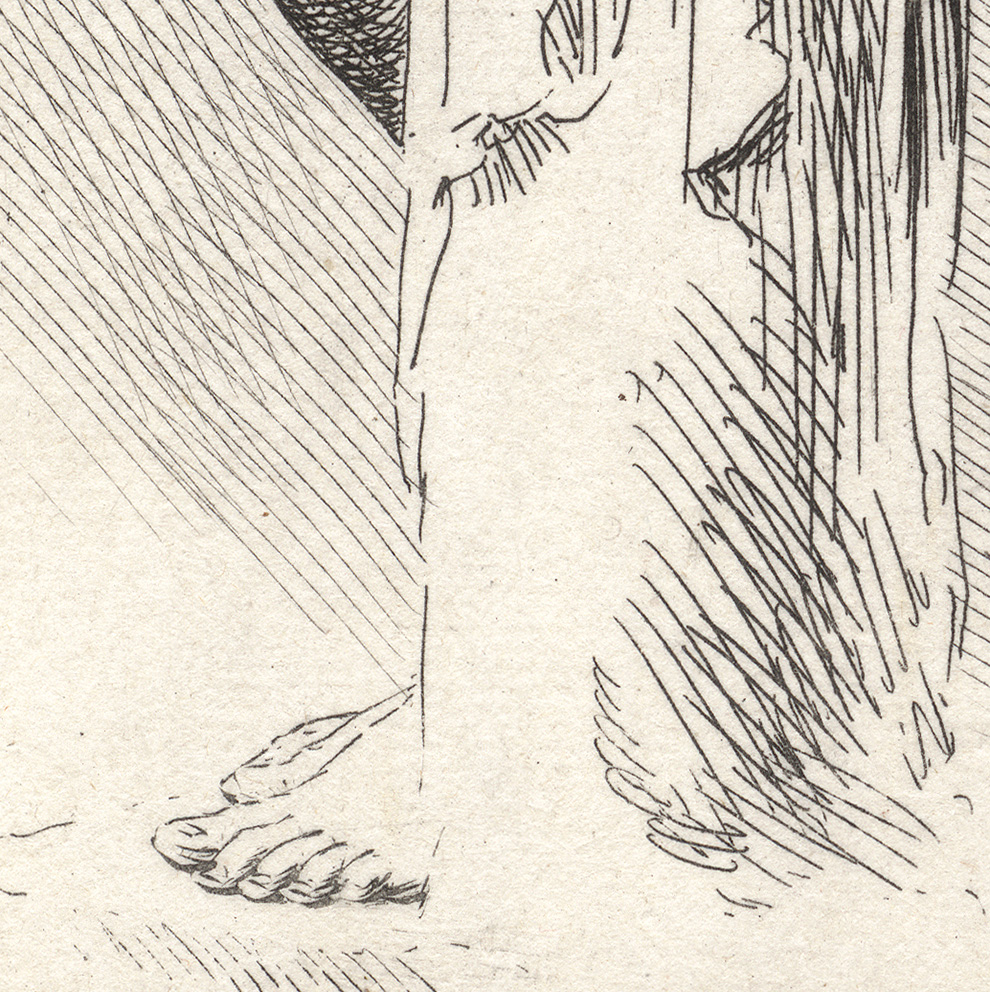
Jan de Bisschop’s etching, “Elder Son of Laocoon”, c1670


Jan de Bisschop (aka Johannes Episcopius) (1628–1671)

“Elder Son of Laocoon”, c1669–71, plate 56 from the series of 157 etchings, “Signorum Veterum Icones” published in two volumes by Nicolaas Visscher II (1649 – 1702) in 1672. This etching is purportedly based on Baccio Bandinelli’s (1493–1560) reconstructed copy of the antique sculpture, “Laocoön and His Sons” (aka “The Laocoön Group”), in the Uffizi Gallery, Florence.

Etching on fine laid paper with narrow margins backed with a support sheet.
Size: (sheet) 24 x 11.1 cm; (plate) 23.3 x 10.3 cm
Inscribed on plate: (upper right corner) “56”; (lower right) (monogram of the artist) ''JE f.'' (Nagler III.2254)

Hollstein 6 (F W H Hollstein 1949, “Dutch and Flemish etchings, engravings and woodcuts c.1450-1700”, Amsterdam); Van Gelder 1985 I.141.56 (Jan Van Gelder & Ingrid Jost 1985, “Jan de Bisschop and his Icones & Paradigmata”, 2, Doornspijk, Davaco).

The British Museum offers the following description of this print:
“Statue of the elder son of Laocoon with the snake and parts of Laocoon's left leg; back view; probably after Baccio Bandinelli's reconstruction” (http://www.britishmuseum.org/research/collection_online/collection_object_details.aspx?objectId=3374911&partId=1&searchText=Bisschop+28&page=1?bibId=4603)

Condition: crisp, well-inked and well-printed early impression (based on the lack of wear to the plate) with narrow margins backed with a support sheet of archival (millennium quality) washi paper. There is a closed tear towards the centre of the left side, otherwise the sheet is in good condition with minor signs of handling (i.e. there are a few marks/spots).

I am selling this intriguing etching showing a fragment of the antique sculpture, “Laocoön and His Sons”, for AU$176 in total (currently US$131.58/EUR111.62/GBP99.20 at the time of posting this listing) including postage and handling to anywhere in the world (but not, of course, any import duties/taxes imposed by some countries).

If you are interested in purchasing beautifully rendered figure—the elder son of Laocoon—battling with a serpent, please contact me (oz_jim@printsandprinciples.com) and I will send you a PayPal invoice to make the payment easy.

This print has been sold


From my understanding of the 157 plates in the series, “Signorum Veterum Icones”, they were designed to be artistic study pieces showcasing major artworks from the past. Mindful of this envisaged role, I can see the reason why De Bisschop chose this particular section of the famous antique sculpture, “Laocoön and His Sons”, to render: the modelling of the figure’s back is a perfect display of manly muscles and a bubble butt.

At this point I should discuss meaningful features of this study piece—such as the principle that there are (almost) no concavities in the silhouette edge of a figure—but I hesitate as I remember reading an analysis of this sculpture by the extraordinary arts writer, Peter Fuller. Fuller recounted a moment of interaction in a lecture with the insight that there is no need to explain in technical terms how the dynamic play of muscles connote that the figures are in distress. After all, we can see clearly that the serpent is killing the boys!

For those who may be unfamiliar with the reason why this figure—the elder son of Laocoon—along with his brother and father are sculpted battling a snake, the reason is (…and I may be wrong) as punishment for his father jabbing his spear into the soldier-filled Trojan horse to reveal that the horse was a military ruse. An alternative reason for the boys’ engagement with the monstrous snake is because their father had sex with his wife in the temple of Poseidon. (What a shameless dude!)

The Curator of the British Museum offers the following information about the subject portrayed in this print:

“This statue of the oldest son of Laocoon, probably after Baccio Bandinelli's reconstruction of the antique group … is now in the Uffizi in Florence (inv. no. 284). The etching shows the figure in reverse, but no draughtsman's name was mentioned. Neither this, nor any intermediary drawing have come to light. In his list of contents and locations De Bisschop says that this plate shows a detail of the antique group. However the viewpoint as well as at least one detail make it likely that Bandinelli's group is reproduced. His group comes closest to this plate because the boy's right heel rests on a slab whereas in both the antique group and the Louvre cast it is raised without any support”