Showing posts with label Troyon (Constant). Show all posts

Tuesday, 27 May 2025

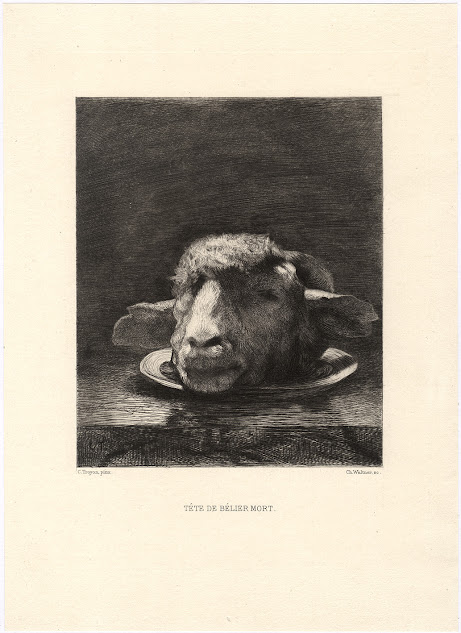
Charles Waltner, “Tête de Bélier Mort”, 1873, after Constant Troyon (2nd copy)

Charles Waltner (aka Charles Albert Waltner) (1846–1925)

“Tête de Bélier Mort” (Dead Ram's Head), 1873, from the series of sixty-eight plates, “Tableaux de premier ordre anciens et modernes composant la galerie de M. John W. Wilson” (Ancient and modern first-rate paintings composing the gallery of Mr. John W. Wilson), after the painting of the same composition by Constant Troyon (1810–1865), printed by François Liénard (fl. c.1860s–1880s) and published in Paris by Jules Claye (aka Jules Alexandre Saturnin Claye) (1806–1886) in 1873.

I understand that the artworks from the former John W Wilson’s collection (which this etching and the others in the series reproduce) were exhibited in the Wilson’s gallery to showcase (transl.) “the artistic and literary Circle of Brussels. For the benefit of the poor of this city” (see Lambertus Vincentius Ledeboer 1878 “Catalogue raisonné de la bibliothèque de M. Lambertus Vincentius Ledeboer Bzn”, Rotterdam, Van Hengel & Eeltjes, pp. 139–40; https://archive.org/details/catalogueraison00ledegoog/page/n155/mode/2up).  

Etching with drypoint on cream laid paper with full margins as published.

Size: (sheet) 35.1 x 26 cm; (plate) 23.2 x 17.8 cm; (image borderline) 16.7 x 13.7 cm.

Inscribed in plate within the image borderline: (lower left corner) “Waltner 1873/ C. T.”

Lettered in plate below the image borderline: (left) “C.Troyon, pinx.”; (centre) “TÊTE DE BÉLIER MORT./ Fçois Liénard,Imp.Paris”; (right) “'Ch.Waltner, sc.”

Beraldi 42 (Henri Béraldi 1892, “Les Graveurs du XIXe Siècle: Guide de l'Amateur d'Estampes Modernes: Saint-Marcel–Zwinger”, vol. XII, Paris, Librairie L. Conquet, p. 262, cat. no. 42 [https://archive.org/details/lesgraveursdu19e12berauoft/page/262/mode/2up]).

The British Museum and the Philadelphia Museum of Art offer descriptions of this print: https://www.britishmuseum.org/collection/object/P_1877-1013-1879; https://www.philamuseum.org/collection/object/7460.

Condition: a strong and well-printed impression with wide margins in a near pristine condition with no tears, holes, folds, abrasions, losses, stains or signs of handling.

I am selling this visually arresting and symbolically potent etching projecting (for me) meanings including sacrifice—in the sense of the biblical reference to Abraham's sacrifice of a ram in place of his son—to feelings of respect for the animal’s fearless male determination, for AU$234 (equivalent to approximately US$151.76, EUR 133.33, or GBP 111.89 at the time of listing) and includes Express Mail Service (EMS) postage and handling to any worldwide destination. Please note that any import duties or taxes levied by the destination country, if any, are the responsibility of the buyer and are not included in the purchase price. Payment is requested in Australian dollars (AU$234).

If you are interested in purchasing this superbly executed and pictorially challenging etching, please contact me (oz_jim@printsandprinciples.com) and I will send you a PayPal invoice to make the payment easy.

Note that this is the second impression of this print that I have listed (the previous copy has been sold).

This print has been sold


Monday, 17 January 2022

Charles Waltner’s etching, “Tête de Bélier Mort”, 1873, after Constant Troyon

Charles Waltner (aka Charles Albert Waltner) (1846–1925)

“Tête de Bélier Mort” (Dead Ram's Head), 1873, from the series of 68 plates, “Tableaux de premier ordre anciens et modernes composant la galerie de M. John W. Wilson” (Ancient and modern first-rate paintings composing the gallery of Mr. John W. Wilson), after the painting of the same composition by Constant Troyon (1810–1865), printed by François Liénard (fl. c1860s–1880s) and published in Paris by Jules Claye (aka Jules Alexandre Saturnin Claye) (1806–1886) in 1873.

I understand that the artworks from the former John W Wilson’s collection (which this etching and the others in the series reproduce in 68 plates) were exhibited in the Wilson’s gallery to showcase (in transl.) “the artistic and literary Circle of Brussels. For the benefit of the poor of this city” (see Lambertus Vincentius Ledeboer 1878 “Catalogue raisonné de la bibliothèque de M. Lambertus Vincentius Ledeboer Bzn”, Rotterdam, Van Hengel & Eeltjes, pp. 139–40; https://archive.org/details/catalogueraison00ledegoog/page/n155/mode/2up).  

Etching with drypoint on cream laid paper with a small margin around the platemark.

Size: (sheet) 28.5 x 20.5 cm; (plate) 23.5 x 18 cm; (image borderline) 16.8 x 13.8 cm.

Inscribed in plate within the image borderline: (lower left corner) “Waltner 1873/ C. T.”

Lettered in plate below the image borderline: (left) “C.Troyon, pinx.”; (centre) “TÊTE DE BÉLIER MORT.”; (right) “'Ch.Waltner, sc.”

Beraldi 42 (Henri Béraldi 1892, “Les Graveurs du XIXe Siècle: Guide de l'Amateur d'Estampes Modernes: Saint-Marcel–Zwinger”, vol. XII, Paris, Librairie L. Conquet, p. 262, cat. no. 42 [https://archive.org/details/lesgraveursdu19e12berauoft/page/262/mode/2up]).

The British Museum offers the following description of this print: “Ram's head on a tray, after Troyon Etching” (https://www.britishmuseum.org/collection/object/P_1877-1013-1879).

See also the description of this print offered by the Philadelphia Museum of Art:  https://www.philamuseum.org/collection/object/7460.

Condition: a strong and well-printed impression in pristine condition (i.e., there are no tears, holes, folds, abrasions, losses, stains, foxing or signs of handling).

I am selling this visually arresting and symbolically potent etching projecting (for me) meanings including sacrifice—in the sense of the biblical reference to Abraham's sacrifice of a ram in place of his son—to feelings of respect for the animal’s fearless male determination, for the total cost of AU$224 (currently US$161.19/EUR141.38/GBP118.19 at the time of posting this listing) including postage and handling to anywhere in the world, but not (of course) any import duties/taxes imposed by some countries.

If you are interested in purchasing this superbly executed and pictorially challenging etching, please contact me (oz_jim@printsandprinciples.com) and I will send you a PayPal invoice to make the payment easy.

This print has been sold


Wednesday, 22 August 2018

Théophile Chauvel’s etching, “Le Bateau de Pêche”, 1879


Théophile Chauvel (aka Théophile Narcisse Chauvel) (1831–1909)
“Le Bateau de Pêche” (The Fishing Boat), 1879, after a painting by Constant Troyon (1810–1865) formerly in the collection of John W Wilson (as lettered on the plate), first published in “L'Art” (1880) and printed by François Liénard (fl.c.1860s–1880s), later published (with this impression) by Grands Magasins du Louvre, Paris. This plate was reissued in the compilation catalogue of around 60 prints, "Tableaux de premier ordre anciens et modernes composant la galerie de M. John W. Wilson", executed by Chauvel and other artists, as reproductive prints showcasing Wilson’s collection of paintings for the auction sale of his collection in 1881 (see the curator of the British Museum’s description of this publication: http://www.britishmuseum.org/research/collection_online/collection_object_details.aspx?objectId=3493727&partId=1&people=91771&peoA=91771-1-7&page=1).

Etching on cream laid paper with full margins (as published) and backed on a support sheet.
Size: (sheet) 44.2 x 30.5 cm; (plate) 34.8 x 23.1 cm; (image borderline) 32 x 18.9 cm
Lettered on plate below the image borderline: (left) C. Troyon. pinx.”; (centre) “LE BATEAU DE PÊCHE / (Collection de Mr. John W. Wilson)”; (right) “Th.Chauvel. sc.”
Lettered in lower margin; (right) “Offert par les GRANDS MAGASINS DU LOUVRE. – PARIS”

IFF 62 (Inventaire du Fonds Français: Bibliothèque Nationale, Département des Estampes, Paris, 1930)

Condition: richly inked and well-printed impression with full margins in excellent condition (i.e. there are no holes, folds, abrasions, stains or foxing but there is a small [4 mm] closed tear at the lower edge and a handling mark on the right edge). The sheet is backed on a support sheet of archival (millennium quality) washi paper.

I am selling this graphically strong image of a sailboat set against moonlight, for [deleted] including postage and handling to anywhere in the world (but not, of course, any import duties/taxes imposed by some countries).

If you are interested in purchasing this very poetic etching that I suspect Albert Pinkham Ryder would have loved if he had seen it, please contact me (oz_jim@printsandprinciples.com) and I will send you a PayPal invoice to make the payment easy.

This print has been sold


Tonight I had one of those strange cathartic moments when an inner troubling truth is revealed … and it was all because of this print! What happened was that I was making a coffee thinking about what I planned to write regarding this print and what makes it so special to me. After all, I bought the etching ten years ago and until now I have had no great urge to sell it, simply because I like it. At that moment I looked over towards my studio table and saw an Elioth Gruner etching (which I also love) resting there. Then, like a lightning strike, I instantly knew what I love in art: images where the subject is stationed in front of a light source— contre-jour compositions like the Gruner! Wow! To be honest I don’t know what this would mean to a psychiatrist but just knowing what makes me excited is wonderful. Now I think back I realise that I always seem to be painting into the light and love the way that I can’t really see a subject “properly”.

Regarding this print, Chauvel in reproducing Troyon’s painting did not have to be too concerned about the colour of Troyon’s painting as this image is ALL about the big and very dark shape of the sail boat set against moonlight. To my eyes, this image is so graphically strong that it’s like an iconic emblem that crystallises the essentials of what sailing is about (or at least for me): a big sail, moist breeze, rolling sea and blinding light.