Adolf van der Laan (aka
Adriaen van der Laan; Andries van der Laan) (c.1690–1742)
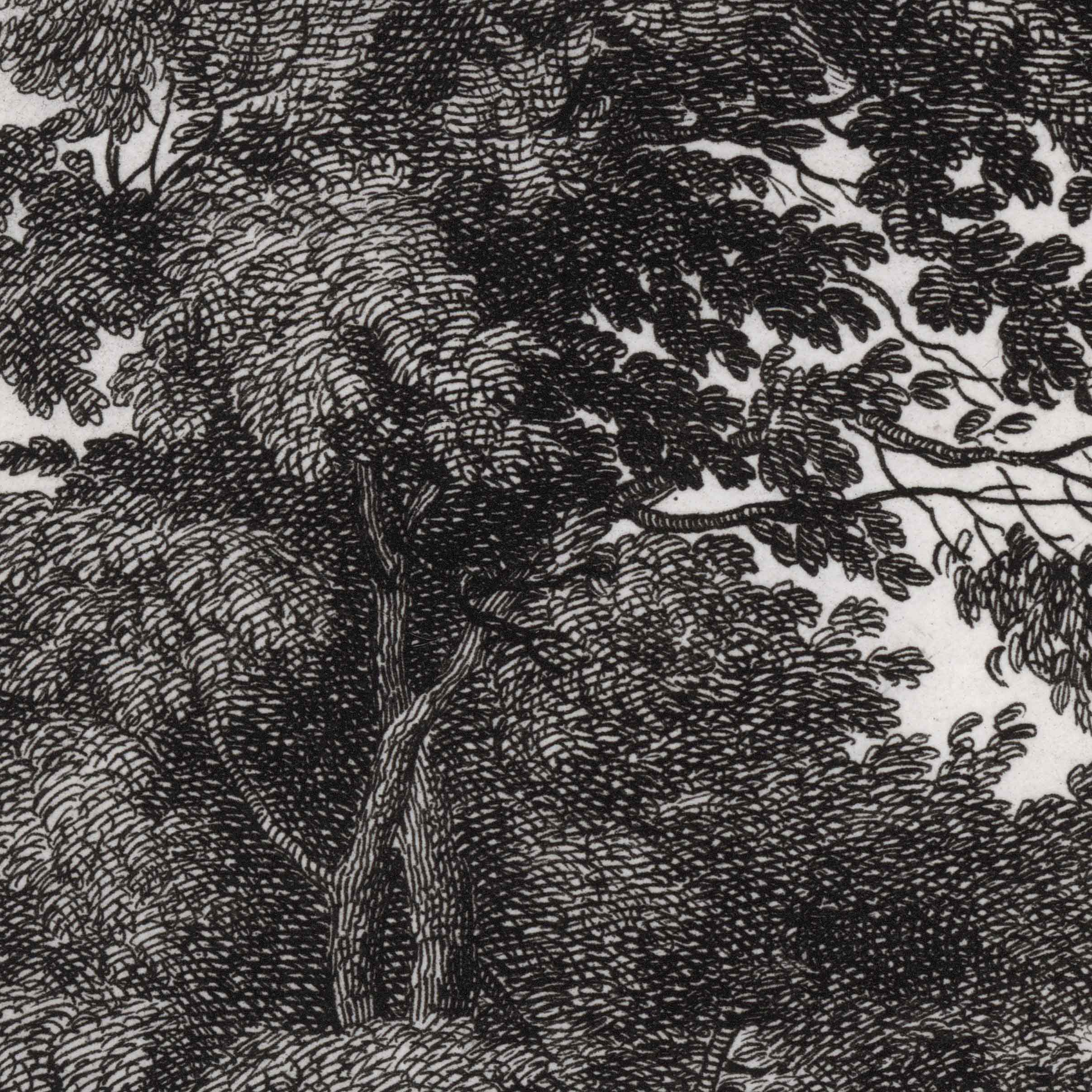
“Arcadian landscape with Shepherds and Two Women”, c.1721,
possibly from the series of forty plates, “Italian and German landscapes” (Hollstein
German 70–109), after Jan Glauber (aka Johannes Glauber; Joannes
Glauber; [nickname] Polidoro or Polydor) (1646-1726), published in Amsterdam by Leonard
Schenk (aka Leon Schenk; Leonard Schenck) (fl.1720–1746) in various books
of prints between 1710 and 1747.
The Philadelphia Museum of Art describes this print
bound in a book of thirty-six plates: https://philamuseum.org/collection/object/23315.
Note that the Rijksmuseum holds a title plate to a published series with thirty
plates (see http://hdl.handle.net/10934/RM0001.COLLECT.134564)
and advises that another “state of this [title plate] print is included in a
forty-part series with representations of Italian and German landscapes, after
Johannes Glauber” (ibid.).
Etching on laid paper with wide margins.
Size: (sheet) 35.9 x 45.5 cm; (plate) 24.3 x 36.7 cm;
(image borderline) 23.5 x 36 cm.
Hollstein German 70–109 (possibly) (Robert Zijlma
[comp.] 1975, “German Engravings, Etchings and Woodcuts, ca. 1400–1700: Georg
(Jörg) to after Johann Andreas Graf”, vol. 10, Amsterdam, Van Gendt & Co, pp.
127–130, cat. nos. 70–109).
The Rijksmuseum offers the following description of
this print: (Transl.) “Arcadian river landscape with shepherds and two women
with [laundry?], on the right a decorative vase on a pedestal. The print is
possibly part of a 40-part series of prints with representations of Italian and
German landscapes” (http://hdl.handle.net/10934/RM0001.COLLECT.134590).
Condition: a strong and well-printed impression with
wide margins. The sheet is in an excellent condition with no tears, holes, folds,
abrasions or significant stains (but there are minor marks in the margins).
I am selling this large and finely executed etching
exemplifying the classical spirit with a strong stylistic leaning to Nicolas
Poussin’s (1594–1665) landscapes—mindful that Jan Glauber who designed this
plate executed the series, “Six Landscapes after Poussin” (TIB 7.20–7.25])—for
a total cost of AU$316 (currently US$210.68/EUR190.73/GBP160.82 at the time of
this listing) including Express Mail (EMS) postage and handling to anywhere in
the world, but not (of course) any import duties/taxes imposed by some
countries. Note that payment is in Australian dollars (AU$316) as this is my
currency.
If you are interested in purchasing this curiously
engaging landscape etching underpinned by a narrative of symbolism waiting to
be read—note for example (and please be mindful that the following points of
interest in the composition are where my eyes paused and may have no symbolic significance
at all): a shepherd seated on an ancient monument topped by a huge urn (possibly
a sarcophagus which could be a reminder that death is inevitable); two washerwomen
engrossed in conversation while walking along a path watched by the shepherd
resting on a potential vanitas symbol; two figures on the right of the monument/sarcophagus
with one wading in a stream (an activity possibly symbolising spiritual nourishment)
while a seated companion watches—please contact me
(oz_jim@printsandprinciples.com) and I will send you a PayPal invoice to make
the payment easy.
This print has been sold