Domenico Tiepolo (aka Giandomenico
Tiepolo; Giovanni Domenico Tiepolo) (1727–1804)
“St Gerolamo
Emiliani” (aka “B.P. Hieronymus
Æmilianus”), 1740–1760, , linked to (but not a part of) the series of seven
etchings that I understand were based on proposed paintings for the Oratorio
del Crocifisso (Oratory of the Crucifix) in San Polo, Venice (Rizzi 58–64).
Note that Aldo Rizzi (1971) in his catalogue raisonné (“The Etchings of the
Tiepolos”) advises that the “style and the icongraphy prove this to be one of
the very earliest etchings by Giandomenico [aka Domenico Teopolo] to be
connected with the series” (p. 138).
Etching on laid paper trimmed around the
image borderline and lower writing edge, backed with a support sheet.
Size: (sheet) 13.6 x 8.7 cm.
Lettered in plate below the image
borderline: “B. P. Hieronymus Æmilianus./ D.Tiepolo Fec.”
State i (of i)
Rizzi 55 (Aldo Rizzi 1971, “The Etchings of
the Tiepolos: Complete Edition”, London, Phaidon Press, p. 138, cat. no. 55); Nagler
18; De Vesme 65; Sack 50.
The British Museum offers the following
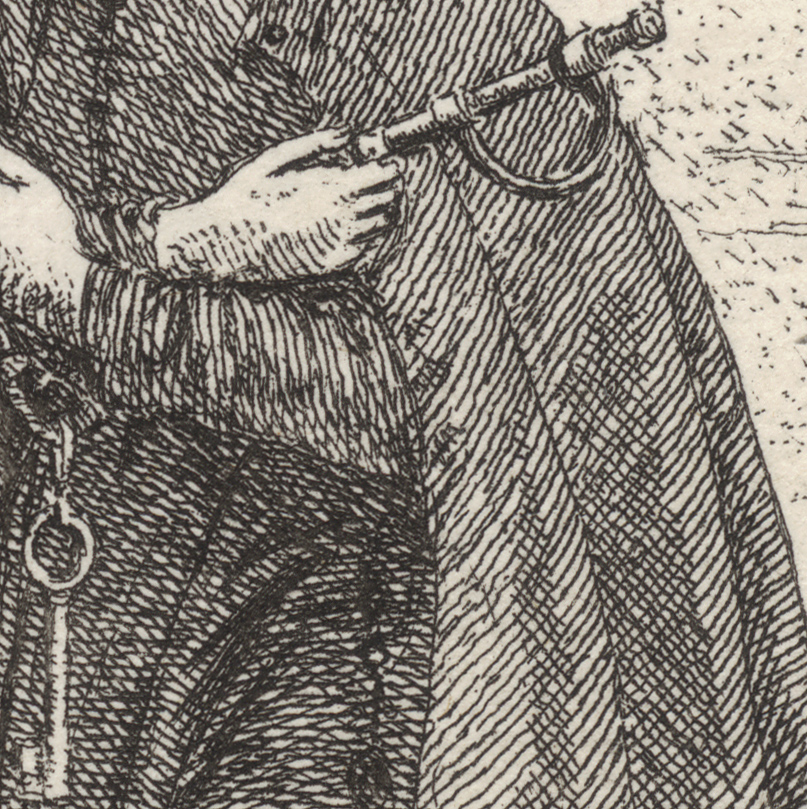
description of this print: “St Jerome Emiliani kneeling holding a key and sword/
Etching” (https://www.britishmuseum.org/collection/object/P_1907-0515-84-52).
Interestingly, a copy of this print held by
the British Museum is a part of the folio of prints by the Tiepolo family, “Opere
Varie”, acquired on behalf of the British Museum by Campbell Dodgson from a London
bookseller in 1907 for what was even then the paltry sum of £5 (actually £2 10s).
When Dodgson inquired why it was so inexpensive, the bookseller advised him: “Well,
Sir, you see it's a bad period” (see https://www.britishmuseum.org/collection/object/P_1907-0515-84-1).
Times change!
Condition: a strong and well-printed
impression, trimmed around the image borderline and laid onto a support sheet
of archival (millennium quality) washi paper. The sheet is in an excellent condition
with no tears, holes, folds, significant stains or foxing.
I am selling this very rare etching showing
the patron saint of orphans, St Gerolamo
Emiliani (1481–1537), who was canonised in 1768 by Clement XIII shortly after
this print was executed, for AU$467 (currently US$332.51/EUR312.76/GBP266.26 at
the time of posting this print) including postage and handling to anywhere in
the world, but not (of course) any import duties/taxes imposed by some
countries.
If you are interested in purchasing this small
but quietly beautiful etching—note how the artist has used stippling to “bathe”
the kneeling saint in heavenly light—please contact me
(oz_jim@printsandprinciples.com) and I will send you a PayPal invoice to make
the payment easy.
This print has been sold