Showing posts with label Baur (Johann Wilhelm). Show all posts

Saturday, 8 February 2025

Johann Wilhelm Baur, “Boreas' Abduction of Orithyia”, 1641

Johann Wilhelm Baur (aka Johann Wilhelm Bauer; Joan Guiliam Bouwer) (1607–1642)

“Boreas' Abduction of Orithyia”, 1641, plate 61 from the series of 148 illustrations to Ovid’s (43–17/18 BC) “Metamorphoses”, initially published in 1641 before the lines of Latin text were added in “Des vortrefflichen Römischen poëtens Publii Ovidii Nasonis Metamorphoseon, oder, funffzehen Bücher der Verwandlungen”. This impression is from the 1709 edition published by Pet. Detleffsen (and Jer. Wolff?) in Augsburg with the Latin text.

Note that Baur etched another plate with minor variations of the same composition, but in the reverse direction, published in 1639 in Vienna(?) as plate 61 to “Des vortrefflichen Römischen poëtens Publii Ovidii Nasonis Metamorphoseon, oder, funffzehen Bücher der Verwandlungen” (see https://archive.org/details/desvortreffliche00baur/page/n117/mode/2up).

Note also that Abraham Aubry (fl. c1650) made etchings in reverse of Bauer’s designs published by Paulus Fürst (1608–1666) in Nuremberg in 1688.

Etching on fine laid paper with a small margin around the platemark and backed with a support sheet providing wide margins.

Size: (sheet) 17.1 x 24 cm; (plate [soft]) 13.3 x 20.9 cm; (image borderline) 12.7 x 20.7 cm.

Numbered and lettered in plate below the image borderline: (left) “Wil: Baur.” (centre in two columns of two lines) “Orithyian amans Boreas & stemmate claram,/ Et specie insignem per sua regna vehit.// Hanc illi genitor bis terq[ue] negarat Erechtheus,/ Nunc ferus ereptam vendicat ipse sibi.” ([trans] Boreas, loving Orithyian, both bright in lineage and distinguished in appearance, carries her through his kingdom. Her father, Erechtheus, had denied her twice and thrice, Now the wild beast claims her for himself.); (right) “lib: 6.  61.”

State ii (of ii) with the addition of Latin text below the image borderline.

Bonnefoit R.185 (Régine Bonnefoit 1997, “Johann Wilhelm Baur (1607–1642). Ein Wegbereiter der barocken Kunst in Deutschland”, Tübingen, Ernst Wasmuth, cat. no. R 180); Hollstein 12.

See also Daniel Kinney’s marvellous documentation regarding Baurer’s series: https://ovid.lib.virginia.edu/tempestabaurnew.html.

The British Museum offers the following description of this print from its first state: “Plate 61: Boreas' Abduction of Orithyia; in the centre, Boreas, the north wind, with wings on his back and feet, carries Orithyia in the sky; Boreas looks toward Orithyia; she looks away from him; the two figures are surrounded by billowing clouds; below at left, the sea, figures, building and ships depicted in miniature; mountains beyond. 1641
Etching” (https://www.britishmuseum.org/collection/object/P_2AA-a-31-61).   

Condition: a strong and well-printed impression with a small margin (approx. 1.5 cm) around the platemark. The sheet is in an excellent condition with no tears, holes, folds, abrasions or significant stains and is laid upon a support sheet of archival (millennium quality) washi paper providing wide margins.

I am selling this superb etching from 1641, showing Perseus about to behead the Medusa, for AU$232 in total (currently/approximately US $145.55/ EUR 140.92/ GBP117.33 at the time of posting this listing) including Express Mail (EMS) postage and handling to anywhere in the world, but not (of course) any import duties/taxes imposed by some countries. Note that payment is in Australian dollars (AU $232) as this is my currency.

If you are interested in purchasing this dramatic scene from Ovid’s “Metamorphoses”, please contact me (oz_jim@printsandprinciples.com) and I will send you a PayPal invoice to make the payment easy.

This print has been sold


Wednesday, 10 July 2024

Johann Wilhelm Baur’s etching, “Perseus Kills Medusa”, 1641

Johann Wilhelm Baur (aka Johann Wilhelm Bauer; Joan Guiliam Bouwer) (1607–1642)

“Perseus Kills Medusa”, 1641, plate 46 from the series of 148 illustrations to Ovid’s (43–17/18 BC) “Metamorphoses”, initially published in 1641 before the lines of Latin text were added in “Des vortrefflichen Römischen poëtens Publii Ovidii Nasonis Metamorphoseon, oder, funffzehen Bücher der Verwandlungen”. This impression is from the 1709 edition published by Pet. Detleffsen (and Jer. Wolff?) in Augsburg with the Latin text.

Note that Baur etched another plate with minor variations of the same composition published in 1639 in Vienna(?) as plate 47 to “Des vortrefflichen Römischen poëtens Publii Ovidii Nasonis Metamorphoseon, oder, funffzehen Bücher der Verwandlungen” (see https://archive.org/details/desvortreffliche00baur/page/n89/mode/2up).

Note also that Abraham Aubry (fl. c1650) made etchings in reverse of Bauer’s designs published by Paulus Fürst (1608–1666) in Nuremberg in 1688.

Etching on fine laid paper with a small margin around the platemark and backed with a support sheet providing wide margins.

Size: (sheet) 15.4 x 22.8 cm; (plate) 13.3 x 20.8 cm; (image borderline) 12.7 x 20.6 cm.

Numbered and lettered in plate below the image borderline: (left) “Wil: Baur: In.” (left of centre) “Dum sopor altus habet metuendum crine Medusam,/ Callidus huic Perseus amputat ense caput.” ([trans] While deep slumber has the dreaded hair of Medusa, the cunning Perseus cuts off her head with his sword.); (right of centre) “Nox erat; aeq[ue] aliam magis interemisse Sororem/ Cum poterat, ratio est, prodita crine suo.” ([trans] It was night; It is reason that he killed another sister even more when he could, betrayed by his hair.); (right) “lib: 4.  46”.

State ii (of ii) with the addition of Latin text below the image borderline.

Bonnefoit R.165 (Régine Bonnefoit 1997, “Johann Wilhelm Baur (1607–1642). Ein Wegbereiter der barocken Kunst in Deutschland”, Tübingen, Ernst Wasmuth, cat. no. R 165); Hollstein 12.

See also Daniel Kinney’s marvellous documentation regarding Baurer’s series: https://ovid.lib.virginia.edu/tempestabaurnew.html.

The British Museum offers the following description of this print from its first state: “Plate 46: Perseus kills Medusa; at right, two female figures are asleep underneath a canopy in a cave, one of which is Medusa, with snakes on her head; to the left is Perseus, brandishing a sword, his right arm outstretched; in the centre, a platform with a pot from which pours forth smoke. 1641/ Etching” (https://www.britishmuseum.org/collection/object/P_2AA-a-31-46).   

Condition: a strong and well-printed impression with a small margin (approx. 1 cm) around the platemark. The sheet is in an excellent condition with no tears, holes, folds, abrasions or significant stains and is laid upon a support sheet of archival (millennium quality) washi paper providing wide margins.

I am selling this superb etching from 1641, showing Perseus about to behead the Medusa, for AU$232 in total (currently/approximately US$156.88/EUR144.69/GBP121.97 at the time of posting this listing) including Express Mail (EMS) postage and handling to anywhere in the world, but not (of course) any import duties/taxes imposed by some countries. Note that payment is in Australian dollars (AU$232) as this is my currency.

If you are interested in purchasing this dramatic scene from Ovid’s “Metamorphoses”, please contact me (oz_jim@printsandprinciples.com) and I will send you a PayPal invoice to make the payment easy.

This print has been sold


Wednesday, 21 June 2023

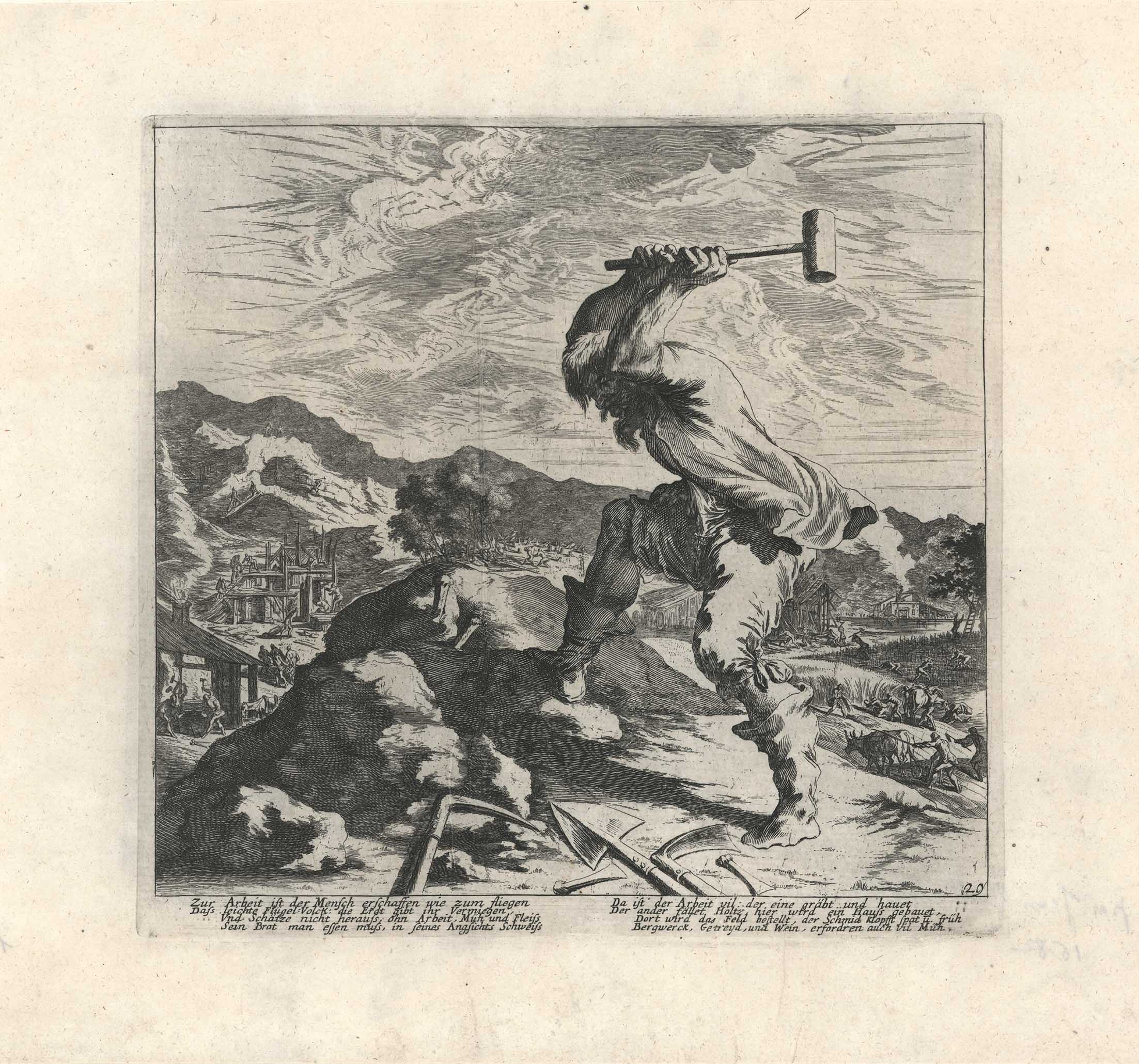
Melchior Küsel’s etching, “Allegory of Work”, 1670, after Johann Wilhelm Baur

Melchior Küsel (aka Melchior Küsell) (1626–1683)

“Allegory of Work” (aka “Personification of Labour”; “Personificatie van Arbeid”), 1670, plate 29 from the series of 149 etchings (including the title plate), “Iconographia” (aka “Joannis Guilielmi Baurn Iconographia”), after drawings by Johann Wilhelm Baur (1607–1642), published by Melchior Küsel in Augsburg.

Regarding the Baur’s drawings and Küsel’s publication of his etchings after Baur’s drawings, the Curator of the British Museum advises “Küsel had acquired a large number of drawings from the heirs of Baur (who died in 1642), and etched and published them himself. The series was a huge success and went through numerous editions between 1670 and 1702” (https://www.britishmuseum.org/collection/object/P_1911-0412-168-1-148).

Etching on fine laid paper with wide margins laid onto a support sheet.

Size: (sheet) 28.5 x 31 cm; (plate) 22 x 23.3 cm; (image borderline) 20.6 x 22.4 cm.

Numbered in plate within the image borderline: (lower right corner) “29”.

Lettered in plate in two quatrains of German: “Zur Arbeit ist der Mensch erschaffen wie zum fliegen/ Dass leichte Flügel-Volck: die Erdt gibt ihr Vergntegen,/ Vnd Schätze nicht heraus, ohn Arbeit, Müh und Fleiss/ Sein Brot man essen muss, in seines Angsichts Schweiss// …”. (Man is created for work as if to fly/ That light winged people: the earth does not give her pleasure/ And treasures, without work, toil and diligence/ One has to eat one's bread, in his face sweat// …).

Hollstein German 329 (Fedja Anzelewsky [ed.] 1977, “German Engravings, Etchings and Woodcuts c.1400–1700: Maria Magdalena Küsel to Johann Christoph Laidig”, vol. 20, Amsterdam, Van Gendt & Co, pp, 105–07, cat. no. 329).

See also the description of this print offered by the Rijksmuseum: http://hdl.handle.net/10934/RM0001.COLLECT.411843.

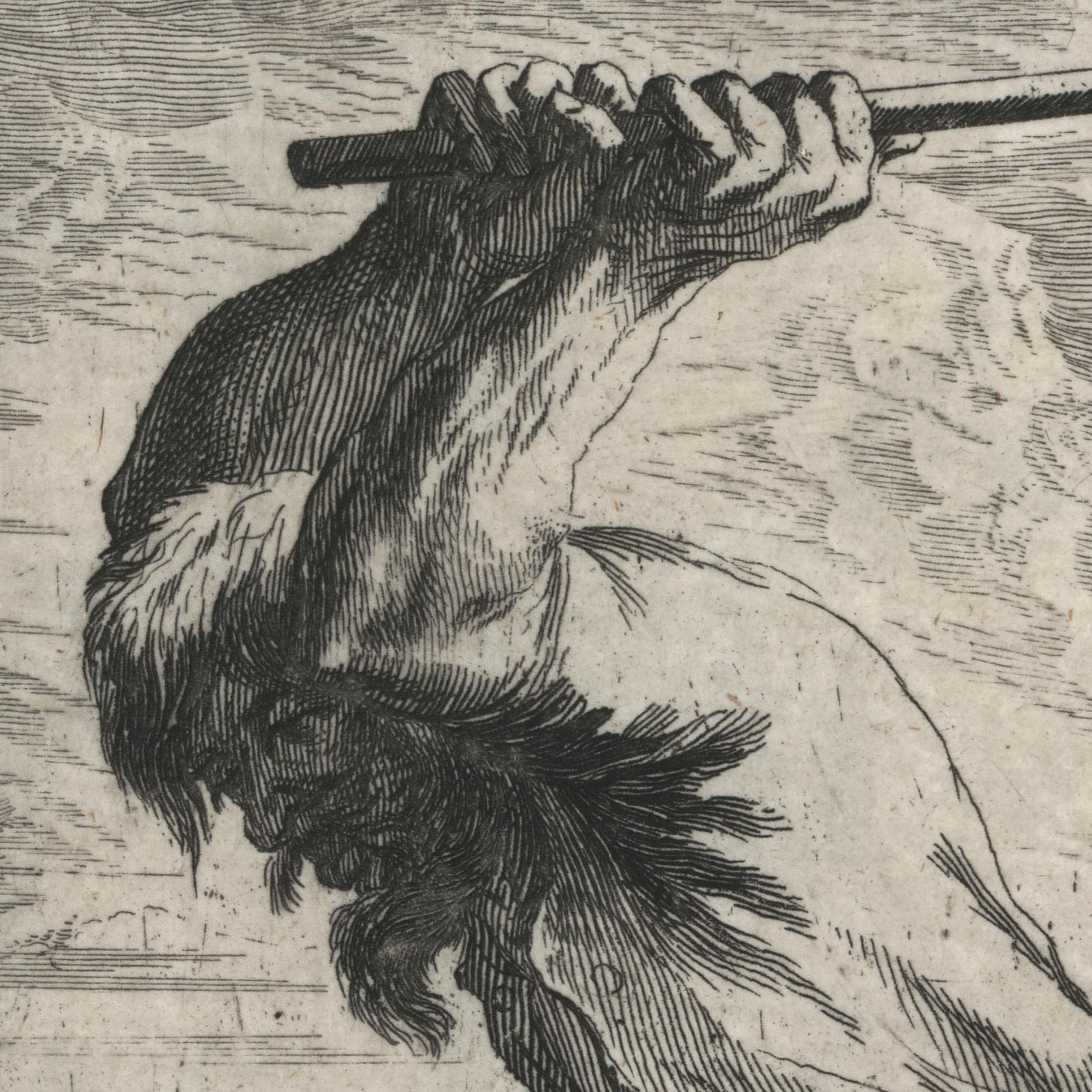
Condition: a strong and well-printed impression with a few signs of wear to the plate (viz. on the figure’s beard and pants) and a restored vertical printer’s crease at left of centre. Interestingly, an impression of this print held by the Harvard Art Museum (see https://hvrd.art/o/92516) also has a vertical printer’s crease close to the same position that it occurs in this impression (before the white printer’s crease was replenished to avoid being visually distracting). Beyond the issue of the printer’s crease, the sheet is in a good condition with no significant stains or foxing.

I am selling this marvellous image of the notion of work being personified by a muscly labourer raising his mallet with the tools of his trade laying at his feet and other workers shown in the distance—note how the clouds in the sky seem to stand as a visual analogue for the buzzing latent energy of the scene—for AU$298 (currently US$199.18/EUR180.22/GBP158.65 at the time of posting this print) including postage and handling to anywhere in the world (but not, of course, any import duties/taxes imposed by some countries).

If you are interested in purchasing this very memorable etching that (at least for me) has the strange effect of removing the idea of becoming a hard worker, please contact me (oz_jim@printsandprinciples.com) and I will send you a PayPal invoice to make the payment easy.


Sunday, 19 September 2021

Johann Wilhelm Baur’s etching, “Proserpina and Ascalaphus”, 1641

Johann Wilhelm Baur (aka Johann Wilhelm Bauer; Joan Guiliam Bouwer) (1607–1642)

Proserpina and Ascalaphus”, 1641, plate 53 from the series of 148 illustrations to Ovid’s (43–17/18 BC) “Metamorphoses”, initially published in 1641 before the lines of Latin text were added (see BM inv. no. 2AA+,a.31.53) in “Des vortrefflichen Römischen poëtens Publii Ovidii Nasonis Metamorphoseon, oder, funffzehen Bücher der Verwandlungen”. This impression is from the 1709 edition published by Pet. Detleffsen (and Jer. Wolff?) in Augsburg with the Latin text.

Note that Baur etched another plate with minor variations of the same composition published in 1639 in Vienna(?) as plate 21 to “Des vortrefflichen Römischen poëtens Publii Ovidii Nasonis Metamorphoseon, oder, funffzehen Bücher der Verwandlungen” (see https://archive.org/details/desvortreffliche00baur/page/21/mode/2up).

Interestingly, in the plate 21 version, the scene shows Nyctimene—daughter of Epopeus, King of Lesbos—who has fled into a forest after having had sex with her father and is turned into an owl as punishment by Minerva (the Goddess of Wisdom); see https://en.wikipedia.org/wiki/Nyctimene_(mythology).

Note also that Abraham Aubry (fl. c1650) made etchings in reverse of Bauer’s designs published by Paulus Fürst (1608–1666) in Nuremberg in 1688.

Etching on fine laid paper with a small margin around the platemark.

Size: (sheet) 16.8 x 24.4 cm; (plate) 13 x 20.6 cm; (image borderline) 12.4 x 20.4 cm.

Numbered and lettered in plate below the image borderline: (left) “53.” (left of centre) “Mala Ditis rapuitsepten .../... noctua dixit eris.”; (right of centre) "Diva furens; meritas .../... mala mala tulit.”; (right) “lib:5. 80// [ligature monogram of the artist] “WB”.

State ii (of ii) with the addition of Latin text below the image borderline.

Bonnefoit R.172 (Régine Bonnefoit 1997, “Johann Wilhelm Baur (1607–1642). Ein Wegbereiter der barocken Kunst in Deutschland”, Tübingen, Ernst Wasmuth, cat. no. R 172); Hollstein 12.

The British Museum offers the following description of this print from its first state:

“Plate 53: Proserpina and Ascalaphus: at right, Prosperpina, with her right arm holding the branch of a tree, looking towards an owl; at left, near the entrance to a cave, a large owl, with the legs of a man and a bird, and human hands; Ascalaphus being transformed into an owl by Prosperpina; beyond, on the walls of the cave, figures have been drawn. 1641 Etching” (https://www.britishmuseum.org/collection/object/P_2AA-a-31-53).   

Condition: a strong and well-printed impression with a small margin (approx. 2 cm) around the platemark. The sheet is in a near pristine condition with no tears, holes, folds, abrasions, losses, stains, foxing or signs of handling.

I am selling this superb etching from 1641, showing Ascalaphus—the custodian of the Orchard of Hades—turned into an owl by Demeter after disclosing that Persephone—Demeter’s daughter—had eaten pomegranate seeds in the Underworld (see https://en.wikipedia.org/wiki/Ascalaphus) , for AU$232 in total (currently US$168.63/EUR143.74/GBP122.75 at the time of posting this print) including postage and handling to anywhere in the world, but not (of course) any import duties/taxes imposed by some countries.

If you are interested in purchasing this dramatic scene from Ovid’s “Metamorphoses”, please contact me (oz_jim@printsandprinciples.com) and I will send you a PayPal invoice to make the payment easy.

This print has been sold


Wednesday, 23 June 2021

Johann Wilhelm Baur’s etching, “The Goddess of Hunger”, 1641

Johann Wilhelm Baur (aka Johann Wilhelm Bauer; Joan Guiliam Bouwer) (1607–1642)

“The Goddess of Hunger” (aka “Die Botin der Ceres vor der Göttin des Hungers” [The messenger of Ceres before the goddess of hunger]), 1641, plate 80 from the series of 148 illustrations to Ovid’s (43–17/18 BC) “Metamorphoses”, initially published in 1641 before the lines of Latin descriptive text were added (see BM inv. no. 2AA+,a.31.27) in “Des vortrefflichen Römischen poëtens Publii Ovidii Nasonis Metamorphoseon, oder, funffzehen Bücher der Verwandlungen”. This impression is from the 1709 edition published by Pet. Detleffsen (and Jer. Wolff?) in Augsburg with the Latin text.

Note that Bauer etched another plate with minor variations of the same composition published in 1639 in Vienna(?) as plate 80 to “Des vortrefflichen Römischen poëtens Publii Ovidii Nasonis Metamorphoseon, oder, funffzehen Bücher der Verwandlungen” (see https://archive.org/details/desvortreffliche00baur/page/79/mode/2up). Note also that Abraham Aubry (fl. c1650) also made etchings in reverse of Bauer’s designs published by Paulus Fürst (1608–1666) in Nuremberg in 1688.

For those who are unfamiliar with the myth of Erysichtho, the story is that he cut down a sacred tree in the grove of Ceres and as punishment, Ceres—shown here riding a fiery beast—instructs the Goddess Hunger (aka Famine)—shown as emaciated woman in the lower right—to install herself in Erysichtho’s entrails—an event shown in the scene of a bedchamber on the left with Hunger about to leap into bed with Erysichtho—so that his insatiable appetite would drive him gnaw on his body until he was completely consumed. Dreadful!

Etching on fine laid paper.

Size: (sheet) 17 x 26.1 cm; (plate) 12.8 x 20.5 cm; (image borderline) 12.3 x 20.4 cm.

Lettered in plate below the image borderline: (left) “Wil. Baür. fe:”; (centre in two columns of two lines) “Læsa Ceres volucri dimittit Oreada curru/ In Scythiam, ad mœsta sordida tecta famis.// Hanc iubet, vt rapidi fauces Erisichthonis intret,/ Illius & miseram cogat egere domum.”; (right) “lib:8- 80”.

State ii (of ii) with the addition of Latin text below the image borderline.

Bonnefoit R.199 (Régine Bonnefoit 1997, “Johann Wilhelm Baur (1607–1642). Ein Wegbereiter der barocken Kunst in Deutschland”, Tübingen, Ernst Wasmuth, p. 162, cat. no. R 199); Hollstein 12.ii.

The British Museum offers a description of this print from its first state: (https://www.britishmuseum.org/collection/object/P_2AA-a-31-80).   

Condition: a strong and well-printed impression with a substantial margin around the platemark. The sheet is in an excellent condition with no tears, holes, folds, abrasions, losses, stains, foxing or signs of handling.

I am selling this superb etching from 1641, showing Ceres riding a fiery monster and giving instructions to the Goddess Hunger, for AU$232 in total (currently US$175.18/EUR146.68/GBP125.33 at the time of posting this print) including postage and handling to anywhere in the world, but not (of course) any import duties/taxes imposed by some countries.

If you are interested in purchasing this dramatic scene from Ovid’s “Metamorphoses”, please contact me (oz_jim@printsandprinciples.com) and I will send you a PayPal invoice to make the payment easy.

This print has been sold