Showing posts with label Visscher I (Nicolaes). Show all posts

Sunday, 14 August 2022

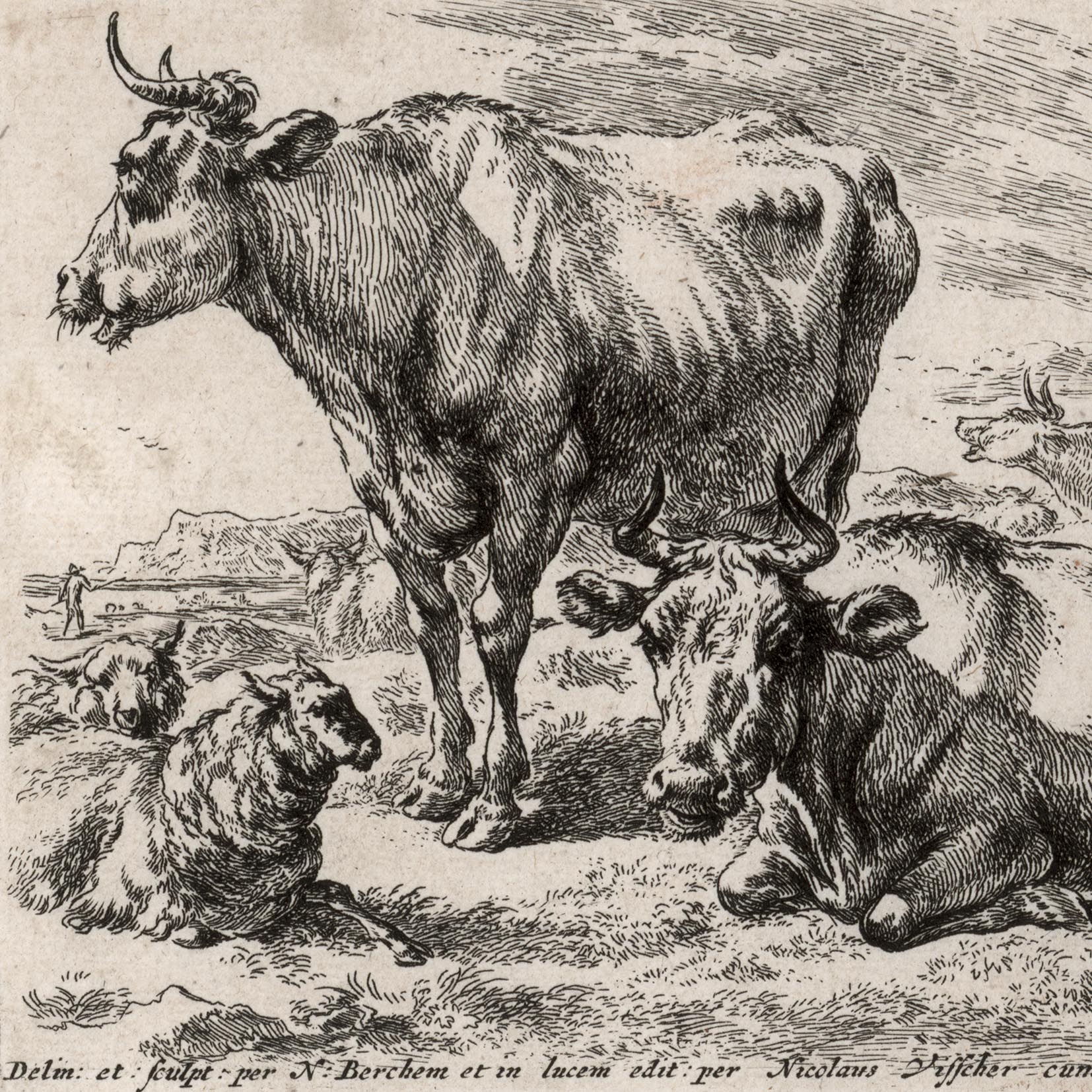
Nicolaes Berchem’s etching, “Cows”, c1679

Nicolaes Berchem (aka Nicolaes Pietersz. Berchem; Nicolaes Berchen; Niclas Berghem; Claes Berighem; Nicolaes Pietersz.Berrighem) (1624–1683)

“Cows” (aka “Les vâches” [Bartsch title]; “Staande en liggende koe met schapen en koe die gemolken wordt” [Rijksmuseum title]; “Standing and lying cow with sheep and cow being milked”), c1679 (based on the life dates of the publisher), plate 1 from a series of six plates showing various animals, “Dieren”, published by Nicolaes Visscher I (aka Claes Claesz Visscher; Nicolaas Visscher) (1618–1679) with privilege by the States General (Belgium Federation).

Etching on fine laid paper with a small margin around the platemark.

Size: (sheet) 13.1 x 18.4 cm: (plate) 12.2 x 17.3 cm.

Lettered in plate along the lower edge: “Delin: et: Sculpt: per N: Berchem et in lucem edit: per Nicolaus Visscher cum Privil: Ordin. general: Belgii Fæderat./ 1”.

State iii (of iii) with the addition of the artist’s name and publication details.

TIB 7(5).13(264) (Otto Naumann 1978, “The Illustrated Bartsch: Netherlandish Artists”, vol. 7, New York, Abaris Books, p. 59, cat. no. 13 [ 264]); Hollstein 13.

The British Museum offers the following description of this print: “A standing cow seen almost in profile with body facing left and a resting cow seen from the front with head turned to the right, surrounded by sheep and other cows; from a series of six prints showing different animals” (https://www.britishmuseum.org/collection/object/P_Sheepshanks-3867).

See also the description of this print offered by the Rijksmuseum: http://hdl.handle.net/10934/RM0001.COLLECT.38015.

For those interested in the origins of names, I have always believed the old story that Nicholaes Berchem had acquired his name from the cries of his mates who yelled, “Berg hem! Berg hem!” (Save him! Save him!), when Nicolaes was trying to escape the wrath and a beating from his father—the famous still-life painter, Pieter Claesz. Although I still love this story, the truth may be much less colourful, as Michael Prodger (2020) explains: “Berchem is the name of his father’s home town” (see “The greats outdoors: How Nicolaes Berchem offered vistas of a golden Arcadia …” [https://www.newstatesman.com/uncategorized/2020/05/greats-outdoors-how-nicolaes-berchem-offered-vistas-golden-arcadia]).

Condition: a richly inked and well-printed (near faultless) impression with a small margin (approx. 5mm) around the platemark. The sheet is in a museum quality (near pristine) condition with no tears, holes, folds, abrasions, significant stains or foxing.

I am selling this truly superb impression by one of the best known of the Dutch Golden Age artists of pastoral scenes, for the total cost of AU$278 (currently US$198.06/EUR193.09/GBP163.17 at the time of posting this listing) including postage and handling to anywhere in the world, but not (of course) any import duties/taxes imposed by some countries.

If you are interested in purchasing this sensitively executed and subtly animated etching—note the marvellous way that Berchem has captured the cow on the left chewing its cud and the cow in the distance happily mooing—please contact me (oz_jim@printsandprinciples.com) and I will send you a PayPal invoice to make the payment easy.

This print has been sold 


Wednesday, 3 March 2021

Jacques de Gheyn II’s engraving, “Daniel in the Lions' Den”, c1652, after Dirck Barendsz.

Jacques de Gheyn II (aka Jacob de Gheyn; Jacob de Geyn) (1565–1629)

“Daniel in the Lions' Den”, c1652, after the design by Dirck Barendsz. (aka Dirk Barentsz.; Dirk Barendsz.; Theodore Bernards Barentsz.; Theodor Amsterodamus Bernard) (1534–1592), from the series of 131 engravings (including the title plate), “Historiae Sacrae Veteris et Novi Testamenti” (aka “Royal-Size Bible”), published by Claes Jansz. Visscher (aka Nicolaes Jansz Visscher; Piscator) (1587–1652) and his son, Nicolaes Visscher I (aka Claes Claesz Visscher) (1618–1679) in Amsterdam. Note: The Curator of the British Museum advises that the publication of the series was “originally started by Claes Jansz Visscher and published by his son Nicolaes after his father's death in 1652” (see BM inv. no. 1939,0130.1.1).

Engraving on laid paper trimmed around the image borderline and the text lines, and slightly within the borderline at the upper edge, backed with a support sheet.

Size: (sheet) 27.5 x 35.7 cm.

Inscribed on plate within the image borderline: (lower left) “Theodorus Berna. Inue./ [ligature monogram] IDGeyn. Scup.”

Lettered on plate in two columns of two lines of Latin text below the image borderline: (left) “Bis funt obiectus (res mira) Leonibus. Idem/ Seruatus DANIEL tot fuit et vicibus:// Corpora bina licet danata darentur ad escam/ Quotidie. et tot oues. Turba perercit ej. [ligature letters] HiR”.

Inscribed on plate below the image borderline: (right) “[ligature monogram] CIVisscher excudit."

State ii (of ii) with the change of publisher from Joos de Bosscher to Claes Jansz. Visscher (see state i impression held by the Rijksmuseum: http://hdl.handle.net/10934/RM0001.COLLECT.446392).

New Hollstein Dutch 25-2(2) (Jan Piet Filedt Kok [comp.] 2000, “The New Hollstein: Dutch and Flemish Etchings, Engravings and Woodcuts 1450–1700: The De Gheyn Family”, part I, Rotterdam, Rijksmuseum Sound and Vision, p. 60 [illus.], 61, cat. no. 25-2[2]).

The British Museum offers the following description of this print:

Daniel in the Lions' Den; Daniel sitting in a rocky cave with a barred grill behind to right, one hand at his breast, looking and throwing out his other arm to left, surrounded by lions, with one sitting under his right foot; second state with address of Visscher; after Dirck Barendsz” (https://www.britishmuseum.org/collection/object/P_1939-0130-1-62).

See also the following references offered by the BM: P. van der Coelen, “Something for Everyone? The Marketing of Old Testament Prints in Holland's Golden Age”, in P. van der Coelen (ed.), “Patriarchs, angels and prophets: The Old Testament in Netherlandish Printmaking from Lucas van Leyden to Rembrandt”, exh.cat. Museum Het Rembrandthuis, Amsterdam, 1997, pp.37-61 (esp. pp.44–46); M. Leesberg, “New Hollstein: Karel van Mander”, 1999, pp. xlii–xliii and n.136; J. van der Waals, “Bijbelse Historien in prent: Nicolaes Visschers royaalbijbel”, in “Prenten in de Gouden Eeuw: van kunst tot kastpapier”, exh.cat. Museum Boijmans Van Beuningen, Rotterdam, 2006, pp.161-167 (see https://www.britishmuseum.org/collection/object/P_1939-0130-1-1).

Condition: a strong impression trimmed along the image borderline and slightly within the border at the upper edge. The sheet has a closed tear at lower centre on the publication centre-fold line, a few dot stains and there are other minor restored tears and abrasions that have been addressed by the sheet having been laid onto a sheet of archival (millennium quality) washi paper.

I am selling this important engraving by Jacques de Gheyn II showing a theatrically inventive way of portraying Daniel in “his” den without an obscuring front wall—note also the angel, Habakkuk, in the sky at upper-left whose mission it is to bring Daniel food (please don’t ask me about the long bearded chap that the angel is with as it doesn’t look like a transcendent short bearded Daniel)—for the total cost of AU$639 (currently US$500.51/EUR413.47/GBP358.12 at the time of this listing) including Express Mail (EMS) postage and handling to anywhere in the world, but not (of course) any import duties/taxes imposed by some countries.

If you are interested in purchasing this masterwork of engraving, please contact me (oz_jim@printsandprinciples.com) and I will send you a PayPal invoice to make the payment easy.

This print has been sold 


Tuesday, 11 June 2019

Jan Collaert's engraving, “Saul Commits Suicide”, 1579


Jan Collaert II (aka Hans Collaert II) (c1561–c1620) (BM attribution); or
Jan Collaert I (aka Hans Collaert I) (Rijksmuseum attribution)

“Saul Commits Suicide”, 1579, from the series of four plates, “The Story of David and Saul” (aka “Theatrum Biblicum Hoc Est Historiae Sacrae Veteris et Novi Testamenti Tabulis Aeneis Expressae”), after Ambrosius Francken I (aka Ambrosius Vrancx) (c1544–1618), originally published by Gerard de Jode (aka Geeraert de Jode; Geerart de Jode; Gheerde de Jode; Girard de Jode; Gerardo de Jode; Gheraerde de Jode) (1516/17–1591). This impression is from the Nicolaes Visscher II (aka Nicolaas Visscher; Claes Claesz Visscher; Nicolai Vischer) (1649–1702) edition (1643) published in Amsterdam.

Engraving on fine laid paper backed with a support sheet and with a faded hand-written remark in brown ink below the platemark.
Size: (sheet) 26.8 x 33 cm; (plate) 21.1 x 30 cm; (image borderline) 21 x 29.8 cm.
Lettered in a single line of Latin below the image borderline: “Pugnatur, fugiunt, proprio, cadit ense Tyrannus, Atque peregrinis dat sua tela Deis. 1.Reg. 31. 8”.
State iii (of iii) with the capitalisation of “Deis” and the addition of the number “8”.
New Hollstein (Dutch & Flemish) 47.III (The Collaert Dynasty); Mielke 20.

The British Museum offers the following description of this print:
“Saul and his armour-bearer kill themselves with their swords. Saul seen dead on the ground, run through by his own sword; his armour-bearer seen to right, falling on his sword; a shield, decorated with a head of a Medusa, seen in the foreground; behind, the Philistines fighting against the Israelites; Saul and his armour-bearer seen escaping to left; after Ambrosius Francken. 1579”

See also the description offered by the Rijksmuseum:

Condition: crisp and well-printed impression with no sign of wear to the printing plate, backed with a support sheet of fine archival/millennium quality washi paper. The engraving has reasonably wide margins (1.7 cm on the sides; 4 cms at the top; 1.9 on the bottom) and the sheet is in excellent condition (i.e. there are no tears, holes, creases, significant stains or foxing) with an antique hand-written report in faded brown ink below the printed text line.

I am selling this eye-catching and very rare engraving showing Saul’s companion (an armour-bearer) committing suicide by falling on his sword while the battle of Giboa between the Philistines and the Israelites rages in the distance, for the total cost of AU$278 (currently US$193.38/EUR170.85/GBP152.08) including postage and handling to anywhere in the world (but not, of course, any import duties/taxes imposed by some countries).

If you are interested in purchasing this illustration to the Old Testament with multiple narratives—note Saul and his armour-bearer in the middle-distance at left fleeing the Philistines before later committing suicide as shown in the foreground—please contact me (oz_jim@printsandprinciples.com) and I will send you a PayPal invoice to make the payment easy.

This print has been sold


For those interested in the verses from the Old Testament that this engraving illustrates, see the following NIV translation of the relevant passage (1 Samuel 31):

1 Now the Philistines fought against Israel; the Israelites fled before them, and many fell dead on Mount Gilboa.
2 The Philistines were in hot pursuit of Saul and his sons, and they killed his sons Jonathan, Abinadab and Malki-Shua.
3 The fighting grew fierce around Saul, and when the archers overtook him, they wounded him critically.
4 Saul said to his armor-bearer, “Draw your sword and run me through, or these uncircumcised fellows will come and run me through and abuse me.” But his armor-bearer was terrified and would not do it; so Saul took his own sword and fell on it.
5 When the armor-bearer saw that Saul was dead, he too fell on his sword and died with him.
6 So Saul and his three sons and his armor-bearer and all his men died together that same day.


Monday, 6 August 2018

Jan van Londerseel’s engraving, “Judah and Tamar”, c1600


Jan van Londerseel (aka Johannes van Londerseel) (1578–c1625) (according to the BM or an anonymous printmaker according to the Rijksmuseum)

“Judah and Tamar”, 1590–1625, after a print by Nicolaas de Bruyn (aka Nicolaas de Bruin; Nicolaes de Bruyn) (1571–1656), after the design by Maarten de Vos (aka Marten de Vos; Maerten de Vos) (1532–1603), after Gillis van Coninxloo (aka Egidius Coninxlogensis; Gillis van Coningsloo) (1544–1607), plate 23 from the series of 131 engraved illustrations (including the title page) to the “Royal-Size Bible” (aka Historiae Sacrae Veteris et Novi Testamenti; Biblische figuren, Darinen die fürnembste historien, in heiliger Schrifft begriffen, geschichtmässig entworffen; Figures de la Bible, demonstrans les principales histoires de la Saincte Escriture; Bybelsche figuren, vertonende de voornaemste historien der Heylige Schrifture; Figures of the Bible, in wich almost every history of the Holy Scriptures is described), published by Nicolaes Visscher I (aka Nicolaas Visscher; Claes Claesz Visscher) (1618–1679) and Claes Jansz. Visscher (aka Piscator; Nicolaes Jansz Visscher) (1587–1652) in Amsterdam.

Engraving on laid paper with red ink lines marking upper and lower borders and a centerfold (as published), trimmed near the image borderline and backed with a support sheet.
Size: (sheet) 39 x 52.5 cm; (image borderline) 36.6 x 52.3 cm
Inscribed on plate within the image borderline: (lower left) "Egidius Coningsloo inven. CIViβcher Excu."
Lettered in Latin text on plate below the image borderline:  "IUDAS ET THAMAR COEUNT PROMITTITUR HOEDUS   ANNULUS, ARMILLÆ, ATQUE PEDUM PRO PIGNORE DANTUR. Genesis 38.6."

Hollstein 10 (Londerseel); Hollstein 21 (after Gilles van Coninxloo); Hollstein undescribed (Visscher)

The British Museum offers the following description of this print:
“Judah and Tamar [Genesis 38:6]; woody landscape with an elderly man embracing a younger woman in lower left, the woman holding a ring and looking at it, a castle surrounded by a moat at centre, mountains and a cascading river in background; after Gillis van Coninxloo; from a series of 130 engravings (plus title-page) forming a Picture Bible”
See also the description of this print at the Rijksmuseum:

Condition: a near faultless early impression (based on the crisp lines and lack of wear to the plate), richly inked and well-printed, trimmed close to the image borderline and backed with a support sheet of archival (millennium quality) washi paper. There are ruled red ink lines bordering the image at the top and lower edges. Otherwise the sheet is in near pristine condition (i.e. there are no tears, holes, folds—apart from the flattened centrefold of publication—abrasions, stains, foxing or signs of use).

I am selling this huge engraving showing not only the shocking liaison between a father-in-law and his daughter-in-law who he has mistaken for a whore, but also a sublime landscape designed by the brother-in-law of Pieter Brueghel the Younger, for AU$405 in total (currently US$299.05/EUR259.01/GBP231.37 at the time of posting this listing) including postage and handling to anywhere in the world (but not, of course, any import duties/taxes imposed by some countries).

If you are interested in purchasing this masterpiece from the late 1500s/early 1600s, please contact me (oz_jim@printsandprinciples.com) and I will send you a PayPal invoice to make the payment easy.

This print has been sold


I have previously listed an illustration of the story for Judah and Tamar executed by Harmen Jansz. Muller, but for those who may have missed the account of what is portrayed in this scene I will give a VERY brief explanation: the chap in the foreground is Tamar and he has mistaken his daughter-in-law, Judah, for a prostitute. He is shown here engaged in the act of purchasing her services by offering her his signet ring which she examining along with his staff which she holds. These items along with bracelets (which the artist has failed to portray) are collateral for a goat which she is later to receive as advised in the Latin text beneath the image: (transl.) “… rings, bracelets, and crook given as collateral. Genesis 38.6”

The publication of this engraving in the “Royal-Size Bible” is rather complicated and so I will leave the explanation to the account offered by the British Museum:

“… a series of 130 engravings known as the 'Royal-Size Bible'. It contains 65 biblical scenes from the Old Testament and 65 biblical scenes from the New Testament; the project was originally started by Claes Jansz Visscher and published by his son Nicolaes after his father's death in 1652. Some prints have the address of Claes Jansz Visscher and others have the address of Nicolaes Visscher, meaning the elder Visscher might have published some plates separately before. The prints are printed on royal size paper (roughly 400 mm by 500 mm), folded vertically and inserted on tabs, bound together in a blindstamped vellum cover. The prints are made by and after various artists. Most of the prints were taken from earlier print series and selected by Visscher to make up a new set and create this Picture Bible, others seem specially made for Visschers' Picture Bible by an unidentified printmaker. Some of the plates were engraved by Pieter Nolpe and Johannes van Londerseel. Many compositions from the 'Theatrum Biblicum' (another Picture Bible published by Claes Jansz Visscher) were copied, transferred to the royal format, as were inventions of artists such as David Vinckboons, Maerten de Vos, Gillis van Coninxloo, Melchior d'Hondecoeter, Peter Paul Rubens, Abraham van Diepenbeeck and Nicolaas de Bruyn.”

The Rijksmuseum also gives an account of the publication details:


Saturday, 3 March 2018

Engraving in reverse after Lucas Vorsterman published by Claes Jansz. Visscher, c1650


Unidentified engraver from the circle of Lucas Vorsterman I (1595–1675)

“Lot (aka Loth) and his family leaving Sodom”, c1650 (Rijksmuseum attribution: 1630–1652 and/or 1630–1702), in reverse after the engraving of the same name by Lucas Vorsterman I (aka Lucas Aemilius Vorsterman) (1595–1675) (see my previous post) based on a chalk drawing by Anthony van Dyck (1599–1641) in the Musée du Louvre, Paris (inv. 20.314), after the painting of the same name (c1613–15) by Peter Paul Rubens (1577–1640) in the collection of The John and Mable Ringling Museum of Art, Sarasota, Florida (Rooses 102; see: http://emuseum.ringling.org/emuseum/objects/21966/the-flight-of-lot-and-his-family-from-sodom), published by Claes Jansz. Visscher II (aka Piscator; Nicolaes Jansz Visscher) (1587–1652) and Nicolaes Visscher I (aka Nicolaas Visscher; Claes Claesz Visscher) (1618–1679) with Nicolaes Visscher II (aka Nicolaas Visscher; Claes Claesz Visscher; Nicolai Vischer) (1649–1702).

Engraving on laid paper trimmed unevenly close to the plate mark and lined with a heavy wove paper support sheet.
Size: (sheet trimmed unevenly) 41 x 51.7 cm; (image borderline) 37 x 51.3 cm
Inscribed on plate within the image borderline along the lower edge: (centre) "P P Rubens invent."; (right of centre) "CIVißcher Excudit."
Lettered below the image borderline with biblical verse in Latin and four columns containing four lines of Dutch verse: "[I]gne et sulphure...statuam vertitur. Gene.19.15." and "Hoe hangt des mensche hert.../...stanck en [roock]".

Hollstein 1 (Vorsterman; copy a); Schneevoogt 1873 2.10; Hollstein undescribed (Visscher)

The Rijksmuseum offers the following description of this print:
“Lot leaves Sodom with his wife and his daughters. Two angels accompany them and show them the way. Under the [image] the title in Latin, four four-line verses in Dutch and a reference to the Bible text in Gen. 19:15.”


Condition: an excellent impression but with numerous condition issues: the sheet has restored losses to the upper left and the two lower corners; there is a flattened fold at centre; there is scattered minor staining; the sheet is trimmed unevenly with chips and tears along the edges (these are addressed by the support sheet); there are abrasions.

I am selling this large engraving in reverse of Vorsterman’s engraving of the same composition for AU$283 (currently US$219.77/EUR249.58/GBP159.22 at the time of posting this listing). Postage for this print is extra and will be the actual/true cost of shipping.

If you are interested in purchasing this beautifully executed engraving—see for example the skill of the engraver to connote the reflective shine of silk and satin, the rigidity and sheen of the angel’s wings, especially in contrast with the suggested softness of angel’s arms—please contact me (oz_jim@printsandprinciples.com) and I will send you a PayPal invoice to make the payment easy.
 This print has been sold


Regarding this print the curator of the Rijksmuseum offers the following explanation about its publication (with possible translation mistakes):

“The Amsterdam publisher Claes Jansz. Visscher (II) produced large biblical prints on so-called generous format paper (approx. 480 x 580 mm) from the [1630s] onwards. After his death in 1652 his son Nicolaes Visscher (I) continued the business and so also the publication of generous Bible prints. When Nicolaes died in 1679, his son Nicolaes Visscher (II) took over the company … Complete picture books in generous format were published by father and son Nicolaes Visscher under the title ‘Historiae Sacrae Veteris et Novi Testamenti.’ The magazines were also sold separately and could be combined with generous Bible prints from other publishers. Several Amsterdam publishers also published Bible prints in a generous format, including Clement de Jonghe and Cornelis Danckerts. The prints produced by the Visscher company were mostly made by anonymous printmakers, following an example of various sixteenth- and seventeenth-century biblical prints and print series. Often the compositions had to be adapted to the larger and elongated generous format. In addition, there are also large magazines by famous printmakers such as Jan van Londerseel, Pieter Nolpe, Jacques de Gheyn (II) and Jan Harmensz. Muller included in the category ‘Bybelsche Figures, on Royaal sheets’ in the Visscher [publication] list. [This print] possibly used in: ‘Historiae Sacrae Veteris et Novi Testamenti’ (Royal Bible).” (https://www.rijksmuseum.nl/nl/collectie/RP-P-1908-3784