Showing posts with label Millet (Jean-Francois). Show all posts

Friday, 9 January 2026

Jean François Millet, “Woman Churning Butter”, 1855

Jean François Millet (1814–1875)
“Woman Churning Butter” (also known as “La Baratteuse” and “Woman Churning”), 1855

Technical Details & Condition:

Etching, with touches of drypoint, printed in rich brown ink on buff laid paper. It is from the third and final state, featuring the scratch inscribed address of the printer, Auguste Delâtre (also known as Auguste Marie Delâtre) (1822–1907). The impression is strong and well-printed, though the printer’s address appears faint. The sheet has small margins (approximately 1 cm) with minor age-toning along the edges. There are remnants of mounting on the verso. Overall, it is in very good condition, free from tears, holes, folds, abrasions, or significant stains.

Dimensions:

• Sheet: 19.6 x 13.8 cm
• Platemark: 17.9 x 11.8 cm

Plate Lettering:

• Along the lower edge (faint and partially lost): “Impe par Aug. [Delâtre] Rue St Jacque 171” 

References:

• Melot M 10 S3 (Michel Melot, Graphic Art of the Pre-Impressionists, 1978, New York, Harry N. Abrams, p. 289, cat. no. M 10)
• The British Museum describes this print as: “Peasant woman churning vat's contents, in barn, cat at her feet. 1855 / Etching, with touches of drypoint” (https://www.britishmuseum.org/collection/object/P_1865-1209-798)

Price & Shipping:

AU$1164 (approximately US$778.07 / €667.74 / £579.27), inclusive of worldwide express shipping. Please note that import duties and taxes are the buyer’s responsibility.

If you are interested in acquiring this quietly beautiful etching by one of the most renowned French artists of the nineteenth century, please contact me at oz_jim@printsandprinciples.com. I will be happy to provide a PayPal invoice for a smooth and secure transaction.

This print has been sold


Monday, 26 February 2024

Armand Gautier’s etching, “Work: Man Sawing Wood”, 1860

Armand Gautier (aka Armand Désiré Gautier) (1825–1894)—a close friend of  Gustave Courbet (1819–1877) and a student of Léon Cogniet (1794–1880)

“Work: Man Sawing Wood” (aka “Le Travail: Homme Sciant du Bois”), 1860, printed in 1864, possibly published by Alfred Cadart (1828-1875) in “Cahier d'eaux-fortes” (based on this print being listed by Beraldi [1887] with this heading [vol. 6, p. 239).

Note that Armand Gautier made a related etching, “Le Travail”, showing a woman at work in a laundry, published by Cadart in “Catalogue complet d'eaux-fortes originales et inédites composées et gravées par les artistes eux-mêmes...” (1873–1876)  (see https://gallica.bnf.fr/ark:/12148/btv1b8470159z/f51.item).

Etching with pale plate tone on wove paper.

Size: (sheet) 20 x 17.9 cm; (plate) 12 x 10.1 cm.

Inscribed in plate at lower left: “A Gautier 1860”.

Beraldi 2 (Henri Beraldi 1887, “Les Graveurs du XIXe Siècle: DORÉ - GAVARD”, vol. 6, Paris, Librairie L. Conquet, p. 249, cat. no. 2 [Cahier d'eaux-fortes (Cadart)])

Musée des beaux-arts du Canada offers a description of this print: https://www.beaux-arts.ca/collection/artwork/le-travail-homme-sciant-du-bois.

Condition: a well-printed impression with minor marks in the margin, otherwise the sheet is in an excellent condition with no tears, holes, folds, abrasions or significant stains.

I am selling this interesting etching showing a timber worker using what must be a back-breaking, but no doubt effective way, to saw logs single handed, for the total price of AU$234 (currently US$153.27/EUR141.22/GBP120.85 at the time of posting this listing) including Express Mail (EMS) postage and handling to anywhere in the world, but not (of course) any import duties/taxes imposed by some countries.

If you are interested in purchasing this seldom seen etching on the art-market with the (to my eyes) nobility of Jean François Millet’s etchings of farm-workers (compare, for instance, with Millet’s etching, “Peasant with a Wheelbarrow”, 1855 (https://www.printsandprinciples.com/2022/07/jean-francois-millets-etching-peasant.html), please contact me (oz_jim@printsandprinciples.com) and I will send you a PayPal invoice to make the payment easy.


Saturday, 10 February 2024

Harry Carmean’s chalk drawing, “Figure Study after Millet”, 1988

Harry Carmean 1922–2022)

“Figure Study after Millet”, 1988 (note that this drawing is inscribed with the date, “[19]68”, but the artist’s wife, Miriam Slater, advises that it “was actually done in 1988” and confirms this adding “—I know, I was there”), a drawing executed in a blue-green (emerald) coloured chalk on grey-blue (acid-free) Canson paper, signed and dated, “68”, with the name of the artist referenced in the study, “Millet” (Jean François Millet [1814–1875]).

© reproduced with kind permission of Harry Carmean

Size: (sheet) 65 x 50 cm.

This rapidly executed drawing by a true master (as may be seen by the unhesitating confidence of the strokes and the profound understanding of anatomy displayed) is a marvellous example showing Carmean’s use of Millet’s principle of using straight lines to create the illusion of curves. For me this drawing is simply marvellous as it clarifies what my father taught me at an early age when he was carving ornamental flourishes on the furniture he made. He pointed out to me that to avoid making “S”-shaped curves that lacked tension (i.e. that looked “flappy”), great artists base their curves on a foundation of straight lines. This was to become a very important principle to me.

Condition: beyond age-toning (fading) at the outer edges, the sheet is in an excellent condition for its age with no tears, holes, abrasions, significant stains or foxing.

I am selling this insightfully executed study by a great modern-day master after Millet—a drawing that needs a worthy home— AU$239 (currently US$155.97/EUR144.59/GBP123.52 at the time of posting this listing) including postage and handling to anywhere in the world.

If you are interested in purchasing this drawing by an acknowledged master draughtsman (see “Drawings of Harry Carmean” [ISBN 10: 087505210X]; and the monograph on the artist, “Carmean” [1974]), please contact me (oz_jim@printsandprinciples.com) and I will send you a PayPal invoice to make the payment easy.


Friday, 9 February 2024

Charles Courtry’s etching with drypoint, “Les Glaneuses”, 1876, after Millet

Charles Courtry (aka Charles Jean Louis Courtry) (1846–1897)

“Les Glaneuses” (Beraldi title) (aka “The Gleaners”), 1876, after Jean François Millet (1814–1875), plate 54 from the series, “Album Boetzel”.

Etching and drypoint with pale plate tone on fine laid paper.

Size: (sheet) 27.8 x 18.8 cm; (plate [faint]) 21.5 x 16.6 cm; (image borderline) 18.1 x 14.1 cm.

Numbered in plate above the image borderline: (right) “54”.

Inscribed in plate below the image borderline: (left) “J F MILLET Pinx”; (right) “CH. COURTRY. SC.”

Beraldi 23 (Henri Beraldi 1886, “Les Graveurs du XIXe Siècle: Cherrier–Dien”, vol. 5, Paris, Librairie L. Conquet, p. 63, cat. no. 23); IFF 75 (Inventaire du Fonds Français: Bibliothèque Nationale, Département des Estampes).

The British Museum offers the following description of this print: “The gleaners, after Millet; two peasant women picking up the grain in the foreground, another standing at right, men loading a cart with hay in the background; plate No 54 in the Album Boetzel year 6, 1876” (https://www.britishmuseum.org/collection/object/P_1876-1111-564).

What I find interesting about Courtry’s adaptation of Millet’s famous etching, “The Gleaners”, c.1855–56 (see https://www.metmuseum.org/art/collection/search/370558), is not just the change in the portrayed spatial depth, with the haystacks in Coutry’s etching having been moved forward, but that Courtry has also captured one of the truly subtle attributes of Millet’s approach to drawing. By this I mean that instead of creating flowing curves when drawing outlines and laying down hatching strokes, Courtry, like Millet, creates the illusion of curves out of a sequence of straight lines. To me this is a hallmark of a great artist who understands that the visual strength in a curve is underpinned by straight lines.

Condition: a richly inked and well-printed impression. Beyond a few marks at upper left (recto) and a stain at upper right (verso), the sheet is in an excellent condition with no tears, holes, folds, abrasions or significant stains.

I am selling this very strong etching after Millet’s famous, even iconic, etching, “The Gleaners” (c.1855–56), for the total cost of AU$239 (currently US$155.97/EUR144.59/GBP123.52 at the time of posting this listing) including postage and handling to anywhere in the world.

If you are interested in purchasing this superb etching (with drypoint), please contact me (oz_jim@printsandprinciples.com) and I will send you a PayPal invoice to make the payment easy.


Monday, 25 December 2023

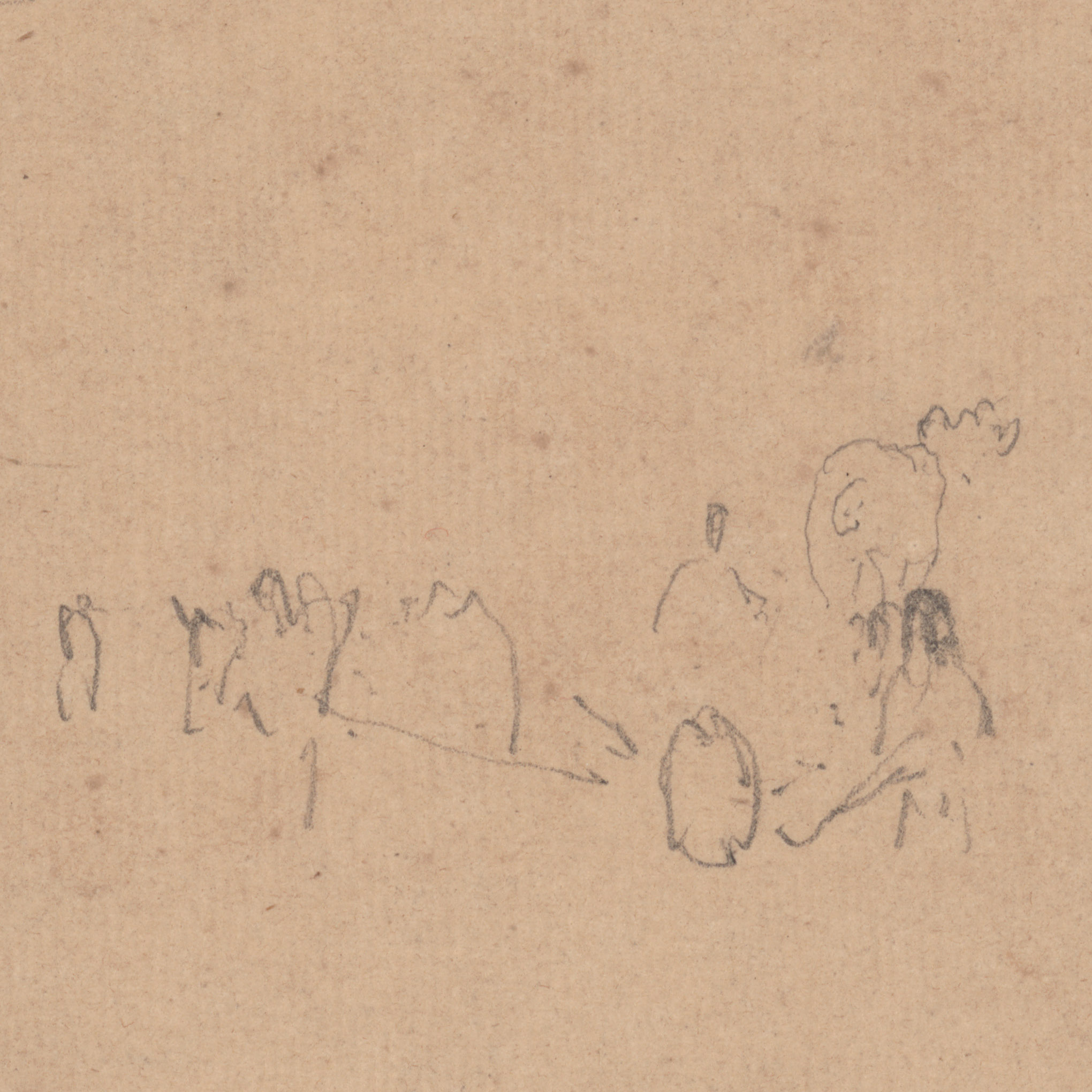
Jean-Baptiste Millet’s pencil studies, “Ploughing Scenes”, c.1870

Jean-Baptiste Millet (1831–1906)—brother and pupil of Jean-François Millet (1814-1875)  

“Ploughing Scenes” (descriptive title only), c.1870/late 1800s, eight (?) seemingly rapid pencil studies executed on the same page, signed by the artist (compare with https://www.impressionism.nl/millet-jean-baptiste/#pgcSgb-cl2-1_cl2_10020) at lower left: “Millet/ J.-B.”.

Pencil on buff coloured laid paper (watermark “LP”), with loss of the upper-right corner of the sheet.

Size: (sheet) 16.5 x 26.4 cm.

Providence: 2008, Dominique Weitz Gallery (Paris); prior to 2008, through the estate of a descendant of Henri Rouart (information supplied by Dominique Weitz)—note that Henri Rouart was an instrumental figure in arranging the exhibition of two of Jean-Baptiste Millet’s works in the Salon of 1875 (see the blog post: “Jean-Baptiste Millet, the unknown brother” (https://www.impressionism.nl/millet-jean-baptiste/).

Note that Jean-Baptiste Millet made several prints following the designs of his famous brother, Jean-François Millet; such as, “La Grande Bergère Assise” (https://www.britishmuseum.org/collection/object/P_1877-1013-813) and “Man Sowing” (https://www.britishmuseum.org/collection/object/P_1878-0713-2677). His approach leans heavily to the interests of the Barbizon School in portraying everyday rural life from direct observation as may be seen in the chalk drawing held by the British Museum, “Summer Landscape with the Artist's home at Gruchy” (descriptive title only): https://www.britishmuseum.org/collection/object/P_2004-1030-5.

Note that I have listed several etchings by Jean-François Millet that are currently still available: https://www.printsandprinciples.com/2022/07/jean-francois-millets-etching-peasant.html and https://www.printsandprinciples.com/2016/05/jean-francois-millet-181475-les_15.html

Condition: the sheet has the upper right corner missing along with chips to the upper edge on the right; otherwise, there are no tears, holes folds or significant stains.

I am selling this remarkable sheet of delicately executed pencil sketches featuring a figure guiding a plough pulled by a team of horses, for AU$436 (currently US$297.18/EUR269.53/GBP233.86 at the time of this listing) including Express Mail (EMS) postage and handling to anywhere in the world, but not (of course) any import duties/taxes imposed by some countries.

If you are interested in purchasing this wonderful sheet of pencil studies revealing the artist’s approach to capturing a scene with fundamental notational strokes, please contact me (oz_jim@printsandprinciples.com) and I will send you a PayPal invoice to make the payment easy.