Showing posts with label Ribera (José de). Show all posts

Wednesday, 20 March 2024

Benoît Louis Prévost, “Women with Children and Prophets on Clouds”, c.1780

Benoît Louis Prévost (c.1735–1804)

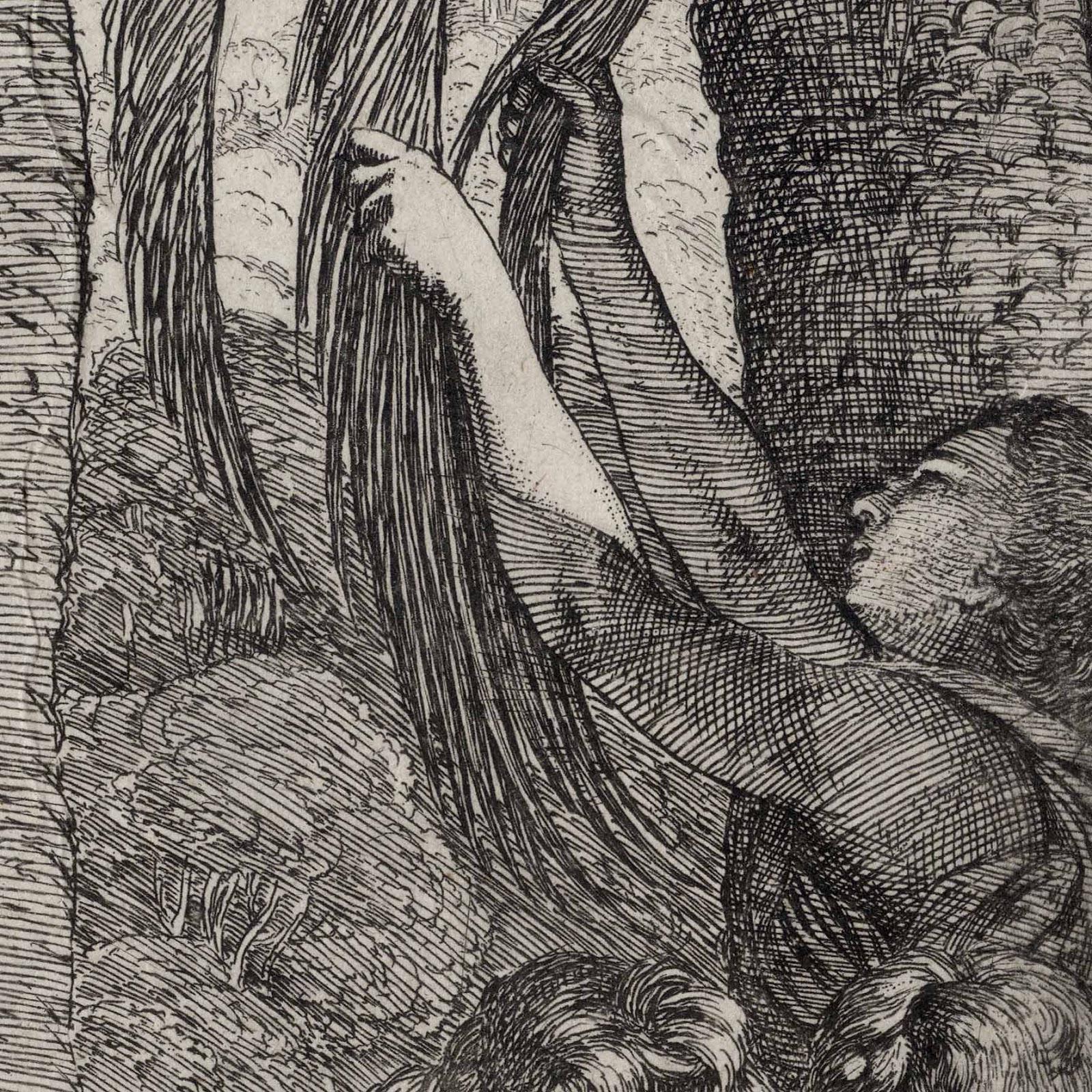
“Women with Children and Prophets on Clouds” (aka “Prophetes ou Apôtres peints par l'Espagnolet dans les Archivoltes de la Nef de l'Eglise Chartreux à Naples”), c.1780, after Francesco Solimena’s (1657–1747) designs for the women and children and after Jusepe de Ribera’s  (1591–1652) designs for the prophets, follow the intermediary drawn design by Jean Honoré Fragonard (1732–1806), published by Jacques-Gabriel Clousier (c.1750–1804) (aka l'Imprimerie de Clousier) in Paris in 1781 in Jean Claude Richard de Saint Non’s (1727–1791) “Voyage Pittoresque ou Description des Royaumes de Naples et de Sicilie”, volume 1 (of four), part 1, facing page 112 (see https://archive.org/details/gri_33125010908040/page/n203/mode/2up).

Etching on laid paper (with watermark) with a small margin around the platemark.

Size: (sheet) 26.5 x 38.8 cm; (plate) 25.3 x 37.3 cm; (left image borderline) 20.6 x 15.8 (right image borderline) 20.6 x 16 cm.

Lettered in plate above the right image borderline: (right) “Naples.”

Lettered in plate below both image borderlines: (left) “Fragonard Del.”; (centre) “Prophetes ou Apôtres peints par l'Espagnolet dans les Archivoltes de la Nef de l'Eglise Chartreux à Naples./ Les Groupes de femmes et d'enfants qui sont au dessous sont de Solimenes et font partie des charmantes peintures de ce/ Maitre qui sont dans la Sacristie de l'Eglise de St. Paul.” ([transl.] “Prophets or Apostles painted by the Spaniard in the Archivolts of the Nave of the Carthusian Church in Naples./ The Groups of women and children below are by Solimenes and are part of the charming paintings of this/ Master which are in the Sacristy of the Church of St. Paul.”; (left) “B.L. Prevost Sculp./ A.P.D.R.”

Condition: a strong and well-printed impression. Beyond a dot stain in the right margin, the sheet is in a very good condition with no tears, holes, folds, abrasions or significant stains.

I am selling this sensitively executed etching showing panels from Francesco Solimena’s frescoes executed between 1689 and 1690 in San Paolo Maggiore in Naples, featuring holy men (possibly two Prophets or Apostles) consulting scriptures in the upper corners and personifications of the eight Beatitudes from the Sermon on the Mount which I understand offer hope for eternity in heaven—for the total cost of AU$255 (currently US$166.76/EUR153.39/GBP131.08 at the time of posting this) including postage and handling to anywhere in the world, but not (of course) any import duties/taxes imposed by some countries.

If you are interested in purchasing this interesting etching that brings together the designs and skills of four significant artists (viz. Benoît Louis Prévost; Francesco Solimena; Jusepe de Ribera and Jean Honoré Fragonard) in a very beautiful diptych, please contact me (oz_jim@printsandprinciples.com) and I will send you a PayPal invoice to make the payment easy.

This print has been sold


Saturday, 16 December 2023

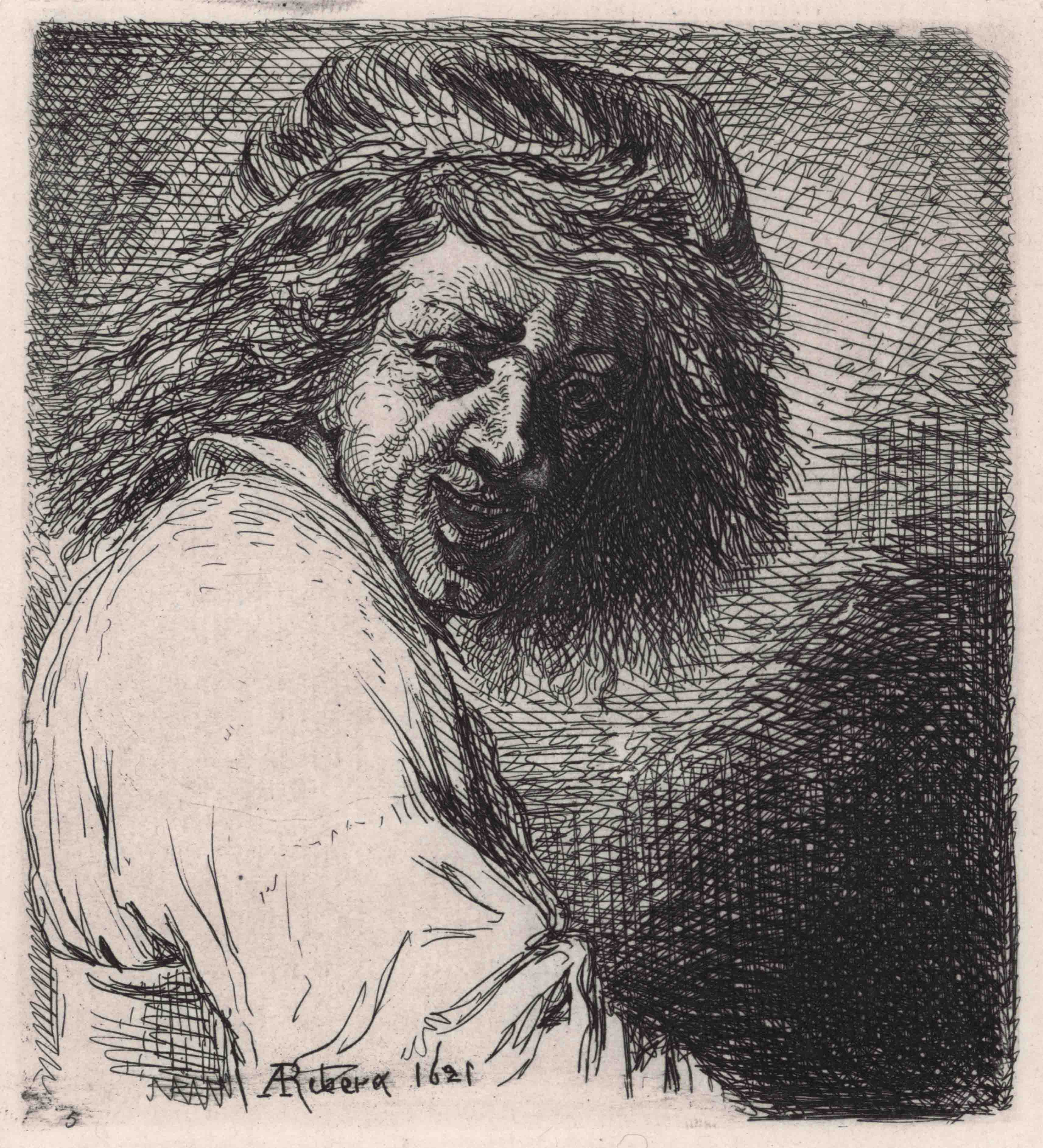
Charles Émile Jacque’s etching, “Rieur”, c.1846, after José de Ribera

Charles Émile Jacque (1813–1894)

“Rieur” (Laughing), c.1846 (1845–47), plate 5 after/attributed to José de Ribera (aka Espagnolet; Spagnoletto; Spaniolet; Giuseppe José de Ribera; Jusepe de Ribera; Joseph de Ribeira) (1591–1652), from a series of pastiches—i.e., in the manner of José de Ribera rather than copies of his work.

Interestingly, Beraldi (1885) offers the following insight regarding the series: (transl.) “[The plates were] ordered from Jacque by a publisher who published them by having them signed with the name of Ribera, 1845–47” (p. 180; see https://archive.org/details/lesgraveursdu19e08berauoft/page/180/mode/2up).

Etching on fine cream laid paper with wide margins.

Size: (sheet) 26.4 x 16.9 cm; (plate) 12 x 11.1 cm; (image borderline) 11.4 x 10.3 cm.

Inscribed in plate along the lower edge: (left) “5”: (left-of-centre) “AR[ligature]ibera 1621”.

Guiffrey 285 (J.-J. Guiffrey 1868, “L’Oeuvre de Ch. Jacque: Catalogue de ses Eaux-Fortes et Pointes Sèches”, Paris, Lemaire, p. 119, cat. no. 285); IFF 513 (Jean Adhémar, Jacques Lethève 1954, “Inventaire du Fonds Francais Apres 1800”, Paris, Bibliothèque nationale de France, vol. 11, cat. no. 513); Beraldi 285 (Henri Beraldi 1885, “Les Graveurs du dix-neuvième siècle”, Paris, Librairie L. Conquet, vol. 8, p. 173, cat. no. 285).

Guiffrey (1868) offers the following description of this print: (transl.) “A half-length man, his dishevelled head covered with a hat, turns towards the spectator, laughing loudly. Etching” (p. 119).

See also the description of this print offered by the British Museum: https://www.britishmuseum.org/collection/object/P_1889-0608-254.

Condition: a strong, well-printed and near faultless impression with wide margins. The sheet is in a near pristine condition with no tears, holes, folds, abrasions, significant stains or signs of handling.

I am selling this visually arresting etching executed by one of the luminaries of the Barbizon School in the manner of one of the major artists of Spanish Baroque, José de Ribera, for AU$277 (currently US$185.15/EUR167.52/GBP147.47 at the time of posting this listing) including Express Mail postage and handling to anywhere in the world, but not (of course) any import duties/taxes imposed by some countries.

If you are interested in purchasing this unusual etching by Jacque, please contact me (oz_jim@printsandprinciples.com) and I will send you a PayPal invoice to make the payment easy.

Note that I have previously listed three other prints by Jacque from the same series (all of which are currently available):

- Charles Émile Jacque’s etching of a man reading beside a skull after José de Ribera (https://www.printsandprinciples.com/2016/12/charles-emile-jacques-etching-of-man.html);

- Charles Émile Jacque’s etching of the prodigal son after José de Ribera (https://www.printsandprinciples.com/2016/12/charles-emile-jacques-etching-of.html);

- Charles Émile Jacque’s etching of a monk portrayed in the manner of José de Ribera (https://www.printsandprinciples.com/2016/12/charles-emile-jacques-etching-of-monk.html).


Saturday, 15 February 2020

Jean Leclerc's etching, "Rest on the Flight into Egypt”, c.1606–33, after Carlo Saraceni


Jean Leclerc (aka Jean Le Clerc) (1586–1633); formerly attributed to José de Ribera (aka Jusepe de Ribera; Spagnoletto; Espagnolet; Spaniolet; Joseph de Ribeira; Giuseppe de Ribera) (1591–1652)

“Rest on the Flight into Egypt” (aka “Repos en Egypte”), c.1606–33, after the painting of the same composition (1606) in the Eremo dei Camaldolesi, Frascati, executed by Carlo Saraceni (c.1579 – 1620), published by Frans van den Wijngaerde (1614–1679).

Note that the British Museum holds a copy in reverse of this impression published by Jean Vallet (c.fl.1600–1636): https://research.britishmuseum.org/research/collection_online/collection_object_details.aspx?objectId=1481155&partId=1&searchText=Jean+Leclerc&page=1

Etching on laid paper trimmed with tread margins around the image borderline, restored upper left corner and backed with a support sheet.
Size: (sheet) 30.1 x 23.1 cm; (image borderline) 29.8 x 22.8 cm.
Inscribed on plate within the image borderline: (lower left) “Carolus Saracenus Inuent”; (lower centre) [monogram of José de Ribera].
State ii (of ii) with the monogram of Ribera.

TIB 44 (20) [19] (87) (with the former attribution to Giuseppe Ribera) (Paolo Bellini & Mark Carter Leach [eds.] 1983, “The Illustrated Bartsch: Italian Masters of the Seventeenth Century”, vol. 44, New York, Abaris Books, p. 288, cat. no. [19]); Bartsch 19; Le Blanc II.518; Robert-Dumesnil 1835-71 V.1.II (as Leclerc); Brown 1989.20 (as a rejected attribution to Ribera).

The British Museum offers the following description of this print:
“Rest on the Flight to Egypt, after Saraceni: Virgin sitting under a palm tree with Child on her knees, listening to three angels singing, and Joseph leading the donkey by the halter and pointing at a fourth angel picking dates”

The Rijksmuseum offers the following description of this print:
(transl.) “Mary sitting by a palm tree, the Christ child on her lap. To her left Joseph, he holds the donkey on a rope. To the right of her four angels”

See also the brief description offered by the Yale University Art Museum:

Condition: very good impression showing minor wear to the printing plate, with restored upper left corner, trimmed with a thread margin around the image borderline and laid upon a support sheet of archival (millennium quality) washi paper.

I am selling this strong etching showing the Holy Family resting on their journey to escape King Herod’s edict to have all newly born male children killed—note the angles singing to them from scored music and gathering dates for a simple meal—for AU$412 (currently US$276/EUR255.41/GBP212.07 at the time of this listing) including postage and handling to anywhere in the world (but not, of course, any import duties/taxes imposed by some countries).

If you are interested in purchasing this visually engaging scene involving not only the suggestion of singing and animated gestures, but also the subtle visual device of having the donkey on the left look at the viewer so that the viewer reflexively feels part of this biblical scene, please contact me (oz_jim@printsandprinciples.com) and I will send you a PayPal invoice to make the payment easy.

This print has been sold


Saturday, 3 December 2016

Charles Émile Jacque’s etching of a man reading beside a skull after José de Ribera


Charles Émile Jacque (1813–94)
“Man reading beside a skull” (descriptive title only), 1866, attributed on the plate to José de Ribera (1591–1652)

Etching on fine wove (Japan) paper, trimmed with narrow margins and lined on a conservator’s support sheet
Size: (sheet) 13.4 x 12.3 cm; (plate) 12.1 x 11.3 cm; (image borderline) 11.5 x 10.5 cm
Inscribed within the image borderline at the lower left with the artist's initials, "C. J." (shown in reverse on the book page) and "ARibera 1621”; numbered outside the image borderline at lower left: “1.”

The British Museum offers the following description of this print:
“Man seen half-length, facing the viewer, reading a book laid on a table; his head rests on his left hand; a skull on the right.” (http://www.britishmuseum.org/research/collection_online/collection_object_details.aspx?objectId=3360514&partId=1&searchText=Jos%25u00e9+de+Ribera&people=119978&page=1)

The curator of the British Museum gives the important and interesting advice that J-J Guiffrey (1866) in “LÓeuvre de Ch. Jacque: Catalogue de ses eaux-fortes et pointes seches” does not describe this print “despite having been made in 1845/47 as part of a series of pastiches which he records” (ibid).

The curator of the British Museum advises that this print and the others from the same series referencing José de Ribera were “a group of prints commissioned to Jacque c.1845/47 and signed as Ribera; however they are pastiches rather than copies after the master.” The curator also cites Henri Beraldi (1885) “Les Graveurs du dix-neuvième siècle”, vol. VIII, Paris, p. 180. (http://www.britishmuseum.org/research/collection_online/collection_object_details.aspx?objectId=3360532&partId=1&searchText=Moine&people=119978&page=1)

Beraldi 1885-92 56bis (Henri Beraldi, 1885 “Les Graveurs du dix-neuvième siècle”, 12 vols plus supplement, Paris); Guiffrey 1866 not described; IFF 509 (Inventaire du Fonds Français: Bibliothèque Nationale, Département des Estampes, Paris, 1930)

Condition: rich and well-printed impression but with beginning signs of wear to the plate, on fine wove (Japan) paper, trimmed with narrow margins and lined on a conservator’s support sheet. Near pristine condition (i.e. there are no stains, tears, holes, abrasions, folds or foxing).

I am selling this original etching by Jacque after José de Ribera for AU$277 (currently US$185.15/EUR167.52/GBP147.47 at the time of posting this listing) including Express Mail postage and handling to anywhere in the world, but not (of course) any import duties/taxes imposed by some countries.

If you are interested in purchasing this arresting image, please contact me (oz_jim@printsandprinciples.com) and I will send you a PayPal invoice to make the payment easy.


There is a skull portrayed in the murky shadows at the lower right corner of this print. Such a subject to be included in an image referencing the time of José de Ribera—the 17th century—was not by chance nor was it considered an incidental feature. The whole meaning of images with skulls in them was grounded on the significance of what skulls symbolise: death (and an array of other associated meanings). By the time that Jacque was making images, the symbolism of skulls was so ingrained that even a slight indication of one was enough for learned folk to understand what the image was all about. In truth, however, the symbolism was not specifically death but rather a codified warning that “things” die. This is the notion of vanitas which is Latin for “emptiness.” Although I may be wrong, the meaningful point of this print of a man reading beside a skull is that his earthly pursuit of knowledge is ultimately worthless. He will die and he will die with the knowledge that he has procured. 

What I like about this image is the arrangement of the skull on the desk. Jacque, in the manner of Ribera, has cast the skull in shadow. Moreover, the skull seems to be reading what the man is reading from the shadows. For me, this treatment of a skull is fascinating as it presents death lurking in the shadows while the temporal world of an everyday pleasure—reading—is clearly seen in the light. Arguably, there is a play of dualities here between the meaning of light and the meaning of shadow.


Charles Émile Jacque’s etching of the prodigal son after José de Ribera


Charles Émile Jacque (1813–94)
“Enfant prodigue” (Prodigal son/child), 1846, attributed on the plate to José de Ribera (1591–1652)
Etching on fine wove (Japan) paper, trimmed with narrow margins and lined on a conservator’s support sheet
Size: (sheet) 13 x 11.8 cm; (plate) 12.2 x 11.1 cm; (image borderline) 11.5 x 10.4 cm
Inscribed within the image borderline at lower centre ”ARibera 1651” and numbered outside the image borderline at lower left: “6.”
State ii (of ii) (Note: this may be a third state as Guiffrey does not mention the inscribed plate number at lower left)

J-J Guiffrey (1866) in “LÓeuvre de Ch. Jacque: Catalogue de ses eaux-fortes et pointes sèches” offers the following description of this print:
(Google Translation) "Seen at half-length, the prodigal son has almost no clothes to cover himself. His long hair hides his face. In one of his hands folded on his breast he holds a bowl. From his right arm hangs a drapery. 1846. This etching was part of the collection of false Ribera of which we have spoken above. First state: Pure etching. Second state: the bottoms and the drapery, which were only unidentified, have become almost black" (p. 77).

The curator of the British Museum advises that this print and the others from the same series referencing José de Ribera were “a group of prints commissioned to Jacque c.1845/47 and signed as Ribera; however they are pastiches rather than copies after the master.” The curator also cites Henri Beraldi (1885) “Les Graveurs du dix-neuvième siècle”, vol. VIII, Paris, p. 180. (http://www.britishmuseum.org/research/collection_online/collection_object_details.aspx?objectId=3360532&partId=1&searchText=Moine&people=119978&page=1)
Guiffrey 1866 137 (undescribed state);  IFF 514 (Inventaire du Fonds Français: Bibliothèque Nationale, Département des Estampes, Paris, 1930.
Condition: rich and well-printed impression, on fine wove (Japan) paper, trimmed with narrow margins and lined on a conservator’s support sheet. Near pristine condition (i.e. there are no stains, tears, holes, abrasions, folds or foxing).

I am selling this original etching by Jacque after José de Ribera for AU$277 (currently US$185.15/EUR167.52/GBP147.47 at the time of posting this listing) including Express Mail postage and handling to anywhere in the world, but not (of course) any import duties/taxes imposed by some countries.

If you are interested in purchasing this arresting image, please contact me (oz_jim@printsandprinciples.com) and I will send you a PayPal invoice to make the payment easy.


Sometimes an image is wonderful just because of a few details. For instance, what I love about this etching is the way that the portray youth clutches his left shoulder in self-pity. Note how Jacque shows the firmness of the youth’s grasp through a slight overlap of flesh of the shoulder as it obscures the tip of his index finger. Note also how the line defining the silhouette edge of the thumb is strengthened where it presses onto the shoulder muscle. I can imagine that these small details are somewhat insignificant in terms of the “big picture” of illustrating the repentant prodigal son but these are the details that catch my attention. 
  
On a broader view, what I also love is the subtle play of light and shadow on the figure that draws attention to the figure’s plight. Regarding this perception of a youth in distress, I am in awe of Jacque’s treatment of the youth’s hair in that it shows perfectly the hair’s oily dirtiness.


Charles Émile Jacque’s etching of a monk portrayed in the manner of José de Ribera


Charles Émile Jacque (1813–94)
“Tête de moine en prière” (Head of a monk in prayer), 1845, in the manner of José de Ribera (15911652)

Etching on fine wove (Japan) paper, trimmed with narrow margins and lined on a conservator’s support sheet
Size: (sheet) 13 x 11.7 cm; (plate) 12.2 x 11.1 cm; (image borderline) 11.6 x 10.4 cm
Inscribed outside the image borderline at lower left: “12.”
State ii (of ii) (Note: this may be a third state as Guiffrey does not mention the inscribed plate number at lower left but the drawn borderline is certainly a feature of state ii)

J-J Guiffrey (1866) in “LÓeuvre de Ch. Jacque: Catalogue de ses eaux-fortes et pointes sèches” offers the following description of this print:
(Google Translation) “A monk, turned to the left, prays while raising his clasped hands. His vast capuchin leaves only his nose and beard in the Light. 1845. First state; Remark test; the subject is not framed. Second state: A black line draws around the engraving & some horizontal lines added in a clear part above the head. Four large chisel strokes, on the right, behind the head. To the left, chisel shots in the background" (p. 50).
Guiffrey 1866 54.II

The curator of the British Museum advises that this print and the others from the same series referencing José de Ribera were “a group of prints commissioned to Jacque c.1845/47 and signed as Ribera; however they are pastiches rather than copies after the master.” The curator also cites Henri Beraldi (1885) “Les Graveurs du dix-neuvième siècle”, vol. VIII, Paris, p. 180. (http://www.britishmuseum.org/research/collection_online/collection_object_details.aspx?objectId=3360532&partId=1&searchText=Moine&people=119978&page=1)

Condition: rich and well-printed impression, on fine wove (Japan) paper, trimmed with narrow margins and lined on a conservator’s support sheet. Near pristine condition (i.e. there are no stains, tears, holes, abrasions, folds or foxing).

I am selling this etching with its strong stylistic referencing of José de Ribera for AU$277 (currently US$185.15/EUR167.52/GBP147.47 at the time of posting this listing) including Express Mail postage and handling to anywhere in the world, but not (of course) any import duties/taxes imposed by some countries.

If you are interested in purchasing this image by Jacque as he explored the Caravaggisti style of Ribera with its dramatic lighting (chiaroscuro) and sombre mood, please contact me (oz_jim@printsandprinciples.com) and I will send you a PayPal invoice to make the payment easy.


This print is far from the scenes of everyday rural life in France that made Jacque famous as a leading luminary of the Barbizon School of artists. Although the reference to José de Ribera was inscribed on many of the associated plates from the series, and I have no trouble seeing the hallmarks of the great painter in Jacque’s use of dramatic lighting (chiaroscuro) and the resonating mood of religious piety of Ribera, this image is more about Jacque’s aesthetic sensitivities than Ribera’s master touch. Why I say this is all to do with the Jacque’s treatment of tone. Although I may be severely reprimanded for suggesting that the background behind the monk could serve just as well as a background for one of Jacque’s chicken pens, I hope my point is not lost. Jacque draws freely and approximates a visual effect; he doesn’t render in a mimetic way. After all, what history now values about Jacque is his free drawing and visual honesty in showing everyday life.