Showing posts with label crayon manner. Show all posts

Sunday, 15 December 2024

Eléonore Lingée, “Plate 4: Profile Study of Nose, Mouth and Chin”, c.1830, after Gédéon François Reverdin

Eléonore Lingée (aka Thérèse Eléonore Lingée; Thérèse Eléonore Hémery; Eléonore Lefèvre) (1753–c.1833?)

“Plate 4: Profile Study of Nose, Mouth and Chin” (descriptive title only), c.1830, crayon-manner stipple engraving after a drawing by Gédéon François Reverdin (1772–1828), published in Paris in 1830 by G.F. Reverdin as an illustration to “Cours complet d'études pour la figure: d'après les plus beaux modèles de l'antiquité et les tableaux des grands maîtres” (Complete course of studies for the figure: based on the most beautiful models of antiquity and the paintings of the great masters) (see https://archive.org/details/gri_33125009329638/page/n69/mode/2up).

Crayon-manner stipple engraving on laid paper with margins as published.

Size: (sheet) 42.1 x 31.9 cm; (plate) 35 x 28 cm.

Inscribed in plate: (upper left) “VE. CR.”; (upper right) “Pl. 4.”; (lower left) “G. Reverdin delt”; (lower centre) “A Paris chez Reverdin Rue du Sentier No.15. et chez les principaux Mds. d’Estampes. […] Déposé à la Bibliothe. Imple.”; (lower right) “E.re Lingée Sc”.

I understand that the publication was issued as a series of twelve notebooks (see p. 2:  https://archive.org/details/gri_33125009329638/page/(2)/mode/2up) and that this plate must be from one of the first five notebooks, as the introductory text advises: (transl.) “ To facilitate study, we took care, in the first five notebooks, to engrave next to the line alone the same shaded part; by this means, the student will have the advantage of seeing the clearly drawn line in his model, and will at the same time be able to know the real shape of the object, by casting his eyes on the same shaded part” (ibid).

The British Museum offers the following description of the publication: “Premiers Élémens du Dessin au Trait. Pour servir d'introduction au Cours complet d'Etudes pour la Figure […] containing 74 numbered plates showing details of faces, hands, feet and limbs from classical sculptures and Old Master paintings for the use of artists, after drawings by G. Reverdin. Including 6 plates from a ‘Supplément’, 6 plates depicting Christian saints after Leonardo, Romano, Raphael and others, and engraved titlepage with profiles of faces and a laurel wreath inscribed ‘Raphael’ and ‘L. de Vinci’ (https://www.britishmuseum.org/collection/object/P_1869-0410-1705-1778 [BM inv.no. 1869,0410.1705-1778]).

Condition: a strong and well-printed impression with wide margins. Beyond minor surface marks (recto and verso), the sheet is in a very good condition with no tears, holes, folds or significant stains.

I am selling this finely executed stipple engraving designed as a drawing model for art students in the early 1800s to copy, for AU$222 in total (currently/approximately US $141.30/ EUR 134.37/ GBP111.87 at the time of this listing) including Express Mail (EMS) postage and handling to anywhere in the world, but not (of course) any import duties/taxes imposed by some countries. Note that payment is in Australian dollars (AU$222) as this is my currency.

If you are interested in purchasing this very beautiful classical study, please contact me (oz_jim@printsandprinciples.com) and I will send you a PayPal invoice to make the payment easy.

For those interested in other prints from the same series, I have previously posted another plate (a very beautiful one!) that is currently still available: https://www.printsandprinciples.com/2024/09/achille-hubert-lefevre-plate-1-study-of.html.

This print has been sold


Saturday, 16 November 2024

Alphonse Leroy, “Young Boy”, c1858, after Agostino Carracci (formerly Annibale Carracci)

Alphonse Leroy (aka Alphonse Alexandre Leroy) (1820–1902)

“Young Boy” (aka “Jeune Garçon”), c.1858, after the chalk study “Portrait de Jeune Homme”, 1585/1592, in the collection of the Musée du Louvre (inv. no. 7381, Recto [see https://collections.louvre.fr/ark:/53355/cl020004306]) by Agostino Carracci (aka Augustin Carrache) (1557–1602), plate 17 (XVII) from the series of 31 plates commissioned under the patronage of Count Alfred Émilien O'Hara van Nieuwerkerke (1811–1892) after old master drawings transcribed as engravings to be used as drawing lesson studies (“Cours de Dessin”) in “Collection de dessins originaux de grands maîtres gravés en fac-simile par Alphonse Leroy; avec texte explicatif par MM. F. Reiset et F. Villot, conservateurs du Musée Imperial du Louvre”, printed by L Eudes (fl.1876–1888) and published in 1857–1859 (for plates 1–20) and 1860 (for plates 21 to 31) by Dusacq & Cie (fl.1864–1869) in Paris.

Note that the inscription in the plate along the lower edge attributes the original drawing to Annibale Carracci with the life dates of 1560–1618 (instead of 1560–1609). This is a former attribution proposed by the renowned connoisseur, Pierre-Jean Mariette (1694–1774), and the drawing is now attributed to Agostino Carracci (see inv. no. 7381, Recto).

Crayon-manner engraving with dot roulette, aquatint and plate tone, printed in a sanguine-coloured ink on buff-coloured chine collé (China paper) on light blue wove paper.

Size: (sheet) 43.5 x 38.5cm; (platemark) 44.5 X 30.8cm; (chine collé unevenly cut) 42.5 x 29cm; (image borderline) 36.5 x 24.9cm.

Lettered and numbered in plate above the image borderline: (centre) “COURS DE DESSIN/ FAC-SIMILE DES GRANDS MAÎTRES.”; (right) “Pl. XVII.”.

Lettered in plate below the image borderline: (left) “Dessiné par Annibal Carrache.”; (left of centre) “Carrache (Annibal) Peintre Bolonais, né en 1560, mort en 1618.”; (centre) “Impe. Eudes, Paris.”; (right) “Gravè par Alphonse Leroy./ DUSACQ & Cie, Bt Poissonnière,14, Paris”.

Guermonprez & Lothe 60 (Paul Guermonprez & José Lothe 2007, “Alphonse Leroy Graveur 1820–1902”, Paris, Héritage Architecturel, p. 154, cat. no. 60).

Condition: a well-printed impression in an excellent condition with no tears, holes, folds, abrasions or significant stains.

I am selling this large crayon-manner engraving designed as a study for copying by art students, for AU$245 (currently US$158.37/EUR150.21/GBP125.49 at the time of posting this print) including Express Mail (EMS) postage and handling to anywhere in the world, but not (of course) any import duties/taxes imposed by some countries. Note that payment is in Australian dollars (AU$245) as this is my currency.

If you are interested in purchasing this exceptionally beautiful engraving after a chalk study by Agostino Carracci (in the collection of the Louvre), please contact me (oz_jim@printsandprinciples.com) and I will send you a PayPal invoice to make the payment easy.


Wednesday, 24 July 2024

Philibert Louis Debucourt, “Étude d'après Rembrandt”, 1813, after Rembrandt

Philibert Louis Debucourt (1755–1832)

“Étude d'après Rembrandt” (Study after Rembrandt) (aka “Bust of a Man with Plumed Cap”; “Tronie of a Man with a Feathered Beret [see https://rkd.nl/images/186430]), 1813.

I understand that the collector, writer and historian, Marcel Guérin (aka Marcel Louis Guérin) (1873–1948), was instrumental in the publication of this etching and the original Rembrandt painting that Debucourt translated into this print was held by the Musée-Napoléon (as inscribed in the plate), but it is now in the collection of the Mauritshuis art museum; see: https://www.mauritshuis.nl/en/our-collection/artworks/149-tronie-of-a-man-with-a-feathered-beret/.

Soft-ground etching with dot roulette in the crayon manner (possibly with aquatint as Maurice Fenaille’s 1899 catalogue of Debucourt’s work advises: “Aquatinte à la manière du crayon” [p. 173]), trimmed within the platemark and backed with a support sheet providing wide margins.

Size: (sheet) 28.5 x 20.5 cm.

Lettered in plate below the image borderline: (left) “Dessiné et Gravé oar O,L.Debucourt.”; (centre) “Étude d'après Rembrandt,/ Tireé du Musée-Napoléon”.

State ii (of ii) with the addition of the title and publication details.

Fenaille 315 (Maurice Fenaille 1899, “L'œuvre gravé de P.-L. Debucourt (1755-1832)”, Paris, Morgand [E. Rahir et cie, succ.], p. 173, cat. no. 315 [see: https://archive.org/details/luvregravedeplde00fena/page/172/mode/2up]).

Condition: a very strong (near faultless) impression with no tears, holds, folds, abrasion or significant stains, trimmed within the platemark and laid onto a support of archival (millennium quality) washi paper providing wide margins.

I am selling this marvellous and eye-catching portrait study after Rembrandt that (to my eyes) is vibrant with life, for AU$227 in total (currently US$149.78/EUR138.09/GBP116.25 at the time of posting this listing) including Express Mail (EMS) postage and handling to anywhere in the world, but not (of course) any import duties/taxes imposed by some countries. Note that payment is in Australian dollars (AU$227) as this is my currency.

If you are interested in purchasing spectacularly fine etching, please contact me (oz_jim@printsandprinciples.com) and I will send you a PayPal invoice to make the payment easy.


Friday, 8 March 2024

Noël François Bertrand’s crayon-manner engraving, “Plate 1”, 1830, after Gédéon François Reverdin

Noël François Bertrand (17841852)

“Plate 1: Study of the Lower Features of a Face” (descriptive title only), 1830, crayon-manner stipple engraving after a drawing by Gédéon François Reverdin (1772–1828), published in Paris in 1830 by G.F. Reverdin as an illustration to “Cours complet d'études pour la figure: d'après les plus beaux modèles de l'antiquité et les tableaux des grands maîtres” (Complete course of studies for the figure: based on the most beautiful models of antiquity and the paintings of the great masters).

I understand that the publication was issued as a series of twelve notebooks (see p. 2:  https://archive.org/details/gri_33125009329638/page/(2)/mode/2up) and that this plate must be from one of the first five notebooks, as the introductory text advises: (transl.) “ To facilitate study, we took care, in the first five notebooks, to engrave next to the line alone the same shaded part; by this means, the student will have the advantage of seeing the clearly drawn line in his model, and will at the same time be able to know the real shape of the object, by casting his eyes on the same shaded part” (ibid).

The British Museum offers the following description of the publication: “Premiers Élémens du Dessin au Trait. Pour servir d'introduction au Cours complet d'Etudes pour la Figure […] containing 74 numbered plates showing details of faces, hands, feet and limbs from classical sculptures and Old Master paintings for the use of artists, after drawings by G. Reverdin. Including 6 plates from a ‘Supplément’, 6 plates depicting Christian saints after Leonardo, Romano, Raphael and others, and engraved titlepage with profiles of faces and a laurel wreath inscribed ‘Raphael’ and ‘L. de Vinci’ (https://www.britishmuseum.org/collection/object/P_1869-0410-1705-1778).

Crayon-manner stipple engraving on fine laid paper with full margins as published.

Size: (sheet) 44.4 x 31.2 cm; (plate) 34.6 x 26.1 cm.

Inscribed in plate: (upper left) “VE. CR.”; (upper right) “Pl.1.”; (lower left) “G. Reverdin delt” (lower centre) “A Paris, chez Reverdin Rue, du Sentier No.15, et chez les principaux Mde d’Estampes. […] Déposé à la Bibliothe. Imple.”; (lower right) “Noel Bertrand Sct”.

Condition: a strong and well-printed impression in an excellent condition with no tears, holes, folds, abrasions or significant stains.

I am selling this remarkably fine stipple engraving designed as a drawing model for art students in the early 1800s to copy, for the total cost of AU$222 (currently US$147.29/EUR134.67/GBP114.94 at the time of posting this print) including postage and handling to anywhere in the world.

If you are interested in purchasing this very beautiful classical study, please contact me (oz_jim@printsandprinciples.com) and I will send you a PayPal invoice to make the payment easy.

This print has been sold 


Wednesday, 10 January 2024

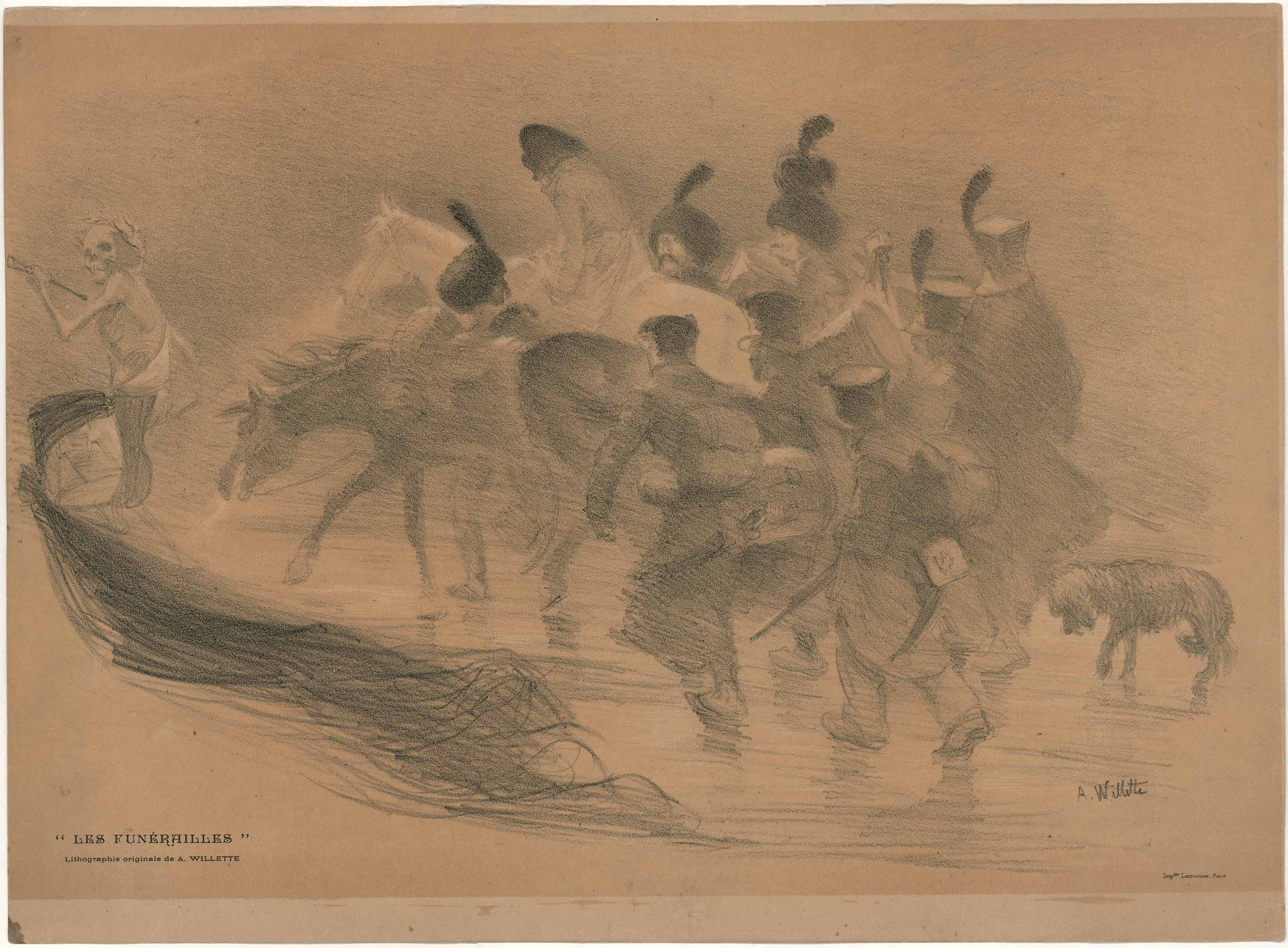
Adolphe Willette’s lithograph, “Les Funérailles”, c.1898

Adolphe Willette (aka Adolphe Léon Willette) (1857-1926)

“Les Funérailles” (aka “The Funeral”; “La Retraite de Russie. L'Empereur et sa Troupe”), c.1898 (date of attribution is based on the reproduction of this lithograph in an article by Léonce Benedite published in 1898), lithograph printed in Paris by Lemercier (aka Lemercier & Cie) (fl.1827–1899[?]).

Crayon-manner lithograph printed in black and tan ink on wove paper (imitation Japanese?), possibly with reduced margins.

Size: (sheet) 32.8 x 44.9 cm.

Inscribed in plate: (lower left) “’ LES FUNÉRAILLES ‘/ Lithographie originale de
A. WILLETTE”; (lower right) “A. Willette/ Impies. Lemercier, Paris.”

The Fine Arts Museums of San Francisco offer a brief description of this print (no image):  https://www.famsf.org/artworks/les-funerailles

I understand that a reduced size version of this lithograph was published by the artist, Paul-Émile Boutigny (1853–1929), as an illustration to issue number 25 of the French magazine, “Cocorico”, in 1899.

Interestingly, the Osenat Auction House (Osenat Maison de vente aux enchères), showcases what may be a preparatory study executed in “pencil and charcoal” for this lithograph, but (to my eyes examining only the reproduced image) the signature, its placement, along with the colour of the sheet, seem very similar to the lithograph (see lot 36) https://www.osenat.com/lot/21004/4364426-adolphe-willette-18571926la-renpp=150&.

Regarding the artist’s approach to making images, Léonce Benedite (1898) in the article, “Adolphe Willette” in “Die Graphischen Künste”, vol. 21 (Vienna, Gesellschaft für Vervielfältigende Kunst) offers the following insights: (transl.) “He [Adolphe Willette] is not an impressionist, not a pointillist, not a symbolist, not a decadent, he does not flirt with Japan, England or Germany in his art. He is as French as one can be, a descendant of Watteau, Boucher and Fragonard, and therefore clings to tradition and his principles are, so to speak, classic. ‘You can only create something new by rearranging the old,’ he writes in Pierrot (January 11, 1889)” (p. 80).

Condition: a well-printed impression in a good condition with no tears, holes, folds or significant stains, beyond a dark mark at the lower left corner.

I am selling this amazingly subtle lithograph showing a personification of death leading Napoleon and his troops on their wintery retreat through fog and snow from Russia, for the total cost of AU$256 (currently US$171.56/EUR156.79/GBP135.08 at the time of posting this print) including Express Mail (EMS) postage and handling to anywhere in the world, but not (of course) any import duties/taxes imposed by some countries.

f you are interested in purchasing this very rare lithograph (mindful that there are reduced size versions of it published in “Cocorico”, in 1899) featuring a very sad looking dog trailing behind the men—possibly a cold and wet French Poodle/Caniche?—please contact me (oz_jim@printsandprinciples.com) and I will send you a PayPal invoice to make the payment easy.