Showing posts with label Bloemaert (Frederik). Show all posts

Wednesday, 22 April 2026

Frederik Bloemaert, “Young Farmer with Basket”, c.1650, after Abraham Bloemaert

Frederik Bloemaert (1610–1669)

“Young Farmer with Basket” (“Jonge boer met mand”), c.1650 (1635–1669)

Technical Details & Condition:

Engraving on fine laid paper featuring a Foolscap watermark. The sheet has been trimmed with a narrow margin around the image borderline and professionally supported on tissue-thin archival (Kozo) washi paper. 

This print is based on a drawing by the artist’s father, Abraham Bloemaert (1564–1651). It is plate 21 from the series of 30 engravings (“The Little Figures” / “De Kleine Figuren”), catalogued as Roethlisberger 322–350. 

The impression is strong, crisp, and well-printed, showing no signs of wear to the printing plate. The sheet is in excellent condition, free of tears, holes, folds, abrasions, or significant stains.

Dimensions:

• Sheet: 12.5 x 8 cm
• Image Borderline: 12.2 x 7.7 cm

In-Plate Numbering:

• Lower right: “21”

References:

• Roethlisberger 341 (Marcel G. Roethlisberger, “Abraham Bloemaert and His Sons: Paintings and Prints”, vol. 1, 1993, Davaco, Doornspuk, p. 241, cat. no. 341)
• Hollstein Dutch 157 (FWH Hollstein, “Dutch and Flemish etchings, engravings and woodcuts ca. 1450-1700: Berckheyde–Bodding”, vol. 2, 1950, Amsterdam, Menno Hertzberger, p. 87, cat. nos. 156–185)
• Rijksmuseum: https://id.rijksmuseum.nl/200160138

Price & Shipping:

AU$239 (approximately US$171.25 / €145.74 / £126.74), including worldwide express shipping. Import duties (if any) are the buyer’s responsibility.

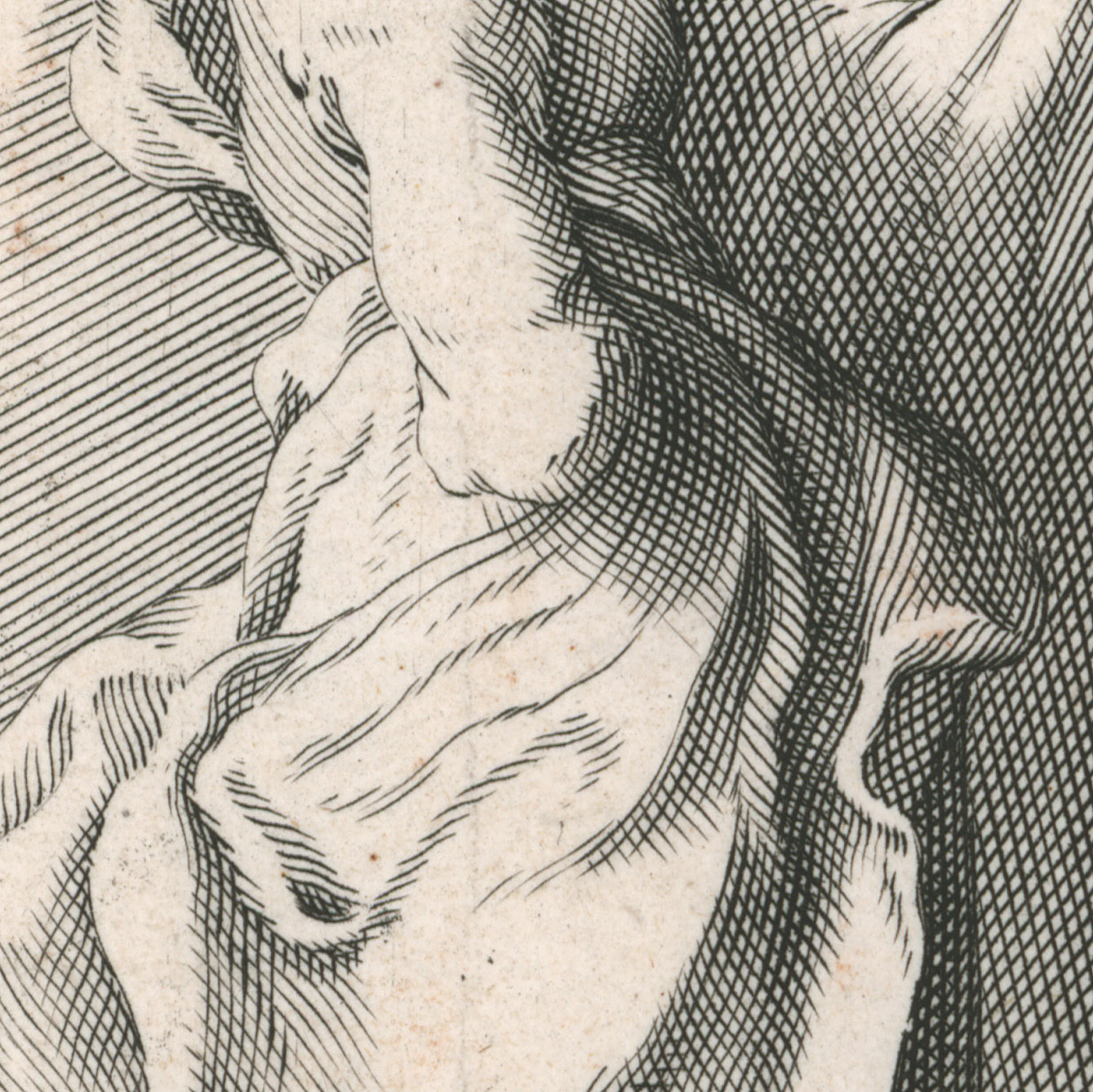
If you’re interested in acquiring this remarkably fine engraving of a curly-haired young farmer holding a basket and a staff—note how the artist insightfully used just enough shadow to “anchor” him, while avoiding a longer cast shadow that might distract from the focus on the young man—please contact me at oz_jim@printsandprinciples.com. I will be happy to provide a PayPal invoice for a smooth and secure transaction.


Friday, 27 March 2026

Frederik Bloemaert, “An Old Beggar”, c.1650, after Abraham Bloemaert

Frederik Bloemaert (1610–1669)

“An Old Beggar” (“Oude bedelaar”), c.1650 (1635–1669)

Technical Details & Condition:

Engraving on fine laid paper featuring a Foolscap watermark. The sheet has been trimmed with a narrow margin around the image borderline and professionally supported on tissue-thin archival (Kozo) washi paper. 

This print is based on a drawing by the artist’s father, Abraham Bloemaert (1564–1651). It is the second plate from the series of 30 engravings (“The Little Figures” / “De Kleine Figuren”), catalogued as Roethlisberger 322–350. 

The impression is strong, crisp, and well-printed, showing no signs of wear to the printing plate. The sheet is in near-pristine condition, free of tears, holes, folds, abrasions, or stains.

Dimensions:

• Sheet: 12.6 x 8 cm
• Image Borderline: 12.1 x 7.7 cm

In-Plate Numbering:

• Lower left corner: “2”

References:

• Roethlisberger 322 (Marcel G. Roethlisberger, “Abraham Bloemaert and His Sons: Paintings and Prints”, vol. 1, 1993, Davaco, Doornspuk, p. 240, cat. no. 322)
• Hollstein Dutch 157 (FWH Hollstein, “Dutch and Flemish etchings, engravings and woodcuts ca. 1450-1700: Berckheyde–Bodding”, vol. 2, 1950, Amsterdam, Menno Hertzberger, p. 87, cat. nos. 156–185)
• Rijksmuseum: https://id.rijksmuseum.nl/200447064

Price & Shipping:

AU$239 (approximately US$164.74 / €142.85 / £123.61), including worldwide express shipping. Import duties (if any) are the buyer’s responsibility.

If you are interested in acquiring this remarkably fine engraving of a beggar—an image reflecting a time when motives of beggars were often explored, with rascal beggars depicted looking back at their troubled origins and carrying bulging satchels, whereas genuine beggars looked ahead and bore no spoils of misadventure—please contact me at oz_jim@printsandprinciples.com. I will be happy to send a PayPal invoice for a smooth and secure transaction.

This print has been sold 


Thursday, 2 May 2024

Frederik Bloemaert, “Farmer's Wife with Two Peacocks, a Parrot and a Rabbit”, c.1645

Frederik Bloemaert (c.1616–1690) or an unidentified engraver from the circle of Frederik Bloemaert

“Farmer's Wife with Two Peacocks, a Parrot and a Rabbit” (MSK title), c.1645, from the second “Animal Series” (aka “Pastorals”) in reverse direction to the engraving, “Peacocks” (Roethlisberger title [cat. no. 147]), 1611, engraved by Boëtius Adamsz. Bolswert (aka Boëtius Adamsz Bolswerd) (1580–1633) (see http://hdl.handle.net/10934/RM0001.COLLECT.84293), after the design by Frederik’s father, Abraham Bloemaert (1564-1651).

Engraving on fine laid paper with a small margin around the platemark and backed with a support sheet.

Size: (sheet) 13 x 15.6 cm; (platemark) 11.9 x 14.3 cm; (image borderline) 10.7 x 14 cm.

The Museum of Fine Arts Ghent offers a description of Frederik Bloemaert’s engraving (see https://mskgent.be/collection/work/data/2014-KJ) and Marcel G. Roethlisberger (1993) in “Abraham Bloemaert and His Sons: Paintings and Prints”, vol. 1 (Davaco, Doornspuk) offers an account of Boëtius Adamsz. Bolswert’s series that was later followed by Frederik Bloemaert’s series; see pp. 166–171.

Condition a well-printed slightly silvery impression in a very good condition with no tears, holes, folds, abrasions or significant stains and laid onto a support sheet of archival (millennium quality) washi paper providing wide margins.

I am selling this very beautiful engraving for AU $306 in total (currently/approximately US $200.07/EUR 186.64/ GBP 159.63 at the time of posting this listing) including Express Mail (EMS) postage and handling to anywhere in the world, but not (of course) any import duties/taxes imposed by some countries. Note that payment is in Australian dollars (AU $306) as this is my currency.

If you are interested in acquiring this marvellous image of country life where the “farmer’s wife” is raising her hands to hold a peacock—an act that suggests that the woman has developed a caring/trusting bond with the farm animals—please contact me (oz_jim@printsandprinciples.com) and I will send you a PayPal invoice to make the payment easy.

This print has been sold


Saturday, 9 December 2023

Frederik Bloemaert’s engraving, “A Beggar Walking on Crutches”, c.1650, after Abraham Bloemaert

Frederik Bloemaert (1610–69)

“A Beggar Walking on Crutches” (“Bedelaar lopend op krukken”), c.1650 (1635–1669), plate 8 from the series of 30 engravings (Roethisberger 322–350), “The Little Figures” (“De kleine figuren”), after a drawing by the artist’s father, Abraham Bloemaert (1564–1651).

Engraving on fine laid paper trimmed with a small margin around the image borderline and backed with a support sheet.

Size: (sheet) 13.2 x 8.3 cm; (image borderline) 12.6 x 7.8 cm.

Numbered at lower right: “8”.

Roethlisberger 328 (Marcel G. Roethlisberger 1993, “Abraham Bloemaert and His Sons: Paintings and Prints”, vol. 1, Davaco, Doornspuk, p. 240, cat. no. 328); Hollstein Dutch 163 (F.W.H. Hollstein 1950, “Dutch and Flemish etchings, engravings and woodcuts ca. 1450-1700: Berckheyde–Bodding”, vol. 2, Amsterdam, Menno Hertzberger, p. 87, cat. nos. 156–185).

See also the description of this print held by the Rijksmuseum: http://hdl.handle.net/10934/RM0001.COLLECT.401409.

Clearly, images like this are not intended to be spiritually uplifting, but there are motivations underpinning them regardless. I understand after reading Larry Silver’s (2006) “Peasant Scenes and Landscapes: The Rise of Pictorial Genres in the Antwerp Art Market”, that popular perceptions at that time was that such folk as this poor man were undesirable. Going further, (shockingly) they were perceived to be potential thieves.

Mindful of these alarming and prevailing social attitudes, I thought I might outline a couple of the pictorial conventions that arguably play a role in this print:

- Cripples, beggars and vagabonds are more likely to be thieves if they look backwards. Fortunately, this man does not look backward, but, interestingly, such subtle symbolism is all tied to the idea that “bad” folk look back to the folly that they’ve created whereas honest folk look forward.

- Cripples, beggars and vagabonds laden with a bulging satchel within a barren setting, as seen here (unless his “satchel” is actually a water container), usually connotes that they have been thieving.

Condition: a strong and well-printed (near faultless) impression with small margin around the image borderline. The sheet is in a near pristine condition with no tears, holes, folds, abrasions or significant stains and is laid onto a support of archival (millennium quality) washi paper providing wide margins.

I am selling this finely executed engraving of a hunched figure supported on two crutches, for AU$229 (currently US$153.06/EUR138.49/GBP121.91 at the time of this listing) including postage and handling to anywhere in the world, but not (of course) any import duties/taxes imposed by some countries).

If you are interested in purchasing this graphically real portrayal of a crippled man finding his way forward, please contact me (oz_jim@printsandprinciples.com) and I will send you a PayPal invoice to make the payment easy.


Sunday, 19 February 2023

Attrib. Crispijn van de Passe the younger’s engraving, “Plate 117: Two Female Figures”, c1656, after Frederick and Abraham Bloemaert

Attrib. Crispijn van de Passe the younger (Crispijn de Passe; Crispin de Passe) (c1594–1670), or an unidentified engraver from the circle of Frederick Bloemaert (1610–1669))

Note that Marcel G Roethlisberger (1993) in his catalogue raisonné, “Abraham and his Sons: Paintings and Prints”, advises that Crispijn van de Passe the younger made engraved copies of Frederick Bloemaert’s plates “in reverse, same sizes, with altered numbering, unsigned” (vol. 1, p. 417).

“Plate 117: Two Female Figures” (descriptive title only), c1656, engraving in reverse after Frederick Bloemaert’s, “Figures: No. 139”, (Roethlisberger T139) (see also a variation in the numbering, “117”,  from a different edition shown in the copy held by the British Museum: https://www.britishmuseum.org/collection/object/P_L-83-118), after Abraham Bloemaert’s (1564–1651) drawing (Cambridge drawing no.14) from “Het Tekenboek” (Artistic drawing book).

Engraving on laid paper trimmed with a small margin around the platemark and backed with a support sheet providing wide margins.

Size: (support sheet) 36 x 29.2 cm; (sheet) 22.2 x 17.4 cm; (plate) 20.8 x 16 cm; (image borderline) 20.4 x 15.6 cm.

Numbered in plate within the image borderline: (lower-right corner) “117”.

Copy in reverse of Roethlisberger T139 (Marcel G. Roethlisberger 1993, “Abraham Bloemaert and His Sons: Paintings and Prints”, vol. 1, Davaco, Doornspuk, p. 411, cat. no. T139).

Condition: a strong and well-printed impression with a small margin around the platemark and laid upon a support of archival (millennium quality) washi paper. Beyond minor surface marks the sheet is in an excellent condition with no tears, holes, folds, abrasions or significant stains.

I am selling this very beautiful engraving showing the highest order of technical skill for the total price of AU$226 (currently US$155.55/EUR145.41/GBP129.16 at the time of this listing) including postage and handling to anywhere in the world, but not (of course) any import duties/taxes imposed by some countries.

If you are interested in purchasing this exceptionally fine engraving designed for artists to copy and advance their skills, please contact me (oz_jim@printsandprinciples.com) and I will send you a PayPal invoice to make the payment easy.

This print has to be sold