Showing posts with label Le Clerc. Show all posts

Thursday, 15 June 2023

Louis Francois Duruisseau’s crayon-manner engraving, “Portrait of a Young Woman with Floral Wreath”, c1790, after Le Clerc

Louis Francois Duruisseau (aka Antoine Durnisseau [according to Nagler]) (1754–early 1800s)

“Portrait of a Young Woman with Floral Wreath”, c1790, a colour crayon-manner engraving (viz. a technique involving a stipple roulette tool rolled over the printing plate to duplicate crayon-like textures devised by Louis Marin Bonnet (1736–1793); see the earlier post: https://www.printsandprinciples.com/2019/12/louis-marin-bonnets-crayon-manner.html), after the design by Le Clerc—possibly Thomas Leclerc (aka Thomas Le Clerc; Pierre Thomas Leclerc) (fl. 1800s)—published in Paris by Mondhare & Jean (fl. 1784–1796)—a twelve-year publishing partnership between Louis Joseph Mondhare [fl. 1760–1792] and his son-in-law, Pierre Jean [fl. 1784–1820]—with an (in plate) dedication to Marquise Spinola.

Crayon-manner engraving with aquatint printed in black, grey and sanguine on laid paper, trimmed with a small margin around the platemark with restorations to the margins and backed with a support sheet.

Size: (sheet) 56.8 x 45 cm; (plate) 55 x 44.4 cm; (image borderline) 51.7 x 41 cm.

Lettered in plate below the image borderline: (left) “Le Clerc Del./ A Paris chez Mondhare et Jean rue St. Jean de Beauvais près celle des Noyers”; (centre) “Dédieé à Marquise Spinola.”; (right) “Duruisseau Sculp/ Par son très Humble et très Obeyβant Serviteur Le Clerc”.

Condition: a well-printed impression with restoration to chipping along the edges, replenished loss of the upper corners and minor spots of abrasion. The sheet has been laid onto a support of archival (millennium quality) washi paper.

I am selling large and very beautiful colour crayon-manner engraving by a printmaker that is arguably best known for his colour prints featuring flowers—an appreciation expressed in issue 166 of “The Connoisseur” (1901), regarding a set of flower prints, “Cahier des Fleurs”, that is described as having “the same grace and elegance as the gowns worn by Marie Antoinette” (p. 124)—for AU$355 (currently US$237.28/EUR214.69/GBP188.99 at the time of posting this listing) including postage and handling to anywhere in the world, but not (of course) any import duties/taxes imposed by some countries).

If you are interested in purchasing this remarkably fine colour engraving executed with great sensitivity, please contact me (oz_jim@printsandprinciples.com) and I will send you a PayPal invoice to make the payment easy.

This print has been sold


Sunday, 6 August 2017

Sébastien Le Clerc's etchings, three idealised landscapes, 1696


Sébastien Le Clerc (aka Sébastien Leclerc) (1637–1714)

Descriptive title: “Ruined Tower on a Rocky Outcrop”, 1696, plate 11 in “Quelqu[es f]igures, chevaux [et] paysages / presen[tés] a monseigneur le duc de Bourgogne par son tres humble et tres obeïssant serviteur le Clerc” published by Gérard Audran (Paris, 1696) comprising 60 prints in eight sequences of 6 plates each and one sequence of 12. (see: http://primo.getty.edu/GRI:GETTY_ALMA21141433490001551)

Etching on laid paper trimmed close to the image borderline and lined onto a conservator’s support sheet. (Note: based on other prints in this series in which there are copies in reverse, I suspect that there is likely to be a reverse copy of this print as well.)
Size: (sheet) 7.5 x 16.1 cm

Jombert 258.52. (Charles-Antoine Jombert 1774,"Catalogue raisonné de l'œuvre de Sébastien Le Clerc, chevalier romain", vol. 2, n° 258.53, Paris)

Condition: crisp impression laid upon a conservator’s support sheet which has helped to flatten creases originally in the sheet. There are a few stains in the sky and the sheet reveals light dustiness and signs of handling.

I am selling this marvellous etching of an idealised landscape for the total cost of AU$126 (currently US$99.89/EUR84.84/GBP76.62 at the time of this listing) including postage and handling to anywhere in the world.

If you are interested in purchasing this tranquil panorama featuring a ruined tower, please contact me (oz_jim@printsandprinciples.com) and I will send you a PayPal invoice to make the payment easy.


____________________


Sébastien Le Clerc (aka Sébastien Leclerc) (1637–1714)

Descriptive title: “Citadel on a rocky outcrop with a tunnelled roadway through the rock formation”, 1696, published by Gérard Audran (Paris, 1696) in “Quelqu[es f]igures, chevaux [et] paysages / presen[tés] a monseigneur le duc de Bourgogne par son tres humble et tres obeïssant serviteur le Clerc” comprising 60 prints in eight sequences of 6 plates each and one sequence of 12. (see: http://primo.getty.edu/GRI:GETTY_ALMA21141433490001551)

Etching on laid paper trimmed close to the image borderline and lined onto a conservator’s support sheet. (Note: there is a copy of this print in reverse)

Size: (sheet) 7.2 x 15.7 cm
Jombert 258.53 (Charles-Antoine Jombert 1774,"Catalogue raisonné de l'œuvre de Sébastien Le Clerc, chevalier romain", vol. 2, n° 258.53, Paris)

Condition: crisp impression laid upon a conservator’s support sheet which has helped to flatten the many creases originally in the sheet. There are small nicks (losses) in the sky and the sheet reveals signs of handling (i.e. there is slight unevenness in the colour mainly due to the original creases.

I am selling this marvellous etching of an idealised landscape for the total cost of AU$126 (currently US$99.89/EUR84.84/GBP76.62 at the time of this listing) including postage and handling to anywhere in the world.

If you are interested in purchasing this tranquil panorama from the 17th century, please contact me (oz_jim@printsandprinciples.com) and I will send you a PayPal invoice to make the payment easy.

This print has been sold

____________________


Sébastien Le Clerc (aka Sébastien Leclerc) (1637–1714)

Descriptive title: “Seaside Landscape with Towering Mountains”, 1696, plate 6 in “Quelqu[es f]igures, chevaux [et] paysages / presen[tés] a monseigneur le duc de Bourgogne par son tres humble et tres obeïssant serviteur le Clerc” published by Gérard Audran (Paris, 1696) comprising 60 prints in eight sequences of 6 plates each and one sequence of 12. (see: http://primo.getty.edu/GRI:GETTY_ALMA21141433490001551)

Etching on laid paper trimmed close to the platemark with thread margins. (Note: based on other prints in this series in which there are copies in reverse, I suspect that there is likely to be a reverse copy of this print as well.)
Size: (sheet) 7.7 x 16.2 cm
Inscribed indistinctly on the plate at the lower edge slightly left of centre in the sea: “S le Clerc f” 

IFF 1184

Condition: crisp impression trimmed near the platemark with thread margins and in excellent condition.

I am selling this marvellous etching of an idealised landscape for the total cost of AU$126 (currently US$99.89/EUR84.84/GBP76.62 at the time of this listing) including postage and handling to anywhere in the world.

If you are interested in purchasing this tranquil panorama, please contact me (oz_jim@printsandprinciples.com) and I will send you a PayPal invoice to make the payment easy.

This print has been sold


Saturday, 5 August 2017

First and Second States of Sébastien Le Clerc’s “Rocky Landscape with River”, 1693 (continued)


Sébastien Le Clerc (aka Sébastien Leclerc) (1637–1714)
“Rocky Landscape with River”, 1693, plate 5 from a series of 12 landscapes, first published by Nicolas Langlois in 1693; a second edition was issued by Lamy in 1784. This is a first state impression from the first edition of 1693. (Note: by pure chance I discovered that I had two impressions of this print. By comparing the two prints, this is clearly the first state and the impression showcased earlier is from the second state.)

Etching on laid paper (1st state) with small margins.
Size: (sheet) 11.8 x 20.4 cm; (plate) 10.3 x 19 cm; (image borderline) 9.4 x 18 cm
Inscribed within the image borderline at the lower-left corner, “S. le Clerc. f.”, and numbered, “5”, below the image borderline at the lower-left corner.
State i (of ii)

IFF 1010.II (Inventaire du Fonds Français: Bibliothèque Nationale, Département des Estampes, Paris, 1930); Jombert 1774 107.5 (Charles-Antoine Jombert 1774, “Catalogue raisonné de l'oeuvre de Sébastien Leclerc, chevalier romain”, 2 vol, Paris)
The British Museum offers the following description of this print:

Condition: crisp impression, in near faultless condition for its age (i.e. there are no tears, holes, stains or foxing) and with small margins (varying in size but approximately 8 mm).

I am selling this stunning lifetime impression by the "graveur du Roi" for Louis XIV, Sébastien Le Clerc, for a total cost of AU$142 (currently US$112.57/EUR95.61/GBP86.35 at the time of this listing) including postage and handling to anywhere in the world.

If you are interested in purchasing this small but graphically powerful etching of an idealised landscape, please contact me (oz_jim@printsandprinciples.com) and I will send you a PayPal invoice to make the payment easy.

This print has been sold


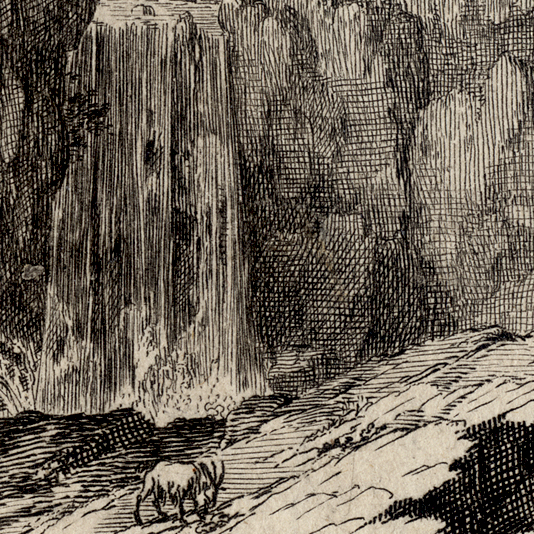
Close examination of the two states of this print reveals considerable reworking of the first state. In the second state, for example, Le Clerc has added more complexity to the modelling of the waterfall shown on the far-left as well including a grove of trees in the distance seen above the waterfall.

To my eyes however, the key difference separating both states is the softening of tonal contrasts that gives the image more pictorial coherence. For instance, note that the added modelling of the rocky terrain featured in the left foreground in the second state pictorially merges the goat shown in the lower-left (i.e. the goat is integrated as a part of the landscape rather than being a visual distraction as I perceive it to be in the first state).


Monday, 3 July 2017

Sébastien Le Clerc’s etching, “Rocky Landscape with River”, 1693


Sébastien Le Clerc (aka Sébastien Leclerc) (1637–1714)
“Rocky Landscape with River”, 1693, plate 5 from a series of 12 landscapes, first published by Nicolas Langlois in 1693; a second edition was issued by Lamy in 1784. This impression is from the second edition of 1764.

Etching on laid paper lined with a conservator’s support sheet.
Size: (sheet) 11.1 x 19 cm; (plate) 10.3 x 19 cm; (image borderline) 9.4 x 18 cm
Inscribed within the image borderline at the lower-left corner, “S. le Clerc. f.”, and numbered, “5”, below the image borderline at the lower-left corner.
State ii (of ii) (Note: I have also listed an impression of the first state).

IFF 1010.II (Inventaire du Fonds Français: Bibliothèque Nationale, Département des Estampes, Paris, 1930); Jombert 1774 107.5 (Charles-Antoine Jombert 1774, “Catalogue raisonné de l'oeuvre de Sébastien Leclerc, chevalier romain”, 2 vol, Paris)

The British Museum offers the following description of this print:

Condition: crisp impression, trimmed along the platemark on the left and right sides with narrow margins at the top and bottom edges and laid upon a support sheet of fine washi paper. The print is in good condition for its age (i.e. there are no tears, holes, stains or foxing), but the surface shows slight signs of use (i.e. the sheet is not pristine).

I am selling this stunning impression by the "graveur du Roi" for Louis XIV, Sébastien Le Clerc, for a total cost of AU$142 (currently US$108.75/EUR95.51/GBP83.75 at the time of this listing) including postage and handling to anywhere in the world.

If you are interested in purchasing this small but graphically powerful etching of an idealised landscape, please contact me (oz_jim@printsandprinciples.com) and I will send you a PayPal invoice to make the payment easy.


This print has been sold


This is a print that has everything that I believe might appeal to a late 17th century taste for landscape: craggy mountains with a rock pinnacle and a natural arch—the arch is somewhat disguised in shadows but is nevertheless shown on the far right—and natural forces forming the land in terms of waterfalls, streams and even eddying currents—the latter suggested by the agitated water in the foreground. Going further, this was the time when popular notions of landscape, especially in the Netherlands, had been shaped by artists like Joachim Patinir (c.1480–1524) whose vision of landscape is what is now termed as “world landscape” or to use the more common German expression: “Weltlandschaft.” To borrow the explanation for this term from Wikipedia, Weltlandschaft is “a type of composition in Western painting [and prints] showing an imaginary panoramic landscape seen from an elevated viewpoint that includes mountains and lowlands, water, and buildings” (https://en.wikipedia.org/wiki/World_landscape).


Wednesday, 3 May 2017

Sébastien Le Clerc’s etching, “Facit Omnia Laeta”, c.1670


Sébastien Le Clerc I (1637–1714)
“Facit Omnia Laeta” (He makes all things prosperous), c.1670, from André Félibien’s (1619–95) “Tapisseries du Roi, où sont représentez les quatre élémens et les quatre saisons” (Tapestries of the King [Louis XIV], representing the four elements and the four seasons), after Jacques Bailly (1629–1679), printed from the original plate held in the Chalcographie du Louvre by Frazier-Soye (or Vernant?) in 1923 for the art revue, “Byblis.”

Etching in dark brown ink on cream wove paper (vélin Lafuma) with margins as published in an edition of 600.
Size: (sheet) 28.2 x 22.6 cm; (plate) 20.8 x 19.1 cm


The British Museum offers the description of another plate by Leclerc from the same series (but not published in “Byblis”): http://www.britishmuseum.org/research/collection_online/collection_object_details.aspx?objectId=1631715&partId=1&searchText=Sebastien+Le+Clerc+&page=1

Condition: faultless impression in pristine condition

I am selling this curiously interesting print executed in the 17th century but printed from the original plate in the 20th century for the total cost of AU$134 (currently US$100.17/EUR91.75/GBP77.49 at the time of posting this listing) including postage and handling to anywhere in the world.
If you are interested in purchasing this original print that uses frogs to express the joy that Louis XIV brought to the world, please contact me (oz_jim@printsandprinciples.com) and I will send you a PayPal invoice to make the payment easy.


At first glance one could be mistaken for believing that this print is an ex libris bookplate (i.e. a print stating in Latin that the book in which it is affixed is from the collection, or library, of a book’s owner whose name is yet to be inscribed upon the print) … but it isn’t! Instead this remarkable image of a landscape framed with a reed wreath held by frogs is a design for a tapestry planned to grace the abode of Louis XIV— France’s Sun King/le Roi Soleil (1638–1715).

For those who may be curious about the significance of a frog framed landscape to the Sun King, the following proposal may be flawed, but from what I can piece together from my evening’s research, the meaning behind the print is not too obscure.

Essentially, this print is a part of a series of images featuring the four elements and seasons, devised by the Tapestry Manufacturers (Manufacture nationale des Gobelins) as propaganda material celebrating the virtues of Louis XIV. The scenic view of water and frogs portrayed is not really all that surprising as water was a critical element for Louis XIV in terms of his vision of protecting his maritime subjects from pirates and securing safe sea routes to the colonies.

According to Thomas P. Campbell (et al.) in “Tapestry in the Baroque: Threads of Splendor” (2007) the element of water had special significance to Louis XIV as it represented his envisaged virtues of “piety, magnanimity, kindliness and valor” (p. 358). What is fascinating for me is that the prints in the series subliminally reference these virtues. For instance, the virtue of piety is visually expressed in another print in the series by “the boundless expanse of the sea” and the virtue of magnanimity is suggested by a “high-sprouting fountain.” To ensure that the visual expression of these virtues is not lost, like this print, inscriptions help clarify the addressed virtue. For example, the image of “the boundless expanse of the sea” has the textual annotation, “Never does he [Louis XIV] transgress the coastline”, and the image of a “high-sprouting fountain” is annotated with “He seeks the relentless font” (ibid.).

Regarding this print, these very happy frogs supporting the view of a river bringing fertility to the land fits very well with the King’s virtue of kindliness, in the sense that is explained by the Latin inscription, “Facit Omnia Laeta”—He makes all things prosperous.