Showing posts with label Pitteri (Marco). Show all posts

Sunday, 1 June 2025

Marco Pitteri, “St Paul”, 1742, after Giovanni Battista Piazzetta

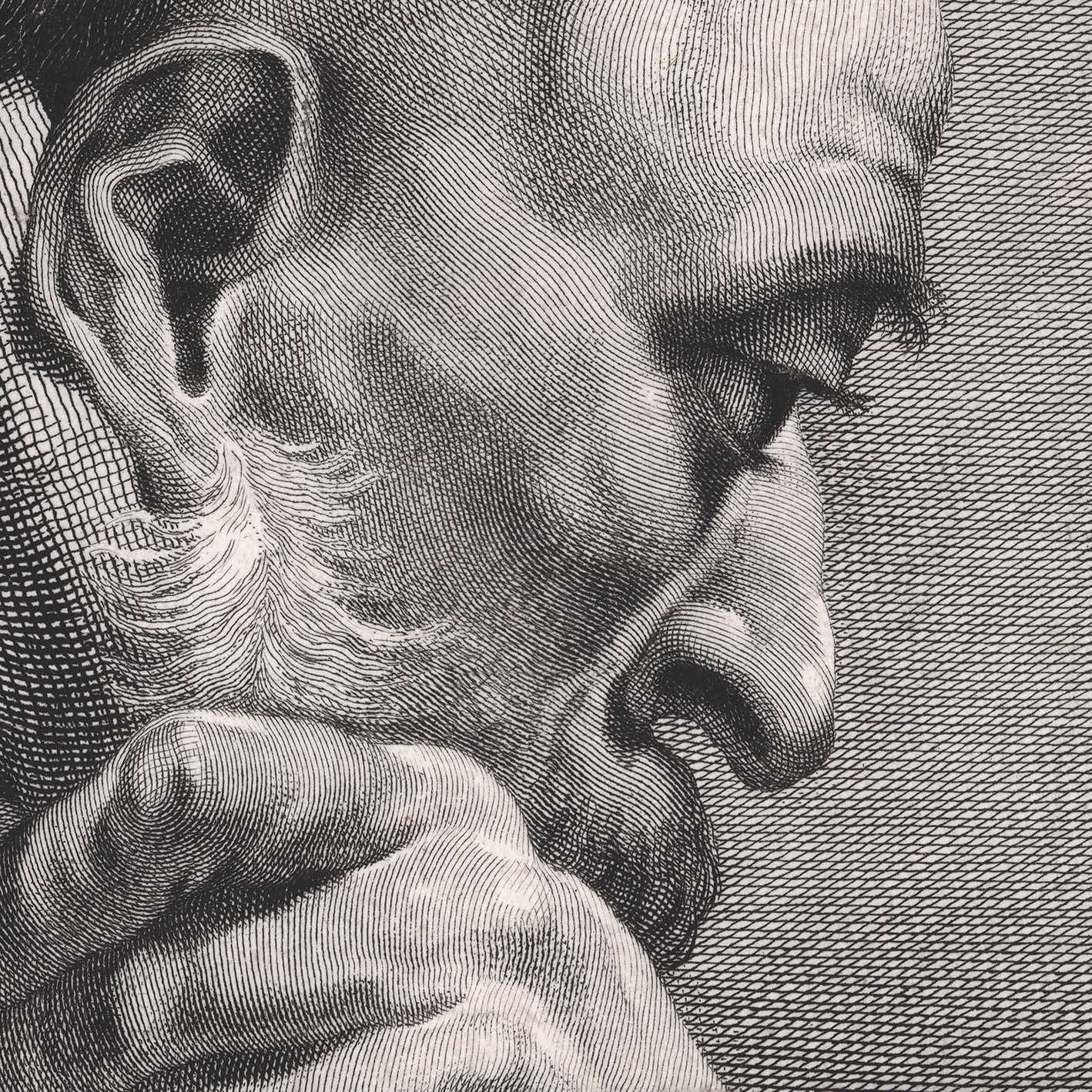
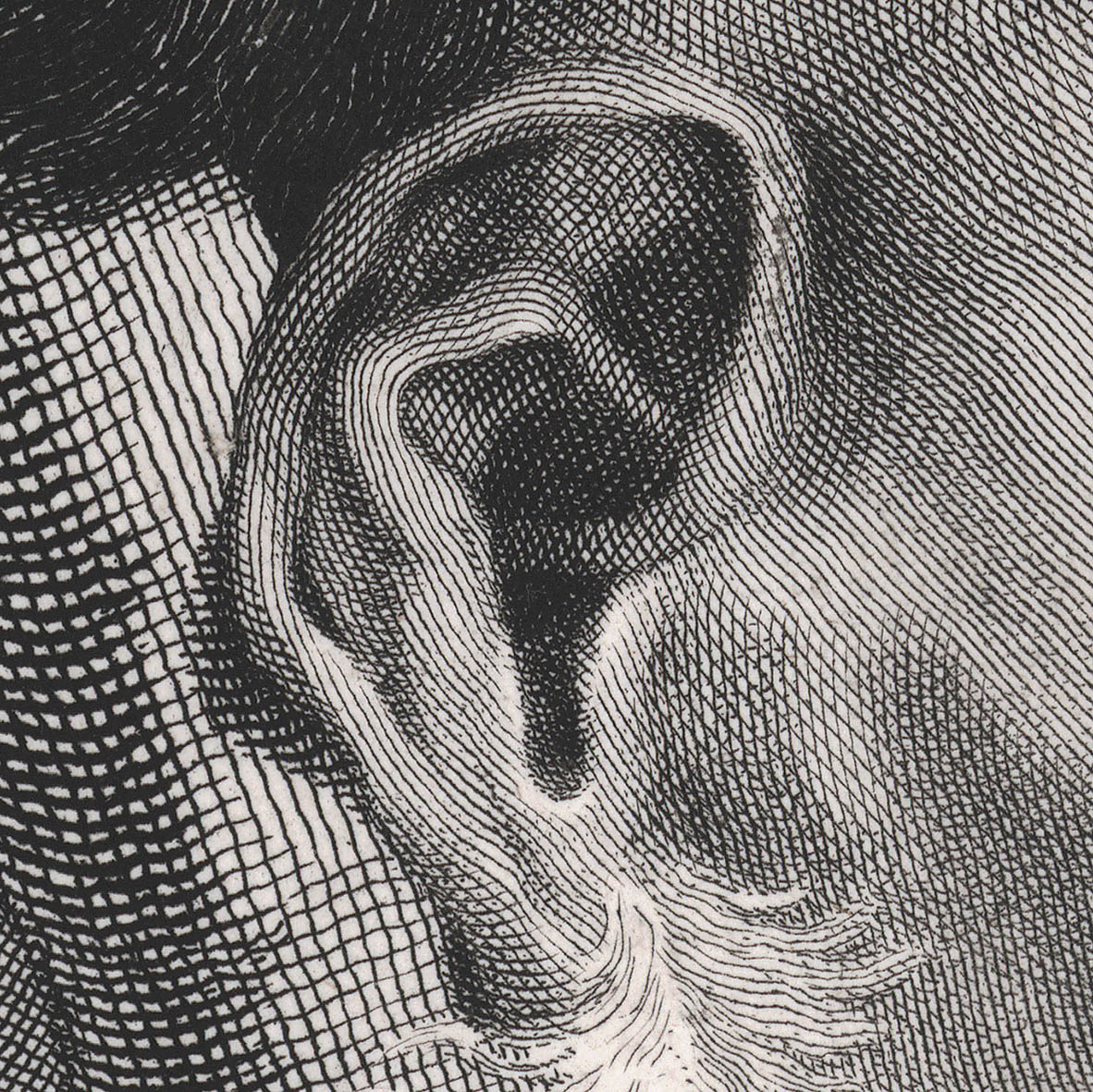
Marco Pitteri (aka Marco Alvise Pitteri; Giovanni Marco Pitteri) (1702–1786)—famous for developing “an original method of engraving (not etching), using parallel lines, which are thickened at regular intervals along their length with more deeply engraved sections” (see https://www.britishmuseum.org/collection/term/BIOG42160)

“St Paul” (aka “Sanctus Paulus”), 1742, from the series “The Holy Family and Apostles”, after the painting by Giovanni Battista Piazzetta (aka Giambattista Piazzetta) (1682–1754) (see https://www.kollerauktionen.ch/en/337441-0001-1196-GIOVANNI-BATTISTA-PIAZZETTA.-H-1196_493349.html).

Engraving on fine laid paper trimmed within the platemark with loss of text below the image borderline and backed with a support sheet.

Size: (sheet) 10.4 x 7.8 cm.

Ravà 109 (Aldo Ravà 1922, “Marco Pitteri: Incisore Veneziano”, Florence, p. 21, cat. no. 109).

Note that the Rijksmuseum offers descriptions of two versions of this print: the larger version, Ravà 108: https://id.rijksmuseum.nl/200244630 and the smaller version, that I am showcasing, Ravà 109: https://id.rijksmuseum.nl/200244636.

See also the description of the larger version offered by Maria Agnese Chiari Moretto Wiel (ed.) 1966, “L’eredità di Piazzetta: volti e figure nell’incisione del Settecento”, exh. cat. Palazzo Ducale, Venice, p. 28, cat. no. 28.

Condition: a strong and well-printed impression trimmed within the platemark (with loss of the text lines) and laid onto a support of archival (millennium quality) washi paper providing wide margins. The sheet has no tears, holes, abrasions or stains.

I am selling this superb engraving executed in Pitteri’s remarkable technique of employing parallel lines interrupted with “dots”—somewhat like knots in string—to render form in dramatic light, for AU$329 (approximately US$212.45, EUR 186.85, or GBP 157.48), including express mail shipping worldwide.  Import duties, if any, are the responsibility of the buyer.

If you are interested in purchasing this jewel of an engraving that despite its somewhat diminutive size is arguably one of Pitteri's masterpieces” (see Maria Agnese Chiari Moretto Wiel [1966], p. 28), please contact me (oz_jim@printsandprinciples.com) and I will send you a PayPal invoice to make the payment easy.


Sunday, 3 September 2023

Marco Pitteri’s engraving, “Profile Portrait of a Young Woman”, c.1760, after Giovanni Battista Piazzetta

Marco Pitteri (aka Marco Alvise Pitteri) (1702–1786)—famous for developing “an original method of engraving (not etching), using parallel lines, which are thickened at regular intervals along their length with more deeply engraved sections” (https://www.britishmuseum.org/collection/term/BIOG42160).

“Profile Portrait of a Young Woman”, c.1760 (1740–1780), engraving after the design by Giovanni Battista Piazzetta (aka Giambattista Piazzetta) (1682–1754)—possibly after a portrait of Piazzetta’s wife, Rosa, and relates to the drawing, “Girl with a Vase”, c.1730 (1720–1740), in the Gallerie dell’Academia in Venice (see Maria Agnese Chiari Moretto Wiel (ed.) 1966, “L’eredità di Piazzetta: volti e figure nell’incisione del Settecento”, exh. cat. Palazzo Ducale, Venice, p. 75, no. 143).

Engraving on laid paper, trimmed slightly unevenly with a small margin around the platemark.

Size: (sheet) 45.5 x 35.5 cm; (plate) 45.4 x 34.4 cm; (image borderline) 44.2 x 34.3 cm.

Lettered in plate below the image borderline: (left) “Piazzetta inue.”; (right) “Pitteri scul.”

Ravà 268 (Aldo Ravà 1922, “Marco Pitteri: Incisore Veneziano”, Florence, p. 68, cat. no. 268).

See also the descriptions of this print offered by the British Museum and the Rijksmuseum: https://www.britishmuseum.org/collection/object/P_1872-0113-11; http://hdl.handle.net/10934/RM0001.COLLECT.165228.

Condition: a strong and well-printed impression in an excellent condition for its large size and considerable age with no tears, holes, folds, abrasions, significant stains (there are a few marks verso) or foxing.

I am selling this large and remarkable engraving—note that the tones rendering the portrait are created with parallel lines encrusted with knot-like undulations varying in width from exceptionally fine (when portraying the lightest features) to thick (when portraying deep shadows)—that (to my eyes) presents the illusion of light shimmering on the surface of the figure’s face, for AU$458 (currently US$306.13/EUR276.98/GBP243.82 at the time of this listing) including postage and handling to anywhere in the world, but not (of course) any import duties/taxes imposed by some countries.

If you are interested in purchasing this museum-quality etching of fascinating and historical importance in the development of printmaking techniques, please contact me (oz_jim@printsandprinciples.com) and I will send you a PayPal invoice to make the payment easy.

This print has been sold 


Wednesday, 12 October 2022

Giovanni Cattini’s engraving, “An Old Man Leaning on a Staff”, 1743, after Giovanni Battista Piazzetta

Giovanni Cattini (aka Joannes Cattini) (c1715–c1804)

“An Old Man Leaning on a Staff” (MET title) (aka “Vecchio Che Si Appoggia a Un Bastone”), 1743, plate 5 from the series of fifteen head studies of character and expression (viz. a frontispiece and fourteen numbered plates), “Icones ad Vivum Expressae” (Images taken from life), after Giovanni Battista Piazzetta (aka Giambattista Piazzetta) (1682–1754), published in Venice by Giovanni Battista Pasquali (fl. 1742–c1763) in 1754 when the plate was numbered. I understand that Cattini collaborated with Marco Alvise Pitteri (1702–1786) to translate into engravings exemplary works in Piazzetta’s oeuvre with the plan that Pitteri would reproduce Piazzetta’s paintings and drawings of holy figures (“immagini sacre”) while Cattini would focus on images of everyday folk (“le profane”) (see https://www.robinhalwas.com/018011-prints-reproducing-paintings-and-drawings-by-piazzetta).

Engraving on laid paper trimmed along the platemark and backed with a support sheet.

Size: (support sheet) 54 x 42.2 cm; (sheet) 44.8 x 34 cm; (interior image borderline) 38.5 x 31.5 cm.

Lettered in plate below the image borderline: (left) “Jo. Bapta Piazzetta delineavit.”; (centre) “Comiti Antonio Abbati Conti Patricio Veneto/ In humillimum observantiæ signum D.D.D./ V.”; (right) “Joannes Cattini Sculptor Venetus.”

Wiel 1996, 46.74 (Maria Agnese Chiari Moretto Wiel 1996, “L'eredità di Piazzetta. Volti e figure nell'incisione del settecento”, Venice, Il Cardo, cat. no. 74, p. 46, ill).

The British Museum and the Metropolitan Museum of Art offer descriptions of this print: https://www.britishmuseum.org/collection/object/P_1943-0709-86; https://www.metmuseum.org/art/collection/search/376271.   

Condition: a richly inked and well-printed impression with a margin around the image borderline and laid onto a sheet of archival (millennium quality) washi paper providing support and wide margins. There is a closed centre tear and a minor nick (in the background at right near the figure’s wrist), otherwise the sheet is in a remarkably good condition for its large size and age.

I am selling this large engraving executed with great skill and sensitivity—from a personal standpoint, I’m amazed how the all the subtle surface contours of the face have been portrayed within a narrow tonal range so that there is strong contrast with the startling white of the figure’s shirt—for the total cost of AU$522 (currently US$328.29/EUR337.35/GBP298.43 the time of this listing) including postage and handling to anywhere in the world, but not (of course) any import duties/taxes imposed by some countries.

If you are interested in purchasing this masterpiece of engraving—please contact me (oz_jim@printsandprinciples.com) and I will send you a PayPal invoice to make the payment easy.


Friday, 6 July 2018

Johann Gottfried Haid’s mezzotint of a young woman with a boy wearing a turban, c1750, after Giovanni Battista Piazzetta


Johann Gottfried Haid (aka John Gottfried Haid) (1714–1776)

“Young woman with a boy wearing a turban” (descriptive title only—note that I have seen the portrayed young woman given the name “Julia” in some websites), c1750, after Giovanni Battista Piazzetta (aka Giambattista Piazzetta) (1682–1754).

Mezzotint on laid paper, trimmed with a small margin around the image borderline and backed with a support sheet.
Size: (sheet) 34.5 x 27.7 cm; (image borderline) 33.5 x 27.1 cm
Inscribed on plate below the image borderline: (left) “Iohann Baptista Piazzetta Venetus delineavit”; (right) “Iohann Gottfried Haid sculpsit”

Condition: richly inked and well-printed impression with many (almost invisible) restorations, trimmed with a small margin around the image borderline and retaining the text line below the image borderline and backed with a support sheet of archival (millennium quality) washi paper.

I am selling this spectacular mezzotint for the total cost of AU$216 (currently US$160.08/EUR136.73/GBP121.06 at the time of posting this print) including postage and handling to anywhere in the world (but not, of course, any import duties/taxes imposed by some countries).

If you are interested in purchasing this rare—so rare that the neither the British Museum nor the Rijksmuseum hold a copy—large and luminously glowing old-master print, please contact me (oz_jim@printsandprinciples.com) and I will send you a PayPal invoice to make the payment easy.

This print has been sold


For those that like comparing prints, this mezzotint by Johann Gottfried Haid (1714–1776) is a perfect print for close study. Not only did the printmaker’s younger brother, Johann Lorenz Haid (1702–1750), execute a similar mezzotint after the same draughtsman designer, Giovanni Battista Piazzetta (1682–1754) featured in my earlier post (see http://www.printsandprinciples.com/2018/04/johann-lorenz-haids-mezzotint-of-young.html), but the technically remarkable, Marco Pitteri (1702–1786), make an engraving of the same composition as this print in reverse (see http://www.britishmuseum.org/research/collection_online/collection_object_details.aspx?objectId=1418781&partId=1&searchText=Piazzetta&page=1 & http://hdl.handle.net/10934/RM0001.COLLECT.165225).

From a personal standpoint, what I find interesting in comparing the three printmakers— Johann Gottfried Haid, Johann Lorenz Haid and Marco Pitteri—is their different approaches to rendering form. In the case of Johann Gottfried, note how he uses reflected light to give luminosity to the shadow areas of his figures and employs haloes of light (for example around the boy’s fingers) to separate spatial planes. By contrast, his brother, Johann Lorenz, invests his figures (see the link to my earlier post above) with an almost theatrical lighting in which reflected light seems to bounce around the composition giving his subject a dramatic edge. Regarding Marco Pitteri’s engraving in reverse (see the link above), Pitteri’s approach to rendering light and shade is startling different as described by the British Museum:

“… an original method of engraving (not etching), using parallel lines, which are thickened at regular intervals along their length with more deeply engraved sections.” (http://www.britishmuseum.org/research/search_the_collection_database/term_details.aspx?bioId=111323).