Showing posts with label Testa (Pietro). Show all posts

Monday, 13 June 2022

Giovanni Cesare Testa’s etching, “The Prophecy of Basilides”, c1650, after Pietro Testa


Giovanni Cesare Testa (c1630–1655)—nephew and supposed pupil of Pietro Testa (1612–1650)

“The Prophecy of Basilides”, c1650, after Pietro Testa’s drawing study in the Rugby School of Art Museum (England) and painting in the Museo di Capodimonte, Naples. Note that Testa’s design also features in Gaspard Dughet’s (1615–1675) fresco executed in 1651 in San Martino ai Monti, Rome. Published in Rome by François Collignon (aka Louis François Collignon) (c1610–1687).

Regarding Pietro Testa’s pen and ink (with chalk) study, Elizabeth Cropper (1988), in her catalogue raisonné for Pietro Testa (Philadelphia Museum of Art), offers the interesting proposal by Ann Sutherland Harris that the drawing “might be an early falsification of a Testa drawing, made by someone familiar with the print and with such preparatory studies from the later 1640s”; nevertheless, Cropper advises that the “drawing is unquestionably by Testa …” (p. 238).

Etching on laid paper (with watermark) with small margins backed with a support sheet.

Size (sheet) 40.5 x 72.9 cm; (plate) 38.4 x 71 cm; (image borderline) 36.3 x 70.9 cm.

Lettered in plate below the image borderline: “Tito Imperatore andando all’imresa di Gerusalemme consultò Basilide figlio de Profeti, e Priore del Monte Carmelo per sapere l'evento della Guerra, quale le predisse la vitoria contro li hebrei, esprimendosi, che Iddio sdegnato contro di quelli, per la morte che havevano dato/ a Christo si doveva sodisfar la giustitia divina con fulminar dardi contro Gerusalemme […] Disegno di Pietro Testa, la cui pitura originale si conserva in S. Martino di Monti in Roma. […] Franc. Petrarcha de Vespasiano ex Suetio, et Tacito./ Pietro Testa delineavit […] Rmo. Pre Gnle de Carmelitani Gio. Anto. Filippini Romano. […] D.D.D. Franc.cus Collignon […] Gio. Cesare Testa Sculpsit”.

State i (of i)

Cropper 111 (Elizabeth Cropper 1988, “Pietro Testa 1612–1650: Prints and Drawings”, Philadelphia, Philadelphia Museum of Art, pp. 240–41, cat. no. 111); Nagler 7.

Cropper (1988) offers the following explanation of the portrayed scene: “The Emperor Titus, as he was going to take Jerusalem, consulted Basilides, the son of Prophets and the prior of Mount Carmel, to learn the outcome of the war; Basilides predicted that he would be victorious over the Hebrews, explaining that God was angry with them for having killed Christ, and that divine justice had to be satisfied by the fulmination of arrows against Jerusalem” (pp. 240–41).

The British Museum offers the following description of this print: “The prophecy of Basilides; the priest on Mount Carmel devines the fate of the Roman Emperor Titus at the left, while Justice points to a vision of the dead Christ at the right. c.1650-55/ Etching” (https://www.britishmuseum.org/collection/object/P_1870-0514-1324).

Condition: an excellent impression with a small margin around the platemark and laid onto a support sheet of archival (millennium quality) washi paper. The sheet is age-toned with spot stains and restored tears. There are ink remarks by an old hand in the margins and a flattened centrefold.

I am selling this very large and exceptionally rare etching of great beauty and pictorial complexity showing the prophet, Basilides, kneeling at an altar in front of the personification of Justice who points to a vision of Christ’s body supported by angels while God draws an arrow from a quiver held by an angel, for AU$632 (currently US$440.61/EUR420.92/GBP360.67 at the time of posting this print) including postage and handling to anywhere in the world, but not (of course) any import duties/taxes imposed by some countries.

If you are interested in purchasing this important and grand scale etching, please contact me (oz_jim@printsandprinciples.com) and I will send you a PayPal invoice to make the payment easy.

This print has been sold 


Monday, 6 April 2020

Pietro Testa’s etching, “The Death of Cato”, 1648


Pietro Testa (1607/11–1650)

“The Death of Cato” (aka “The Death of Cato Uticensis”; “Death of Cato of Utica”), 1648, first state/ lifetime impression before the addition of the publication details of Arnold van Westerhout (aka Arnoldus Westerhout; Arnoldus van Westerhout) (1651–1725) in Rome (possibly circa 1681 when the publisher lived with Cornelis Bloemaert near San Ignazio) and later by Vincenzo Billy (aka Vincenzo Billi; Vincenzo Belli) (early 1700s).

Etching and engraving on laid paper with the watermark, “anchor in a circle topped by a star” (Roman paper 1638), trimmed around the platemark.
Size: (sheet) 27.9 x 41.4 cm.

Lettered with seven lines of Latin on panel at right addressed to Cato by Testa: “Sic fortitudinis, Cato; æternum præbes monimentum; qui/ turpe uitæ præcium seruitutem existimans, plus ad liber=/ tatem, quam ad mortem uiscera aperuisti. Quid gladi=/ um aufertis libertatis adsertorem'.  ecce manus/ uindex gloriosam manumittit animam. Silcant in=/ anes fletus: generosus Cato non interijt, nichil/ egit fortuna, Virtus semper in tuto est./ P.Testa 1648”.

State i (of iv) before the addition of Van Westhout's address at bottom centre and the indication of breakage of the plate at lower right corner of state ii; the replacement of Van Westerhout’s address with that of Vincenzo Billy of state iii; the abrasion of all addresses of state iv but still retaining the corner damage to the plate arising in state ii. See the first state impression held by the Rijksmuseum: http://hdl.handle.net/10934/RM0001.COLLECT.185151.

TIB 4506.020 (Paola Bellini & Richard W Wallace [eds.] 1990, “The Illustrated Bartsch: Italian Masters of the Seventeenth Century”, vol. 45, Commentary, New York, Abaris Books, p. 148, cat. no. .020 S1 or S4; [Illus.] vol. 45, p.141); Bartsch 20 (Adam von Bartsch 1920–22, “Le Peintre Graveur”, Würzburg, p. 1270, cat. no. 20); Bellini 39 (Paolo Bellini 1976, “L'opera incisa di Pietro Testa”, Vicenza); Cropper 116 (Elizabeth Cropper 1988, “Pietro Testa, 16121650: Prints and Drawings”, Philadelphia, Philadelphia Museum of Art, pp. 252–56).

Fine Arts Museums of San Francisco offer the following description of this print:
“numerous grieving men around a bed on which the dead Cato is sprawled face down, lamp in the corner, sad standing male figure at right by doorway, lamp in the corner, portrait busts over two doorways”

The Metropolitan Museum of Art offers a different reading of what is portrayed:
“The suicide of the philosopher Cato, who lies on his bed pulling out his innards watched by horrified disciples”

Wellcome Collection offers the following insights regarding this print:
“Cato is shown lying on his bed, surrounded by his mourning friends, and killing himself by tearing out his own entrails. Cato Marcus Porcius (95-46 BC) leader of the Optimates, tried to preserve the Roman Republic against power seekers, in particular Julius Caesar. Cato's sole chance to preserve the republic lay in supporting Pompey, whom he had formerly opposed. After Pompey's defeat, Cato led a small remnant of troops to Africa, where he killed himself after evacuating his adherents by sea”

Condition: well-printed first state/lifetime impression printed in a silvery grey ink showing no sign of wear to the printing plate. The sheet is trimmed along the plate mark and is in a clean condition with no tears, losses, stains or foxing—but there are a few minor abrasions (e.g. on the figure above Cato). There are flattened fold marks verso but these are not visible recto.

I am selling this visually arresting etching showing the conservative Roman senator and Stoic philosopher, Cato the younger (95–46 BC), committing suicide by eviscerating himself rather than losing his liberty to Julius Caesar—mindful that Testa committed suicide two years after executing this etching—for AU$632 in total (currently US$382.40/EUR353.52/GBP311.45 at the time of posting this listing) including postage and handling to anywhere in the world (but not, of course, any import duties/taxes imposed by some countries).

If you are interested in purchasing this grim celebration by Testa of a beautiful life–note that the tablet onto which Cato is falling is inscribed with the absolute geometry ratio of 6:12–please contact me (oz_jim@printsandprinciples.com) and I will send you a PayPal invoice to make the payment easy.


This print has been sold


Wednesday, 22 November 2017

(attrib.) Giovanni Cesare Testa’s etching, “Otio and Poverta”, c1700, after an ink drawing by Pietro Testa


(Attrib.) Giovanni Cesare Testa (c1630–1655) previously attributed to Nicolo Billy (fl.1700)
“Otio and Poverta” (aka “Two figures representing Sloth and Poverty”), c1650–c1750, after a pen and brown ink drawing (c1639) by Pietro Testa (1611/12–1650) held in the Kunstmuseum Düsseldorf (Graphische Sammlung, Notebook [Budde 132] folio 9 recto).

Etching on laid paper with small margins lined upon a washi support sheet and remargined/cradled with archival laid paper.
Size: (remargined sheet) 26.9 x 32.2 cm; (sheet) 12.8 x 18.5 cm; (plate) 11.9 x 17.2 cm
Inscribed on the plate: (lower left) “PTesta deline.” and “Otio”; (lower right) “Pouerta”

Speciale 27.21 ii/ii (Onofrio Speciale 1977, “Pietro Testa nei rami della Calcografia”, Rome, p. 27, cat.no. 21); Rijksmuseum no. RP-P-OB-35,392; The Met no. 51.501.4282; see also a reproduction of Testa’s original pen and ink drawing in Elizabeth Cropper’s 1988, “Pietro Testa 1612–1659: Prints and Drawings”, exh. cat., Philadelphia Museum of Art, p, 78.

The Rijksmuseum offers the following description of this print:
“On the left a naked woman (Otio), lying against pig. On the right a seated naked man (Poverta)” (http://hdl.handle.net/10934/RM0001.COLLECT.80666)

Condition: a near faultless impression in excellent condition (apart from a few light dot stains towards the lower left) laid upon a support sheet and remargined

I am selling this rare etching from the late 1600s to early 1700s exemplifying the fine art of translating a pen and ink drawing into an original etching for an early publication showcasing the work of Testa upon his death, for AU$412 (currently US$311.65/EUR265.02/GBP235.34 at the time of posting this listing) including postage and handling to anywhere in the world.

If you are interested in purchasing this exceptionally rare etching—so rare in fact that apart from the impression held by the Rijksmuseum and the Metropolitan Museum of Art I have never seen another copy—please contact me (oz_jim@printsandprinciples.com) and I will send you a PayPal invoice to make the payment easy.

This print has been sold


Painting, prints and drawings by Pietro Testa were in high demand during his lifetime and, not surprisingly, when he died in 1650 dealers sought to continue satisfying this demand by having his drawings reproduced as prints. This etching is a marvellous example.

Interestingly, one of the writers of the time, Filippo Baldinucci (1681–1728), made the observation that ALL of Testa’s notebook sketches were reproduced into prints (see F Ranalli (ed.) 1974 reprint of Baldinucci’s “Notizie dei  professori del disegno da Cimabuie in qua …”, vol. 5). Even if this is an exaggeration—which undoubtedly it is as only six “schizzi” (the term for sketches translated into etchings) seem to have been documented—the point that there was a great demand by the public to have reproductions of Testa’s drawings is worth noting. (See Elizabeth Cropper’s 1988, “Pietro Testa 1612–1650” exh. cat., pp.75–6, for an insightful account about the reproduction of Testa’s drawings into prints at the time.)

There is, of course, a huge difference between a dreadful copy and a superb one and the difference is all about how well the reproductive printmaker is able to translate fluid pen and ink strokes into the medium of an etching. 


Saturday, 12 August 2017

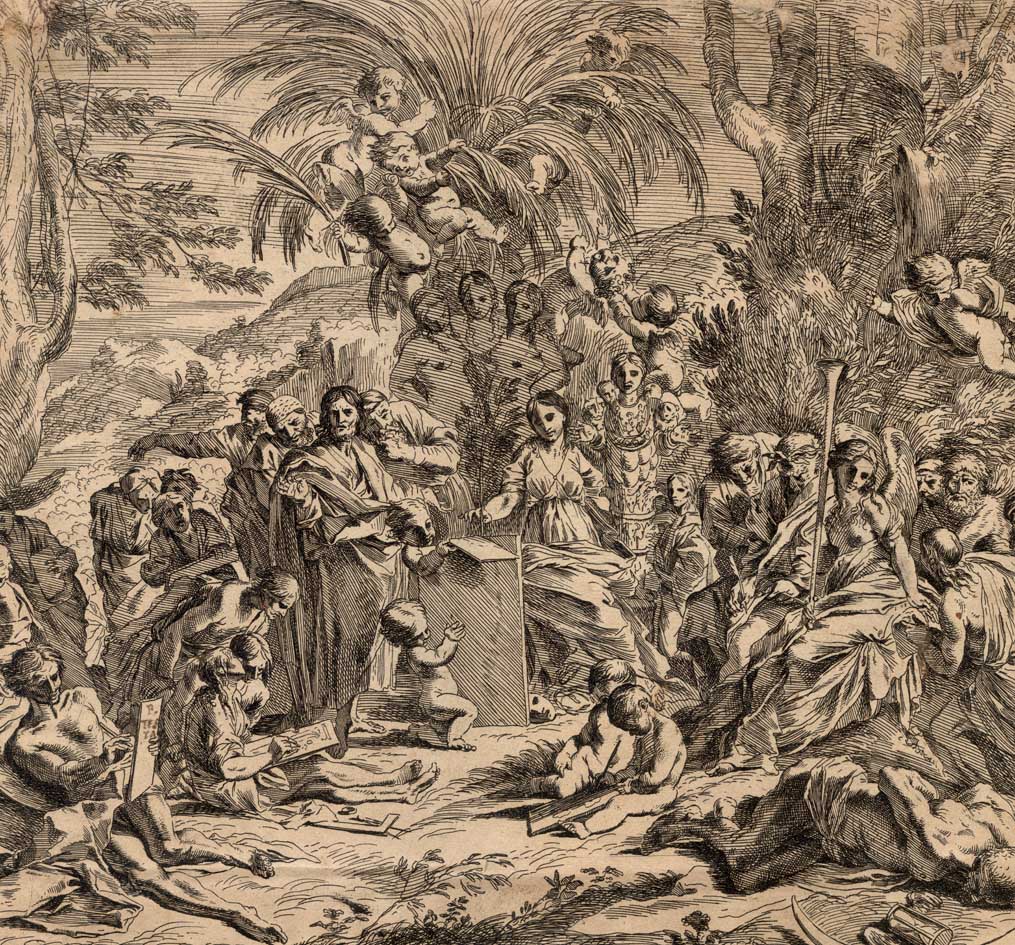
Pietro Testa’s etching, “An Allegory of Painting” (2nd impression), 1637–38


(After) Pietro Testa (1611–50)

“An Allegory of Painting”, 1637–38
Note: this is the same print held by the British Museum that TIB (vol. 45 Commentary, p. 157) describes as Copy 1 because the first line of the inscription below the image borderline ends with the words “chiamando la” while the original ends with the letters “chia.” This is also the second copy of “Allegory of Painting” that I have offered. The earlier listing (now sold) was for an impression in poor condition with restorations, while this impression is in near perfect—museum quality—condition with the full text lines and margins.

Etching on laid paper with margins and a collector’s stamp verso.
Size: (sheet) 29.4 x 34.4 cm; (plate) 27.8 x 32.7 cm
Lettered in the bottom margin with a dedication to Cardinal Franciotti and four lines of description.

Cropper 37; Bartsch 29 (see also TIB, 45 Commentary, p. 157); Bellini 5
The British Museum offers the following description of this print:
“Allegory of painting, who as an [sic] child in the centre left draws on a tablet and gazes upon nature in the centre.” (http://www.britishmuseum.org/research/collection_online/collection_object_details.aspx?objectId=1634465&partId=1&searchText=testa&page=2)

Condition: a near faultless impression in near perfect condition apart from minimal signs of handling over the centuries (i.e. there are no tears, holes, folds, abrasions, stains or foxing, but the verso shows a few minor marks and pencil notes from previous collectors).

I am selling this exceptionally rare print—so rare that the British Museum only has a very poor impression of it—for AU$360 (currently US$284.04/EUR240.41/GBP218.48 at the time of this listing) including postage and handling to anywhere in the world.

If you are interested in purchasing this important print after Testa (the original print must be so rare that it is not held in any online collection that I have found), please contact me (oz_jim@printsandprinciples.com) and I will send you a PayPal invoice to make the payment easy.


This print has been sold


From a personal standpoint, this etching is a visual crystallisation of Testa’s life in terms of what he valued and his attitude to death. What I mean by this bold assertion is that this etching celebrates the key principles that he valued and his acceptance that his work would live on despite setting himself on the dreadful trajectory of committing suicide.

Regarding Testa’s principles, he believed that the foundation to a good art education was the study of nature. Indeed, to quote from Elizabeth Cropper's (1984) “The Ideal of Painting: Pietro Testa’s Düsseldorf Notebook”, Princeton, “Testa castigates those poor teachers who tear their pupils away from the nourishing breast of Nature, feeding them instead such weak gruel that they fly into the arms of Ignorance” (p. 248; cited in Cropper [1988] “Pietro Testa”, p. 71).

Testa signifies his belief in the importance of studying nature by portraying the infants towards the centre of the composition drawing on tablets in the “proper” way. To the left of them Testa depicts a reclining figure in the act of painting with another artist behind him surveying the painter’s progress. This small interaction may be viewed as Testa’s second stage in an ideal student’s development: adding colour to drawing. Seated beside the painter is another artist who is drawing architectural elements. This component in an artist’s development is also important as Cropper (1988) points out: “Testa argues that the perfect painter must also master the principles of architecture" (p. 71).

I could keep working my way around each group of figures as each adds another dimension to Testa’s notions of ideal art practice, but the element that really catches my attention, and best summaries Testa attitude to art is shown at the lower-right corner of the composition: a man lying in a way that suggests his arms are bound behind him and beside him is a winged hourglass and a scythe. This figure is a constrained Father Time who is not able to hold his symbolic attributes. Of course, the significance of portraying time Father Time in this way—an ineffectual force that can no longer cut folk down and limit their stay in the world of the living— is that philosophically art can never die even if the artist may pass away. For me, the symbolism of this figure foreshadows Testa’s acceptance of his approaching death by suicide and the fact that we can still admire his artwork today.


Sunday, 5 March 2017

Pietro Testa’s etching, “An Allegory of Painting”, 1637–38


Pietro Testa (1611–50)
“An Allegory of Painting”, 1637–38
Etching on laid paper trimmed to the image borderline with old restorations, especially to the upper left corner where a loss has been redrawn in ink.
Size: (sheet) 26 x 32.7 cm
Cropper 37; Bartsch 29 (see also TIB, 45 Commentary, p. 157); Bellini 5

The British Museum offers the following description of this print (note: the impression that the BM holds is not the original print but rather a copy after the original):
“Allegory of painting, who as an [sic] child in the centre left draws on a tablet and gazes upon nature in the centre.” (http://www.britishmuseum.org/research/collection_online/collection_object_details.aspx?objectId=1634465&partId=1&searchText=testa&page=2)

Condition: well-inked and crisp impression trimmed to the image borderline. The sheet is in a poor condition (i.e. significant losses, abrasions, stains and age-toning) with old restorations.

I am selling this exceptionally rare print—so rare that the British Museum only has a copy of it—for AU$337 (currently US$255.80/EUR241.22/GBP208.27 at the time of this listing) including postage and handling to anywhere in the world.
If you are interested in purchasing this major print by Testra, please contact me (oz_jim@printsandprinciples.com) and I will send you a PayPal invoice to make the payment easy.

This print has been sold


From a personal standpoint, this etching is a visual crystallisation of Testa’s life in terms of what he valued and his attitude to death. What I mean by this bold assertion is that this etching celebrates the key principles that he valued and his acceptance that his work would live on despite setting himself on the dreadful trajectory of committing suicide.

Regarding Testa’s principles, he believed that the foundation to a good art education was the study of nature. Indeed, to quote from Elizabeth Cropper's (1984) “The Ideal of Painting: Pietro Testa’s Düsseldorf Notebook”, Princeton, “Testa castigates those poor teachers who tear their pupils away from the nourishing breast of Nature, feeding them instead such weak gruel that they fly into the arms of Ignorance” (p. 248; cited in Cropper [1988] “Pietro Testa”, p. 71).

Testa signifies his belief in the importance of studying nature by portraying the infants towards the centre of the composition drawing on tablets in the “proper” way. To the left of them Testa depicts a reclining figure in the act of painting with another artist behind him surveying the painter’s progress. This small interaction may be viewed as Testa’s second stage in an ideal student’s development: adding colour to drawing. Seated beside the painter is another artist who is drawing architectural elements. This component in an artist’s development is also important as Cropper (1988) points out: “Testa argues that the perfect painter must also master the principles of architecture" (p. 71).

I could keep working my way around each group of figures as each adds another dimension to Testa’s notions of ideal art practice, but the element that really catches my attention, and best summaries Testa attitude to art is shown at the lower-right corner of the composition: a man lying in a way that suggests his arms are bound behind him and beside him is a winged hourglass and a scythe. This figure is a constrained Father Time who is not able to hold his symbolic attributes. Of course, the significance of portraying time Father Time in this way—an ineffectual force that can no longer cut folk down and limit their stay in the world of the living— is that philosophically art can never die even if the artist may pass away. For me, the symbolism of this figure foreshadows Testa’s acceptance of his approaching death by suicide and the fact that we can still admire his artwork today.  


Wednesday, 28 December 2016

Giovanni Cesare Testa’s etching, “The Body of Christ Mourned by Angels” after Pietro Testa and Karel Dujardin's "The Battlefield"


Giovanni Cesare Testa (1630–55, Parma)
“The Body of Christ Mourned by Angels”, c.1650, after Pietro Testa (1612–50)
Etching on heavy laid paper with narrow margins.
Size: (sheet) 19.7 x 25.7 cm; (plate) 19.2 x 25.3 cm; (image borderline) 18.6 x 24.5 cm
State ii (of ii)
Inscribed in the image in the lower right corner “[entwined letters] PTL Lo: Ces: Testa Inc."; below, in a different script: “Gio Jacomo de Rossi formis Romae alla Pace”; above: “Pietro Testa Inv.”

The National Gallery of Scotland offers a description of this print and advises that the copy in their collection was purchased “July 1979 from Christopher Mendez for £15,500” (https://art.nationalgalleries.org/art-and-artists/134477/dead-christ-mourned-angels?page=1&artists[21380]=21380&search_set_offset=79)
The British Museum holds one of the original drawings by Pietro Testa used for this print. The curator’s discussion about this drawing and its extension into other artworks is very interesting; see http://www.britishmuseum.org/research/collection_online/collection_object_details.aspx?objectId=714150&partId=1&searchText=cesare+testa&view=list&sortBy=objectTitleSort&page=1

Provenance: collection of Conrad Baumann v. Tischendorf
Nagler 5 II

Condition: crisp and well-printed impression with narrow margins in very good condition. The print is affixed to a support sheet at the upper corners (verso). There is a light stain slightly to the left of centre on the lower edge and there are other areas of minor toning.

I am selling this exceptionally rare print for a total cost of AU$437 (currently US$314.71/EUR301.18/GBP256.78 at the time of this listing) including postage and handling to anywhere in the world.
If you are interested in purchasing this startling and anatomically fine portrayal of Christ, please contact me (oz_jim@printsandprinciples.com) and I will send you a PayPal invoice to make the payment easy.

This print has been sold


Giovanni Cesare Testa’s printmaking career is somewhat shrouded in mystery. One thing is certain, however, his prints are rare and seldom found on the market and they command high prices (for example the National Gallery of Scotland acquired their copy of this print in “July 1979 from Christopher Mendez for £15,500” according to the gallery’s website). A part of the mystery surrounding GC Testa is that the main source of documentation about him is written by Filippo Baldinucci “(1847) in “Notizie dei professori del disegno da Cimabue in qua …” (reprinted in 1974) which Elizabeth Cropper (1988) in “Pietro Testa 1512–1650: Prints and Drawings” advises is “not especially accurate” (p. 240). Nevertheless, from what I understand, GC Testa was P Testa’s nephew on his father’s side. The details that I am choosing to ignore is the claim that GC Testra was born in 1640 and that his printmaking career was condensed to just the five years after the death of P Testa. One intriguing glimpse into GC Testa’s life is made by Giovanni Battista Passeri (1679) in “Die Künstlerbiographien” (Ed. Jacob Hess, 1934) with the curious comment that GC Testa’s “death was not so worthy of compassion.” (p. 188; see also Cropper [1988] p. 240).

If I may leave the mire of information and misinformation surrounding GC Testa for the others to ponder, what I love about this print is how well the figure of the dead Christ is drawn. Indeed, the drawing of this figure is so confidently handled—apart from the torso that may be a little too schematic in the delineation of musculature—that it compares very favourably with the dead figure portrayed in Karl Dujardin’s (1622–78) “The Battlefield” (1652) that the great master, Walter Sickert, proposed: “Enlarged photographs of the naked corpse should be in every art school as a standard of drawing from the nude” (Clifford S Ackley 1981, “Printmaking in the Age of Rembrandt”, Museum of Fine Arts, Boston, pp. 214–5).


Karel Dujardin (aka Carel Dujardin) (1622–78)
“The Battlefield” [La champ de bataille], 1652
Etching and drypoint on fine laid paper
State II (of II)
(sheet) 16.2 x 19.3 cm
Bartsch 1.28 (181); Hollstein 28.ii
See descriptions of this print at Auckland Art Gallery
Condition: Marvellous impression in excellent condition trimmed on, or within, the platemark. There are conservator hinges attached verso from previous mounting.
I am selling this very famous original etching by Dujardin for a total cost of AU$206 (currently US$147.82/EUR142.06/GBP120.86 at the time of this listing) including postage and handling to anywhere in the world.
If you are interested in purchasing this print, please contact me (oz_jim@printsandprinciples.com) and I will send you a PayPal invoice to make the payment easy.


This print has been sold