Showing posts with label Martsen (Jan). Show all posts

Sunday, 21 January 2018

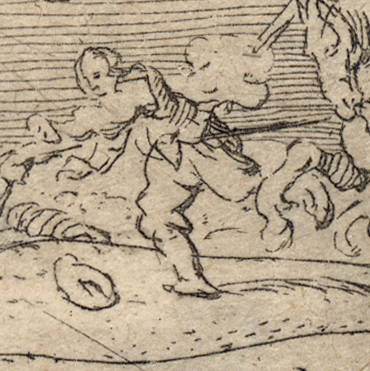
Jan Martsen’s etching “Three cavalrymen engaged in close combat”, c1640


Jan Martsen (aka Jan Martsz. de Jonghe; Jan Marsse; Jan Maertsen; Jan de Jonge Martszen) (1609–1647/8)

“Three cavalrymen engaged in close combat” (BM descriptive title [see S.5000), c1640 (note: the Rijksmuseum propose dates between 1619 and 1649 and the British Museum propose dates between 1630 and 1650), plate 2 from the series, “Cavalry Battles”, most likely published by Claes Jansz. Visscher (1587–1652).


Etching on fine laid paper trimmed close to the image borderline with a collector’s stamp verso.
Size: (sheet) 11.7 x 17.8 cm
Lettered in lower right corner "2 / M.D.Jonge.fe"
State ii (of ii?) See a copy of the first and second states at the Rijksmuseum: (unlettered first state) http://hdl.handle.net/10934/RM0001.collect.150215  and (lettered second state) http://hdl.handle.net/10934/RM0001.collect.150216

Hollstein 2-2 (3) (F W H Hollstein 1949, “Dutch and Flemish etchings, engravings and woodcuts c.1450–1700”, Amsterdam)

The British Museum offers the following description of this print:
“Three cavalrymen engaged in close combat; on the ground lies a dead soldier and a discarded pistol.”

Condition: crisp and strong impression trimmed at the image borderline in excellent condition (i.e. there are no tears, holes, folds, abrasions, stains or foxing).

I am selling this small and very rare print exemplifying the spirit for dramatic battle scenes by Dutch printmakers in the early 1600s for AU$218 (currently US$174.5/EUR142.72/GBP125.94 at the time of posting this listing). Postage for this print is extra and will be the actual/true cost.

If you are interested in purchasing this fascinating etching offering an insight into early combat on horseback, please contact me (oz_jim@printsandprinciples.com) and I will send you a PayPal invoice to make the payment easy.

This print has been sold


One of the key principles of composition is to use an odd number of subjects. The reason for this principle in art is the same as the principle of choosing an odd number of people for a committee: in committee meetings odd numbers of committee members allow for clear resolutions to be passed and, in the case of art, odd numbers of subjects allow for a single centre of interest.

In this battle scene, for example, the composition is structured around the three figures on horseback at the centre of the scene with the figure wearing a cuirass in the middle of the three figures catching the viewer’s eye as the centre-of-interest. Interestingly, this middle figure holds the composition and the action of the scene together in a literal way. After all he is about to defend himself with his rapier against the attack of the figure on the right while the figure on the left thrusts a pistol into his chest.

Regarding the compositional arrangement of the middle figure as the centre-of-interest, note how the abandoned pistol shown at the lower right corner “points” towards the centre figure, as do the rear legs of the horse on the left, the tail of the centre figure’s horse and the reins held by the figure on the right. Going further, note also how the angle of the raised sword held by the distant figure on the far left continues the line of the pistol thrust into the centre figure’s chest. 


Tuesday, 21 November 2017

Jan Martsen’s etching “Cavalry soldiers with pistols on galloping horses”, c1640


Jan Martsen (aka Jan Martsz. de Jonghe; Jan Marsse; Jan Maertsen; Jan de Jonge Martszen (1609–1647/8)

“Cavalry soldiers with pistols on galloping horses” (BM descriptive title [see S.5005), c1640, plate 4 from the series, “Cavalry Battles”, published by Claes Jansz. Visscher (1587–1652). 

Etching on fine laid paper with small margins lined onto a conservator’s support sheet of washi paper.
Size: (sheet) 8.8 x 11.9 cm; (plate) 8.1 x 11.2 cm
Inscribed on the plate at lower edge: "CJVisscher ex.”; “MDIonge.fecit"
Numbered on the plate at lower right: “4”

Hollstein 7 (F W H Hollstein 1949, “Dutch and Flemish etchings, engravings and woodcuts c.1450-1700”, Amsterdam); Nagler 5; Nagler Monogrammisten III, 2852 (G K Nagler 1835, “Neues allgemeines Künstler-Lexikon”, 22 vols, Munich)
The British Museum offers a description of this print; see:

Condition: slightly silvery impression with light retouching (almost invisible) of small areas of abrasion/plate wear otherwise in excellent condition (i.e. there are no tears, holes, folds, stains or foxing).

I am selling this marvellous and very rare print exemplifying the spirit for dramatic battle scenes by Dutch printmakers in the early 1600s, for AU$196 (currently US$148.48/EUR126.63/GBP112.07 at the time of posting this listing) including postage and handling to anywhere in the world.

If you are interested in purchasing this almost iconic image of a cavalry charge with a surprisingly early representation of a circle of bullet “smoke” shot from a distant figure on horseback—a device that illustrators term as an “agitron”—please contact me (oz_jim@printsandprinciples.com) and I will send you a PayPal invoice to make the payment easy.

This print has been sold


One of the key advances in 17th century printmaking (said half-jokingly) was the discovery that viewers liked to see rearing horses. Antonio Tempesta was arguably the first to show horses in this way in his battle themed etchings beginning in the 1590s (see the argument presented by Eckhard Leuschner [2003] in his essay, “Censorship and the Market: Antonio Tempesta’s ‘New’ subjects in the Context of Roman Printmaking ca. 1600” in “The Art Market in Italy 15th–17th Centuries”, pp.69–70). By the time that Martsen made this etching in around 1640 there was even an expectation that battle-scenes would feature rearing horses.

For those who share my interest in the positions of horses’ legs when horses rear upwards, I have stumbled upon a few terms that are useful to know for after-dinner conversations focussing on the ways in which horses can make their rider’s position uncomfortable when rearing.

My favourite of these terms, often used by cowboys who like to fish on the weekends, is the “sun fish” manoeuvre of a horse which the website, “Cowboy Showcase: Home of the Western Spirit”, explains is “when a bronc bucks and twists its body into a crescent, and throws head alternately to right and left...looks as though he is trying to sun both sides of his body.” (http://www.cowboyshowcase.com/horse-terms.html#.WhPtI0qWaUk)

Another useful term to know about is the “Swap ends” manoeuvre, explained again by “Cowboy Showcase” to be “when a bronc is bucking and goes up facing one direction but lands facing the opposite direction.” (loc. cit.)

Regarding Martsen’s familiarity with such horse manoeuvres, I really don’t know. Nevertheless, I see clear evidence that he believes (perhaps incorrectly) that when a horse is in its early stage of rearing and its back legs are under full tension in a near squat position that its front legs are symmetrically aligned, as opposed to its right leg being extended slightly forward of its left leg and with the right hoof slightly straightened. Although I may be unduly picky about what I see here and in his drawings, such as “Charge of the Cavalry”, 1630 (see https://rkd.nl/nl/explore/images/record?query=+Jan+Martszen+de+Jonge&start=17), Martsen’s arrangement of legs suggests that knowledge about how horses really move may still have been in its infancy.