Showing posts with label Lefebvre (Jules Joseph). Show all posts

Monday, 24 June 2019

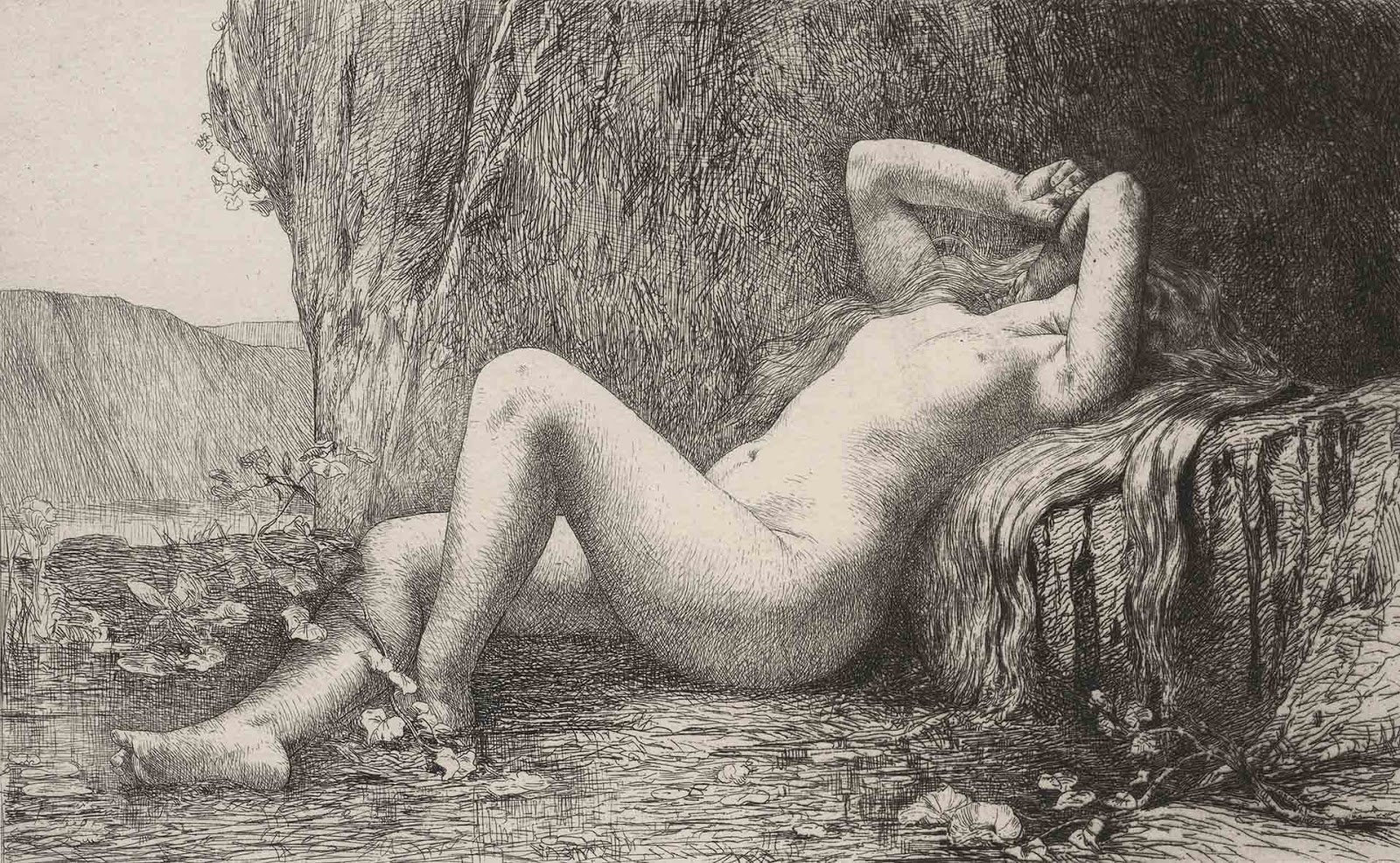
Jules Joseph Lefebvre's etching, “Madeleine”, c1876


Jules Joseph Lefebvre (aka Jules Joseph Lefevre; Jules Lefebvre) (1836–1911)

“Madeleine”, c1876, after the painting by the artist, “Mary Magdalene In the Cave”, 1876, exhibited in the Salon of 1876 and now in the collection of the Hermitage Museum (Saint Petersburg). This etching was published in “'La Gazette des Beaux-Arts” and printed by Alfred Salmon (aka Alfred Fortuné Salmon) (fl.1863–94) in Paris.

Etching on laid paper with small margins and backed with a support sheet.
Size: (sheet) 18 x 24.6 cm; (plate) 15.1 x 22.3 cm; (image borderline) 12.4 x 20.1 cm.
Lettered on plate below the image borderline: (left) “JULES LEFEVRE PINX & SCULP. / Gazette des Beaux-Arts.”; (centre) “MADELEINE”; (right) “SALON DE 1876 / Imp. A. Salmon, Paris.”

Beraldi 1885-92 6 (Henri Beraldi 1885, “Les Graveurs du dix-neuvième siècle”, 12 vols plus supplement, Paris); IFF undescribed (Département des Estampes 1930, “Inventaire du Fonds, Français: graveurs du XVIIe siècle”, Paris, Bibliothèque Nationale).

The British Museum offers the following description of this print:
“St Mary Magdalene, lying naked in landscape”

For those unfamiliar with the portrayed subject, legend proposes that after Christ’s crucifixion, Saint Marie Madeleine (Mary Magdalene) travelled by a rudder-less boat to the coast of Provence and “spent the last 30 years of her life in prayer and meditation in a mountain cave in the sacred forest of La Saint Baume. As the story goes, her only sustenance was the Holy Eucharist, which she received on a daily basis from angels.” (http://www.marymagdalenewisdom.com/the-cave-of-magdalene)

Condition: near faultless impression backed with a support sheet of fine archival/millennium quality washi paper. There are flattened creases in the lower margin otherwise the sheet is in excellent condition (i.e. there are no tears, holes, abrasions, stains, foxing or significant signs of use).

I am selling this sensitive and very sensual depiction of Mary Magdalene resting outside her cave—the Sainte-Baume grotto—for AU$220 (currently US$152.95/EUR134.23/GBP120.04 at the time of this listing) including postage and handling to anywhere in the world (but not, of course, any import duties/taxes imposed by some countries).

If you are interested in purchasing this beautifully rendered nude showing finely tuned contrasts between the pale tones and softness of the saint’s skin set against the darker tones and coarse textures of her surroundings, please contact me (oz_jim@printsandprinciples.com) and I will send you a PayPal invoice to make the payment easy.

This print has been sold


Friday, 5 August 2016

William Julian-Damazy’s etching, “Violetta”, after Jules Joseph Lefebvre


William Julian-Damazy (1865–c1920) after Jules Joseph Lefebvre (1836–1911)
“Violetta”, 1896, published by the Société des amis des arts
Etching and engraving on cream wove paper (Japon/Japanese vellum) with a remarque of a violet below the image, blind stamped (below the image lower right) with the seal of the Société des amis des arts
Size: (sheet) 44 x 31.1 cm; (plate mark [faint]) 33.7 x 23.8 cm; (image) 27.4 x 18.6 cm
Inscribed within the image (upper left) “Jules LeFebvre”
Condition: crisp impression in pristine condition.

I am selling this beautifully executed engraving in (rare) perfect condition, for a total cost of AU$97 (currently US$74.32/EUR66.61/GBP56.47 at the time of this listing) including postage and handling to anywhere in the world.
If you are interested in purchasing this masterwork of engraving, please contact me (oz_jim@printsandprinciples.com) and I will send you a PayPal invoice to make the payment easy.

This print has been sold


Among the many attributes of this fine print, there are two features in particular that amaze me.

The first is the stunning treatment of the girl’s hands arranged almost tangentially at the lower borderline. Beyond the visually arresting placement of the hands, they are also beautifully drawn. In fact, my eyes have great difficulty even seeing the fineness of the line work that renders them—even with my glasses focused on the hands only centimetres from the paper. For me, they are portrayed with such finely adjusted tonal nuance that the only words I can find to describe the treatment is: “breathtakingly delicate.”

The second feature that I find amazing is more of a formal technical nature: the evenness of the tonal gradation portraying the sweep of background tone from medium grey at the bottom to almost black at the top. On close examination, I can see how the artist has made the gradation using lightly laid diagonal strokes on top of a horizontal and vertical crosshatching, but the virtuosity to make the transition from light to dark is almost seamless. This reveals Julian-Damazy’s high order of technical skills just as much as the finely rendered features of the young woman.

I can understand how some viewers would dismiss prints like this as simply “nineteenth century romantic syrup.” From my standpoint, however, I can ignore the slight touch of saccharine and examine it without a moment of boredom.