Showing posts with label Dietricy (Christian Wilhelm Ernst). Show all posts

Thursday, 13 March 2025

Christian Wilhelm Ernst Dietricy, “St. William, The Hermit Saint”, 1760

Christian Wilhelm Ernst Dietricy (aka Christian Wilhelm Ernst Dietrich) (1712–1774)

“St. William, The Hermit Saint” (aka “Heiliger Wilhelm”; “Paysage, oit l'on voit S. Guillaume” [Le Blanc]), 1760, etching in the manner of Salvator Rosa (1615–1673). See the brief description of this print offered by the Cleveland Museum of Art: https://www.clevelandart.org/art/1971.288.  

Etching on laid paper with a thread margin around the platemark, backed with a support sheet providing wide margins

Size: (sheet) 18.5 x 13.9 cm; (plate) 18.3 x 13.8 cm

Inscribed in plate: (left of centre on upper edge) “63”; (upper right corner) “Dietricy”.

State ii (of iii) before the number (“63”) is effaced in the third state.

Le Blanc (Charles Le Blanc 1856, “Manuel de l'amateur d'estampes, contenant un dictionnaire des graveurs de toutes les nations: ouvrage destiné à faire suite au Manuel du libraire par J.Ch. Brunet”, vol. 2, Paris, P. Jannet, p. 131, cat. no. 109 state ii); Linck 161 (JF Linck 1846, “Monographie der von C. W. E. Dietrich radierten, geschabten und in Holz geschnittenen malerischen Vorstellungen”, Berlin).

Condition: a strong and well-printed (faultless) impression with a thread margin around the platemark and laid onto a support of millennium quality washi paper providing wide margins. The sheet is in a pristine condition with no tears, holes, folds, abrasions or stains.

I am selling this fascinating image of the French hermit who was beatified in 1202 and died in 1157, Saint William (aka William of Maleval; Guillaume de Malavalle; William the Hermit; William the Great), bound against a rock with his upraised arms tied by the wrists to a tree—possibly as an act of penitence for sins committed in his earlier years in the military?— for AU$296 (equivalent to approximately US$186.27, EUR 171.80, or GBP 143.97 at the time of listing) and includes Express Mail Service (EMS) postage and handling to any worldwide destination. Please note that any import duties or taxes levied by the destination country are the responsibility of the buyer and are not included in the purchase price. Payment is requested in Australian dollars (AU$296).

If you are interested in purchasing this superb etching, please contact me (oz_jim@printsandprinciples.com) and I will send you a PayPal invoice to make the payment easy.


Wednesday, 17 January 2024

Christian Wilhelm Ernst Dietrich’s etching, “The Hermitage between Rocks”, 1743

Christian Wilhelm Ernst Dietrich (aka Christian Wilhelm Ernst Dietricy) (1712–1774)

“The Hermitage between Rocks” (aka “Die Einsiedelei zwischen Felsen”; “Landschap met kluizenaarswoning” “Landscape with Hermitage”), 1743.

Etching on fine laid paper with a narrow margin around the platemark and image borderline. Verso has two collectors’ marks: Lugt no. 492 (p. 90) and another not described in Lugt.

Size: (sheet) 9.8 x 14.7 cm; (platemark faint); (image borderline) 8.6 x 13.7 cm.

Inscribed in plate: (upper left corner) “D. 1743.”; (upper right edge in sky near tree) “44”.

State iii (of iv) with the addition of the number “44” at upper right next to tree branches and before this number is erased in the fourth state.

Linck 145 (J F Linck 1846, “Monographie der von dem vormals K. Poln. und Churfürstl. Sächs. Hofmaler und Professor etc. C. W. E. Dietrich radirten, geschabten und in Holz geschnittenen . Abrisse der Lebensgeschichte des Künstlers”, Berlin, pp. 237–38, cat. no. 145).

J F Linck (1846) offers the following description of this print: (transl.) “Under large, only partially overgrown rocks, almost in the middle of the page, you can see a hermit's hut, in front of which a saint's house and a large wooden cross are erected. Smoke can be seen rising from the chimney of the hermitage. Further to the right, a depression under the rock appears to form the entrance to a cave. On the left you can see a large waterfall and distant mountains above it” (pp. 237-38).

The Rijksmuseum and the British Museum offer descriptions of this print in its second state: http://hdl.handle.net/10934/RM0001.COLLECT.105703; https://www.britishmuseum.org/collection/object/P_1855-0609-40.

Condition: a strong and well-printed impression trimmed with a small margin around the image borderline. Verso has remnants of mounting, ink collectors’ stamps and pencil notations. The sheet has minor age-toning and is a good condition with no tears, holes, folds or significant stains.

I am selling this curiously interesting small etching showing the humble dwelling of a hermit with a crudely erected cross and a wayside shrine symbolically announcing the owners’ ascetic retreat from everyday life—note that the interest in showing such simple hermitages meshed well with the leaning (especially in Germany) for valuing the landscape as a place of solace and regeneration with (arguably) female hermits choosing their abodes closer to town than male hermits—for AU$246 in total (currently US$161.55/EUR148.22/GBP127.33 at the time of posting this listing) including postage and handling to anywhere in the world, but not (of course) any import duties/taxes imposed by some countries.

If you are interested in purchasing this luminous etching of a hermitage tucked into a rocky outcrop with a waterfall and stream at left and a forest at right, please contact me (oz_jim@printsandprinciples.com) and I will send you a PayPal invoice to make the payment easy.


Wednesday, 1 February 2023

Johann Christian Klengel’s etching “Herd of Cattle in Front of Ruins”, 1775

Johann Christian Klengel (1751–1824)

“Herd of Cattle in Front of Ruins” (aka “Viehherde vor Ruine”; “Landschap met ruïne op een rots waarvan aan de voet een herder met kudde” [Rijksmuseum title]; “Landscape with a Ruin on a Rock at the Foot of which a Shepherd with Herd”), 1775, from the series of twelve etchings, “XII Different Landscapes Invented and Etched by Johann Christian Klengel” (aka “XII verschiedene Landschafften erfunden und radirt von Johann Christian Klengel”).

Etching on laid paper, trimmed within the image borderline on the left and the right sides with loss of the artist’s name and date (1775) inscribed below the image, backed with a support sheet.

Size: (support sheet) 34 x 32 cm; (sheet) 16.3 x 16.3 cm.

Fröhlich G.66 (Anke Fröhlich 2005, “Glücklich gewählte Natur. Der Dresdner Landschaftsmaler Johann Christian Klengel (1751-1824): Monographie und Werkverzeichnis der Gemälde, Zeichnungen, Radierungen und Lithographien”, Hildesheim, George Olms, p. 327, cat. no. G.66).

The Rijksmuseum offers a description of this print (not reproduced): http://hdl.handle.net/10934/RM0001.COLLECT.132640.

Condition: a strong impression, trimmed significantly within the platemark and laid onto a backing sheet.

I am selling this very beautiful etching showing a woman and a man leading a mixed herd of livestock along a road running near a ruin—note that I originally thought that the ruin was a citadel tower, but I now understand that it may instead be a part of a Roman aqueduct (see https://www.heimatkreis-kesselsdorf.de/christian-klengel/)— for the total cost of AU$246 (currently US$173.88/EUR159.95/GBP141.21 at the time of this listing) including postage and handling to anywhere in the world, but not (of course) any import duties/taxes imposed by some countries.

If you are interested in purchasing this sun drenched etching that (to my eyes) shows the influence of the artist's etching teacher, the stylistically versatile, Wilhelm Ernst Dietrich (commonly called Dietricy) (1712–1774)—see a print by this artist that I’ve listed previously and is presently available: https://www.printsandprinciples.com/2020/10/christian-wilhelm-ernst-dietrichs.html—please contact me (oz_jim@printsandprinciples.com) and I will send you a PayPal invoice to make the payment easy.


Saturday, 30 April 2022

Christian Wilhelm Ernst Dietrich’s etching, “The Hermit on the Bridge”, 1744


Christian Wilhelm Ernst Dietrich (aka Christian Wilhelm Ernst Dietricy) (1712–1774)

“The Hermit on the Bridge” (aka “Der Einsiedler auf der Brücke”; “Landschap met kerk en links een kluizenaar op de brug”; “Landscape with a Church Amid Trees on a Mound and a Wooden bridge”), 1744, after a pen and black ink drawing by the artist in the collection of the British Museum (see https://www.britishmuseum.org/collection/object/P_1854-1020-320). Not that the British Museum does not appear to hold a copy of this etching. 

Etching on laid paper with a narrow margin around the platemark and backed with a support sheet.

Size: (sheet) 16 x 19.7 cm; (plate) 15.3 x 19 cm.

State iii (of v) with the reworked fir trees in the abyss and rock at right added by Dietrich in 1764 and with the mottled toning to the sky above the bridge added by Adrian Zingg (1734–1816), but before the addition of the number “54” at upper right corner. Alternatively, this impression may be from state v with the number erased, but this is unlikely as there are still traces of the borderline on the right which is no longer visible in state iv (see Linck [1846] pp. 238–240).

Linck 146 (J F Linck 1846, “Monographie der von dem vormals K. Poln. und Churfürstl. Sächs. Hofmaler und Professor etc. C. W. E. Dietrich radirten, geschabten und in Holz geschnittenen . Abrisse der Lebensgeschichte des Künstlers”, Berlin, pp. 238–240, cat. no. 146).

The Rijksmuseum offers descriptions of this print in its first and second states: (state i) http://hdl.handle.net/10934/RM0001.COLLECT.105704; & (state ii) http://hdl.handle.net/10934/RM0001.COLLECT.105705.

Condition: a richly inked and well-printed impression trimmed with a narrow margin around the platemark and laid onto a support of archival (millennium quality) washi paper. There are replenished losses to the margin, otherwise the sheet is in a very good condition with no stains or foxing.

I am selling this curiously interesting etching—note the unusual composition with the vertical alignment of the foreground fir tree and distant bell tower, and what I see as a stylistic leaning to the sparkling landscapes of Allaert van Everdingen (1621–1675)—for AU$215 in total (currently US$151.93/EUR144.03/GBP120.87 at the time of posting this listing) including postage and handling to anywhere in the world, but not (of course) any import duties/taxes imposed by some countries.

If you are interested in purchasing this portrayed sundrenched landscape with a distant hermitage (according to J F Linck [1846]) and a monk with a cane crossing a bridge above a waterfall by an artist who is famous for his considerable skill in referencing the styles of earlier artists—please contact me (oz_jim@printsandprinciples.com) and I will send you a PayPal invoice to make the payment easy.


Friday, 15 October 2021

Christian Wilhelm Ernst Dietrich’s etching, “The River Between High Rocky Banks”, 1744 (2nd copy)

Christian Wilhelm Ernst Dietrich (aka Dietricy) (1712–1774)

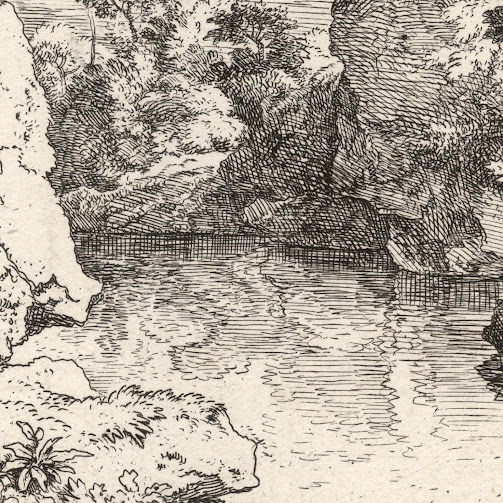
“The River Between High Rocky Banks (In Manner of Salvator Rosa)” (aka “Der Fluß zwischen hohen Felsenufern”), 1744.

Etching on laid paper trimmed with a small margin around the platemark and backed with a support sheet.

Size: (support sheet) 29.2 x 33.2 cm; (sheet) 15.8 x 21cm; (plate) 15.1 x 20.4 cm; (image borderline) 14.9 x 20.1 cm.

Inscribed in plate at lower right: “Dietricy f 1744”.

Linck 148 iv (of iv) with the plate number (“56”) erased from the upper right corner.

Linck 148 iv (J.F. Linck 1846, “Monographie der von C.W.E. Dietrich radierten, geschabten und in Holz geschnittenen malerischen Vorstellungen”, Berlin, Rudolph Weigel, pp. 242–143, cat. number 148 [see: https://digital.slub-dresden.de/werkansicht/dlf/105498/256]).

J.F. Linck (1846) offers the following description of this print:

(Google Transl.) “From the center of the background, to the right, a river flows between high rocky banks, the front almost half the width  of the image. On the left you can see, next to a large piece of rock, the trunk of a large, half-uprooted tree, the branches of which extend beyond the upper edge of the plate.  The right bank of the river is overgrown with trees in several places. Except for a few birds hovering in the air, the landscape is not animated by any staffage.” (p. 242).

See also the British Museum’s description of this print: https://www.britishmuseum.org/collection/object/P_1855-0609-43.

Condition: a strong impression with small margins and laid onto a support of archival (millennium quality) washi paper. There is an area of replenished loss to the upper margin and lower left corner; otherwise the sheet is in a very good condition with no significant stains or foxing.

I am selling this 1744 nature study executed in the style of Salvator Rosa for the total cost of AU$294 (currently US$218.30/EUR188.08/GBP158.75 at the time of posting this listing) including postage and handling to anywhere in the world, but not (of course) any import duties/taxes imposed by some countries.

If you are interested in purchasing this remarkably strong etching of light catching on the surfaces of rocks, trees and water, please contact me (oz_jim@printsandprinciples.com) and I will send you a PayPal invoice to make the payment easy.

Note that this is the second copy of this print that I have listed. Thre previous impression has been sold.

Sadly, Dietericy is not fondly remembered by the gatekeepers of history. The reason for this clouded view of his reputation as a printmaker is not so much that he did not have amazing technical skill—I cannot imagine any academic who would propose that criticism. In fact, the "problem" is all about his high level of skills regarding his dexterity at being able to reproduce other artists’ styles (i.e. to appropriate them as his own). In this etching, for instance, the image smacks the eye with the style of Salvator Rosa in terms of his contouring of forms (e.g. in the curved marks rendering the tree limbs), his use of tiny breaks in the outlining of forms (e.g. the dotted outline of the tree limbs on the upper left) and his free handling of linework—almost calligraphic—where the speed that the marks are laid is reflected in the tiny return strokes at the ends of the lines (e.g. the “sketchy” strokes representing water reflections) … and a plethora of other stylistic traits.