Showing posts with label Salamanca (Antonio). Show all posts

Thursday, 5 February 2026

Enea Vico, (right fragment) “Statues of Minerva and a Woman”, 1541

Enea Vico (1523–1567)
(Right fragment) “Statues of Minerva and a Woman,” 1541

Technical Details & Condition:
Engraving on laid paper, trimmed around the right figure of a larger composition (see https://www.britishmuseum.org/collection/object/P_V-8-52), depicting two archaic sculptures—the left figure representing the goddess Minerva—and backed with a support sheet.

The artist’s name is inscribed within the plate, featuring his initials “E.V” on the tablet at right, along with the publisher’s initials “A. S.” for Antonio Salamanca (1478–1562), and the date of publication, “1541,” lettered along the lower edge of the sheet.

The impression is strong and well-printed. The sheet, as a fragment of a larger composition, shows some restored losses along the edges and minor stains, consistent with its age and fragmentary nature.

Dimensions:
• Sheet: 23.5 x 90 cm

References:
• TIB 30.44 (John Spike [ed.], The Illustrated Bartsch: Italian Masters of the Sixteenth Century: Enea Vico, vol. 30, 1985, New York, Abaris Books, p. 61, cat. no. 44)
• The British Museum: Same fragment of the larger composition — https://www.britishmuseum.org/collection/object/P_Ii-5-76

Price & Shipping:
AU$288 (approximately US$200.01 / €169.59 / £147.61), including worldwide express shipping. Import duties and taxes are the buyer’s responsibility.

If you are interested in acquiring this rare 1541 engraving of an ancient sculpture—possibly representing Urania, the muse of Astronomy, though her defining attributes of a celestial globe and compass are now lost—please contact me at oz_jim@printsandprinciples.com. I am happy to provide a secure PayPal invoice for a seamless purchase.

This print has been sold 


Monday, 10 March 2025

Master of the Die, “Apuleius Changed into a Donkey”, c.1527, after Michiel Coxie I

Master of the Die (fl.1522–33)

Note the “Benezit Dictionary of Artists” (2005) proposes that the Master of the Die may be Bernardo Daddi (fl.c.1530–1660) and the British Museum proposes that the artist may be Tommaso Vincidor (1493–1536); see https://www.britishmuseum.org/collection/term/BIOG37609.

“Apuleius Changed into a Donkey” (TIB title), c.1527 (1520–1535), plate 1 from the series of thirty-two plates (second version with verses and plate number), “Fable of Psyche” (TIB title) (aka "The Story of Cupid and Psyche as told by Apuleius" [MET title]), after the design by Michiel Coxie I (aka Michiel van Coxcyen) (1490–1592), published in Rome by Antonio Salamanca (1478–1562).

Engraving on fine laid paper with a narrow margin around the platemark, backed with a support sheet providing wide margins.

Size: (sheet) 21 x 24.2 cm; (plate) 20.1 x 23.6 cm; (image borderline without the writing edge) 17.3 x 23.2 cm

Inscribed in plate within the image borderline: (lower right) “Ant. Sal exc./ Sup: lic:”

Numbered twice in plate at lower left: “1”.

Lettered in plate below the image borderline in four lines of Italian in two columns: “Narra Apulcó, che(mentr' egli cangiato/ In Asino, seruiua à genti ladre)/ Vua sposa rubbaro il destinato/ Didele nozze le rapaci squadre.// Cui (per farle scordare un sogno ingrato)/ Dona conforto una canuta madre,/ Che l'hauea in guardia, et con grata fauella/ Le racconta di Psiche la nouella.” ([Google Transl.] “Apulco narrates that (while he was changed/ Into a donkey, he was serving thieving people)/ His destined bride was stolen/ By the rapacious squads of his men.// To whom (to make her forget an unpleasant dream)/ A gray-haired mother comforted/ Who kept her on guard, and with a pleasant tongue/ Recounted to her the story of Psyche.”).

State iii showing Antonio Salamanca as the publisher (see the explanation of the various states offered by the Curator of the BM: https://www.britishmuseum.org/collection/object/P_M-44-2 [BM inv. no. M,44.2]).

TIB 29.39 (Suzanne Boorsch [ed.] 1982, “The Illustrated Bartsch: Italian Masters of the Sixteenth Century”, vol. 29, Abaris Books, New York, p.195, cat no. 39); Bartsch XV.212.39 (Adam Bartsch 1803, “Le Peintre graveur”, vol. 15, Vienna)

The British Museum offers the following description of this print: “Plate 1: Apuleius changed into a donkey listening to the story told by an old woman/ Engraving” (https://www.britishmuseum.org/collection/object/P_L-67-1 [BM inv. L,67.1]).

Condition: a strong and well-printed impression with a small margin around the image borderline. Beyond surface unevenness in the writing edge and fractures in the upper right edge, the sheet is in a very good condition with no tears, holes, folds, abrasions, or significant stains.

I am selling this curiously interesting and very beautiful engraving by the 16th century printmaker whose work is often inscribed with a symbol of a dice—hence the artist’s descriptive title, “Master of the Die”—for AU$377 (equivalent to approximately US$238.28, EUR 220.15, or GBP 184.88 at the time of listing) and includes Express Mail Service (EMS) postage and handling to any worldwide destination. Please note that any import duties or taxes levied by the destination country are the responsibility of the buyer and are not included in the purchase price. Payment is requested in Australian dollars (AU$377).

If you are interested in purchasing this superb print from the Renaissance era not only exemplifying an interest at the time for classical mythology, but also showing a use of the distaff—the spindle for spinning fibre that, I understand, was a woman’s weapon of choice when battling men—as a symbol of female power, please contact me (oz_jim@printsandprinciples.com) and I will send you a PayPal invoice to make the payment easy.

This print has been sold


Tuesday, 26 November 2024

Master of the Die, “Psyche Enters the Underworld”, 1530–60, after by Michiel Coxie I

Master of the Die (fl.1522–33)

Note the “Benezit Dictionary of Artists” (2005) proposes that the Master of the Die may be Bernardo Daddi (fl.c.1530–60) and the British Museum proposes that the artist may be Tommaso Vincidor (1493–1536); see https://www.britishmuseum.org/collection/term/BIOG37609.

“Psyche Enters the Underworld” (TIB title), 1530–60, plate 26 from the series of thirty-two plates (second version with verses and plate number), “Fable of Psyche” (TIB title) (aka "The Story of Cupid and Psyche as told by Apuleius" [MET title]), after the design by Michiel Coxie I (aka Michiel van Coxcyen) (1490–1592), published in Rome by Antonio Salamanca (1478–1562).

Engraving on fine laid paper. This is a rare early impression still retaining the lettering guide lines.

Size: (sheet) 24.2 x 29.7cm; (plate) 19.8 x 23.3cm; (image borderline) 16.3 x 22.6cm

Inscribed in plate within the image borderline: (lower right) “Ant. Sal exc.”

Numbered twice in plate at lower left: “26”.

Lettered in plate below the image borderline in four lines of Italian in two columns: “Poi c'ha passata la palude morta,/ et le maluage Linaiuole ancora/ Viene à l'horribil can, che 'n su la porta,/ Con tré teste à la guardia fa dimora,// Di polenta dui pan la Donna porta,/ Danne uno al mostro, che lo ingoglia e uora/ L altro serbando a se per la iornata,/ Come era dala torre ammaestrata” ([Google Transl.] Then he has passed the dead swamp,/ and the evil Linaiuole again/ He comes to the horrible dog, who at the door,/ With three heads to guard it,// The Lady brings two loaves of polenta,/ Giving one to the monster, who swallows it and eats it/ Keeping the other for himself for the day,/ As he was trained from the tower).

State iii showing Antonio Salamanca as the publisher (see the explanation of the various states offered by the Curator of the BM: https://www.britishmuseum.org/collection/object/P_M-44-2 [BM inv. no. M,44.2]).

TIB 29.64-II (Suzanne Boorsch [ed.] 1982, “The Illustrated Bartsch: Italian Masters of the Sixteenth Century”, vol. 29, Abaris Books, New York, p.220, cat no. [29] 64-II); Bartsch XV.222.64 (Adam Bartsch 1803, “Le Peintre graveur”, vol. 15, Vienna)

The British Museum offers the following description of this print: “Plate 26: Psyche enters the underworld giving an offering to Cerberus, at left sit three old women/ Engraving” (https://www.britishmuseum.org/collection/object/P_M-44-54 [BM inv. no. M,44.54]).

Condition: a richly inked and well-printed early impression (still showing the guidelines for lettering) with wide margins. The sheet is in an excellent condition with no tears, holes, folds, abrasions, stains or significant signs of handling.

I am selling this early impression of a very beautiful engraving by the 16th century printmaker whose work is often inscribed with a symbol of a dice—hence the artist’s descriptive title, “Master of the Die”—for AU$388 (currently US$251.34/ EUR239.63/ GBP199.88 at the time of posting this listing) including Express Mail (EMS) postage and handling to anywhere in the world, but not (of course) any import duties/taxes imposed by some countries. Note that payment is in Australian dollars (AU$388) as this is my currency.

If you are interested in purchasing this superb print from the Renaissance era exemplifying the interest at the time for classical mythology, please contact me (oz_jim@printsandprinciples.com) and I will send you a PayPal invoice to make the payment easy.

This print has been sold


Friday, 25 August 2023

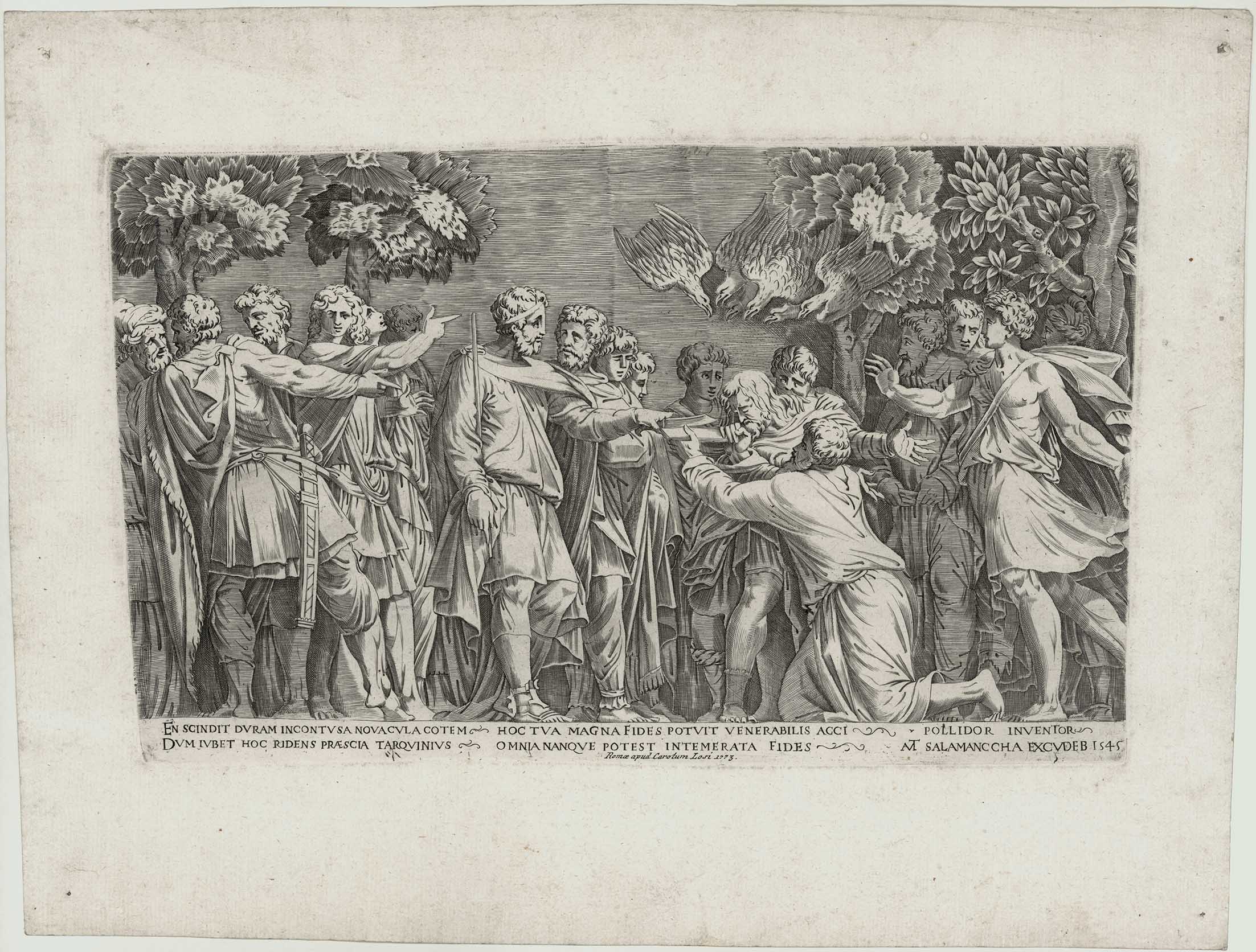
(Attrib.) Michele Lucchese’s engraving, “Tarquinius Priscus Cutting the Whetstone”, 1545, after Polidoro da Caravaggio

(Attrib.) Michele Lucchese (aka Michele Crecchi; Michele Grechi; Michele Greco) (fl.1534–1564), formerly attributed to Nicolas Beatrizet (aka Nicolas Beatricetto) (c.1507–c.1566)

“Tarquinius Priscus Cutting the Whetstone”, 1545, after Polidoro da Caravaggio (aka Polidoro Caldara; Polidoro da Caravagio) (c.1499–1543), possibly relating to a lost façade on Monte Citorio (see the Curator of the BM comment; inv. no. V,8.76), published in Rome by Antonio Salamanca (1478–1562) and later in 1773 (as is the case with this impression) by Carlo Losi (fl.Rome 1757–after 1805).

Engraving on heavy laid paper with wide margins.

Size: (sheet) 36.3 x 47.6 cm; (plate) 24.2 x 40.5 cm; (image borderline) 22.1 x 40.4 cm.

Lettered in plate below the image borderline: “EN SCINDIT DVRAM INCONTVSA NOVA CVLA COTEM ... POLLIDOR INVENTOR/ DVM IVBET HOC … [ANT] SALAMANCCHA EXCVDEB 1545/ Romæ apud Carolum Losi 1773.”

State ii (of ii) with the addition of the publication details for Carlo Losi.

Mariette I, p. 257 (as Caldara); Passavant 119 (as Beatrizet); Bianchi D 14 (attributed to Beatrizet).

See also the description of this print offered by the British Museum: https://www.britishmuseum.org/collection/object/P_1871-0429-615.

Condition: a strong and well-printed impression with wide margins. Beyond a pinhole in each corner of the margin and minor surface dustiness, the sheet is in an excellent condition with no tears, losses, abrasions, significant stains or foxing.

I am selling this rare engraving for AU$376 (currently US$251.32/EUR227.39/GBP200.17 at the time of posting this listing) including postage and handling to anywhere in the world (but not, of course, any import duties/taxes imposed by some countries).

If you are interested in purchasing this strong impression showing at left-of-centre, Tarquinius Priscus—by tradition, the fifth king of Rome (reigning between c.616–578 BC)—slicing through a whetstone (tool sharpener) with his knife to demonstrate his divine power, contact me (oz_jim@printsandprinciples.com) and I will send you a PayPal invoice to make the payment easy.

Note that I have previously listed another engraving by Michele Lucchese, “The Martyrdom of St. Lawrence” (c.1520), after Marcantonio Raimondi (and Baccio Bandinelli) that is currently still available: https://www.printsandprinciples.com/2017/02/luccheses-engraving-1539-after.html.

This print has been sold