Showing posts with label Guercino. Show all posts

Monday, 13 April 2026

Francesco Bartolozzi, “Holy Family”, c. 1764, after Guercino


Francesco Bartolozzi (1728–1815)

“Holy Family”, c. 1764

Technical Details & Condition:

Etching printed in a rich dark brown ink on heavy laid paper, trimmed unevenly with some significant losses of the writing edge. The sheet has been professionally laid onto washi paper for support and features wide margins. It was published in Rome in 1764 as a plate in the series of twenty-eight etchings after Guercino (also known as Giovanni Francesco Barbieri) (1591–1666) by various artists titled “Raccolta di alcuni disegni di Barbieri da Cento detto il Guercino”. For reference, see https://www.britishmuseum.org/collection/object/P_1929-1028-6-1.

The design is based on a drawing by Guercino, which was part of the collection of the print publisher, collector, and printmaker Antonio Maria Zanetti I (1680–1767) at the time of this print’s creation.

The impression is strong and well-printed, though the sheet shows notable signs of handling, including marks, abrasions (notably around Christ’s genitals), and fractures.

Dimensions:

• Sheet: 37.8 x 28.2 cm
• Image borderline: 35.8 x 26.9 cm

In-Plate Lettering:

• Lower-left corner: “Guercino da Cento inv”

References:

• Calabi & De Vesme 2111 (Augusto Calabi, Francesco Bartolozzi. Catalogue des estampes et notice biographique d'après les manuscrits de A. De Vesme entièrement réformés et complétés d'une étude critique par A. Calabi, 1828, Milan, Guido Modiano, cat. no. 2111)
• British Museum: https://www.britishmuseum.org/collection/object/P_S-5-13
• National Galleries of Scotland: https://www.nationalgalleries.org/art-and-artists/158056

Price & Shipping:

AU$261 (approx. US$183.54 / €157.02 / £136.95), including worldwide express shipping. Import duties and taxes (if any) are the buyer’s responsibility.

To acquire this masterfully executed and richly glowing etching of the Virgin Mary breastfeeding the Christ Child, with Saint Joseph looking on, please contact me at oz_jim@printsandprinciples.com. I am happy to provide a secure PayPal invoice for a seamless transaction.


Sunday, 2 November 2025

Baron Dominique Vivant Denon, “An Old Man with Two Children”, c. 1790, after Guercino

Baron Dominique Vivant Denon (aka Vivant De Non; Vivant Denon) (1747–1825)

“An Old Man with Two Children” (TIB title) (aka “Viellard tenant deux enfants”), c. 1790, after a drawing by Guercino (aka Giovanni Francesco Barbieri) (1591–1666).

This is an early impression before the addition of the inscription, “Tiré de Cabinet de Mr Denon” (Taken from the Cabinet of Mr. Denon) (see TIB 12101.349), when it was published in 1829 after Denon’s death as plate/table 202 in volume 3 of the series of 310 plates by a variety of artists including Denon, “Monuments des arts de dessin chez les peuples, tant anciens que modernes recueillis par le Baron Denon pour servir à l'histoire des arts” (Monuments of the drawing arts among peoples, both ancient and modern, collected by Baron Denon to serve the history of art). See details about this series offered by the British Museum (inv. no. 1856,0209.558-973) and the page from the 1829 publication: https://commons.wikimedia.org/wiki/File:Monuments_des_arts_T._3_1829_(23685419).jpg.

Etching on laid paper backed with a support sheet.

Size: (sheet) 29.4 x 37.5 cm; (plate) 20.5 x 30.5 cm; (image borderline) 17.7 x 26 cm.

Inscribed in plate below the image borderline: (lower left) “De[n]on S.”

TIB 12101.349 (Petra ten-Doesschate Chu 1988, “The Illustrated Bartsch: Dominique Vivant Denon: French Masters of the Nineteenth Century”, Vol. 121 [Part 2], New York, Abaris Books, p. 285, cat. no. [12101].349).

Condition: a richly inked and finely printed impression with wide margins. The sheet has a closed tear and a flattened wrinkle in the lower margin; aside from these issues, it is in an excellent condition with no significant stains. The print has been mounted onto an archival, millennium-quality washi paper support to ensure its stability and preservation.

Price & Shipping: The total price is AU$276 (approximately US$181.01 / €156.86 / £137.72), which includes worldwide express shipping. Please note that import duties and taxes are the responsibility of the buyer.

If you would like to acquire this freely drawn interpretative etching of a drawing by the renowned draughtsman Guercino—executed with great confidence and insight—please contact me at oz_jim@printsandprinciples.com. I will gladly send you a PayPal invoice for a secure and straightforward purchase.


Wednesday, 20 February 2019

Dominique Vivant Denon’s etching, “The Raising of Lazarus”, c1792


Dominique Vivant Denon (aka Vivant De Non; Vivant Denon; Baron Dominique-Vivant Denon) (1747–1825)

“The Raising of Lazarus” (Résurrection de Lazare), c1792 (1780–1803), after the painting of the same composition by Guercino (aka Giovanni Francesco Barbieri) (1591–1666). The curator of the British Museum advises that “Denon's catalogue, 1803” shows that Guercino’s painting (https://commons.wikimedia.org/wiki/Category:The_Raising_of_Lazarus_-_Guercino_-_Louvre_INV_77#/media/File:Guercino_Res_Lazzaro_2.jpg) “was acquired by the Count of Angivillers for the King in 1785, and is now in the Musée du Louvre, Paris” (see BM no. 1869,0410.2306.+).

Etching with drypoint on heavy wove paper.
Size: (sheet) 44.5 x 47.9 cm; (plate) 31 x 33.7 cm; (image borderline) 28 x 32.6 cm
Inscribed on plate: (along the lower edge of Lazarus’ shroud) “Guercino Pinx De Non Scul”
Lifetime impression (before lettering for publication?)

TIB 12101.282 (Petra ten-Doesschate Chu 1985, “The Illustrated Bartsch: Dominique Vivant Dennon: French Masters of the Nineteenth Century”, vol. 121, Part 1, New York, Abaris Books, p, 282); IFF 145 (Inventaire du Fonds Français: Bibliothèque Nationale, Département des Estampes, Paris, 1930).

The British Museum offers the following description of this print:
“The raising of Lazarus, after Guercino; Christ, standing on the left points at Lazarus, whose hands are being untied by a man …”

Condition: a superb, richly inked and faultless impression with wide margins in near pristine condition (i.e. there are no tears, holes, folds, abrasions, stains, foxing or signs of handling).

I am selling this exceptionally rare and very beautiful impression—compare this impression to the copy held by the BM (“decorated with yellow wash and black borders”) which seems to be the only repository showcasing a copy—for the total cost of AU$257 (currently US$183.98/EUR161.99/GBP141.08 at the time of this listing) including postage and handling to anywhere in the world (but not, of course, any import duties/taxes imposed by some countries).

If you are interested in purchasing this near faultless impression exemplifying Denon’s magical ability to invest his portrayed subjects with the spirit of life, please contact me (oz_jim@printsandprinciples.com) and I will send you a PayPal invoice to make the payment easy.
This print has been sold


Tuesday, 15 May 2018

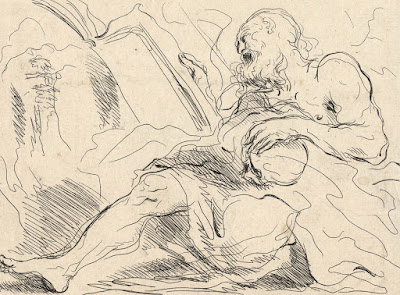
Heinrich Theodor Joseph Bislinger’s etching, “St Jerome,” 1781, after Guercino


Heinrich Theodor Joseph Bislinger (1742-1774) and/or Johann Gerhard Huck (c.1759–1811)

Although the British Museum proposes that Huck may be involved in the execution of this particular plate (see BM no. 1858,1113.247) I have reservations about this attribution. The reason—and I may be very wrong—is that when this plate was executed in 1781, it was a year before Huck began his training as a pupil of Valentine Green from 1782 to 1788 and was not at this time involved in the series of plates reproducing drawings from the Dusseldorf Gallery. Nevertheless, after completing his training the BM advises that he worked on the plates as Green's agent in engraving the Dusseldorf Gallery prints and both engravers names are inscribed on the first plate of the series “Gravées par Theodor Bislinger et Gerard Huck” (see BM no. 1858,1113.229).

“Saint Jerome”, 1781, after Guercino (aka Barbieri, Giovanni Francesco Guercino) (1591–1666), from the series of fifty etchings, “Collection d'estampes d'apres les desseins originaux”, after drawings in the collection of the Academy of Düsseldorf, published by the artist and Johann Gottlieb Prestel (1739–1808) in Amsterdam, Düsseldorf and Nuremberg.

Etching on cream laid paper trimmed on or within the platemark and backed with a support sheet.
Size: (sheet) 16 x 20.2 cm; (image borderline) 13.3 x 18.1 cm
Inscribed on plate below the image borderline; “Saint Jerome—par Guercino da Cento”

The British Museum offers the following description of this print:
“Saint Jerome in the desert reading and turned left, after Guercino (?). 1781 Etching”

Condition: crisp and well-printed impression with no sign of wear to the plate. The sheet has been trimmed along, or within, the platemark and laid upon a support sheet of archival (millennium quality) washi paper. The sheet has thin areas (verso) but this issue is not visible on the front, otherwise the print is in very good condition.

I am selling this etching capturing the fluid strokes of Guercino's pen drawing of Saint Jerome as he symbolically holds a skull while reading—an activity that the saint is attributed with the insight: “When we pray, we speak to God; but when we read, God speaks to us”—for the total cost of AU$126 (currently US$93.98/EUR79.39/GBP69.81) including postage and handling to anywhere in the world (but not, of course, any import duties/taxes imposed by some countries).

If you are interested in purchasing this fascinating print what would have been closely studied by art students wanting to see an example of Guercino's intuitively searching and expressive pen strokes, please contact me (oz_jim@printsandprinciples.com) and I will send you a PayPal invoice to make the payment easy.


For those looking for a very good example of the “return stroke” (i.e. a quickly scribbled zigzag line) then this etching is perfect. This stroke may seem like a very ordinary type of lightly laid line that an artist might make when casually “blocking-in”/approximating an area of tone—and it is! In the history of printmaking, however, this mark has a well-documented history that reveals that the use of such a line is far from “ordinary,” beginning with the first artist to use it: Antonio del Pollaiuolo (1431–1498) in his large and only engraving, “Battle of the Nudes”, c. 1470. What makes Pollaiuolo’s use of the return stroke fascinating is that he contrived the “look” of the quick mark that one might make with a pen using the engraver’s tool, the burin, which is almost impossible to use for creating continuous zigzag line ... until Pollaiuolo showed how it could be done.

I should mention at this point that Bislinger’s etching also reveals an understanding of the “hook stroke” (i.e. the same quickly scribbled zigzag line of the return stroke but with the “return” leg of the stroke suggested by the trace of a hook-like twist of its start and conclusion) as may be seen in the same areas of the drawing as before. Historically this hook stroke also had a famous practitioner exploring its use: Francesco Rosselli (c. 1445–before 1513) whose engraved lines retain the “hooks” of the return strokes (see David Landau & Peter Parshall 1994, “The Renaissance Print 1470–1550”, Yale University Press, New Haven, p. 73).