Showing posts with label L’eau-forte mobile. Show all posts

Friday, 20 October 2023

Ludovic Napoléon Lepic’s etching, “Environs de Dordrecht”, c.1876

Ludovic Napoléon Lepic (aka Viscomte Ludovic-Napoléon Lepic) (1839–1889)

Environs de Dordrecht”, c.1876, from the series, “Croquis Hollandais et Autres”, published in 1876 in Paris by Alfred Cadart (aka [publications made by his widow] Veuve Cadart) (1875–1882) as plate 325 to “L'Illustration Nouvelle”, vol. 8.

Etching with plate tone on laid paper.

Size: (sheet) 27 x 32.7 cm; (platemark) 16.1 x 24.1 cm; (image borderline) 15 x 23.2 cm.

Numbered in plate: (upper right corner) “325.”

Inscribed in plate within the image borderline: (lower left corner) “Lepic”.

Lettered in plate below the image borderline: (left) “L.Lepic, prinx. et sculp.”; (centre) “ENVIRONS DE DORDRECHT”; (right) “Vve A.Cadart,Edit.Imp.56.BardHaussmann,Paris.”

Beraldi 4 (Henri Beraldi 1889, “Les Graveurs du XIXe Siècke; guide de l'amateur d'estampes modernes”, vol. 9, Paris, L Conquet, p. 143, cat. no. 4 [series]); IFF 108 (Inventaire du Fonds Français après 1800, Paris, 1937–1985, XIV.66.108).

Henri Beraldi (1889) offers the following insight about Lepic’s approach to wiping the etching plate: (Transl.) “… Count Lepic was particularly attached to the question of the impression, and the varieties of effects that obtained from a plate according to the inking mode. ... he would say, ‘the secret of etching as I get it … is the use of ink and rag: with these two weapons you can get anything from a plate. I am master in front of my plate as in front of a canvas, I can transform all the subjects according to my fancy, modify their effects. This process existed from the time of great master engravers, and I have found it’. ... Count Lepic called this kind of printing with the rather singular name ‘mobile etching’ [l’eau-forte mobile]." (p. 144).

Condition: a strong and skilfully wiped impression (e.g., the controlled wiping of the centre sail and suggestion of distance). Beyond a few minor marks in the margin, the sheet is in an excellent condition.

I am selling this bold etching exemplifying the artist’s confidence and free handling of the etching needle for AU$288 in total (currently US$192.50/EUR174.17/GBP153.32 at the time of posting this listing) including postage and handling to anywhere in the world, but not (of course) any import duties/taxes imposed by some countries.

If you are interested in purchasing this marvellous evocation of light and breeze on the Dordrecht's canals (havens)—note, for instance, how Lepic has wiped/removed the plate tone from the centre sail to capture the effect of bright light and, in doing so, draws attention to the freely drawn ripples in the sail—please contact me (oz_jim@printsandprinciples.com) and I will send you a PayPal invoice to make the payment easy.

This print has been sold


Tuesday, 26 October 2021

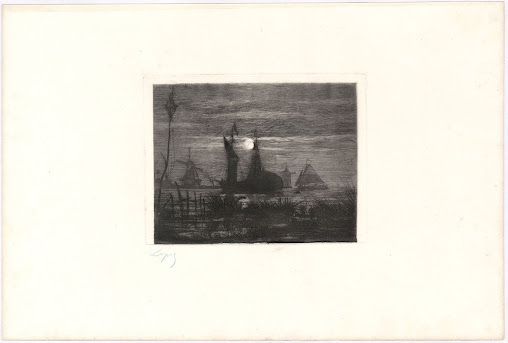
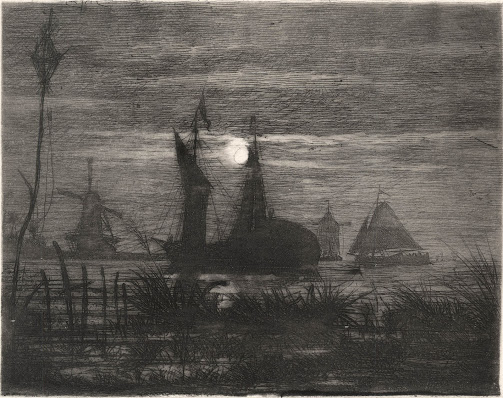
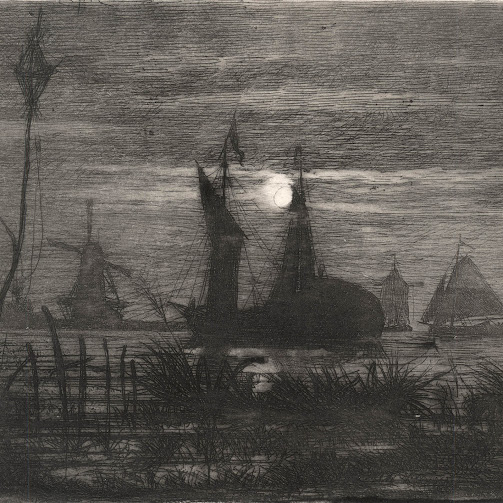
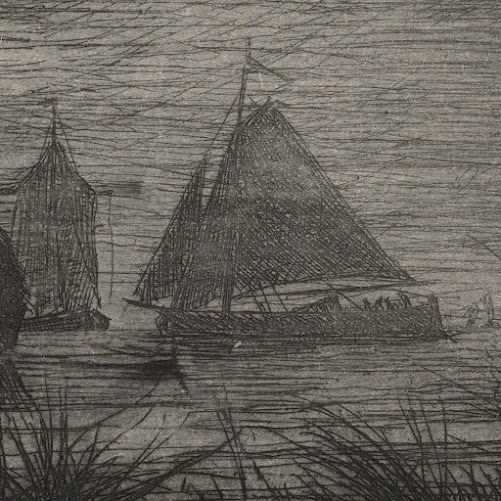
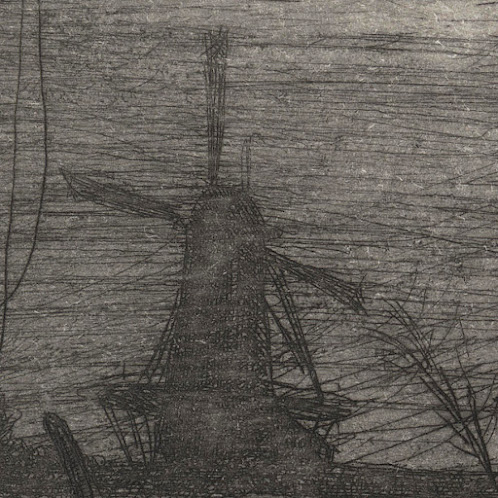
Ludovic Lepic's etching, "Moonlit Night", c1870

Ludovic Lepic (aka Ludovic Napoléon Lepic; Vicomte Ludovic-Napoléon Lepic) 1839–1889

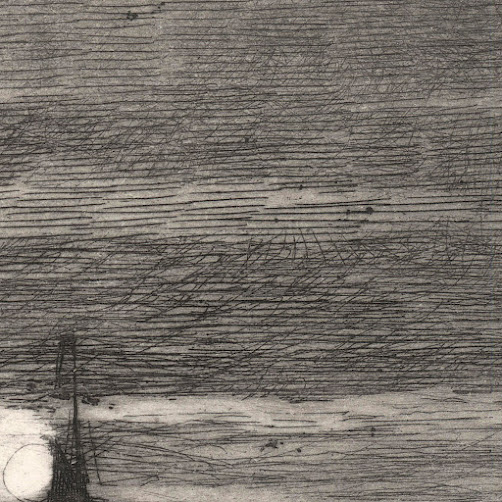
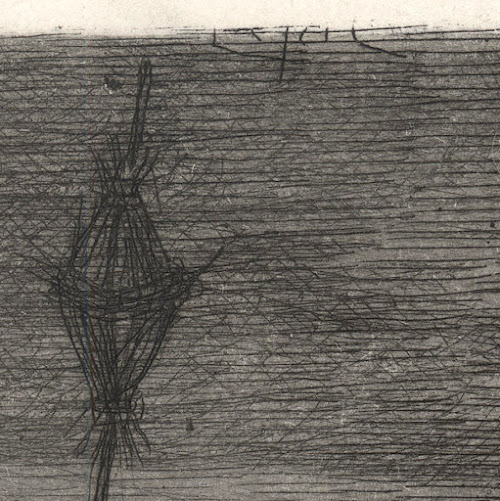
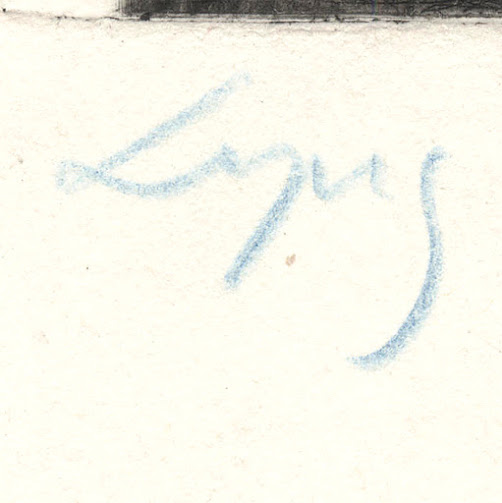
“Moonlit Night” (aka “Moonlight Night” [“Лунная ночь” Hermitage Museum]), c1870, from the series, “Landscapes of Holland” (Beraldi “Dutch Sketches”), signed by the artist in the plate at upper edge and hand-signed by the artist in blue crayon at lower left.

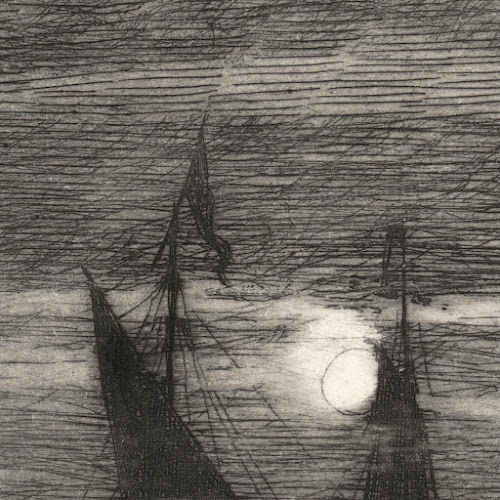
Etching (and aquatint?) with roulette and plate tone from free wiping by the artist (“l'eau-forte mobile” [variable etching]), signed in the plate and by hand in blue crayon, with wide margins.

Size: (sheet) 28.9 x 43.1 cm; (plate) 14.4 x 18.8 cm; (image borderline) 13.7 x 17.4 cm.

Inscribed in plate within the image borderline: (along the upper edge at left) “Lepic”.

Hand-signed in blue crayon below the image borderline: (lower left) “Lepic”.

Beraldi 4 (Henri Beraldi 1889, “Les Graveurs du XIXe Siècke; guide de l'amateur d'estampes modernes”, vol. 9, Paris, L Conquet, p. 143, cat. no. 4 [Croquis hollandaise]).

Henri Beraldi (1889) offers the following insight about Lepic’s approach to wiping the etching plate:

(Transl.) “… Count Lepic was particularly attached to the question of the impression, and the varieties of effects that obtained from a plate according to the inking mode. ... he would say, ‘the secret of etching as I get it … is the use of ink and rag: with these two weapons you can get anything from a plate. I am master in front of my plate as in front of a canvas, I can transform all the subjects according to my fancy, modify their effects. This process existed from the time of great master engravers, and I have found it. ... Count Lepic called this kind of printing with the rather singular name ‘mobile etching’." (p. 144).

See the descriptions of this print offered by Binoche et Giquello auctions and by the Hermitage Museum (the latter site may be slow to open): https://www.binocheetgiquello.com/lot/8075/1553155;  https://hermitagemuseum.org/wps/portal/hermitage/digital-collection/04.%20Engraving/527433/.

Condition: a richly inked, but (in my opinion) a slightly over-wiped impression in an almost pristine condition (i.e., the sheet has no tears, holes, folds, abrasions, stains, foxing or signs of handling) with generously wide margins.

I am selling this rarely seen, hand-signed etching exemplifying the artist’s well-known approach to printing—termed “l'eau-forte mobile” [the mobile/variable etching])—for AU$426 in total (currently US$319.93/EUR275.49/GBP232.34at the time of posting this listing) including postage and handling to anywhere in the world, but not (of course) any import duties/taxes imposed by some countries.

If you are interested in purchasing this fine example of an artist’s selective wiping of a printing plate to create the poetic effect of moonlight illuminating sailing boats and distant windmills, please contact me (oz_jim@printsandprinciples.com) and I will send you a PayPal invoice to make the payment easy.

This print has been sold 


Friday, 15 May 2020

Ludovic Napoléon Lepic’s etching, “The Remains of the Noble William of Naillac”, 1869


Ludovic Napoléon Lepic (aka; Ludovic Lepic; Vicomte Ludovic Lepic) (1839–1889)

“The Remains of the Noble William of Naillac” (Ce qui Restait du Puissant Guillaume de Naillac), 1869, proof-state impression from the series, “Croquis Hollandais et Autres” (Dutch Sketches and Others), hand-signed in blue pencil by the artist at lower left.

This extraordinary etching shows the remains of the crusader knight, Lord Guillaume de Naillac (1238–1266). From what I understand, the tomb of this knight was opened in Lepic’s presence and this etching is based on his viewing of the remains. No doubt the image is redolent with the notion of vanitas (i.e. the transience of life and the futility of fame and honours) as suggested by the many blurred honorific titles of the knight inscribed beneath his remains in the print. Interestingly, the fame of this man changed over time as a sculpture made in his honour had the reputation of assisting young maidens with their fertility if they scratched the sculpture’s genitals. Indeed, there is even an horrific tale that one demure maiden was grabbed by the hand by the sculpture when it came to life and gruffly told her to scratch harder. (Yikes!) Sadly, this belief led to significant wear in the genital area of the sculpture and a caring priest proposed that scratching the sculpture’s chin would be more effective—until it too was worn away. Even the tomb of Lord Guillaume de Naillac was not immune to passionate maidens scratching the stone edifice with knives. Their aim was to gather the stone powder that would later be mixed with a glass of white wine to assist with fertility.

Etching with plate tone on chine volant, proof impression hand-signed in blue pencil.
Note that the variation in the ways that Lepic inked and wiped his plate became a hallmark technique of this artist which he termed “l’eau-forte mobile” (variable etching). The variations allowed for unique proofs such as this darkly glowing example.

Regarding Lepic’s explorations that cemented his fame, Michel Melot (1966) in “The Impressionist Print” proposes that Lepic would “have been forgotten as a printmaker had he not published in 1876 a curious album of prints … ‘L’eau-forte mobile’ (‘The Mobile Etching’)” (p. 123). The ingredient that aroused public interest in Lepic was his willingness to push the boundaries of the medium. For example, Lepic inked one of his etched plates in eighty-five different ways to create eighty-five very different images taken from the same original plate. In Lepic’s own words (translated from French):
“I organised tools of my own, used neat acid, slammed on varnish, sand clay—anything to achieve the right black. … I shall make prints like a painter, not like a printmaker.” (Melot p.123)

Size: (sheet) 30.5 x 22.3 cm; (plate) 23.8 x 15.8 cm.
Inscribed on plate: (lower centre in four lines of honorific titles once distinguishing the deceased crusader) “Ce …/ …/ … De son tom Bleau” (Prince de Soyons; Chevalier d’Ordre du Roi; Grand Maître de l’Artillerie …); (lower left corner) “Lepic”.
Hand-signed in blue pencil below the platemark at lower left: “Lepic”.

This print is described (without image) at C & J Goodfriend Gallery:

Condition: richly-inked impression with significant plate tone and a few ink marks left during the printing of the plate on the left margin appropriate to a proof-state. There are scattered light dots of foxing to the margins.

I am selling this exceptionally rare hand-signed, proof-state etching by the intimate friend of Degas and an important experimental printmaker famous for his technique, “L’eau-forte mobile” (the mobile/variable etching), for AU$426 (currently US$275.16/EUR254.55/GBP225.30 at the time of this listing) including postage and handling to anywhere in the world (but not, of course, any import duties/taxes imposed by some countries).

If you are interested in purchasing this fine example of an artist’s selective wiping of the printing plate to create an intensely bright highlight on the brow of the portrayed skull of the crusader knight, please contact me (oz_jim@printsandprinciples.com) and I will send you a PayPal invoice to make the payment easy.

This print has been sold