Showing posts with label Galestruzzi (Giovanni Battista). Show all posts

Friday, 13 December 2024

Giovanni Battista Galestruzzi, “Rape of the Sabine Women”, c.1650, after Polidoro da Caravaggio

Giovanni Battista Galestruzzi (1619–c.1678)

“Rape of the Sabine Women” (aka “Les Romains enlevant les Sabines”; “The Rape of the Sabine Women by the Romans”), c.1650 (1640–1660), plate two from the series of six plates, “Façade of the Palazzo Milesi” (aka “Subjects from Roman History” [TIB title]), after the fresco design by Polidoro da Caravaggio (aka Polidoro Caldara; Polidoro da Caravagio) (c.1499–1543).

Etching on fine laid paper, trimmed with a thread margin around the image borderline and backed with a support sheet.

Inscribed and numbered in plate: (lower right) “POLIDORO INVEN.  2./ Gio. B. Galestruzzi fece”.

TIB 46.5 (Paolo Bellini [ed.] 1982, “The Illustrated Bartsch: Italian Masters of the Seventeenth Century”, vol. 46, New York, Abaris Books, p. 78, cat. no. 4); Bartsch XXI.53.4.

The British Museum offers a description of this print: https://www.britishmuseum.org/collection/object/P_1856-1213-47 (BM inv.no. 1856,1213.47).

Condition: a strong and well-printed impression, trimmed around the image borderline and laid upon a support of archival (millennium quality) washi paper. Beyond a minor abrasion in the upper edge, the sheet is in an excellent condition with no tears, holes, folds or significant stains.

I am selling this superb early impression (based on the quality of line showing no sign of wear to the printing plate) of a small but historically important record of a section of the now badly deteriorated façade of the Palazzo Milesi (aka Golden Mask Palace) in Rome (see https://www.tripadvisor.in/LocationPhotoDirectLink-g187791-d12996950-i481038121-Palazzo_Milesi-Rome_Lazio.html), for total cost of AU$287 (currently US $182.67/ EUR 173.91/ GBP 144.73 at the time of this listing) including Express Mail (EMS) postage and handling to anywhere in the world, but not (of course) any import duties/taxes imposed by some countries. Note that payment is in Australian dollars (AU $287) as this is my currency.

If you are interested in purchasing this boldly executed etching—note how the artist has created the illusion of depth to this frieze by hatching over the more distant figures to give focus to those in the foreground— please contact me (oz_jim@printsandprinciples.com) and I will send you a PayPal invoice to make the payment easy.


Monday, 8 January 2024

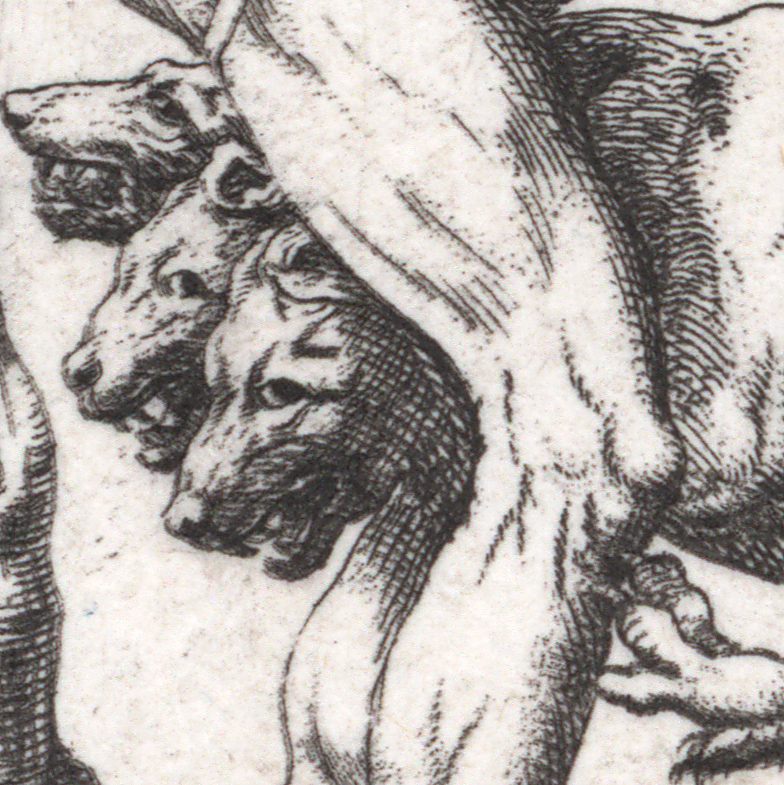
Giovanni Battista Galestruzzi’s engraving, “Hercules and Cerberus”, 1657

Giovanni Battista Galestruzzi (1619–c.1678)

“Hercules and Cerberus” (aka “Hericole e Cerbero”; “Hercules et Cerberus”), 1657, plate 5 from the series, “Gemmae et Sculpturae Antiquae Depictae” (Painted Gems and Ancient Sculptures), executed as an illustration to Leonardo Agostini’s (1593–c.1670) book, “Le Gemme Antiche Figurate” (The Antique Figurative Gems), published in Rome initially in 1657. The portrayed subject shown in the original gem was executed in variegated agate.

I believe that this is a lifetime impression from the first edition published in 1657.

Interestingly, in the later 1686 edition published by Appresso Gio. Battista Brusottiis, the plate number is altered to “40” ( see https://archive.org/details/LeGemmeAnticheFigurate/agostini-l-antiche-1686-RTL019351/page/n455/mode/2up) and, in the 1699 edition published by Leonardum Strik, the image is reversed (see https://archive.org/details/GemmaeEtSculpturaeAntiquaeDepictae/agostini-l-gemme-1699-RTL019350/page/n657/mode/2up).

Etching on fine laid paper with full margins as published.

Size: (sheet) 23 x 17.1 cm; (plate) 13.2 x 9.8 cm.

Inscribed in plate: (upper centre) “HERICOLE E CERBERO”: (upper right corner) “5”; (lower centre) “in Agata Varia”.

TIB 283 (79).46 (21) (Paolo Bellini [ed.] 1982, “The Illustrated Bartsch: Italian Masters of the Seventeenth Century”, vol. 46, Abaris Books, New York, p. 229, cat. no. 283 [79]).

Condition: a strong impression, showing slight movement (doubling of line) in the printing, with full margins of publication. There is a printer’s crease in the upper-left margin and an offsetting of another image (a fleur-de-lis?) at lower right within the image; otherwise the sheet is in excellent condition with no tears, holes or significant stains.

I am selling finely executed etching based on the design engraved on an agate gem, from the collection of Cardinal Francesco Barberini (1597–1679), showing Hercules thwarting the "hound of Hades", Cerberus—or more precisely the moment in the battle in which Hercules “… stroked the monster's neck with his heavy hand” (translation from the Latin verses describing this scene (see https://archive.org/details/GemmaeEtSculpturaeAntiquaeDepictae/agostini-l-gemme-1699-RTL019350/page/n597/mode/2up)—for the total cost of AU$287 (currently US$192.04/EUR175.37/GBP151.09 at the time of posting this print) including Express Mail (EMS) postage and handling to anywhere in the world, but not (of course) any import duties/taxes imposed by some countries.

If you are interested in purchasing this insightfully composed etching employing the spreading limbs of the tree at left—possibly Hesperides’ golden apple tree—to create balance and a spiralling flow, please contact me (oz_jim@printsandprinciples.com) and I will send you a PayPal invoice to make the payment easy.

This print has been sold 


Friday, 10 March 2023

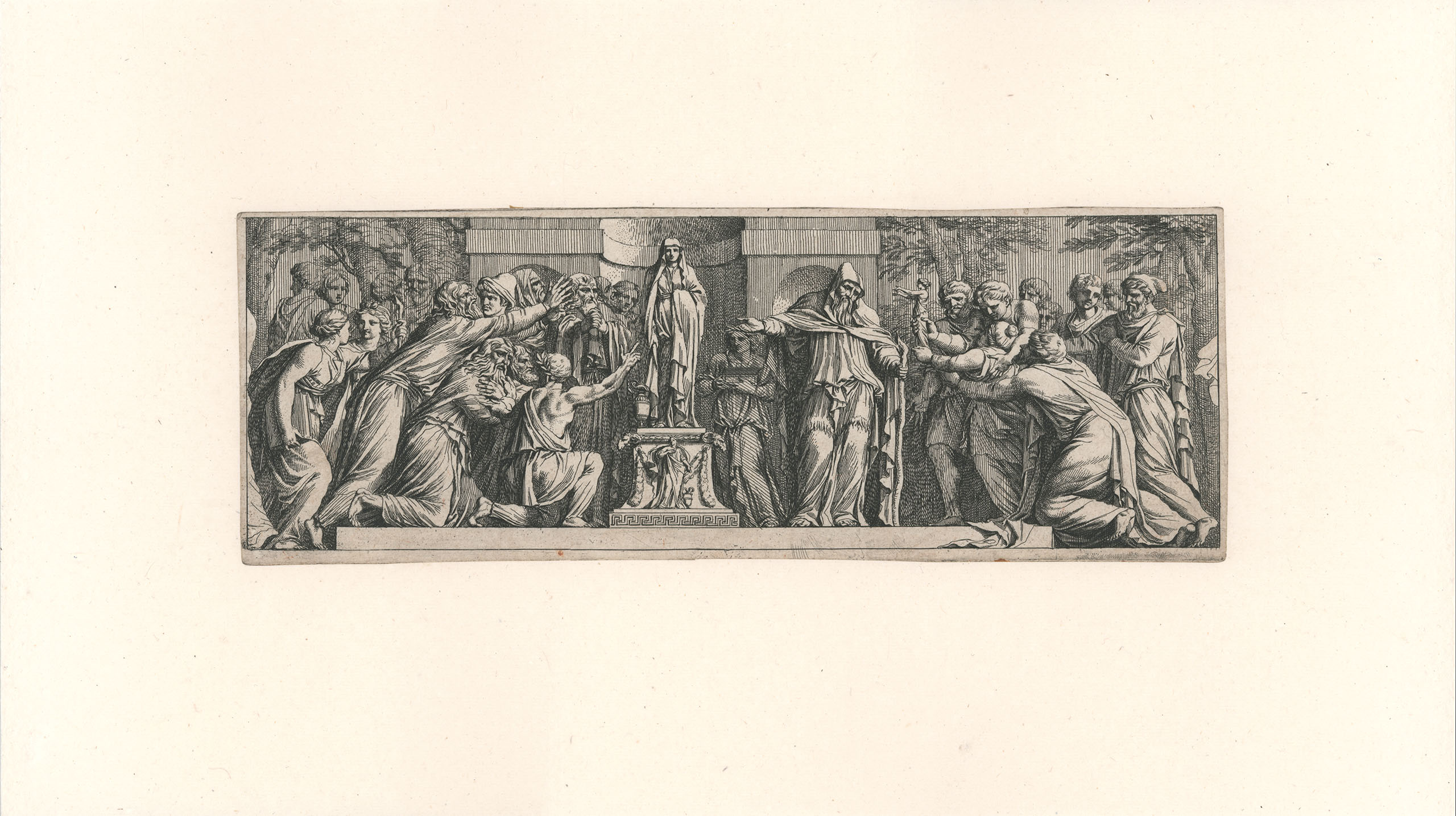
Circle of Giovanni Battista Galestruzzi’s etching, “Niobe Adored on the Altar”, c1656, after Polidoro da Caravaggio

Unidentified artist from the circle of Giovanni Battista Galestruzzi (1619–c1678)

“Niobe Adored on the Altar”, c1656, in reverse direction to the etching by Giovanni Battista Galestruzzi (see https://www.britishmuseum.org/collection/object/P_1856-1213-54) plate/sheet 3 from the series of five plates, “Niobid frieze of the Palazzo Milesi” (aka “History of Niobe” [TIB title]), after the design of Polidoro da Caravaggio’s (aka Polidoro Caldara; Polidoro da Caravaggio; Polidoro da Caravagio) (c1499–1543) frieze on the lower register of the Palazzo Milesi in Rome—sadly the frescoes on the façade have almost completely vanished by deterioration.

Etching on laid paper trimmed along the platemark and backed with a support sheet.

Size: (support sheet) 26.5 x 47 cm; (sheet) 11.3 x 31.6 cm; (Image borderline) 10.7 x 31.1 cm.

Ref. for Galestruzzi’s etching that this print follows in reverse: TIB 46 (21).18 (59) (Paolo Bellini [ed.] 1982, “The Illustrated Bartsch: Italian Masters of the Seventeenth Century”, vol. 46, Abaris Books, New York, p. 88, cat. no. 18 [59]).

Condition: a strong and well-printed impression, showing no sign of wear to the printing plate, trimmed along the platemark and laid upon a support sheet of archival (millennium quality) washi paper. Beyond age toning, the sheet is in an excellent condition with no tears, holes, folds, stains or foxing.

I am selling this historically important etched frieze that is a surviving visual record of Polidoro da Caravaggio’s now lost—in the sense of badly deteriorated—fresco on the façade of the Palazzo Milesi in Rome, for the total cost of AU$237 (currently US$156.04/EUR146.62/GBP129.67 at the time of posting this print) including Express Mail (EMS) postage and handling to anywhere in the world, but not (of course) any import duties/taxes imposed by some countries.

If you are interested in purchasing this strong and beautiful etching from the mid-1600s, please contact me (oz_jim@printsandprinciples.com) and I will send you a PayPal invoice to make the payment easy.

This print has been sold


Thursday, 25 February 2021

Giovanni Battista Galestruzzi’s etching, “The Soldiers of Cyrus Attacking the Army of Spargabise”, c1650, after Polidoro da Caravaggio

Giovanni Battista Galestruzzi (1619-c1678)

The Soldiers of Cyrus Attacking the Army of Spargabise” (MET title) (aka “The Soldiers of Cyrus Tearing Apart the Army of Spargabise” [TIB title]; “Les soldats de Cyrus taillant en pièces l'armée de Spargabise”; ), c1650 (1640–1660 [BM dates]), plate 4 in the series, “Subjects from Roman History” [Havard title]), after Polidoro da Caravaggio’s (aka Polidoro da Caravagio; Polidoro Caldara da Caravaggio; Polidoro Caldara) (c1500–1536/7 [BM dates]) fresco on the façade of the Palazzo Milesi in Rome—sadly the frescoes on the façade have almost completely vanished by deterioration.

Etching on laid paper trimmed with a thread margin around the image borderline and backed with a support sheet.

Size: (sheet) 10.9 x 12.3 cm.

Inscribed on plate in lower left tablet: “POLIDORO. INVENTORE. Gio. Batta. Galestruzzi 4/ fe.”

TIB 46 (21).6 (54) (Paolo Bellini [ed.] 1982, “The Illustrated Bartsch: Italian Masters of the Seventeenth Century”, vol. 46, Abaris Books, New York, p. 79, cat. no. 6[54]); Bartsch XXI.54.6.

See the descriptions of this print offered by the British Museum and the Harvard Art Museum: https://www.britishmuseum.org/collection/object/P_1856-1213-49; https://hvrd.art/o/234737.

Condition: a strong and well-printed impression, showing no sign of wear to the printing plate, trimmed with a thread margin around the image borderline and laid upon a support sheet of archival (millennium quality) washi paper. There is a minor restoration to chipping at the upper left corner, otherwise the sheet is in excellent condition with no tears, holes, folds, stains or foxing.

I am selling this historically important etched frieze that is a surviving visual record of Polidoro da Caravaggio’s now lost—in the sense of badly deteriorated—fresco on the façade of the Palazzo Milesi in Rome, for the total cost of AU$287 (currently US$229.47/EUR188.08/GBP162.21 at the time of posting this print) including Express Mail (EMS) postage and handling to anywhere in the world, but not (of course) any import duties/taxes imposed by some countries.

If you are interested in purchasing this small but visually arresting battle scene from the mid-1600s, please contact me (oz_jim@printsandprinciples.com) and I will send you a PayPal invoice to make the payment easy.

Note that I have listed another three-panel etching by Giovanni Battista Galestruzzi that is currently available for the same price: https://www.printsandprinciples.com/2018/11/giovanni-battista-galestruzzis-etching.html.

This print has been sold 


Friday, 17 July 2020

Giovanni Battista Galestruzzi’s etching, “The Slaughter of Niobe’s Chlidren”, 1656, after Polidoro da Caravaggio


Giovanni Battista Galestruzzi (1619–1678)

“The Slaughter of Niobe’s Chlidren” (TIB title) (aka “Niobid frieze of the Palazzo Milesi”), 1656, plate five in the series of five plates, “History of Niobe”, after Polidoro da Caravaggio’s (aka Polidoro da Caravagio; Polidoro Caldara da Caravaggio; Polidoro Caldara) (c1500–1536/7 [BM dates]) fresco on the façade of the Palazzo Milesi in Rome—sadly the frescoes on the façade have almost completely vanished by deterioration.

Etching on fine laid paper trimmed with a narrow margin around the image borderline and backed with a support sheet.
Size: (sheet) 11.6 x 34.5 cm; (image borderline) 11 x 34.2 cm.
Inscribed on plate on horse at lower left: “GIO. BAT. GALESTRVZZI/ FECE / GG (monogram); (abraded below the image borderline at lower left corner): “D”.

Early impression before numbering with “5” below the image borderline at centre (see a similar unnumbered impression held by the Harvard Art Museums: https://www.harvardartmuseums.org/collections/object/234880?position=18).

TIB 46 (21).20 (59) (Paolo Bellini [ed.] 1982, “The Illustrated Bartsch: Italian Masters of the Seventeenth Century”, vol. 46, New York, Abaris Books, p. 89, cat. no. 20 [59]); Bartsch XXI.59.20.

The British Museum offers the following description of this print:
“Apollo and Diana killing with their arrows the children of Niobe, in five sheets: sheet 5. 1656”

Condition: well-printed impression but with minor spots of abrasion (e.g. lower left corner), edge tears (e.g. lower edge towards the right) and restored small holes (e.g. on the extended arm of the young woman at lower right). The sheet has mellowed with age-toning and is laid upon an archival support sheet of millennium quality washi paper.

I am selling this historically important etched frieze that is a surviving visual record of Polidoro da Caravaggio’s now lost—in the sense of badly deteriorated—fresco on the lower register of the façade of the Palazzo Milesi in Rome, for AU$315 (currently US$220.02/EUR192.54/GBP175.36 at the time of this listing) including postage and handling to anywhere in the world (but not, of course, any import duties/taxes imposed by some countries).

If you are interested in purchasing this visually arresting old master etching exemplifying the Baroque period style, please contact me (oz_jim@printsandprinciples.com) and I will send you a PayPal invoice to make the payment easy.

This print has been sold