Showing posts with label Chaplin (Charles Joshua). Show all posts

Thursday, 20 July 2023

Charles Chaplin’s etching, “Les Bulles de Savon”, 1867

Charles Chaplin (aka Charles Joshua Chaplin) (1825–1891)

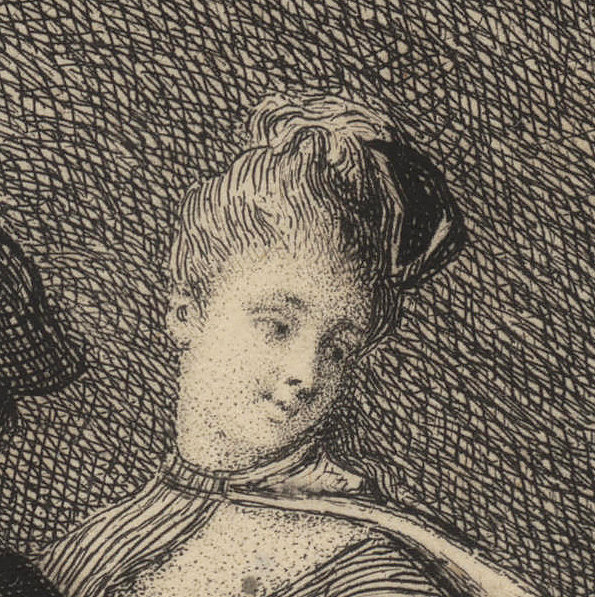
“Les Bulles de Savon” (Soap Bubbles), 1867, etching after Charles Chaplin’s painting in the Luxembourg Museum (see https://commons.wikimedia.org/wiki/File:Chaplin-The_Soap_Bubbles.jpg), plate 278 from the fifth volume of prints produced by the Société des Aquafortistes (Society of Etchers), printed in Paris by Alfred Cadart (1828–1875) (as lettered in plate), before/after the change of publication details to the printer, Auguste Delâtre (aka Auguste Marie Delâtre) (1822–1907) and publication by Cadart & Luquet (fl.1863–1867) in “Eaux-Fortes Modernes”, vol. 5 (1867).

Etching on laid paper with wide margins.

Size: (sheet) 25.5 x 20.1 cm; (plate) 15 x 11.7 cm; (image borderline) 12.1 x 9.3 cm.

Numbered in plate above the image borderline: (right) “278.”

Lettered in plate below the image borderline: (left) “Ch. Chaplin sculp.”; (centre) “LES BULLES DE SAVON.”; (right) “Imp. A. CADART, Paris.”

Beraldi 36 (Henri Beraldi 1886, “Les Graveurs du XIX Siecle”, Paris, Librairie L. Conquet, vol. 4, p. 92, cat. no. 36).

The British Museum offers a description of this print with the earlier/later printer and publisher details: https://www.britishmuseum.org/collection/object/P_1867-1214-41.

Condition: a strong and well-printed impression with wide margins in a near pristine condition with no tears, holes, folds, abrasions, significant stains (note that the back of the sheet is slightly dusty) or foxing.

I am selling this small and beautifully executed etching from the genre of vanitas prints—mindful that bubbles are often used in images to symbolise the notions of life’s transience, brevity and the spontaneity of death—and prints that draw upon the symbolism of women and their labours—mindful that the distaff shown here leaning on the spinning wheel has a history of being a symbolic weapon of women while the spinning wheel is a key symbolic tool of women’s industry—for AU$212 in total (currently US$141.70/EUR128.21/GBP112.86 at the time of this listing) including postage and handling to anywhere in the world, but not (of course) any import duties/taxes imposed by some countries.

If you are interested in purchasing this wonderful etching—to my eyes it has the allure of a Vermeer! —please contact me (oz_jim@printsandprinciples.com) and I will send you a PayPal invoice to make the payment easy.


Monday, 16 May 2022

Charles Joshua Chaplin’s lithograph, “Shepherds of the Cevennes”, c1850


Charles Joshua Chaplin (1825–1891) —not to be confused with the almost legendary silent film actor, Charlie Chaplin (Sir Charles Spencer Chaplin KBE).

“Shepherds of the Cevennes” (aka “Pâtres des Cévennes”), c1850, after a painting by CJ Chaplin exhibited in the Salon of 1885, printed by Victor Jacques Bertauts (fl.1830s–1880) and published in Paris by Marchant (aka Alliance des Arts) (fl.c1830–80) in “L'Artiste”.

Interestingly, this print plays a significant role in uncovering an act of fraud. Henri Béraldi (1886) explains that in 1885 an unknown painting by Millet appeared on the market that was guaranteed as being an authentic Millet. Chaplin was shocked as this painting was in fact his own painting: “Shepherds of the Cévennes.” Chaplin’s name had been erased and replaced with Millet’s signature. What the forger hadn’t bargained on, however, was that this print (executed by Chaplin after the artist’s painting) existed confirming that the signature on the painting was a forgery and the the painting was by Chaplin. Béraldi advises that: (transl.) “[the forger] …got caught red-handed. Chaplin laughed at the adventure” (p. 96). From my understanding of the relationship between Chaplin and Millet, Millet may have been scornful of Chaplin as Chaplin had “become a declared opponent of the realistic landscape” leading to Chaplin’s lament ; “For once I'm [portraying] pigs [and] I'm out of luck!” (ibid.)

Lithograph printed in black ink on wove paper backed with a support sheet.

Size: (support sheet) 42.2 x 34.9 cm; (sheet) 30.6 x 22.5 cm; (image borderline) 20.7 x 16.8 cm.

Inscribed and lettered on plate below the image borderline: (left) “Ch.Chaplin.pinx. et lith.”; (centre) “Pâtres des Cévennes.”; (right) “Imp. Bert[auts]/ Marchant, Editr.­­_Alliance des Arts.”

Béraldi 61 (Henri Béraldi 1886, “Les graveurs du XIXe siècle: Guide de l'amateur d'estampes modernes”, vol. 4, Paris, Librairie L Conquet, p. 96, cat. no. 61).

Henri Béraldi (1886) offers the following description of this print: (transl.) “The last vestiges of twilight, in a mountainous landscape. a herdsman and a peasant woman drive a herd before them of pigs descending towards the foreground. — Salon of 1850” (p. 96).

See also the description of this print offered by the British Museum: https://www.britishmuseum.org/collection/object/P_1889-0608-356.

Condition: a well-printed impression with small margins laid onto a support of archival (millennium quality) washi paper. Beyond minor handling marks, the sheet is in a very good condition with no tears, holes, folds, abrasions, significant stains or foxing.

I am selling this poetically evocative lithograph where a descending drove of pigs is only partially visible in fading twilight, for the total cost of AU$237 (currently US$163.38/EUR156.94/GBP133.34 at the time of this listing) including Express Mail (EMS) postage and handling to anywhere in the world, but not (of course) any import duties/taxes imposed by some countries.

If you are interested in purchasing this remarkable lithograph of rural life at dusk, please contact me (oz_jim@printsandprinciples.com) and I will send you a PayPal invoice to make the payment easy.

Note that I have listed two other prints by Charles Chaplin that are currently still available:

https://www.printsandprinciples.com/2021/04/charles-joshua-chaplins-etching.html;

https://www.printsandprinciples.com/2022/03/charles-joshua-chaplins-etching.html.


Saturday, 26 March 2022

Charles Joshua Chaplin’s etching, “L'embarquement pour l'île de Cythère”, 1849, after Antoine Watteau


Charles Joshua Chaplin (1825–1891) —not to be confused with the almost legendary silent film actor, Charlie Chaplin (Sir Charles Spencer Chaplin KBE).

“L'embarquement pour l'île de Cythère”, 1849 (see Wold Cat: https://www.worldcat.org/title/embarquement-pour-lile-de-cythre/oclc/996752428), after Antoine Watteau’s (aka Jean-Antoine Watteau) (1684–1721) painting, “Le Pèlerinage à l’isle de Cythère” (1717), in the Musée du Louvre (Paris), inv. 8525 (see http://watteau-abecedario.org/Pelerinage_de_lisle_de_Cythere.htm).  

Interestingly, J Claye’s (1864) critique of this print in the first volume of the “Gazette des Beaux-Arts” advises (somewhat erroneously) that before Chaplin’s etching, Watteau’s famous painting (in transl.) “had never been engraved” (p. 561). Fortunately the author goes on to qualify this assertion noting that Nicolas Henry Tardieu (1674–1749) had made an earlier engraving (1733) of Watteau’s painting, but dismissed it as “rather cold and rather dull.”  In terms of the reviewer’s assessment of Chaplin’s etching, the print was viewed very favourably at the time: (transl.) “M. Chaplin's etching is full of verve, very colourful, very exact.  A few little muzzles of crazy shepherdesses could perhaps use a little more accent, but it's the work of an hour of work with a point or a chisel [etching or engraving], and the whole is fair and luminous, this which is the highest praise that can be given to this difficult reproduction.  It's a hell of a fight to fight, with a point, against Watteau's brush, with a printing pad, against his sunny palette... Mr. Charles Chaplin has won his stripes” (ibid.).

Etching (with aquatint?) on buff coloured chine collé on heavy wove paper trimmed within the plate mark and backed with a support sheet.

Size: (sheet) 45.8 x 61.8 cm; (chine collé) 37 x 55.1cm.

Lettered in plate below the image borderline: (left) “WATTEAU PINXIT.”; (centre) “L'EMBARQUEMENT POUR L’ILE DE CYTHÈRE.”; (right) “CHAPLIN SCULPSIT”.

Béraldi 55 (Henri Béraldi 1885–1892, “Les graveurs du XIXe siècle: Guide de l'amateur d'estampes modernes”, vol. 4, Paris, Librairie L Conquet, p. 95, cat. no. 55).

Condition: a richly inked and well-printed impression trimmed with margins around the image borderline (but within the platemark) and laid onto a support sheet of archival (millennium quality) washi paper. The chine collé has been refixed with minor variation to its original position. Beyond a closed tear to the edge at lower right, sheet is in a very good condition.

I am selling this large and very beautiful—perhaps even glorious!—etching of Watteau’s famous masterwork, for AU$304 (currently US$228.49/EUR207.97/GBP173.24 at the time of posting this print) including Express Mail (EMS) postage and handling to anywhere in the world, but not (of course) any import duties/taxes imposed by some countries.

If you are interested in purchasing this important 19th century translation of Watteau’s famous painting into a masterwork of etched line, please contact me (oz_jim@printsandprinciples.com) and I will send you a PayPal invoice to make the payment easy.


Friday, 30 April 2021

Charles Joshua Chaplin’s etching, “Novembre”, 1856

Charles Joshua Chaplin (1825–1891) —not to be confused with the almost legendary silent film actor, Charlie Chaplin (Sir Charles Spencer Chaplin KBE).

“Novembre” (aka “November, Aunay”; “Novembre à Aunay”), 1856, lettered below the image with four lines of Robert Burns’ (1759–1796) “The Gloomy Night is Gath'ring Fast” (1786).

Etching printed in brown ink on buff coloured chine collé (China) on wove paper with wide margins.

Size: (sheet) 29.7 x 43.3 cm; (plate) 19 x 26.2 cm; (chine collé) 17.3 x 25.1 cm; (image borderline) 14.9 x 24.2 cm.

Inscribed and lettered on plate below the image borderline: (left) “Ch. Chaplin”; (centre) “NOVEMBRE./ The gloomy night is gath'ring fast,/ Loud roars the wild inconstant blast// Yon murky cloud is foul with rain./ I see it driving o'er the plain./ BURNS”; (right) “Aunay Nov. 1856”.

Béraldi 13 (Henri Béraldi 1885–1892, “Les graveurs du XIXe siècle: Guide de l'amateur d'estampes modernes”, vol. 4, Paris, Librairie L Conquet, p. 89, cat. no. 13); IFF 6 (Département des Estampes 1930–, “Inventaire du Fonds Francais Après 1800”, vol. 4, Paris, Bibliothèque Nationale de France, p. 286, cat. no. 6).

The British Museum offers the following description of this print:

“Landscape of a field in tempestuous weather, where silhouettes of windmills are seen beyond at right; a flock of sheep and a herder in the right foreground. 1856
Etching on chine collé” (https://www.britishmuseum.org/collection/object/P_1874-1114-99).

See also the description of this print offered by the Metropolitan Museum of Art: https://www.metmuseum.org/art/collection/search/725315.

Condition: a well-printed, near faultless impression with generous margins. The sheet has a few minor marks in the margin otherwise the sheet is in remarkably good condition for its considerable age with no tears, holes, folds, abrasions, losses, significant stains or foxing.

I am selling this poetically evocative etching featuring a shepherd tending sheep in the foreground and distant windmills silhouetted against the softly fading light of twilight, for the total cost of AU$283 (currently US$220.40/EUR181.70/GBP158.06 at the time of this listing) including Express Mail (EMS) postage and handling to anywhere in the world, but not (of course) any import duties/taxes imposed by some countries.

If you are interested in purchasing this etching of great simplicity and beauty, please contact me (oz_jim@printsandprinciples.com) and I will send you a PayPal invoice to make the payment easy.