Melchior
Küsel (aka Melchior
Küsell) (1626–1683)
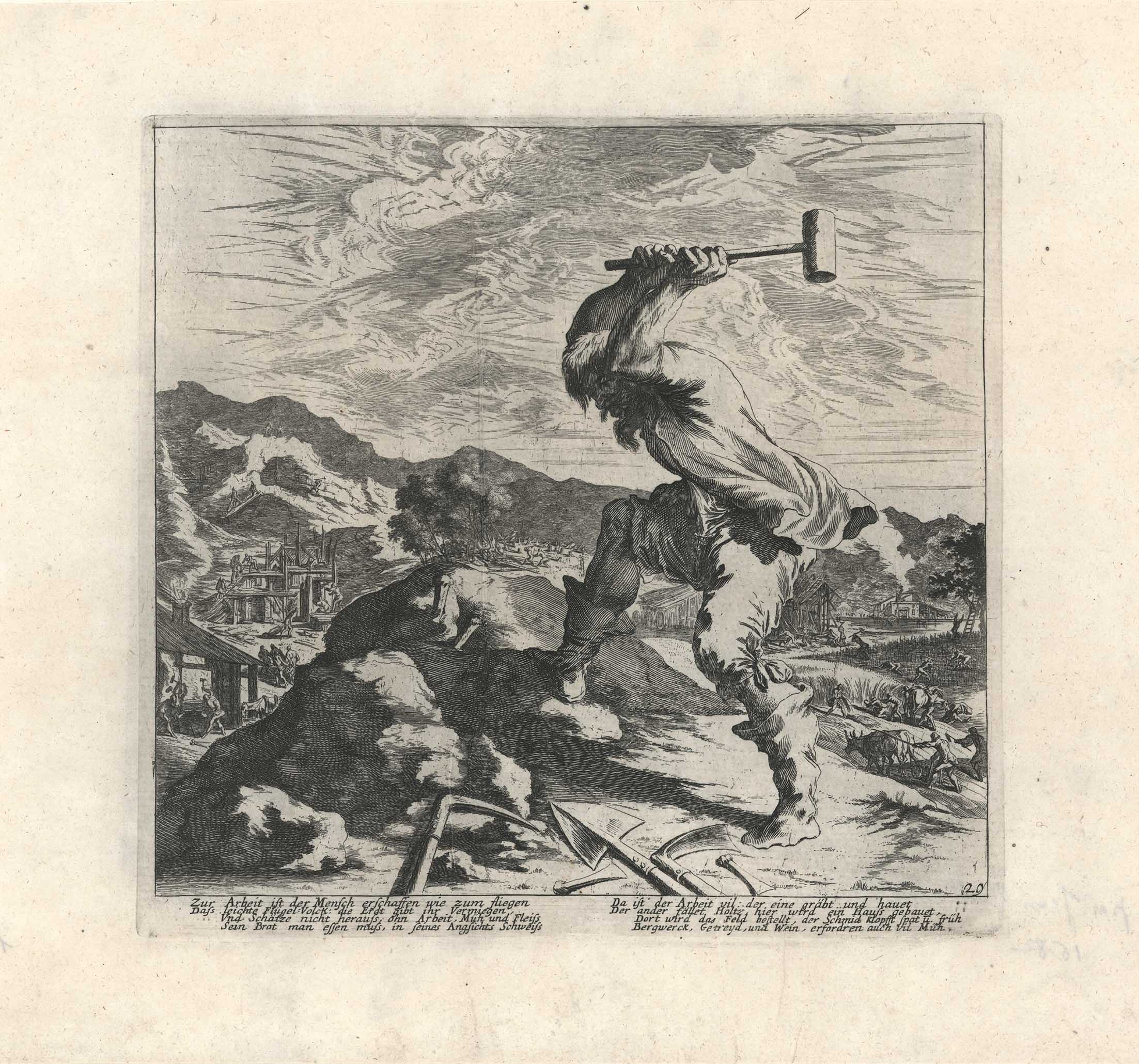
“Allegory of Work” (aka “Personification of
Labour”; “Personificatie van Arbeid”), 1670, plate 29 from the series of 149 etchings
(including the title plate), “Iconographia” (aka “Joannis Guilielmi Baurn
Iconographia”), after drawings by Johann Wilhelm Baur
(1607–1642), published by Melchior Küsel in Augsburg.
Regarding the Baur’s drawings and Küsel’s
publication of his etchings after Baur’s drawings, the Curator of the British
Museum advises “Küsel had acquired a large number of drawings from the heirs of
Baur (who died in 1642), and etched and published them himself. The series was
a huge success and went through numerous editions between 1670 and 1702” (https://www.britishmuseum.org/collection/object/P_1911-0412-168-1-148).
Etching on fine laid paper with wide margins
laid onto a support sheet.
Size: (sheet) 28.5 x 31 cm; (plate) 22 x 23.3
cm; (image borderline) 20.6 x 22.4 cm.
Numbered in plate within the image borderline:
(lower right corner) “29”.
Lettered in plate in two quatrains of German: “Zur
Arbeit ist der Mensch erschaffen wie zum fliegen/ Dass leichte Flügel-Volck:
die Erdt gibt ihr Vergntegen,/ Vnd Schätze nicht heraus, ohn Arbeit, Müh und
Fleiss/ Sein Brot man essen muss, in seines Angsichts Schweiss// …”. (Man is
created for work as if to fly/ That light winged people: the earth does not
give her pleasure/ And treasures, without work, toil and diligence/ One has to
eat one's bread, in his face sweat// …).
Hollstein German 329 (Fedja Anzelewsky [ed.] 1977,
“German Engravings, Etchings and Woodcuts c.1400–1700: Maria Magdalena Küsel to
Johann Christoph Laidig”, vol. 20, Amsterdam, Van Gendt & Co, pp, 105–07, cat.
no. 329).
See also the description of this print offered
by the Rijksmuseum: http://hdl.handle.net/10934/RM0001.COLLECT.411843.
Condition: a strong and well-printed
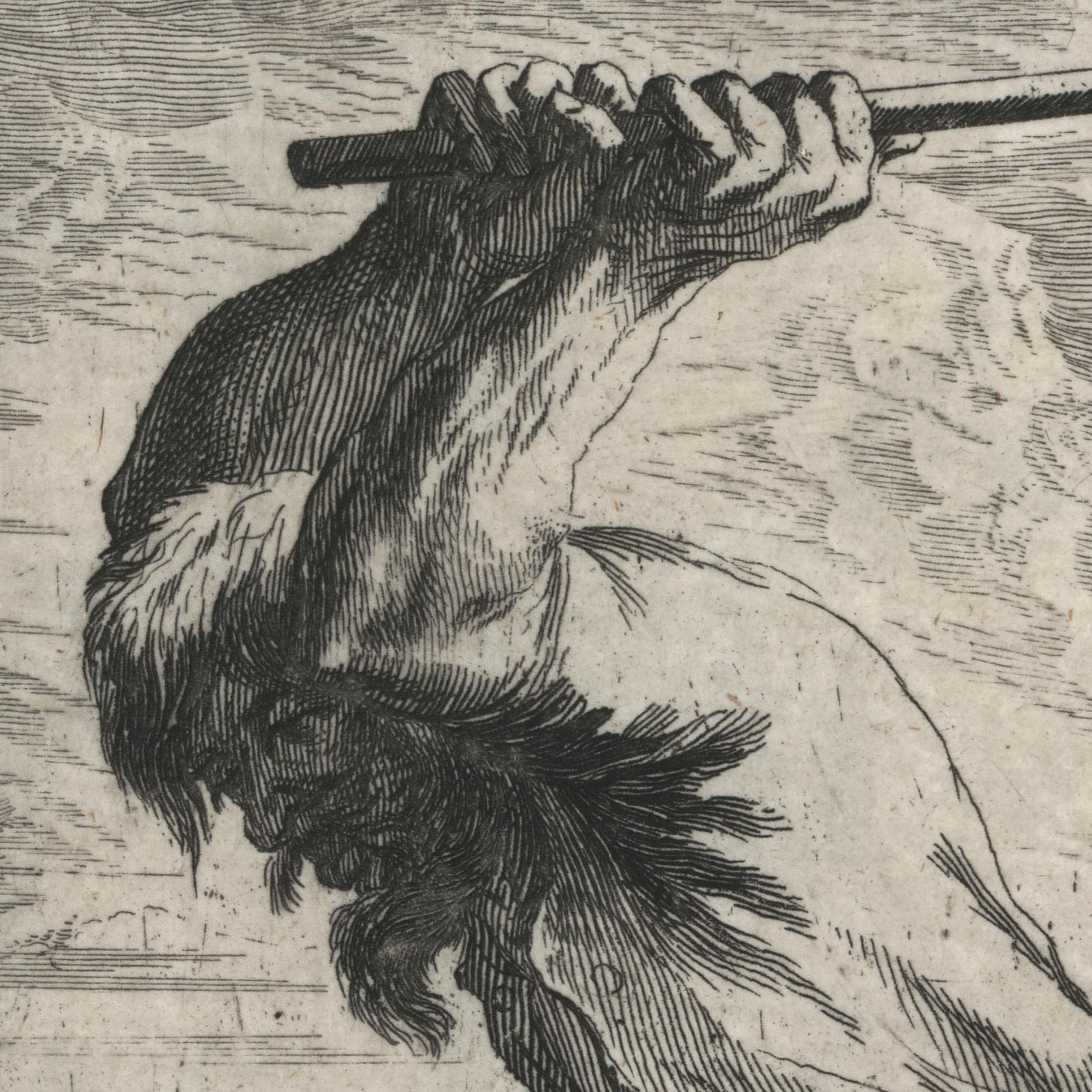
impression with a few signs of wear to the plate (viz. on the figure’s beard
and pants) and a restored vertical printer’s crease at left of centre. Interestingly,
an impression of this print held by the Harvard Art Museum (see https://hvrd.art/o/92516) also has a vertical
printer’s crease close to the same position that it occurs in this impression (before
the white printer’s crease was replenished to avoid being visually distracting).
Beyond the issue of the printer’s crease, the sheet is in a good condition with
no significant stains or foxing.
I am selling this marvellous image of the
notion of work being personified by a muscly labourer raising his mallet with
the tools of his trade laying at his feet and other workers shown in the distance—note
how the clouds in the sky seem to stand as a visual analogue for the buzzing latent
energy of the scene—for AU$298 (currently US$199.18/EUR180.22/GBP158.65 at the
time of posting this print) including postage and handling to anywhere in the
world (but not, of course, any import duties/taxes imposed by some countries).
If you are interested in purchasing this very
memorable etching that (at least for me) has the strange effect of removing the
idea of becoming a hard worker, please contact me
(oz_jim@printsandprinciples.com) and I will send you a PayPal invoice to make
the payment easy.