Showing posts with label Visscher (Claes Jansz). Show all posts

Saturday, 21 March 2026

Harmen Jansz. Muller, “The Servant Buries his Talent”, c.1570, after Gerard van Groeningen (2nd copy)

Harmen Jansz. Muller (1540–1617)

“The Servant Buries his Talent” (aka “Dienaar begraaft zijn talent”), c.1570 (1565–72)

Technical Details & Condition:

Engraving on fine laid paper with the Arms of Amsterdam watermark, with a small margin around the platemark and backed with a support sheet of tissue-thin (Kozo) washi paper. 

This is plate 3 from the series of six engravings, “The Parable of the Talents,” after the design by Gerard van Groeningen (also known as Gerard van Groenning, Gerard P Groenning, Gerard Groenning, Gerardum Groeninghen, Gerrit van Groenwegen, Gerardo a Gruningen) (fl. 1550–1599). 

The print was first published in Antwerp in its initial state by Gerard de Jode (1509/17–1591) in “Thesaurus novi Testamenti elegantissimis iconibus expressus continens historias atque miracula doni nostri Iesu Christi” (1579–85). It was later reissued in Amsterdam in its second and final state by Claes Jansz. Visscher II (1587–1652) in “Theatrum Biblicum Hoc Est Historiae Sacrae Veteris et Novi Testamenti Tabulis Aeneis Expressae” (1646). 

This impression is from Visscher’s second state, with the addition of the biblical reference (“Matt. 25.18.”) and the number “3” below the image at the lower right corner. 

This is a strong impression. Aside from a closed tear in the upper margin, the sheet is in excellent condition for its age—free of holes, folds, abrasions, or significant stains.

Dimensions:

• Sheet: 22.5 x 31.2 cm
• Platemark: 20.3 x 29.2 cm

Plate Numbering and Lettering:

• Within the image at lower right: “3”
• On column base at lower right: “[Artist’s monogram] F”
• Below image: “Qui vero unum acceperat abiens fodit in terram et abscondit pecuniam Domini sui. Matt. 25. 18. 3”

References:

• New Hollstein Dutch (Harmen Jansz. Muller) 51 (Ger Luijten [ed.], “The New Hollstein: Dutch and Flemish Etchings, Engravings and Woodcuts 1450–1700: The Muller Dynasty”, 1999, vol. 1, Rotterdam, Rijksprentenkabinet, p. 134, cat. no. 51)
• New Hollstein Dutch (Gerard van Groeningen) 110 (Christiaan Schuckman [comp.] 1997, “The New Hollstein: Dutch and Flemish Etchings, Engravings and Woodcuts 1450–1700: Gerard van Groeningen”, vol. 1, Rotterdam, Rijksprentenkabinet Sound and Vision Interactive, p. 146, cat. no. 110)
• Mielke 49 (H. Mielke, “Antwerpener Graphik in der 2. Hälfte des 16. Jahrhunderts. Der Thesaurus veteris et novi Testamenti des Gerard de Jode (1585) und seine Künstler,” in: Zeitschrift für Kunstgeschichte, vol. 38, no. 1, 1975, p. 82, cat. no. 49)
• Rijksmuseum: https://id.rijksmuseum.nl/200564850

Price & Shipping:

AU$310 (approximately US$217.74 / €188.10/ £163.16), including worldwide express shipping. Import duties and taxes (if any) are the buyer’s responsibility.

If you’re interested in acquiring this superb engraving illustrating the biblical parable from Matthew 25:18—depicting the “neglectful” servant burying a stash of money, a “talent” worth the equivalent of 16 years of labour—please contact me at oz_jim@printsandprinciples.com. I will gladly send you a PayPal invoice to make the purchase seamless.


Friday, 31 January 2025

Jan van de Velde II, “Figures on a Country Road Near a Farm”, 1616

Jan van de Velde II (c.1593–1641)

“Figures on a Country Road Near a Farm” (aka “Figuren op een landweg bij een boerderij”), 1616, plate 2 (as numbered at lower right corner) from part 4 (as numbered in the upper right corner) of the series, “Sixty Landscapes”—a series of sixty etchings grouped in five parts of twelve prints—printed in Amsterdam by Claes Jansz. Visscher (aka Nicolaes Jansz. Visscher; Piscator) 1587–1652), as inscribed in the title plate to the series (see https://id.rijksmuseum.nl/200393054).

Etching on fine laid paper, trimmed around the image borderline and backed with a support sheet providing wide margins.

Size: (sheet) 12.3 x 19 cm.

Numbered in plate: (upper right corner) “4”; (lower right corner) “2”.

Hollstein 269 (Ger Luijten & Christiaan Schuckman [comp.] 1989, “Dutch and Flemish Etchings, Engravings and Woodcuts c.1450–1700: Jan van de Velde II to Dirk Vellert”, vol. 33, Roosendaal, Koninklijke Van Poll, cat. no. 269); Franken & Van der Kellen 308 (Daniel Franken & Johan Philip van der Kellen 1883, “L'oeuvre gravé de Jan van de Velde II”, Amsterdam, p.122, cat. no. 308).

See also the descriptions of this print offered by the Rijksmuseum and the British Museum: https://id.rijksmuseum.nl/200392999; https://www.britishmuseum.org/collection/object/P_Sheepshanks-5961.

Condition: a strong and well-printed impression, trimmed around the image borderline and laid upon an archival support sheet of millennium quality washi paper providing wide margins. The sheet is in an excellent condition with no tears, holes, folds or significant stains.

I am selling this superb etching from the early 1600s showing what is still an everyday scene of travellers asking for directions—note, however, that the depiction of the culvert in the foreground along with the huge boulder at left might also be seen by viewers from Van de Velde’s time as visual reminders (“telling signs”) of the natural forces of the divine underpinning everyday life—for AU $374 (currently US $233.05/ EUR 223.96/ GBP 18748 at the time of posting this print) including Express Mail (EMS) postage and handling to anywhere in the world, but not (of course) any import duties/taxes imposed by some countries. Note that payment is in Australian dollars (AU $374) as this is my currency.

If you are interested in purchasing this sensitively executed etching from the Dutch Golden Age, please contact me (oz_jim@printsandprinciples.com) and I will send you a PayPal invoice to make the payment easy.

This print has been sold


Friday, 10 January 2025

Harmen Jansz. Muller, “Hirah the Adullamite with the Kid”, c.1566, after Maarten van Heemskerck (2nd copy)

Harmen Jansz. Muller (1540–1617)

Hirah the Adullamite with the Kid” (aka “Hirah the Adullamite with the Kid, inquiring for the Harlot”; “Judah Orders Hira to Search for the Prostitute”; “Juda geeft Chira de opdracht om de prostituee te zoeken”), c.1566, after a drawing by Maarten van Heemskerck (aka Maarten van Veen; Martin Heemskerk) (1498–1574), plate 2 from the series of 4 engravings, “History of Judah and Tamar”, published by Claes Jansz. Visscher (II) (1586–1652) in Amsterdam between 1643 and 1646.

Engraving on fine laid paper with handwritten notes in brown ink by an old hand in the margin, backed with a support sheet.

Size: (sheet) 26.9 x 31.5cm; (plate) 21.1 x 26.5cm; (image borderline) 19.6 x 25.9cm.

Inscribed in plate within the image borderline: (lower right corner) “2/ MH [interlaced] eemskerck Inuen/ HMVL [interlaced] fe,”.

Lettered in plate below the image borderline: “HAVD MORA PROMISSIS STAT IVDAS MITTIT ET HOEDVM AT SCORTVM HOC HÆSISSE LOCO CVNCTI ORE NEGABA[N]T/ Gene. 38.20.”

State ii (of ii) with the addition of the plate number “2”.

New Hollstein (Muller) 6 (Ger Luijten & Christiaan Schuckman [eds.] 1999, “The New Hollstein: Dutch and Flemish Etchings, Engravings and Woodcuts 1450–1700: The Muller Dynasty”, vol. 1, Rotterdam, Rijksprentenkabinet, p. 87, cat. no. 6); New Hollstein (Heemskerck) 40 (Ilja Veldman [comp.] 1993–94, “The New Hollstein: Dutch and Flemish Etchings, Engravings and Woodcuts 1450–1700: Maarten van Heemskerck”, vol. 1, Roosendaal, Koninklijke Van Poll, p. 51, cat. no. 40).

The Rijksmuseum offers the following description of this print (state ii): (transl.) “Judah orders his friend Hira to give a billy goat as a payment to the prostitute while pointing out the departing Tamar. Hira holds the goat under his arm and will search for the prostitute, but not find her. At the bottom of the margin a reference in Latin to the Bible text in Gen. 38:20” (http://hdl.handle.net/10934/RM0001.COLLECT.552731).

See also the description of this print at the Metropolitan Museum of Art: https://www.metmuseum.org/art/collection/search/632500.

Condition: a well-printed impression showing no sign of wear to the printing plate with wide margins and handwritten notes by an old hand in brown ink in the margin. Beyond a replenished spot in the upper margin at right, the sheet is in a good condition with no and is laid onto a support sheet of archival (millennium quality) washi paper.

I am selling this exceedingly rare print executed by the father of Jan Harmensz. Muller for AU $323 in total (currently US $202.34/ EUR 197.44/ GBP 165.71 at the time of posting this listing) including Express Mail (EMS) postage and handling to anywhere in the world, but not (of course) any import duties/taxes imposed by some countries. Note that payment is in Australian dollars (AU $323) as this is my currency.

If you are interested in purchasing this fascinating scene of a father-in-law (the figure pointing) who slept with his daughter-in-law (the young woman with a staff at left) after mistaking her for a prostitute—perfectly understandable as mistakes happen!—directing his friend to deliver a billy goat as payment for her services with the hope of having the security on her services returned (viz. his seal, its cord, and staff), please contact me (oz_jim@printsandprinciples.com) and I will send you a PayPal invoice to make the payment easy. (My apologies if my account of the Biblical story of Judah and Tamar [Genesis 38] has too many inaccuracies.)

Note that this is the second impression of this print that I have listed. The previous copy has been sold.

This print has been sold


Sunday, 21 January 2024

Jan Collaert I’s engraving, “The Shunammite's Son Restored to Life”, c.1579, after Maarten de Vos

Jan Collaert I (aka Hans Collaert) (c1525/30–1580 [BM])

“The Shunammite's Son Restored to Life” (aka “Dood van de zoon van de Sunnemitische vrouw” [Rijksmuseum title]; “Death of the Son of the Sunnemite Woman”), c.1579, plate 3 from the series of 6 plates (Hollstein 122–127 [de Vos]), “The Story of Elisha and the Sunnemite Woman” (aka “Het verhaal van Elisa en de Sunnemitische vrouw”), after the design by Maarten de Vos (aka Maerten de Vos) (1532–1603), initially published by Volcxken Diericx (Volcxken Dierickx; Volcxken Diericx) (fl.1570–1600) and later (as is the case with this impression) by Claes Jansz. Visscher (aka Nicolaes Jansz.Visscher; Piscator) (1587–1652) in Amsterdam in 1643 (possibly in “Thesaurus Sacrarum Historiarum Veteris Testament”) and later still by Jan Schabaelje (aka Jan Philipsz Schabaelie; Jan Schabalje) (fl.1643–1649) in 1646.

Engraving on laid paper.

Size: (sheet) 23.8 x 31 cm; (plate) 20.6 x 28.6 cm; (image borderline) 18.9 x 28.2 cm.

Inscribed in plate within the image borderline: (left of centre on lower edge) “M. de Vos inuent.”

Numbered and lettered in plate below the image borderline: (left) “3”; (centre in two columns of Latin in two lines) “Paruulus ad Patrem properans, dû forte per estus,/ Spicea dum grauidas diffundit Meβis aristas.// Confestim tener heu morbo tentatur acuto,/ Inq[ue] sinu matris vitales deserit auras.”; (right) “2. Regum cap 4 ver. 19./ 3”.

State: iv (of v)

Hollstein 124 (Christiaan Schuckman [comp.] 1996, “The New Hollstein: Dutch and Flemish Etchings, Engravings and Woodcuts 1450–1700: Maarten de Vos,” vol. 44, Rotterdam, Sound and Vision Rijksprentenkabinet, cat. no. 124); New Hollstein (The Collaert Dynasty) 61 (Ann Diels & Marjolein Leesberg [comp.] 2005–2006, “The New Hollstein: Dutch and Flemish Etchings, Engravings and Woodcuts 1450–1700: The Collaert Dynasty,” vol. 1, Ouderkerk aan den Ijssel, Sound and Vision, p. 74, cat. no. 61); Riggs 196 (Timothy A. Riggs 1977, “Hieronymus Cock: Printmaker and Publisher,” New York, Garland Publishing).

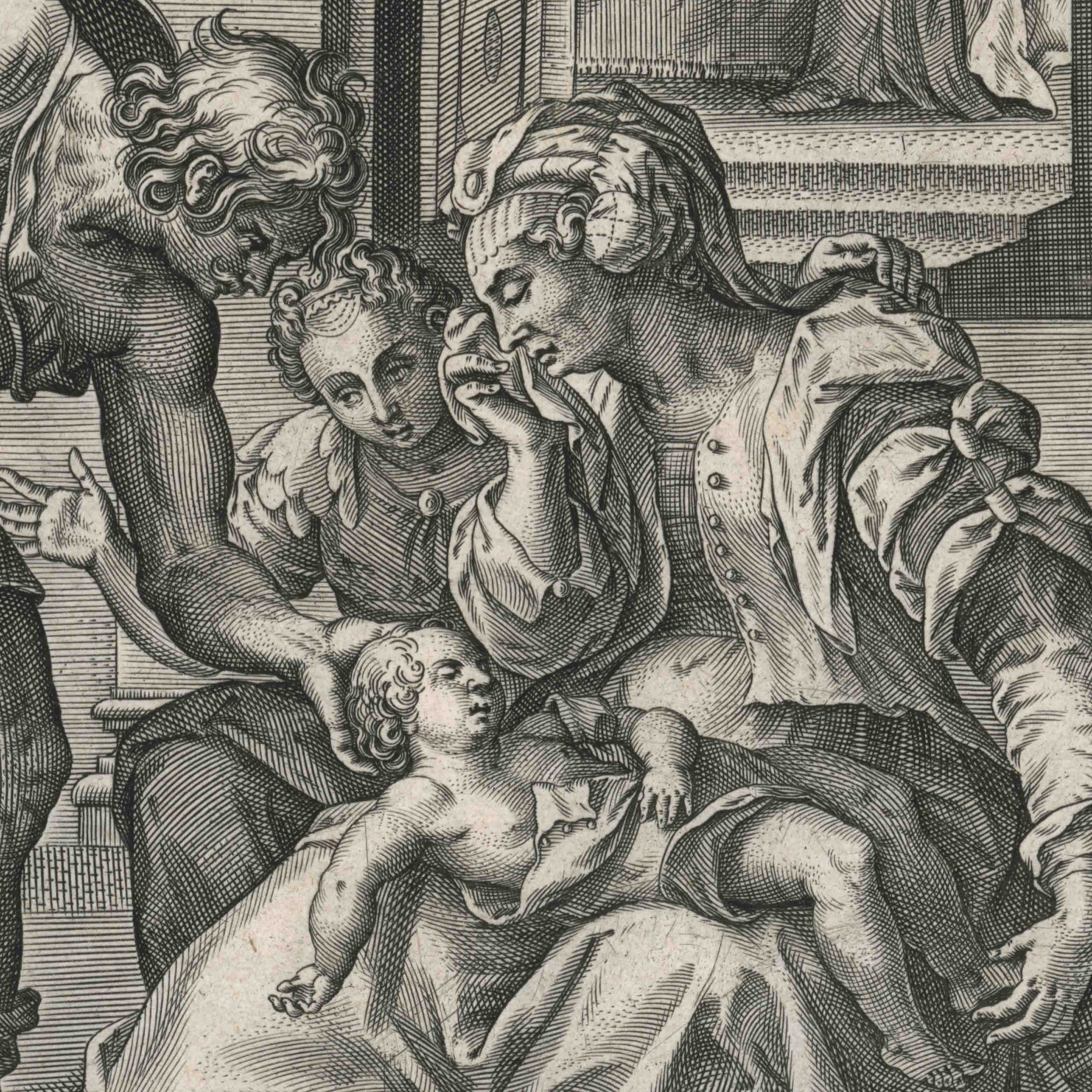
The British Museum offers the following description of this print: “The collapsed son brought to his mother; the Shunammite woman weeping with the child in her lap, her husband and a maid attending the child; at left labourers harvest a field of wheat, and Elisha seen talking to the husband of the Shunammite woman and to her child; to right, the Shunammite woman seen putting her child to bed; plate 3; on full sheet; after Maarten de Vos. Engraving” (https://www.britishmuseum.org/collection/object/P_1937-0915-87).

See also the description of this print offered by the Rijksmuseum: http://hdl.handle.net/10934/RM0001.COLLECT.97253.

Condition: a strong and well-printed (near faultless) impression with good margins.
Beyond faded brown ink annotations (recto), the sheet is in an excellent condition for its considerable age with no tears, holes, folds, losses, abrasions or significant stains.

I am selling this superb impression of a beautifully executed engraving exemplifying the Flemish Mannerist leaning towards lively rhythms and theatrical gestures, for AU$289 (currently US$190.87/EUR175.10/GBP150.22 at the time of this listing) including Express Mail (EMS) postage and handling to anywhere in the world, but not (of course) any import duties/taxes imposed by some countries.

If you are interested in purchasing this superb engraving featuring a fascinating layering of complexity in illustrating an episode in the narrative of the Story of Elisha (2 Kings. 4:19)—for example, in the foreground the child of the Sunnemite woman dies in his mother's arms, while in the distant bedchamber at right the Sunnemite woman’s child is shown having being brought back to life—please contact me (oz_jim@printsandprinciples.com) and I will send you a PayPal invoice to make the payment easy.

This print has been sold


Friday, 8 December 2023

Circle of Gerard de Jode’s engraving, “Hezekiah Stopping the Water Supply Outside Jerusalem”, 1585, after Maarten de Vos

Unidentified printmaker from the circle of Gerard de Jode (aka Geeraert de Jode; Geerart de Jode; Gerardo de Jode; Gheerde de Jode; Gheraerde de Jode; Girard de Jode; Gerard de Jode (1516/17–1591)

Hezekiah Stopping the Water Supply Outside Jerusalem” (aka “Hizkia sluit de bronnen buiten Jeruzalem af”), 1585, plate 2 from the series of four plates, “The Story of Hezakiah and Sennacherib” (aka “Geschiedenis van Hizkia en Sanherib”), after the design by Maarten de Vos (aka Maarten de Vos; Maerten de Vos) (1532–1603) and published in 1585 in Antwerp by Gerard de Jode and later in 1643 (state ii) by Claes Jansz. Visscher (aka Piscator) (1587–1652) in “Thesaurus Sacrarum historiarum Veteris et Novi Testamenti.” This is a lifetime impression from the first edition published by Gerard de Jode.

Engraving on fine laid paper with a fork-tailed Gothic letter "P" surmounted by a quatrefoil watermark (Briquet 8684/8686).

Size: (sheet) 23.8 x 31.6 cm; (plate) 19.7 x 28.9 cm; (image borderline) 18.8 x 28.8 cm.

Lettered in plate below the image borderline: “Hostibus obturat fontes puteosque Esechias Ne longa ciuis obsidione prema[n]t 2 Paral. capit. 32.” ([Google transl.] “Ezekias stops the enemies' fountains and wells, so that he does not pressurize the people with a long siege.”)

State i (of ii) before the addition of the plate number (“2”).

Hollstein 130 i/ii (Christiaan Schuckman comp. 1996, “Dutch and Flemish etchings, engravings and woodcuts ca. 1450–1700: Maarten de Vos”, vol. 44, Rotterdam, Sound and Vision Rijksprentenkabinet, pp. 37–38, cat. no. 130).

The Rijksmuseum offers the following description of this print: “[transl.] King Hezekiah has the wells and irrigation canals outside Jerusalem closed so that Sennacherib and his army will not have an abundance of water during the siege of Jerusalem. In the background, the walls of Jerusalem are being reinforced and provided with towers. Below the scene a reference in Latin to the Bible text” (http://hdl.handle.net/10934/RM0001.COLLECT.553734).

See also the descriptions of this print offered by the British Museum (with somewhat startling contemporary colouring) and the Metropolitan Museum of Art: https://www.britishmuseum.org/collection/object/P_1968-1018-1-151; https://www.metmuseum.org/art/collection/search/651819.  

Condition: a strong and well-printed early impression from a plate showing no sign of wear. Beyond an abraded mark on the left side, the sheet is in an excellent condition for its considerable age with reasonably wide margins, no tears, folds or significant stains (but there are a few minor marks).

I am selling this strong lifetime impression of an engraving showing the thirteenth king of Judah, King Hezekiah (aka Ezekias), on the left directing his workers to cut off the water supply necessary for his foe, King Sennacherib of the Neo-Assyrian Empire, to lay siege on Jerusalem, for a total cost of AU$293 (currently US$195.84/EUR177.20/GBP155.98 at the time of this listing) including postage and handling to anywhere in the world, but not (of course) any import duties/taxes imposed by some countries.

If you are interested in purchasing this marvellous engraving exemplifying the spirit of the period style of Mannerism—note the abundant rhythms, theatrical gestures, distortion of figures and shallow pictorial space—please contact me (oz_jim@printsandprinciples.com) and I will send you a PayPal invoice to make the payment easy.

This print has been sold