Showing posts with label Bos (Cornelis). Show all posts

Thursday, 26 November 2020

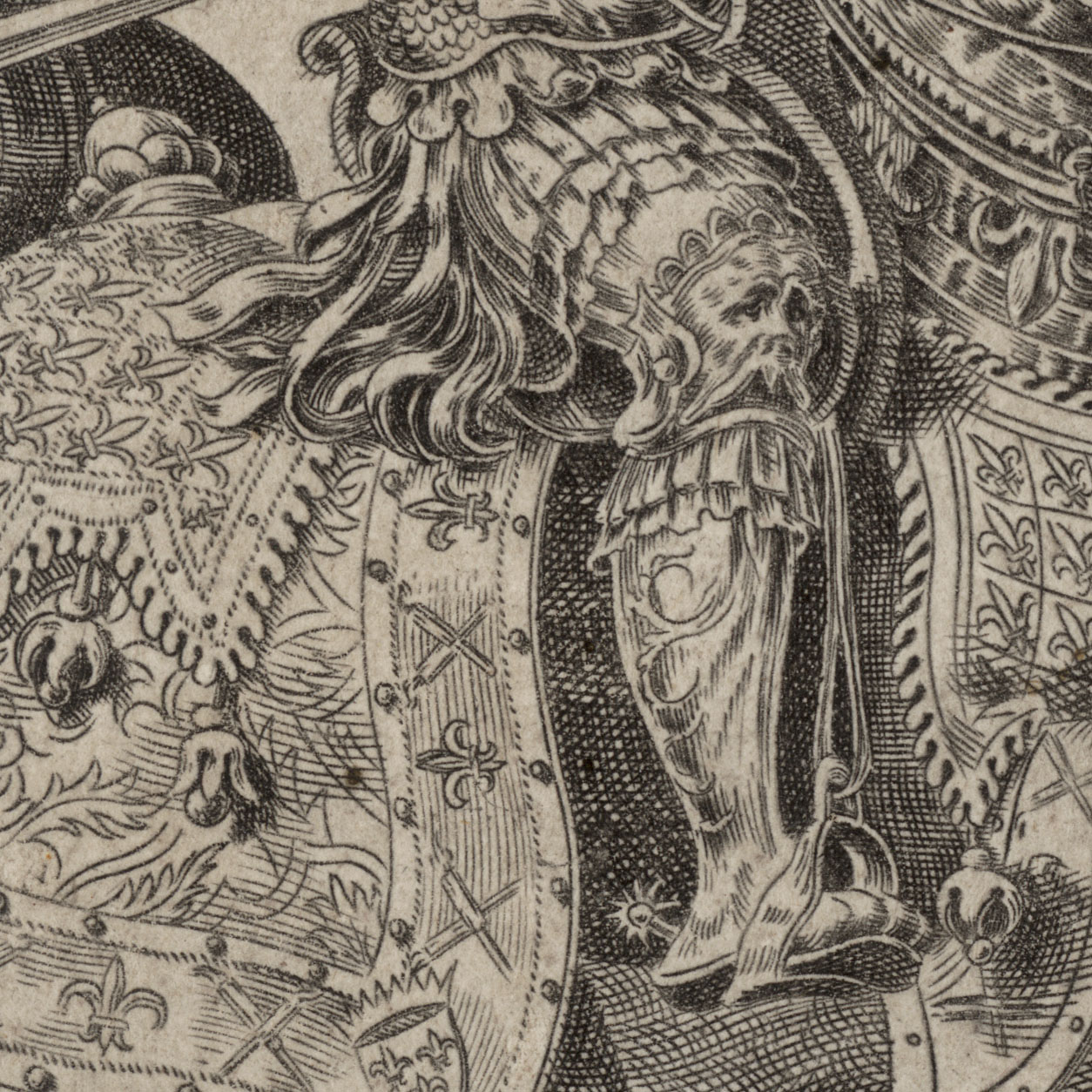
Dirck Volkertsz. Coornhert’s engraving, “King Francis Taken Prisoner at the Battle of Pavia”, 1555, after Maarten van Heemskerck

Dirck Volkertsz. Coornhert (aka Dirk Volkertsz Coornhert; Dirk Volkertsz Cuerenhert) (1522–1590)

Note: “The Illustrated Bartsch” (1991) catalogue raisonné for Coornhert lists this print as by the hand of Dirck Volkertsz. Coornhert (vol. 55 [Supplement], p. 243), but the Rijksmuseum is more tentative and advises that it is possibly by Coornhert or possibly by Cornelis Bos (c1506/10–1555).

“King Francis Taken Prisoner at the Battle of Pavia” (TIB title) (aka “Captured by Francis I during the Battle of Pavia, 1525” [Rijksmuseum title]), 1555, plate 2 from the series of twelve plates, “The Victories of Charles V (1555–56)” (aka “Divi Caroli. V. imp. opt. max. victoriae, ex multis praecipuae”), after the design by Maarten van Heemskerck (aka Martin Heemskerk; Maarten van Veen) (1498–1574), published by Hieronymus Cock (aka Jérome Cock) (c1517–1570) in Antwerp.

Engraving and etching trimmed around the image borderline (with loss of Latin text below the borderline) and backed with a support sheet.

Size: (sheet) 14.6 x 23.3 cm.

Inscribed on plate within the image borderline: (lower left) “II”; (lower right on shield rim) “MH [ligature letters] eemskerk Inuent.”

State ii or later (of iv) Note: Although this impression is not from the first state, because it has the plate number (“II”), the loss of the text lines below the image borderline make the attribution of the exact state problematic.

TIB 5501.070.2 (Ilja M Veldman [ed.] 1991, “The Illustrated Bartsch: Dirck Volkertsz. Coornhert”, vol. 55 [Supplement], New York, Abaris Books, p. 243, cat. no. [5501].070.2); Hollstein 217 (F W H. Hollstein 1951, “Dutch and Flemish Etchings, Engravings and Woodcuts c.1450–1700: Brun to Coques”, vol. 4, Amsterdam, Menno Hertzbergerp, p. 231, cat. no. 217).

The Rijksmuseum offers the following description of this print:

(Transl.) “The capture of Francis I, King of France, at the Battle of Pavia (1525). The king on horseback is surrounded by three knights, also on horseback. In the foreground is the body of a defeated knight. In the background tents and armies with the city of Pavia in the distance. The print is part of a twelve-part series about the victories of Charles V”

(http://hdl.handle.net/10934/RM0001.COLLECT.98309).

See also the description of this print by the British Museum: https://www.britishmuseum.org/collection/object/P_1868-0208-58.

Condition: a strong and well-printed impression showing very little wear to the plate but there are many small replenished losses and restored tears. The sheet is trimmed around the image borderline with loss of the lower margin and laid onto a support of archival (millennium quality) washi paper.

I am selling this extraordinary (but restored) Renaissance period battle scene for AU$302 (currently US$222.51/EUR186.78/GBP166.54 at the time of this listing) including Express Mail (EMS) postage and handling to anywhere in the world, but not (of course) any import duties/taxes imposed by some countries.

If you are interested in purchasing this remarkable engraving almost shimmering with action and the reflections of shiny armour, please contact me (oz_jim@printsandprinciples.com) and I will send you a PayPal invoice to make the payment easy.

This print has been sold


Thursday, 25 January 2018

Cornelis Bos’ engraving, “Ornamental panel of grotesques in the style of the Vatican Loggie”, 1548


Cornelis Bos (aka Cornelis Bosch; Cornelis Bus) (c1515–1556) or by an unidentified artist after Bos

“Ornamental panel of grotesques in the style of the Vatican Loggie” (descriptive title only), 1548, from the series of 6 plates, “Frisians with grotesques, scrolls, fantasy animals, animals and scrolls”
Engraving on fine laid paper trimmed unevenly within the platemark and re-margined with a support sheet.
Size: (support-sheet) 21.7 x 23.9 cm; (sheet trimmed unevenly) 4.2 x 7.8 cm
Inscribed on plate: (upper left) “1548”; (upper right) “C B”

Ref: Irene Margaretha de Groot 1988, “Ornamentprenten in het Rijksprentenkabinet”, Amsterdam.
See the description of this print at the Riksmuseum: http://hdl.handle.net/10934/RM0001.COLLECT.445306.

Condition: crisp impression without significant wear but trimmed within the platemark and re-margined on a support sheet. The sheet is in good condition (i.e. there are no tears, holes, folds, abrasions, significant stains or foxing) with minor signs of use.

I am selling this VERY small engraving from the Renaissance era—interestingly it was executed at the very time that Michelangelo had just commenced working on his sculpture, “The Deposition” (aka “Bandini Pietà” or “The Lamentation over the Dead Christ”)—for AU$189 (currently US$152.71/EUR123.04/GBP107.11 at the time of posting this listing). Postage for this print is extra and will be the actual/true cost of shipping.

If you are interested in acquiring this exceptional rare and early engraving, please contact me (oz_jim@printsandprinciples.com) and I will send you a PayPal invoice to make the payment easy.

This print has been sold


Mindful that Bos was expelled from Antwerp for heresy only four years before he executed this tiny ornamental panel, just looking at the whimsical grotesques involved in the design gives a good idea that he liked to push boundaries. For example, note the close—but not inoffensively close—arrangement of vines bound together by the hole in the portrayed strapwork near the crotch of the naked female at the centre of the composition. I must say at this point, however, that Bos’ designs are far less sexually explicit than similar panels of grotesques by artists like Heinrich Aldegrever executed around the same time; see for example http://hdl.handle.net/10934/RM0001.COLLECT.322645.

What makes Bos’ ornamental panels different and delicately elegant by comparison with the densely worked compositions of his contemporaries is the suggestion of airy three-dimensional space. What I mean by this comment is that Bos chooses to leave the backgrounds of his designs blank (as opposed to the darkly cross-hatched backgrounds of Aldegrever) and to ”weave” various pictorial elements, like the vines, so that they flow in three-dimensions. One feature of the weaving that I find particularly intriguing is the tail of the bird on the left. This tail creates a marvellous optical illusion as it is shown in front of the scrolled strap and yet the bird is perched behind the strap.