Showing posts with label Losi (Carlo). Show all posts

Saturday, 1 February 2025

Michele Lucchese, “The Martyrdom of Saint Laurence”, 1525–1537, after Marcantonio Raimondi and Baccio Bandinelli

Michele Lucchese (aka Michele Crecchi Lucchesi; Michele Greco; Michele Grech) (fl.1534–64) see also the discussion about this engraver in M. Bury’s (2001) “The Print in Italy 1550–1625”, London, British Museum, p. 228.

“The Martyrdom of Saint Laurence”, 1539, after Marcantonio Raimondi’s (1470/82–1527/34) engraving (1490–152) shown in the same direction (see https://id.rijksmuseum.nl/200307840), after a drawing by Baccio Bandinelli (1493–1560), initially published in Rome by Antoine Lafréry (aka Antonio Lafreri) (c.1512–1577). This impression was published by Giovanni Giacomo de Rossi (1627–1691) and the Wellcome Collection holds an impression published in 1774 by Carlo Losi (c.1757–[after]1805) (see https://wellcomecollection.org/works/z8xs6a4d).

Engraving on laid paper trimmed along the image borderline and backed with a support sheet providing wide margins

Size: (sheet) 27.6 x 35.5 cm.

Inscribed in plate along lower edge: (left) “M.L cu privilegio”; (on tablet) “BACCIVS/ BRANDIN/ […?] INV/ […?]; (centre) Ant. Lafrerj. Rom; (right) “Gio Bat.de Rossi [….?] Petri de Nobilibus Formis”

TIB 26.104C (Konrad Oberhuber [ed.] 1978, “The illustrated Bartsch: The Works of Marcantonio Raimondi and of his School”, vol. 26, New York, Abaris Books, p. 136, cat. no. 104C).

Condition: a slightly silvery impression with signs of wear to the printing plate (notably at upper right), trimmed along the image borderline and laid upon an archival support sheet of millennium quality washi paper providing wide margins. The sheet is in a good condition with no tears, folds or significant stains.

I am selling this exceptionally rare, delicately beautiful and large Renaissance period engraving showing the martyrdom by fire grill of Saint Laurence (aka St Lawrence)—one of the seven deacons of Rome martyred in 258 AD during the persecution of Christians by Emperor Valerian—watched by the Roman prefect and two floors of spectators, for AU $603 (currently US $374.70/ EUR 361.58/ GBP 302.20 at the time of posting this print) including Express Mail (EMS) postage and handling to anywhere in the world, but not (of course) any import duties/taxes imposed by some countries. Note that payment is in Australian dollars (AU $603) as this is my currency. 

If you are interested in purchasing this superb engraving that is seldom seen on the art market, please contact me (oz_jim@printsandprinciples.com) and I will send you a PayPal invoice to make the payment easy.

This print has been sold


Friday, 25 August 2023

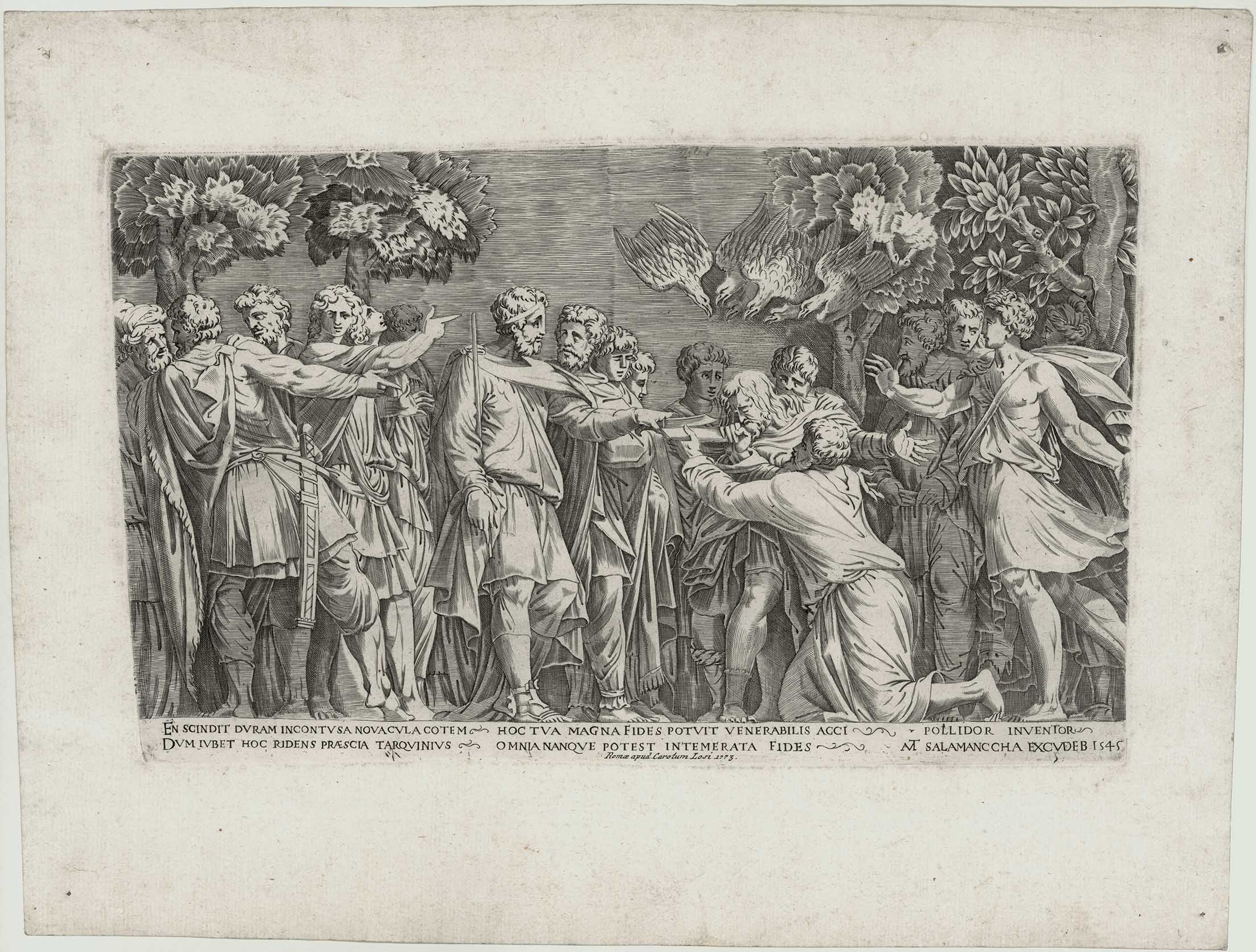
(Attrib.) Michele Lucchese’s engraving, “Tarquinius Priscus Cutting the Whetstone”, 1545, after Polidoro da Caravaggio

(Attrib.) Michele Lucchese (aka Michele Crecchi; Michele Grechi; Michele Greco) (fl.1534–1564), formerly attributed to Nicolas Beatrizet (aka Nicolas Beatricetto) (c.1507–c.1566)

“Tarquinius Priscus Cutting the Whetstone”, 1545, after Polidoro da Caravaggio (aka Polidoro Caldara; Polidoro da Caravagio) (c.1499–1543), possibly relating to a lost façade on Monte Citorio (see the Curator of the BM comment; inv. no. V,8.76), published in Rome by Antonio Salamanca (1478–1562) and later in 1773 (as is the case with this impression) by Carlo Losi (fl.Rome 1757–after 1805).

Engraving on heavy laid paper with wide margins.

Size: (sheet) 36.3 x 47.6 cm; (plate) 24.2 x 40.5 cm; (image borderline) 22.1 x 40.4 cm.

Lettered in plate below the image borderline: “EN SCINDIT DVRAM INCONTVSA NOVA CVLA COTEM ... POLLIDOR INVENTOR/ DVM IVBET HOC … [ANT] SALAMANCCHA EXCVDEB 1545/ Romæ apud Carolum Losi 1773.”

State ii (of ii) with the addition of the publication details for Carlo Losi.

Mariette I, p. 257 (as Caldara); Passavant 119 (as Beatrizet); Bianchi D 14 (attributed to Beatrizet).

See also the description of this print offered by the British Museum: https://www.britishmuseum.org/collection/object/P_1871-0429-615.

Condition: a strong and well-printed impression with wide margins. Beyond a pinhole in each corner of the margin and minor surface dustiness, the sheet is in an excellent condition with no tears, losses, abrasions, significant stains or foxing.

I am selling this rare engraving for AU$376 (currently US$251.32/EUR227.39/GBP200.17 at the time of posting this listing) including postage and handling to anywhere in the world (but not, of course, any import duties/taxes imposed by some countries).

If you are interested in purchasing this strong impression showing at left-of-centre, Tarquinius Priscus—by tradition, the fifth king of Rome (reigning between c.616–578 BC)—slicing through a whetstone (tool sharpener) with his knife to demonstrate his divine power, contact me (oz_jim@printsandprinciples.com) and I will send you a PayPal invoice to make the payment easy.

Note that I have previously listed another engraving by Michele Lucchese, “The Martyrdom of St. Lawrence” (c.1520), after Marcantonio Raimondi (and Baccio Bandinelli) that is currently still available: https://www.printsandprinciples.com/2017/02/luccheses-engraving-1539-after.html.

This print has been sold


Wednesday, 31 May 2023

Jacopo Caraglio’s engraving, “Ariadne”, 1526, after Rosso Fiorentino


Jacopo Caraglio (aka Giovanni Jacopo Caraglio; Giacomo Caraglio) (c1500–1565)

“Ariadne” (aka “Ariadne with a Crown of Stars”), 1526, plate 18 from the series of twenty plates, “The Gods in Niches” (aka “Mythological Gods and Goddesses”; “Classical Gods”; “Goden in Nissen”), after Rosso Fiorentino (aka Giovanni Battista de' Rossi; Giovanni Battista di Jacopo di Guasparre) (1494–1540). Although this impression is somewhat light in tonal contrast—an attribute documented for first/second state impressions (see TIB, vol., 28 [Commentary], p. 117)—this is a lifetime impression before the plate was reworked with the addition of shading around the niche by Francesco Villamena (1564–1624) in the third state and before publication by Carlo Losi (fl.c1757−1805) in the fourth and final state.

Note that this engraving is deceptively close to the copy of it made by Jacob Binck (aka Jacob Bink) (1494/1500–1569) in 1530; see http://hdl.handle.net/10934/RM0001.COLLECT.90632; TIB 16(8).43(274) (Robert A Koch [ed.] 1980, “The Illustrated Bartsch: Early German Masters; Jacob Bink, Georg Pencz, Heinrich Aldegrever”, vol., 16, New York, Abaris Books, p. 43, cat. no. 43). One of the differences is in the shape of the shadow cast by the figure’s bent leg and the variation in the phrasing (pressure) of the borderline in the same area. The Budapest Museum of Fine Arts holds a later copy of Caraglio’s engraving after the plate was revised by Francesco Villamena; see: https://www.mfab.hu/artworks/ariadne-plate-18-from-the-series-of-the-gods-in-niches/.

Madeline Cirillo Archer (1995), in the commentary volume to “The Illustrated Bartsch”, vol., 28 (New York, Abaris Books), offers the following marvellous insights into the series (“The Gods in Niches”) of which this engraving is a part: “…while using niches as settings, [the portrayed figures] make no attempt to imitate sculpture. In plasticity, activities, poses, and environment, the figures are emphatically pictorial in their conception and execution. […] in most of the compositions, the general effect is of forms either bursting out of the niche, or of balancing on the edge, their upper bodies possess a spatial ambiguity with the niche behind. The variety of textures and pictorial use of chiaroscuro increase the sense that these are not sculpture, but living forms” (pp. 116–17).

Engraving on laid paper, trimmed along the platemark on the top and sides and within the borderline on the lower edge with loss of the line of text (“.MORTALIS.BACCHO.PLACVI.QVE.ARIADNA.MARITO.” [The mortal Bacchus pleased Ariadne as her husband]), backed with a support sheet.

Size: (sheet) 21 x 11.2 cm.

Numbered in plate: (lower right corner) “18”.

State i/ii (of iv). Note that TIB (1995) advises: “Technically, [this print and all the other plates except for “Saturn”] in the series are not second states, since they do not record changes to the plates. […] Plates are very worn” (p. 117). This first/second state impression is before the significant revisions made in the Villamena edition of the third state.

TIB 2802.041(Robert A Koch [ed.] 1980, “The Illustrated Bartsch: Italian Masters of the Sixteenth Century”, vol., 28 Commentary, New York, Abaris Books, pp. 159–60, cat. no. [2802].041).

Condition: a delicate impression with soiling, trimmed along the platemark on the top and sides and within the borderline on the lower edge with loss of the line of text. The sheet has been laid upon an archival support sheet of millennium quality washi paper providing wide margins.

I am selling this exceptionally rare early/lifetime impression that was interestingly pulled from the press eight years before Michelangelo commenced work on his “Last Judgement” in the Sistine Chapel—a remarkable history of folk have held this print (and left their marks!)—for the total cost of AU$387 (currently US$258.67/EUR234.05/GBP206.03 at the time of posting this listing) including postage and handling to anywhere in the world, but not (of course) any import duties/taxes imposed by some countries.

If you are interested in purchasing this Renaissance period female nude, please contact me (oz_jim@printsandprinciples.com) and I will send you a PayPal invoice to make the payment easy.


Friday, 3 December 2021

Giulio Bonasone’s engraving, “The Birth of John the Baptist”, c1550 after Jacopino del Conte

Giulio Bonasone (1500/10–1574)

“The Birth of John the Baptist” (TIB title), c1550 (1531–1576), after (as proposed by the BM) Jacopino del Conte (1513–1598) or (as proposed by Bartsch/TIB, but less likely) Jacopo da Pontormo (aka Jacopo Carrucci) (1494–1557), published in Rome by Carlo Losi (fl.1757–1805).

Engraving on laid paper with large margins and flattened centrefold.

Size: (sheet) 41.5 x 56.4 cm; (unevenly cut plate) 29.6 x 45.3 cm; (image borderline) 28.7 x 44.9 cm.

Lettered in plate: (lower centre) “Romæ apud Carolum Losi”; (on column pedestal) “IACOBVS/ FLORENTINVS/ IN VENTOR// NATIVITAS / BEATI IOANNIS / BAPTISTÆ// IVLIO B. F.”

State v (of v), with the erasure of previous publishers and the addition of the publication details for Losi.

TIB 28 (15).76 (131) (Suzanne Boorsch & John Spike [eds.] 1985, The Illustrated Bartsch: Italian Masters of the Sixteenth Century”, New York, Abaris Books, vol. 28, p. 280, cat. no. 76; vol 28 [comm.], pp. 285–86, cat. no. [2803].076 S5); Cumberland 50 (1793, p. 56); Huber 10 (vol. 3, p. 110); Armano 218 (p. 41); Le Blanc 71 (vol.1, p. 412); Massari 71 (1983, vol. 1, p. 66).

The British Museum offers the following description of this print: “The Birth of St John the Baptist who is held aloft by the woman at the left, Elizabeth is in the bed, the scene is set against classical architecture” (https://www.britishmuseum.org/collection/object/P_H-7-74)

Regarding the quandary about the author of the original design of this print, TIB (vol. 28 [comm.], p. 285) proposes that this print “could well preserve a lost composition by Jacopino del Conte”, as it may reproduce “a rejected design by Jacopino from around 1538 for the scene of this subject in the Oratory of S. Giovanni Decollato, Rome.” Interestingly, the rejection of the design may have arisen because of “rivalry between Jacopino and [Francesco] Salviati while they both worked on projects at the Oratorio.” TIB goes on to explain that “Bartsch's misattribution of this design to Pontormo can be traced to a 1731 description by [Pierre] Mariette in a letter to Gaburri” (cited by Giovanni Bottari [1757] in “Raccolta di lettere sulla pittura, scultura ed architettura scritte da'più celebri personaggi che in dette arti fiorirono dal secolo XV. al XVII ..”, vol. 2, p. 231; see https://archive.org/details/raccoltadiletter02bott/page/230/mode/2up).

Condition: a well-printed and slightly silvery impression with generously wide margins and a flattened centrefold. The sheet has surface dustiness (mainly visible in the margins) and there seems to be some offsetting of ink within the image on the lower left, otherwise the sheet is in good condition with no significant issues.

I am selling this large old master engraving from a late edition by Carlo Losi showing an episode from the birth of John the Baptist (Luke 1:57–64) in which Zacharias (who has been struck dumb by an angel) is portrayed writing the name of the baby held aloft by the woman at left—for the total cost of AU$327 (currently US$229.04/EUR202.38/GBP173.05 at the time of posting this listing) including postage and handling to anywhere in the world, but not (of course) any import duties/taxes imposed by some countries.

If you are interested in purchasing late impression of a rare engraving exemplifying the period style of Mannerism, please contact me (oz_jim@printsandprinciples.com) and I will send you a PayPal invoice to make the payment easy.


Tuesday, 28 September 2021

Nicolas Beatrizet’s engraving, “St. Elizabeth of Hungary Visiting the Sick”, c1550

Nicolas Beatrizet (aka Nicolas Beatricetto) (c1507/15–1573/77)

“St. Elizabeth of Hungary Visiting the Sick” (TIB title), c1550 (1540–1566), after the design by Girolamo Muziano (aka Brescianino) (1528/32–1592). Initially published by Antoine Lafréry (aka Antonio Lafreri) (1512?–1577), this impression is from the later edition published in Rome by Carlo Losi (fl. late-1700s) in 1773 (as inscribed in plate).

Engraving with etching printed in a warm silvery-grey ink on laid paper.

Size: (sheet) 54.4 x 41.4 cm; (plate) 45.2 x 36.1 cm; (image borderline) 44.8 x 34.9 cm.

Lettered in plate: (upper left on wall) “SANCTA ELISABETH REGIS/ VNGARIE FILIA VAS VIRTV/ TVM ET MIRACVLORVM MA/ GNITVDINE CLARA QVÆ/ PARENTVM GENEROSITATE/ ET DIVITIARVM IACTANTIA/ CONTEMPTA PRO CORONA/ CINERE ET PRO PECTORALI/ FASCIA CILICIVM SVSCIPIENS/ MVNDO SE FECIT IGNOBILEM/ VT NOBILIS CVM CHRISTO/ EFFICERETVR IN COELIS”; (lower left corner) “HIERONVMO/ MVCIANO/ BRIXIANO/ INVENT”; (lower centre edge) “Presso Carlo Losi 1773”; (lower right corner) “NICOLAVS BEATRICIVS/ LO[TH]ARINGVS INCIDIT/ ET FORMIS SVIS EXC.”

State iii (of iii) with the erasure of the publication details added in state ii for Antoine Lafréry (“Romae Ant. Lafrerij”) and the addition of the publication details for Carlo Losi. Note that traces of the erased address of Lafréry may be seen between the second and third tile from the left.

TIB 31 (255) (Suzanne Boorsch [ed.] 1982, “The Illustrated Bartsch: Italian Masters of the Sixteenth Century”, vol. 29, New York, Abaris Books, p. 275, cat. no. 31 [255]); Bartsch XV.255.31.

The British Museum offers the following description of this print: ”St Elizabeth of Hungary visiting the sick, she blesses a woman who kneels before her. Engraving” (https://www.britishmuseum.org/collection/object/P_1874-0613-603).

See also the descriptions of this print at the Rijksmuseum and the Philadelphia Museum of Art: http://hdl.handle.net/10934/RM0001.COLLECT.76241; https://philamuseum.org/collection/object/144.

For those unfamiliar with Saint Elizabeth of Hungary (aka Elizabeth of Thuringia) (1207–1231), the block of Latin text at upper left in the engraving advises that Saint Elizabeth was the daughter of the King of Hungary (Ludwig IV) and “a vessel of virtue and miracles”. Although born to wealth and nobility, I understand that Elizabeth despised both and—again from my reading of the Latin text—famously wore “ashes” rather than (I assume) jewels when she engaged in charitable acts for the sick and poor as portrayed in the print. Elizabeth had three children and died at only 24.

Condition: a well-printed impression that shows very few signs of wear to the printing plate despite the silvery grey colour of the printing ink suggesting otherwise. The sheet has generous margins with tear fractures; otherwise, the sheet is in a good condition with no holes, significant stains or foxing. Verso has several numbers written in faded ink by an old hand.

I am selling this large and very beautiful engraving that to my eyes seems to delicately shimmer with the silvery grey ink in which it was printed, for the total cost of AU$312 (currently US$226.92/EUR194.31/GBP165.90 at the time of this listing) including postage and handling to anywhere in the world, but not (of course) any import duties/taxes imposed by some countries.

If you are interested in purchasing this engraving executed at the time of Michelangelo—mindful that the engraver worked under the direction of Michelangelo—please contact me (oz_jim@printsandprinciples.com) and I will send you a PayPal invoice to make the payment easy.