Showing posts with label Demanne. Show all posts

Sunday, 26 June 2016

De Demanne after Deshayes


De Demanne after the illustration by Deshayes
published in Paris by Jean-Baptiste-Joseph Duchesne in "Guide de la Culture des Bois, ou Herbier Forestier," (the atlas contains 64 lithographs), 1826
“Pin à Pignon” [Pinyon Pine], 1825–26.
Lithograph on wove paper, (sheet) 42.2 x 27 cm.
Inscribed (lower right) “Deshayes delt.”; (lower centre) “Pin à Pignon.”; (lower right) “Lith: de Demanne.”
Condition: rich impression with generous margins. There is very light spotting, otherwise the sheet is in excellent condition for its age.

I am selling this exceptionally fine lithograph along with the lithograph shown below, which is also of a fir/pine specimen by the same artist, (i.e. two lithographs by Demanne after Deshayes) for AU$110 in total (currently US$81.56/EUR74.09/GBP60.86 at the time of posting this listing) including postage and handling to anywhere in the world. If you are interested in purchasing this pair of botanical drawings, please contact me (oz_jim@printsandprinciples.com) and I will send you a PayPal invoice to make the payment easy.


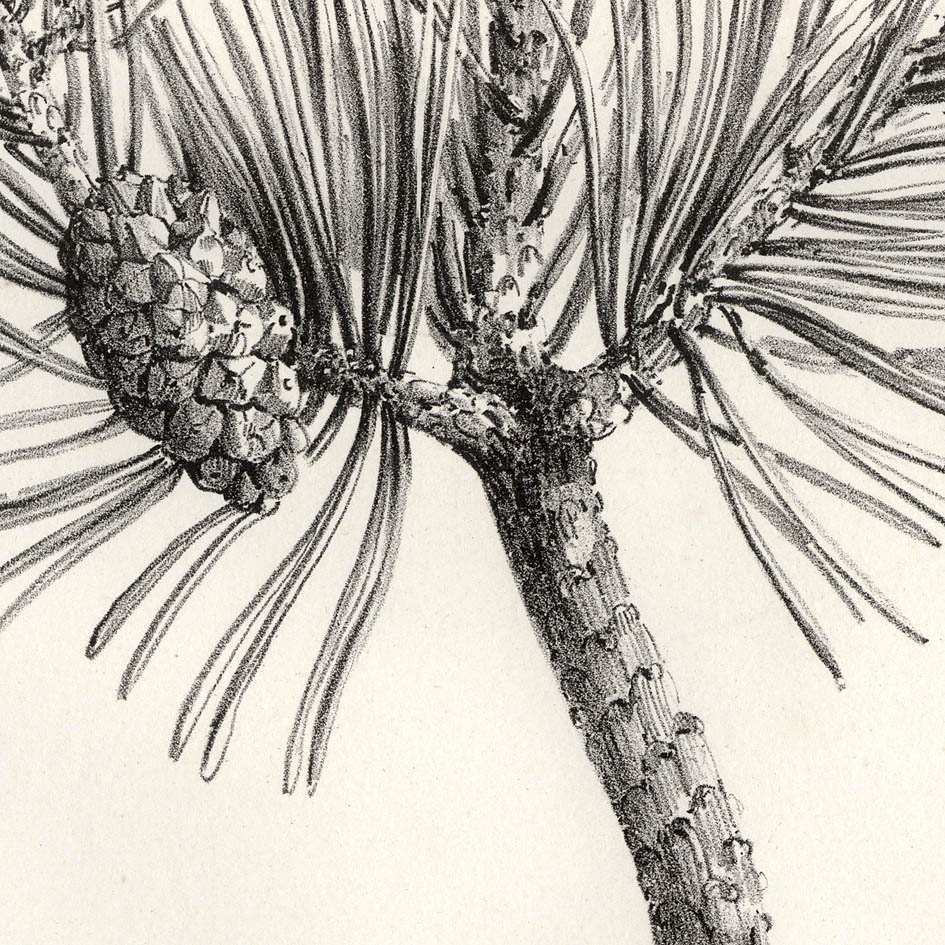
Sometimes when looking at drawings by a master the subtle principles underpinning the artist’s approach to portraying a subject can be overlooked. Mindful of this potential, I thought I would share a few of the principles that caught my eye that makes this drawing wonderful.

First, note how the artist—actually there are two artists involved in this study: Deshayes who made the original drawing and Demanne who translated/copied his drawing for this print—has used “white” lines to portray the individual pine-needles when they are clumped as a dark mass and “black” lines to show the pine-needles at the outer rim of their clumps.

Second, note how the artist has applied the principle of only showing details, such as contour marks (i.e. lines that are drawn to show the curving form of the subject), in the half lights in the rendering of the cone. By this I mean that the darker areas of the cone towards its base are not encumbered with contour lines; the half-lit areas around the cone’s middle have contour marks, while the more lit aspects of the cone towards its tip have very few contour marks.

Third, note how the artist uses small lines and dots to punctuate spots of deepest shadow (e.g. deepest points in the abutting segments of the cone) and critical textures (e.g. the spiky nodes at the base of the lower branch).


De Demanne after the illustration by Deshayes
published in Paris by Jean-Baptiste-Joseph Duchesne in "Guide de la Culture des Bois, ou Herbier Forestier," (the atlas contains 64 lithographs), 1826.
“Sapin Épicéa” [Spruce Fir], 1825–26.
Lithograph on wove paper, (sheet) 42.2 x 27.4 cm.
Inscribed (lower right) “Deshayes del.”; (lower centre) “Sapin épicéa.”; (lower right) “Lith. de Demanne.”
Condition: rich impression with generous margins. There is very light spotting, otherwise the sheet is in excellent condition for its age.


Sunday, 29 May 2016


De Demanne after the illustration by Deshayes published in Paris by Jean-Baptiste-Joseph Duchesne in "Guide de la Culture des Bois, ou Herbier Forestier," (the atlas contains 64 lithographs), 1826

“Pin sauvage dit d’Ecosse ou de Genêve” [Wild Pine from Scotland or Geneva], 1825–26
Lithograph on wove paper
Size: (sheet) 42 x 27.4 cm

Inscribed (lower right) “Deshayes delt.”; (lower centre) “Pin sauvage dit d’Ecosse ou de Genêve.”; (lower right) “Lith: de Demanne.”

Condition: rich impression with generous margins. There is light spotting, otherwise the sheet is in excellent condition for its age.


I am selling this exceptionally fine lithograph along with the next lithograph I am listing, “Pin maritime ou de Bordeaux” by the same artist, (i.e. two lithographs by Demanne after Deshayes) for AU$110 in total (currently US$79.04/EUR71.10/GBP54.05 at the time of posting this listing) including postage and handling to anywhere in the world.

If you are interested in purchasing this pair of botanical drawings, please contact me (oz_jim@printsandprinciples.com) and I will send you a PayPal invoice to make the payment easy.


De Demanne after the illustration by Deshayes published in Paris by Jean-Baptiste-Joseph Duchesne in "Guide de la Culture des Bois, ou Herbier Forestier," (the atlas contains 64 lithographs), 1826

“Pin maritime ou de Bordeaux” [Maritime Pine], 1825–26
Lithograph on wove paper
Size: (sheet) 42 x 27.4 cm

Inscribed (lower right) “Deshayes delt.”; (lower centre) “Pin maritime ou de Bordeaux.”; (lower right) “Lith: de Demanne.”

Condition: rich impression with generous margins. There is spotting, otherwise the sheet is in good condition for its age.


Recently I had an interesting discussion with a long-distance internet friend about a woodblock print by the legendary Japanese printmaker, Hiroshige. The point of interest in our short discussion concerned Hiroshige’s choice to separate the key subject of the print (viz. travellers on horseback and walking) from the representation of falling snow depicted behind them. My standpoint was that by showing the figures set against a background of falling snow was not as visually satisfying as immersing the figures within a veil of snow falling all around them.

If I may now link that discussion with this pair of prints, I wish to suggest that the artists who drew these botanical illustrations (Demanne, the lithographer and Deshayes, the designer) are like artists who allow falling snow to be in front of the key subject. What I mean by this comment—especially seeing that there is clearly no snow featured in the prints—is that these artists have represented the true way that pine cones and needles are attached to their stems and they have achieved this realism by ensuring that features in the front (i.e. closer to the viewer) obscure those behind. Although I would be hesitant to propose that true scientific objectivity is about not showing everything, in these illustrations there may be the case for an argument.