Showing posts with label Delacroix (Eugène). Show all posts

Thursday, 1 January 2026

Gustave Greux, “Heliodorus Expelled from the Temple”, 1882, after Eugène Delacroix

Gustave Greux (also known as Gustave Marie Greux) (1838–1919)
“Heliodorus Expelled from the Temple” (also referred to as “Héliodore chassé du Temple [Fresque dans la Chapelle des Saints Anges à Saint-Sulpice.]”), 1882

Technical Details & Condition:

An etching on fine laid paper with generous margins. This print is after Eugène Delacroix’s (also known as Ferdinand Victor Eugène Delacroix) fresco (oil and wax on plaster), created between 1854 and 1861, located in the Saints-Anges' chapel of the church of Saint-Sulpice in Paris. (See https://commons.wikimedia.org/wiki/File:Eug%C3%A8ne_Delacroix_-_Heliodoros_Driven_from_the_Temple_-_WGA06222.jpg). The etching was printed by François Liénard (active circa 1860s–1880s) and published in Paris in the renowned art periodical L'Art in 1882.

The impression is richly inked and well-printed (near faultless). The sheet is in near pristine condition, free of tears, holes, folds, significant stains, or signs of handling.

Dimensions:

• Sheet: 42.4 x 29.4 cm
• Plate mark: 33 x 23 cm
• Image border: 28.2 x 18.9 cm

Lettering within the plate beneath the image border:

• Left: “Eugène Delacroix pinx./ L’Art.”
• Centre: “HÉLIODORE CHASSÉ DU TEMPLE (Fresque dans la Chapelle des Saints Anges à Saint-Sulpice.)”
• Right: “Gustave Greux sc./ F. Liénard. Imp. Paris.”

References:

• IFF 27 (Jean Adhémar & Jacques Lethève, 1960), Inventaire du Fonds Français après 1800: GAVARRET–GUILLARD, vol. 9, Paris, Bibliothèque Nationale de France, p. 377, cat. no. 27. (See https://gallica.bnf.fr/ark:/12148/bpt6k54892064/f389.item)
• Additionally, see the description of this print offered by the British Museum: https://www.britishmuseum.org/collection/object/P_1883-0414-38

Price & Shipping:

AU$223 (approximately US$148.85 / €126.68 / £110.47), inclusive of worldwide express shipping. Please note that import duties and taxes are the buyer’s responsibility.

This compelling etching by Gustave Greux, after Eugène Delacroix’s painting, vividly depicts the moment when three angels descend upon Heliodorus—the treasurer of King Seleucus IV, sent to confiscate the Temple’s treasures in Jerusalem. The high priest Onias observes from above with outstretched arms at the veiled entrance to the Ark of the Covenant. One angel guides his steed with his knees while raising a rod of command, and the other angels are caught mid-flight, scourging Heliodorus with a whip.

If you are interested in acquiring this striking and highly detailed etching, please contact me at oz_jim@printsandprinciples.com. I am happy to provide a secure PayPal invoice for a seamless purchase.


Thursday, 11 September 2025

Lucien Daniel Carred, “Dante et Virgile”, 1886, after Delacroix

Lucien Daniel Carred (fl.1873–1886)—Parisian printmaker, student of Édouard Lièvre and Léon Gaucherel, exhibited at the Salon between 1873 and 1886

“Dante et Virgile”, 1886, after Eugène Delacroix’s (1798–1863) painting, “The Barque of Dante”, 1822, in the collection of the  Musée du Louvre, Paris (see https://en.wikipedia.org/wiki/The_Barque_of_Dante), printed by A Clément (fl.c.1886-1892) and published in Paris in the art periodical, “L’Art”.

Etching printed in a warm black ink on chine collé on buff laid paper with partial watermark.

Size: (sheet) 28.6 x 42.1 cm; (plate) 26.7 x 34.5 cm; (image borderline) 23.1 x 30.5 cm.

Lettered in plate below the image borderline: (left) “Eugène Delacroix pinx./ L’Art”; (centre) “DANTE ET VIRGILE/ Conduits par Plégias, traversent le lac qui entoure la ville infernale de Dité.” [Dante and Virgil/ led by Plegias, they cross the lake surrounding the infernal city of Dite.]; (right) L. Carred sc./  Imp. A. Clément_Paris.”

IFF 3 (Jean Adhémar 1949, “Inventaire du Fonds Français après 1800: CABANE–CICÉRI”, Paris, Bibliothèque Nationale de France, Département des Estampes, vol. 4, p. 123, cat. no. 3 [https://gallica.bnf.fr/ark:/12148/bpt6k5510949t/f145.image]).  

Condition: a strong, well-printed and near faultless impression in a near pristine condition with no tears, holes, folds or significant stains (there is a small mark on the lower edge of the sheet).

I am selling this superb impression of a very beautiful etching for the total price of AU$248 (approximately US$163.96, EUR 140.17, or GBP 121.26), which includes worldwide express shipping. Please be aware that any applicable import duties are the buyer’s responsibility.

If you are interested in purchasing this finely executed etching after Delacroix’s famous painting, please contact me (oz_jim@printsandprinciples.com) and I will send you a PayPal invoice to make the payment easy.

Note that currently mail services from Australia to the USA have been suspended. Consequently, at the moment I am unable to accept purchases needing shipping to the United States.


Friday, 26 April 2024

Abel Jamas, “Portrait of Chopin”, c.1938, after Delacroix

Abel Jamas (1862–c.1940)

“Portrait of Chopin” (aka “Frédéric Chopin”), c.1938, after the unfinished painting by Eugène Delacroix (1798–1863), “Portrait of Frédéric Chopin and George Sand”, 1838—note that this painting was later cut in two so that the each section could be sold separately with the portrait of Chopin now in the Louvre (Paris) (see https://www.wikiart.org/en/eugene-delacroix/frederic-chopin-1838).

Etching and engraving on cream wove (Japon) paper with wide margins and a remarque of a man’s face facing to the front with curled long hair and a pointed beard.

Regarding the remarque (the tiny etching of a rather gaunt head with its Van Dyck styled “goatee” shown below the main image), I believe that the subject may be a likeness of Frédéric Chopin (1810–1849), or at least, as the artist (Abel Jamas) imagined him. This idea (and it may be very flawed) is based on my understanding that Chopin suffered alopecia areata on the left side of his face. Going further, from my close examination of the image, only half a beard is shown and it is on Chopin’s right side. This stylistic arrangement of a half beard seems correct (for me), mindful that Chopin’s interest was all about his right side as that was the side his audience saw during a performance.

Size: (sheet) 55.8 x 43.8 cm; (plate) 39.8 x 29.9 cm; (image borderline) 33.2 x 26.8 cm.

See descriptions of this print offered by the Louvre and the Athens School of Fine Arts : https://collections.louvre.fr/en/ark:/53355/cl020529818 & https://digilib.asfa.gr/s/library-eng/item/2543.

Condition: a strong and well-printed impression with generously wide margins in an excellent (near pristine) condition.

I am selling this large, rare and fascinating portrait of Chopin, with a tiny portrait remarque in the margin that may (if I am right and there is no certainty about this) show Chopin with a half-beard/“goatee” on his right side owing to his inability (because of a medical condition [alopecia areata]) to grow facial hair on his left, for AU$314 in total (currently US $205.54/EUR 191.45/GBP 164.24 at the time of this listing) including Express Mail (EMS) postage and handling to anywhere in the world, but not (of course) any import duties/taxes imposed by some countries.

If you are interested in purchasing this marvellous portrait, please contact me (oz_jim@printsandprinciples.com) and I will send you a PayPal invoice to make the payment easy.


Thursday, 8 February 2024

Jean-Baptiste de Roy's etching, “Tigress with Her Cubs”, c.1850

Jean-Baptiste de Roy (1759–1839)—a Flemish artist who is known for his landscape and animal paintings

Note that I initialled believed that the printmaker may not have been Jean-Baptiste de Roy and that this artist was the intermediary designer who translated the original painting on which this etching is based into line, but after consulting C. G. Voorhelm Schneevoogt's (1873) "Catalogue des Estampes Gravées d’Apres P. P. Rubens” the printmaker responsible is given as “Deroy” (p. 230, cat. no. 39).

“Tigress with Her Cubs” (aka “Tigress Suckling Her Cubs”), c.1850, published in Paris in the art periodical, “L'Artiste: Revue de Paris” and printed by Sarazin (aka Sarasin) (fl.c.1846–1880), after the oil painting, “Tigress with Her Cubs”, 1620, in the Akademie der Bildenden Kunste, Vienna, attributed to either Peter Paul Rubens (1577–1640) or Jan Wildens (1586–1653).

Interestingly, this print has been attributed to Eugène Delacroix (aka Ferdinand Victor Eugène Delacroix) (1798–1863) (see http://www.artdiplomatic.com/grafica/1067-delacroix-eugene-ferdinand-victor-1798-1863-francesa-lions-et-ses-petites-.html), but Lous Delteil’s catalogue raisonnë of Delacroix’s graphic work does not describe this print.

Note that Johann Elias Ridinger (1698–1767) executed an etching after Rubens, in which the lower right section of its composition features the subject of this print (see https://hvrd.art/o/278343). Note also that Nikolaus Rhein (1767–1819) executed a mezzotint in 1790 of the same composition (with difference in the format) attributed at the time to Rubens (see https://www.britishmuseum.org/collection/object/P_1891-0414-1263).

Etching on wove paper trimmed with a narrow margin around the platemark and backed with a support sheet providing wide margins.

Size: (sheet) 23.5 x 33.7 cm; (plate) 22.3 x 33.1 cm; (image borderline) 21.2 x 32.3 cm.

Lettered in plate: (above the image borderline at centre) “L'ARTISTE”; (below the image borderline at left) “DE ROY”; (below the image borderline at right) “SARAZIN IMP PARIS”.

Condition: a strong and well-printed impression, trimmed with a narrow margin around the platemark and laid onto a support of archival (millennium quality) washi paper providing wide margins. The sheet is in near pristine condition with no tears, holes, folds, abrasions or significant stains.

I am selling this superb etching executed with great skill—note how the artist has been able to suggest the pale tones and fine hair of the cubs in contrast to the much darker tones and comparatively coarse hair of the tigress—for the total cost of AU$282 (currently US$183.52/EUR170.31/GBP145.45 at the time of this listing) including postage and handling to anywhere in the world, but not (of course) any import duties/taxes imposed by some countries.

If you are interested in powerful portrayal of a protective tigress with her suckling cubs, please contact me (oz_jim@printsandprinciples.com) and I will send you a PayPal invoice to make the payment easy.

This print has been sold


Monday, 11 December 2023

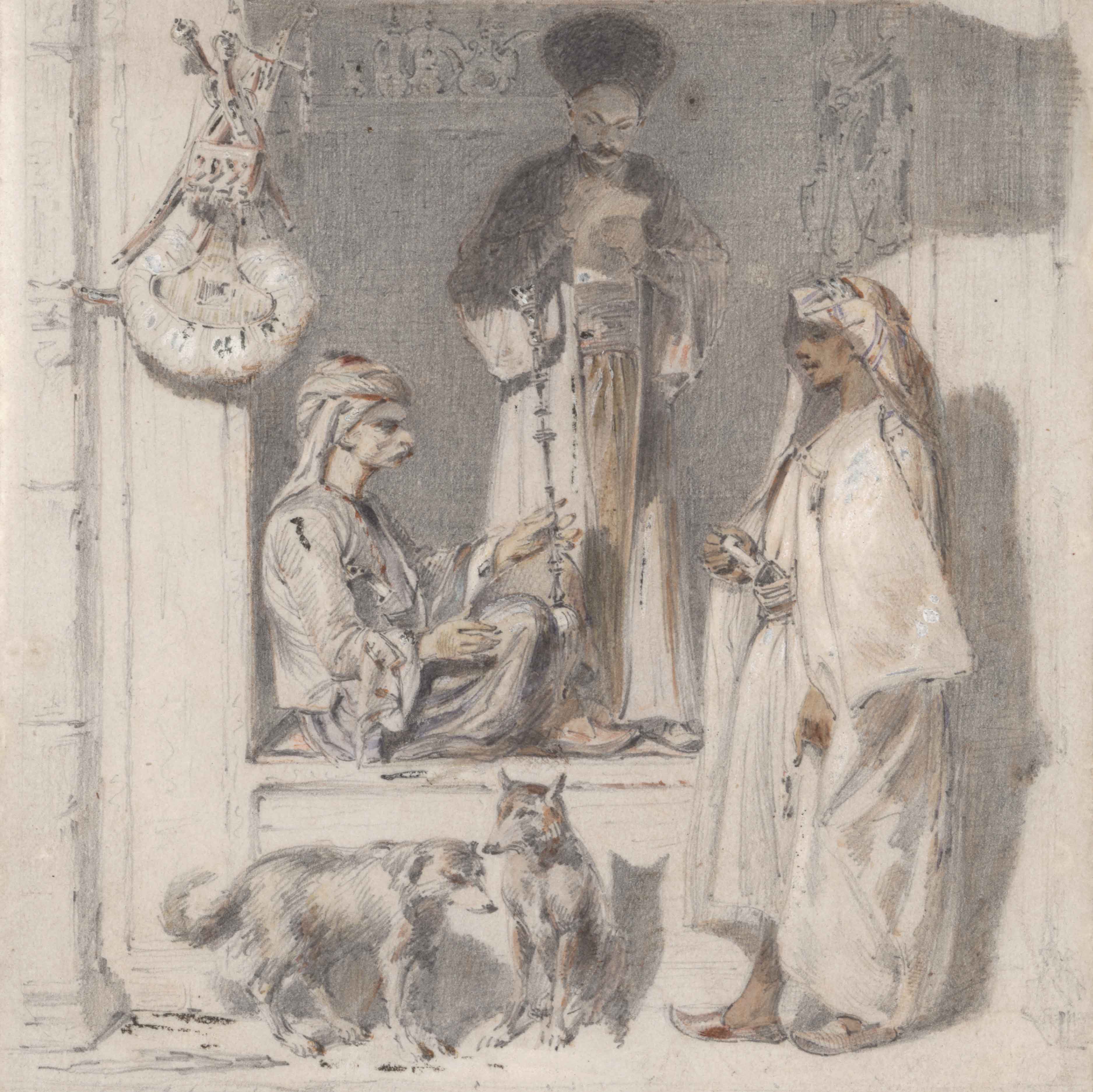
Alexandre Bida’s drawing with watercolour, “Street Scene in Cairo”, before 1850

Alexandre Bida (1813–1895)—a French Orientalist and student of Eugène Delacroix who specialising in scenes of Egypt (as shown here), Greece, Turkey, Lebanon and Palestine, and his illustrations for “Les Saints Evangeles”, published in 1873 (see https://en.wikipedia.org/wiki/Alexandre_Bida).

“Street Scene in Cairo” before 1850; alternatively, “Commandant Brey in Cairo”, a drawing possibly portraying Ibrahim Bey (aka Abram Sinjikashvili; აბრამ სინჯიკაშვილი) (1735–1817), the Mamluk leader who fought against Napoleon Bonaparte (see https://en.wikipedia.org/wiki/Ibrahim_Bey_(Mamluk)) at the “Battle of the Pyramids” (1798). or Murad Bey Mohammed (c.1750–1801) who was the commander of the cavalry during the “Battle of the Pyramids” and joint ruler of Egypt with Ibrahim Bey at the time (see https://en.wikipedia.org/wiki/Murad_Bey).

Note that the attribution of this drawing (with watercolour and gouache) to Alexandre Bida, along with the proposed date of its execution and alternative title are all based a faint pencil notation inscribed along the lower edge of the sheet: (be mindful that my reading of this text may have errors) “Alex Bida/ à M Bey Commandant du Cairo/ avant 1850” (“Alex Bida/ to M Bey Commander of Cairo/ before 1850”). Regarding the identity of the portrayed figure seated at left, the inscription, if I have read it correctly as “M Bey”, may be interpreted to be “Monsieur Bey”, but this reading does not seem likely to me (with apologies if I am wrong) as the word “Bey” is not usually a surname, but rather refers to the title of “chieftain”. Consequently, my research has centred on a leader in Cairo who was given the title of being a “Bey”. I would like to believe the most likely leader would be Murad Bey Mohammed which fits in with the inscription “M Bey”, but an extant image of this man suggests that this may not be the case. The historical fact that Bonaparte’s defeat of the “Bey” commanders in Cairo in 1798 suggests that this drawing may be an illustration rather than observation of a street scene, but I have no documentation to support this idea.

Pencil and watercolour with body colour (gouache) on heavy card with a pencil inscription (possibly not by the artist) at lower right.

Size: (sheet) 17 x 12.1 cm.

Condition: the sheet has been cleaned (a sun bath in water with no chemicals), but there are still faint dots and other marks but no tears, holes, folds or significant stains.

I am selling this very beautiful drawing of three figures accompanied by two dogs in a shady alcove on a street in Cairo in the early 19th century for AU$478 (currently US$319.50/EUR289.08/GBP254.47 at the time of this listing) including postage and handling to anywhere in the world, but not (of course) any import duties/taxes imposed by some countries.

If you are interested in purchasing this treasure of a drawing by one of the major French Orientalists, please contact me (oz_jim@printsandprinciples.com) and I will send you a PayPal invoice to make the payment easy.