Showing posts with label Goya (Francisco de). Show all posts

Wednesday, 18 September 2024

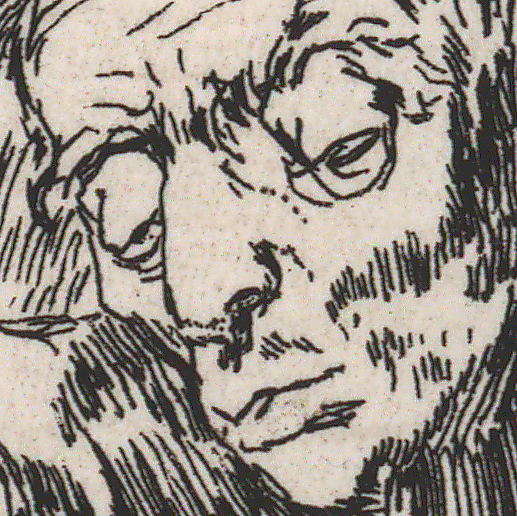
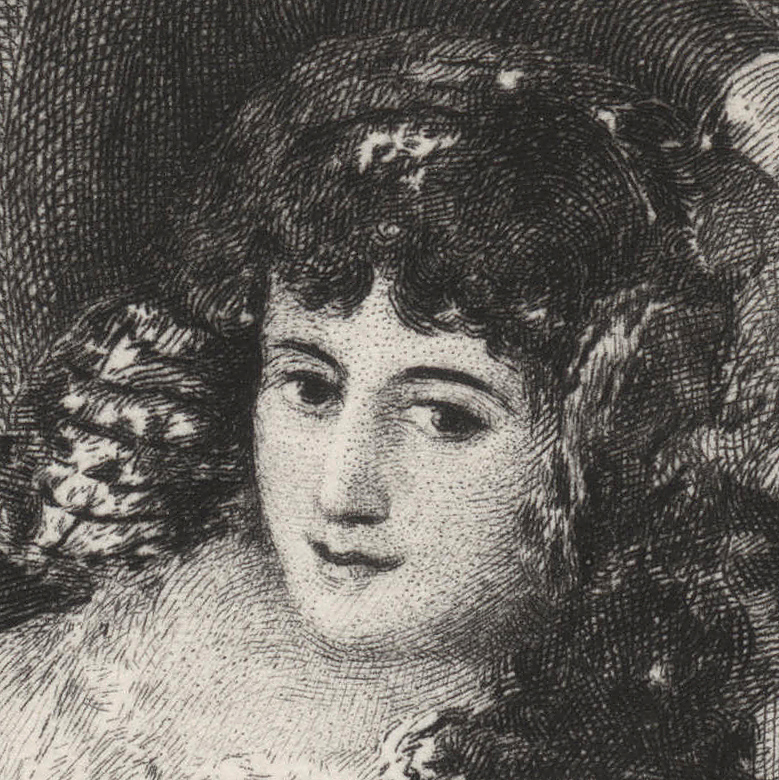
Goya, “Franco. Goya y Lucientes, Pintor”, 1799

Francisco de Goya (aka Francisco José de Goya y Lucientes; Francisco Goya) (1746–1828)

“Franco. Goya y Lucientes, Pintor”, 1799, from the second edition published in c.1855, Plate 1 (Frontispiece) to the series, “Los Caprichos.”

Etching, aquatint, drypoint and engraving on wove paper, trimmed within the platemark and “restored” with paint made from a crushed hornet. The sheet is laid upon a support of heavy wove paper (Dutch Etch).

Size: (sheet) 19.1 x 14.7 cm; (image borderline) 13.7 x 11.3 cm.  

Lettered (with losses) outside the image borderline with title and plate number.

Harris 36.III (Tomás Harris 1964, “Goya: Engravings and Lithographs”, Oxford, Bruno Cassirer); Delteil 38 (Loys Delteil 1902, “Le Peintre-Graveur Illustré [XIXe et XXe siècles]”, Paris).

See also the description of this print by the British Museum:  https://www.britishmuseum.org/collection/object/P_1975-1025-420-6.

Condition: The sheet is trimmed with a margin around the image borderline and glued onto a heavy support sheet providing wide margins. There many loses and alterations to the originally very damaged (but original) etching that has now been “restored” with a cream-coloured paint made from a crushed hornet.

This original impression of Goya’s marvellous self-portrait featuring his quizzically and very knowing eye peering towards the viewer was once in a shocking state of damage with its surface so eaten by insects that it resembled the surface of the moon. In short, the print was in a such a poor condition that I thought that it was ready for the bin. That was, until I decided to lovingly restore it using a crushed hornet as the patch-up paint pigment. Although there might be many who may be disappointed with my pigment choice for the restoration—some may even be angry with my decision—as I too agree that using powdered hornet does lean to being bizarre and disrespectful of a great artist’s work. Nevertheless, I believe that Goya may not be highly offended and might even see my solution to restoring his self-portrait as appropriate for a satirical folio of images.

Technique for making hornet paint used in restoring the Goya self-portrait:

1. Find the carcass of a dead and dried out hornet

2. Crush the hornet in a mortar and pestle—I fragmented the hornet in a blender as well

3. Cover the ground hornet with Coca-Cola and leave for a day (or two) to dissolve

4. Add Ethanol to the Coca-Cola and hornet syrup to kill any potential bacteria

5. Allow the liquid to evaporate leaving the hornet to become dust

6. Choose a suitable medium to use the hornet dust as a paint pigment

(I chose an acrylic medium to mix with the hornet dust, but no doubt egg tempera or a glue medium would have been fine.)

I am selling this heavily restored, nevertheless, an original impression of Goya’s famous self-portrait that served as the frontispiece for his highly celebrated series, “Los Caprichos”, for AU$403 in total (currently US$272.19/EUR244.72/GBP206.87 at the time of posting this listing) including Express Mail (EMS) postage and handling to anywhere in the world, but not (of course) any import duties/taxes imposed by some countries. Note that payment is in Australian dollars (AU$403) as this is my currency.

If you are interested in purchasing this “restored” impression of one of Goya’s most famous prints with many significant alterations, please contact me (oz_jim@printsandprinciples.com) and I will send you a PayPal invoice to make the payment easy.

This print has been sold 


Monday, 15 May 2023

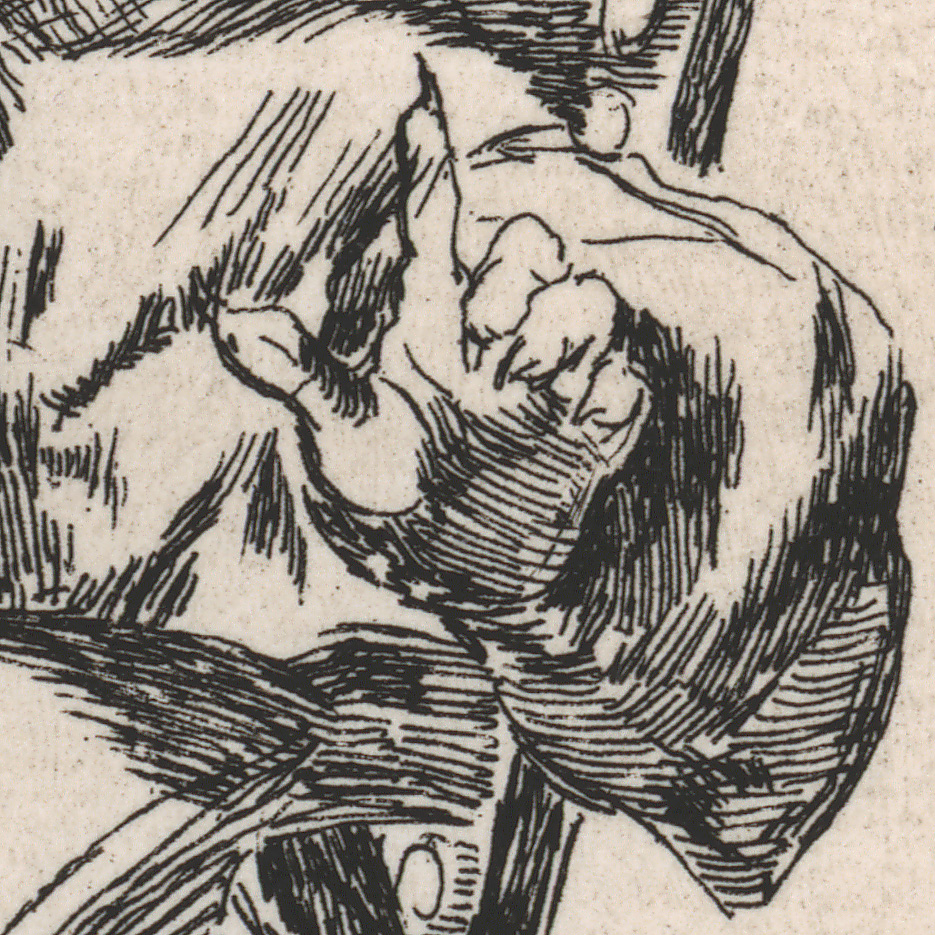
Francisco de Goya’s etching, “And They Are Like Wild Beasts”, 1814–15

Francisco de Goya (aka Francisco José de Goya y Lucientes) (1746–1828)

“And They Are Like Wild Beasts” (aka “Y son fieras” [title inscribed in plate]); “Et elles sont comme des bêtes féroces”), 1814–15. plate 5 from the series of eighty plates, “The Disasters of War”, possibly printed by the workshop of Laurenciano Potenciano and published by Real Academia de Nobles Artes de San Fernando in Madrid in 1863 in “Los Desastres de la Guerra: Coleccion de ochenta láminas inventadas y grabadas al agua fuerte por Don Francisco Goya” (see https://www.royalacademy.org.uk/art-artists/book/los-desastres-de-la-guerra-coleccion-de-ochenta-laminas-inventadas-y & https://www.royalacademy.org.uk/art-artists/work-of-art/y-son-fieras).  

Etching with burnished aquatint and drypoint on laid paper printed in a warm black ink on cream laid paper with wide margins.

Size: (sheet) 23.5 x 31 cm; (plate) 15.3 x 20.5 cm; (image borderline) 13.5 x 18 cm.

Numbered and lettered in plate outside the image borderline: (upper left corner) “5”; (lower centre) “Y son fieras”. 

State iv (of iv) with the addition of the title and the edges of the printing plate bevelled.

Delteil 124 (Loys Delteil 1906, “Le Peintre-Graveur Illustré: (XIXe et XXe siècles)”, vol. 15, Paris, Chez lauteurp, cat. no. 124 [see https://archive.org/details/lepeintregraveur1415delt/page/n197/mode/2up]); Harris 125 (Tomás Harris 1964, “Goya: Engravings and Lithographs”, vol. I [text and Illustrations], vol. II [catalogue raisonné], Oxford).

The British Museum offers a description of this print: https://www.britishmuseum.org/collection/object/P_1975-1025-421-7.

See also the wonderful background insights regarding this print provided by Eleanor A. Sayre (1974) in “The Changing Image: Prints by Francisco Goya”, Boston, Museum of Fine Arts (exh. cat.): “This print is one of several depicting brave Spanish women, and the title is related to that of the print that precedes it in the series, “Las mugeres dan valor” (The women give courage)” (p. 131). Towards the end of the explanatory background account, Sayre draws attention to the plight of the Spanish women with the following poignant quote from Robert Southey’s (1823) “History of the Peninsular War”, London: “During the [second] siege six hundred women and children perished, not by bombardment and the mines, but in action, by the sword, or bayonet or bullet” (vol. 2, p. 150).

Condition: a strong and well-printed impression with wide margins in an excellent/near pristine condition with no tears, holes, folds, abrasions, stains, foxing or signs of handling.

I am selling this grim and graphically powerful etching from Goya’s famous series, “The Disasters of War”, showing women in the front line of battle attacking soldiers by hurling rocks and using pikes against infantry men armed with rifles and cutlasses, for the total cost of AU$698 (currently US$460.53/EUR416.69/GBP366.80 at the time of this listing) including postage and handling to anywhere in the world, but not (of course) any import duties/taxes imposed by some countries.

If you are interested in purchasing this creatively inventive masterwork, please contact me (oz_jim@printsandprinciples.com) and I will send you a PayPal invoice to make the payment easy.

This print has been sold


Friday, 9 December 2022

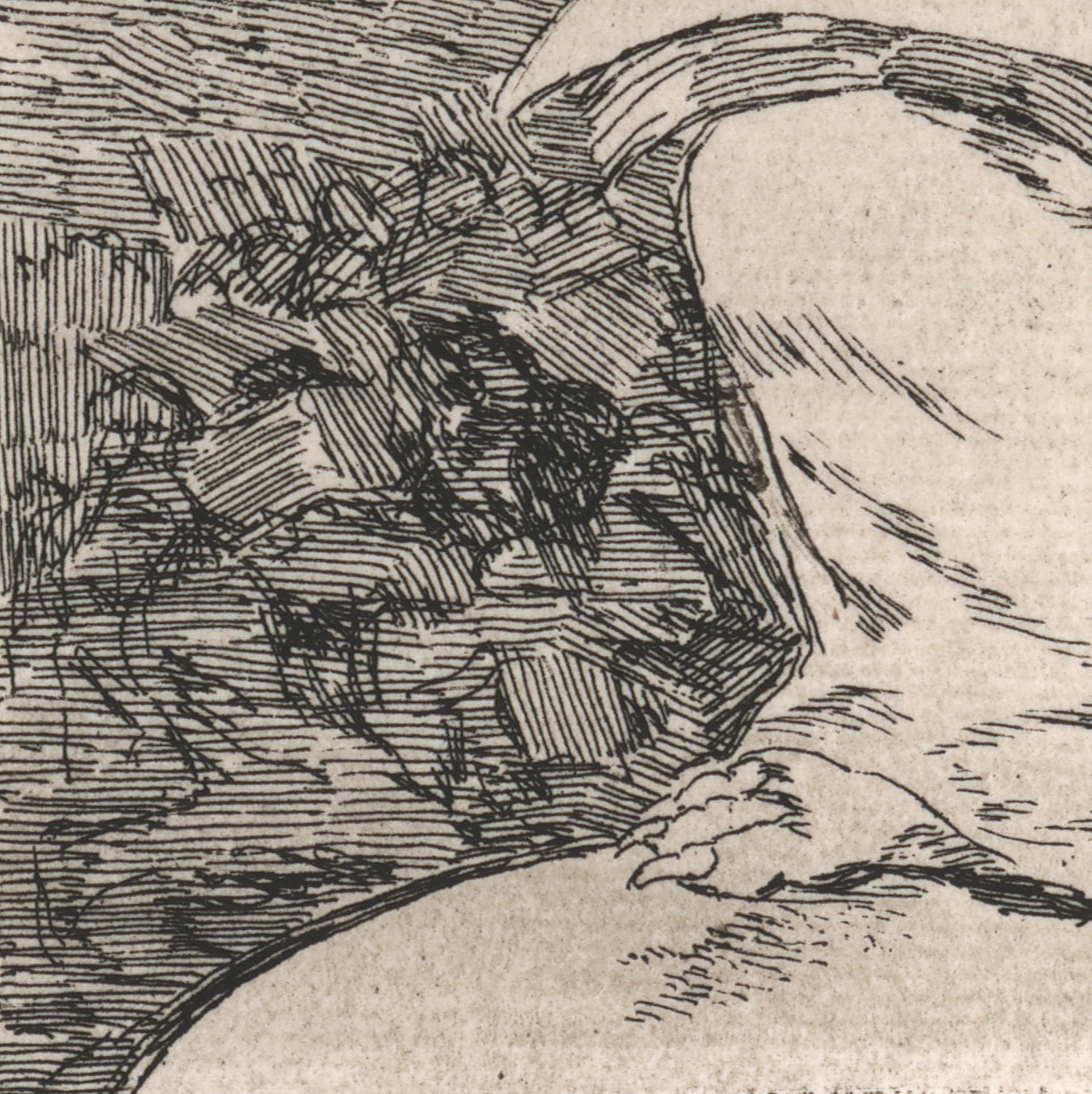
Francisco de Goya’s etching, “Against the Common Good”, 1814–15

Francisco de Goya (aka Francisco José de Goya y Lucientes) (1746–1828)

“Against the Common Good” (“Contra el Bien General”), 1814–15, plate 71 from the series of eighty plates, “The Disasters of War” (“Los Desastres de la Guerra”), published in Madrid in 1863 in “Los Desastres de la Guerra: Coleccion de ochenta láminas inventadas y grabadas al agua fuerte por Don Francisco Goya” (see https://www.royalacademy.org.uk/art-artists/book/los-desastres-de-la-guerra-coleccion-de-ochenta-laminas-inventadas-y & https://www.royalacademy.org.uk/art-artists/work-of-art/contra-el-bien-general).   

Etching and burnished aquatint on laid paper printed in a warm black ink on cream laid paper with wide margins.

Size: (sheet) 25.9 x 32.1 cm; (plate) 17.6 x 21.1 cm; (image borderline) 14.7 x 18.5 cm.

Numbered and lettered in plate outside the image borderline: (upper left corner) “71”; (lower centre) “Contra el ‘bien general.”  

State iii (of iii) with the addition of the title.

Delteil 190 (Loys Delteil 1906, “Le Peintre-Graveur Illustré: (XIXe et XXe siècles)”, vol. 15, Paris, Chez lauteurp, cat. no. 190 [see https://archive.org/details/lepeintregraveur1415delt/page/n279/mode/2up]); Harris 191 (Tomás Harris 1964, “Goya: Engravings and Lithographs”, vol. I [text and Illustrations], vol. II [catalogue raisonné], Oxford).

The British Museum offers the following description of this print: “Plate 71: demon with bat's wing ears sitting on chair writing in volume, with imploring figures below to right; from an unbound album of first impressions, 1863. c.1814-1815” (https://www.britishmuseum.org/collection/object/P_1975-1025-290).

Condition: a strong and well-printed impression showing no sign of wear to the printing plate with wide margins in a near pristine condition with no tears, holes, folds, abrasions, significant stains, foxing or signs of handling.

I am selling this remarkable etching—possibly a demon from the Inquisition chronicling confessions from victims of judicial torture? (My apologies if I am wrong about this)—from Goya’s famous series, “The Disasters of War”, for the total cost of AU$988 (currently US$632.26/EUR545.74/GBP545.74 at the time of this listing) including postage and handling to anywhere in the world, but not (of course) any import duties/taxes imposed by some countries.

If you are interested in purchasing this creatively inventive masterwork, please contact me (oz_jim@printsandprinciples.com) and I will send you a PayPal invoice to make the payment easy.

This print has been sold


Wednesday, 4 May 2022

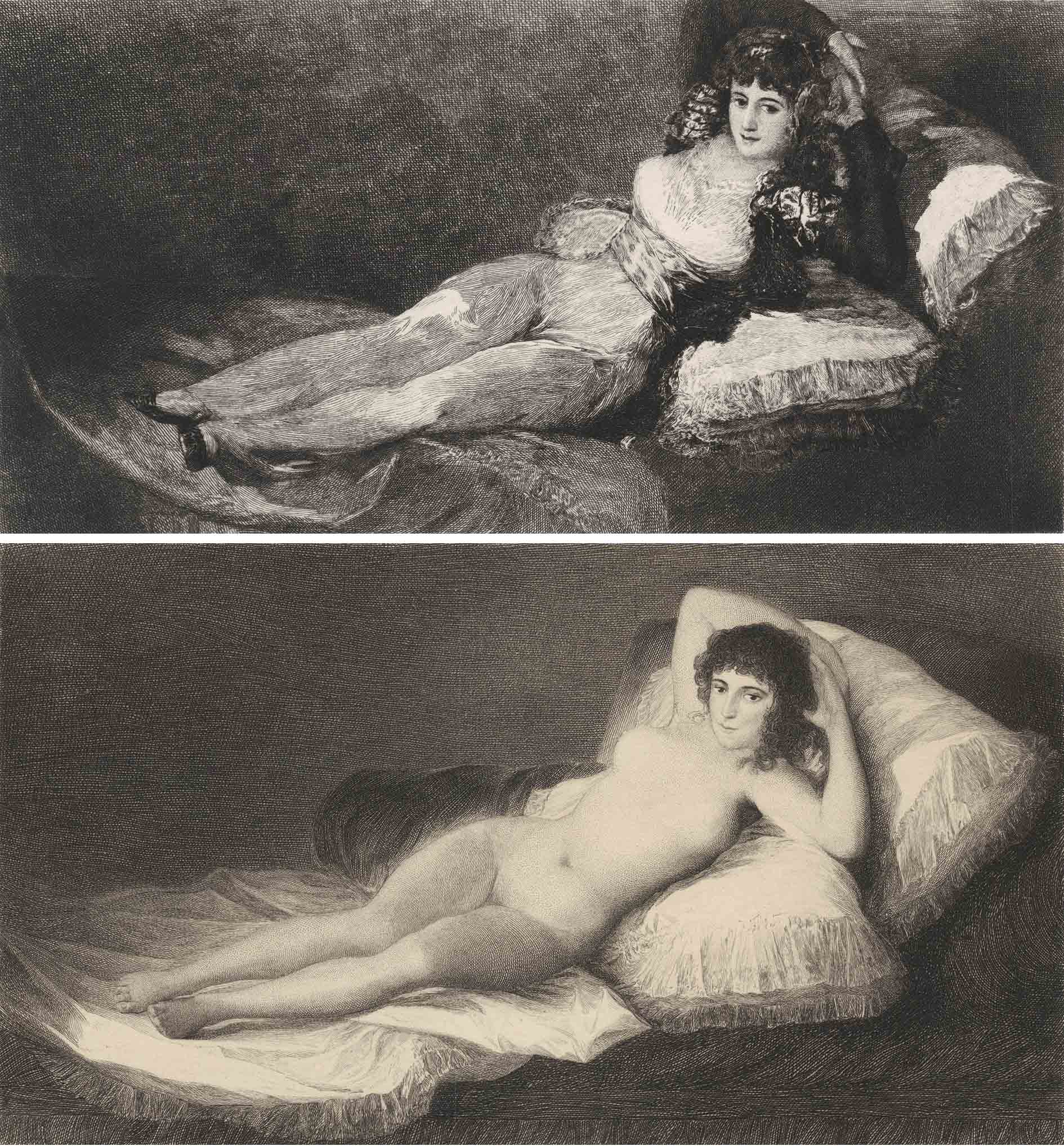
Ricardo de Los Rios & Antoine François Dezarrois’ etchings, “La Maja”, 1902, after Goya


“La Maja” & “La Maja Desnuda” after the paintings, “The Clothed Maja”, 1800–1807, and  “The Naked Maja”, 1795–1800, by Francisco José de Goya y Lucientes (1746–1828) in the Museo Nacional del Prado (Madrid).

Both etchings were published in Paris by Librairie de L'Art Ancien et Moderne as illustrations to Paul Lafond’s (1847–1918) “Goya” in 1902; see https://archive.org/details/goya00lafo/page/20/mode/2up  & https://archive.org/details/goya00lafo/page/24/mode/2up.

__________

(UPPER)

Ricardo de Los Rios (1846–1929)

“La Maja”, 1902, after Goya’s painting, “The Clothed Maja”, 1800–1807, printed by A. Clément (fl.c1887–1892) and published in Paris in 1902 by Librairie de L'Art Ancien et Moderne.

Etching on wove paper.

Size: (sheet) 21.2 x 29.5 cm; (plate) 13.5 x 23 cm; (image borderline) 10.6 x 21 cm.

Lettered in plate below the image borderline: (left) “F. Goya pinx.”; (centre) “LA MAJA/ (Académie de San Fernando)”; (right) “R. de Los Rios. sc./ Imp. A. Clément_Paris”.

__________

(LOWER)

Antoine François Dezarrois (aka Mâcon Antoine François Dezarrois) (1864–1934/9) (see http://hdl.handle.net/20.500.12835/88112)

“La Maja Desnuda”, 1902, after Goya’s painting, “The Clothed Maja”, 1800–1807, printed by Louis Fort (fl. early 1900s) and published in Paris in 1902 by Librairie de L'Art Ancien et Moderne.

Etching and engraving on cream wove paper.

Size: (sheet) 21.2 x 29.3 cm; (plate) 13.1 x 20 cm; (image borderline) 10.4 x 18.1 cm.

Lettered in plate below the image borderline: (left) “F. Goya. pinx.”/ Revue de l’Art ancien et moderne”; (centre) “LA MAJA DESNUDA/ (Académie de San Fernando)”; (right) “Dezarrius, sc./Imp.L.Fort, Paris.”

__________

Condition: both prints are strong and well-printed (near faultless) impressions in near pristine condition.

I am selling this pair of etchings after Goya’s famous paintings of the same composition for AU$384 in total for the pair (currently US$272.91/EUR259.21/GBP218.21 at the time of posting this listing) including postage and handling to anywhere in the world, but not (of course) any import duties/taxes imposed by some countries.

If you are interested in purchasing this curiously wonderful pair of etchings please contact me (oz_jim@printsandprinciples.com) and I will send you a PayPal invoice to make the payment easy.

This pair of prints have been sold


Sunday, 12 September 2021

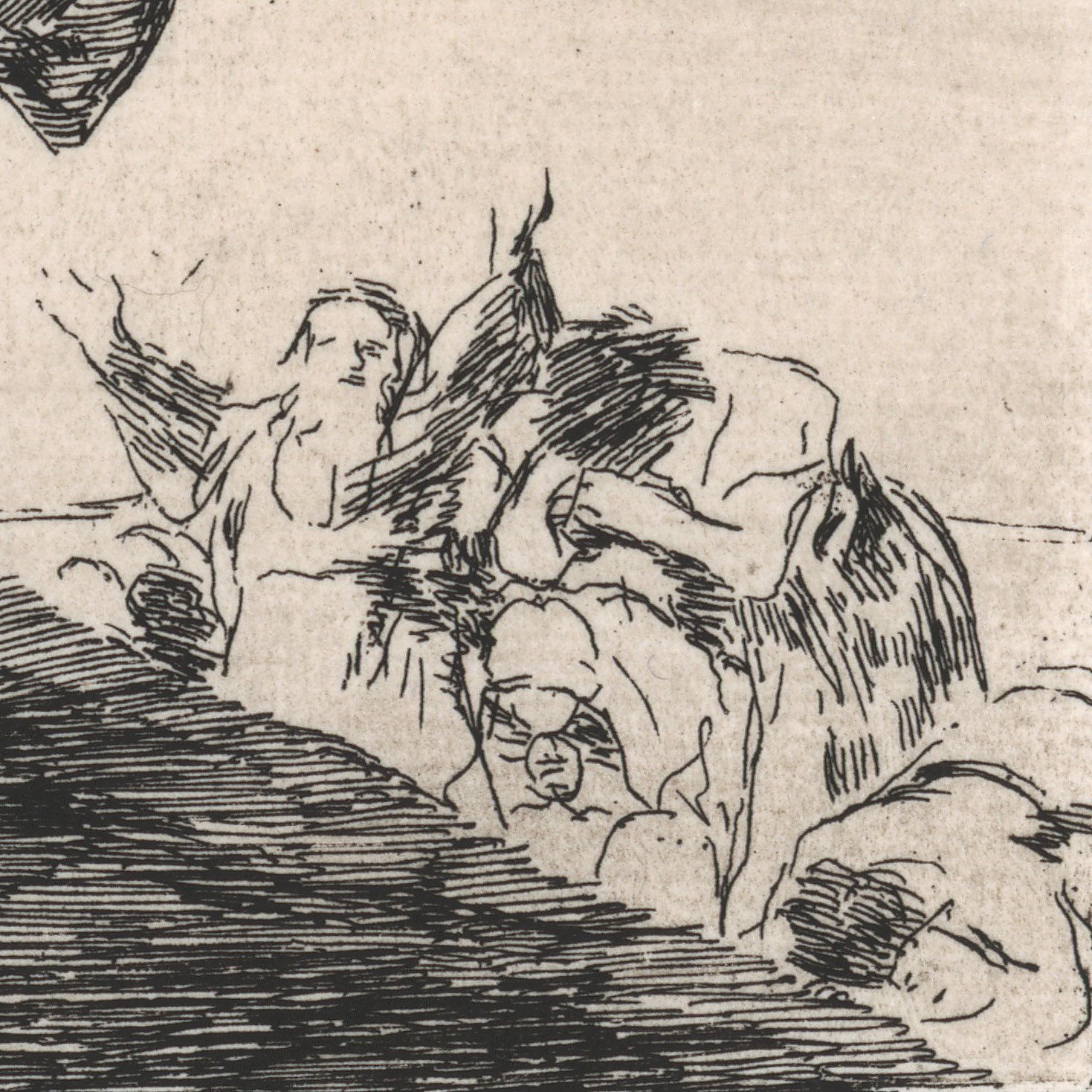
Francisco de Goya’s etching (with aquatint and drypoint), “El Famoso Moro Gazul”, 1816

Francisco de Goya (aka Francisco José de Goya y Lucientes) (1746–1828)

“El Famoso Moro Gazul” (aka “El animoso Moro Gazul es el primero que lanceó toros en regla” [The spirited Moor Gazul is the first to spear bulls according to the rules]; “Otro capeo de Toros, hecho por los Moros en plaza” [The Moor Makes a Different Play in the Ring]), 1816, plate 5 from the series that was initially of 33 plates in the first edition, but afterwards expanded to 40 plates, “La Tauromaquia” (Wikipedia showcases all the prints from this series online: https://en.wikipedia.org/wiki/La_Tauromaquia).

Etching, burnished aquatint and drypoint printed in a bluish-black ink on cream laid paper (Arches watermark) with full margins as published and backed with a support sheet.

Note that Goya has burnished the extra fine aquatint directly behind the Gazul on horseback and the bull so that the plate is almost clear of aquatint to create a soft halo of light around the action.

Interestingly, Eleanor A Sayre (1794) in “The Changing Image: Prints by Francisco Goya” (Museum of Fine Arts, Boston) points out that in Goya’s later prints (such as this one), “…the designs have force and simplicity and what can best be described as a painterly manner of shading, not unlike the brush strokes on the canvasses Goya was painting. The aquatint, light in these prints, and delicately burnished, is extraordinarily subtle and evocative” (p. 205).

Size: (sheet) 37.5 x 56.2 cm; (plate [soft]) 24.8 x 35.6 cm; (image borderline) 20.6 x 31.1 cm.

Numbered in plate outside the image borderline: (upper right) “5”.

Harris, 208 III (Tomás Harris 1983, “Goya: Engravings and Lithographs”, 2 vols., San Francisco, Alan Wofsy, p. 318, cat. no. 208 III).

The British Museum offers the following description of this print: “Plate 5: Moor on horseback spearing bull; from an unbound album of first edition impressions. 1816
Etching, burnished aquatint and drypoint” (https://www.britishmuseum.org/collection/object/P_1862-0712-145)

See also the descriptions of this print offered by the Rijksmuseum: http://hdl.handle.net/10934/RM0001.COLLECT.42784 & http://hdl.handle.net/10934/RM0001.COLLECT.118022.

Condition: a strong and well-printed impression showing no sign of wear to the printing plate with full margins as published and laid onto a sheet of archival (millennium quality) washi paper. There is a restored hole (almost invisible) above the image borderline at right of centre and a closed tear on the right margin edge, otherwise the sheet has no significant stains or foxing.

I am selling this original Goya etching (with aquatint and drypoint) for a total cost of AU$900 (currently US$660.62/EUR560.14/GBP478.09 at the time of this listing) including postage and handling to anywhere in the world (but not, of course, any import duties/taxes imposed by some countries).

If you are interested in purchasing this genuine etching by Goya taken from the original plate with full margins as published, please contact me (oz_jim@printsandprinciples.com) and I will send you a PayPal invoice to make the payment easy.

This print has been sold