Showing posts with label Pontius (Paulus). Show all posts

Friday, 6 June 2025

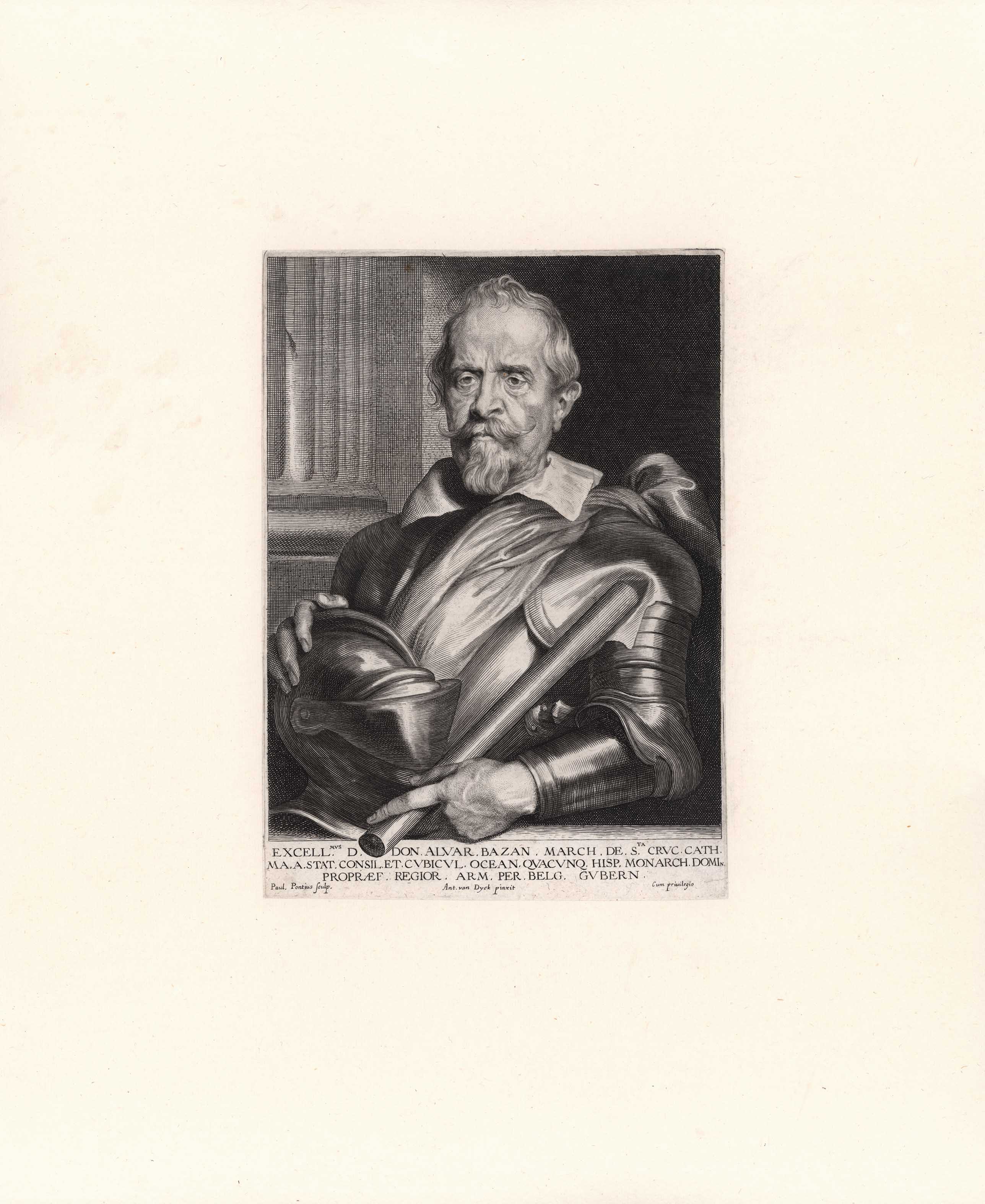
Paulus Pontius, “Don Alvar Bazan”, 1630–1640, after Anthony van Dyck

Paulus Pontius (aka Paulus du Pont) (1603–1658)

“Don Alvar Bazan” (aka “Portret van de Commandant Don Álvaro de Bazán”; “Don Alvaro de Bazan Marquis of Santa Cruz”) —Spanish Admiral, Don Álvaro de Bazán y Benavides, II Marqués de Santa Cruz de Mudela, I Marqués de Viso (1571–1646), 1630–1640, from the series, “Icones Principum Virorum”, after Anthony van Dyck’s (aka Anthoni [Ridder] van Dijck; Anthony van Dijck; Antoon van Dijk; Anton van Dyck) (1599–1641) grisaille portrait now in the collection of the Duke of Buccleuch, Boughton House, Northamptonshire.

Engraving on fine laid paper, trimmed along the platemark and backed with a support sheet.

Size: (sheet) 23.3 x 17.3 cm; (image borderline) 21.9 x 16.9 cm.

Lettered in plate below the image borderline in three lines of Latin: “EXCELL.MVS D. DON. ALVAR. BAZAN ... / …/ … GVBERN.”; (left) “Paul. Pontius Sculp.”; (centre) “Ant. van Dyck pinxit”; (right) “Cum priuilegio”.

State iii (of v) before the addition of the initials of the publisher, Gillis Hendricx, in state iv.

Hollstein Dutch 54-3(5); New Hollstein Dutch 17-3(5); Mauquoy-Hendricx (van Dyck) 43-3(5); Van Someren 296.

The British Museum offers the following description of this print: “Portrait of Álváro de Bazán, Marqués de Santa Cruz, half-length in front of a fluted column, directed slightly to left, wearing armour and sash, and holding a baton in his left hand and resting his right on a visored helmet …” (https://www.britishmuseum.org/collection/object/P_1863-0509-833 [BM inv. no. 1863,0509.833]).

See also the description of this print offered by the Rijksmuseum: https://id.rijksmuseum.nl/200245490.

Condition: a strong and well-printed (near faultless) impression, trimmed along the plate mark and laid onto a support of archival (millennium quality) washi paper providing generously wide margins. Beyond a minor brown mark at upper left and another near the figure’s right eye, the sheet is in an excellent condition with no tears, holes, folds, abrasions or significant stains.

I am selling this superb engraving with its eye-catching feature of the Admiral’s baton portrayed extending beyond the picture plane, for AU$304 (approximately US$197.58, EUR 172.62 or GBP 145.75), including express mail shipping worldwide. Import duties, if any, are the responsibility of the buyer.

If you are interested in purchasing this very fine impression of a masterwork of engraving, please contact me (oz_jim@printsandprinciples.com) and I will send you a PayPal invoice to make the payment easy.

This print has been sold 


Monday, 25 March 2024

Paulus Pontius, “Gerardus Honthorst”, 1630–45, after Anthony van Dyck

Paulus Pontius (aka Paulus du Pont) (1603–1658)

“Gerardus Honthorst” (aka “Portret van de schilder Gerard van Honthorst”), 1630–45, a half-length portrait of the Dutch artist, Gerard van Honthorst (aka Gherardo della Notte; Gerrit van Honthorst; Gherardo della Notte; Gherardo delle Notti) (1590–1656), who was trained under Abraham Bloemaert, influenced by Caravaggio and famous for his night time scenes (see https://www.britishmuseum.org/collection/term/BIOG31972), from the series, “Icones Principum Virorum”, after a painting by Anthony van Dyck (1599–1641).

Engraving on fine laid paper with Seven Provinces’ “States Lions” watermark of Jan Honig & Zoonen (18th century) featuring a rampant heraldic lion wielding a sword and holding a bundle of seven darts (see Churchill no. 120, p. LXXXV) with wide margins.

Size: (sheet) 33.5 x 24.1 cm; (plate) 23.9 x 16.9 cm; (image borderline) 21.6 x 16.7 cm.

Lettered in plate below the image borderline: (left) “Ant. van Dyck pinxit/ Paul du Pont Sculp.”; (centre) “GERARDVS HONTHORST/ HAGÆ COMITIS PICTOR HUMANARUM FIGVRARARVM MAIORṼ.”; (RIGHT) Cum priuilegio”/

Final state: vii (New Hollstein); viii (Hollstein)

Hollstein Dutch 87-8(8); New Hollstein Dutch 67-7(7); Mauquoy-Hendricx (van Dyck) 52-8(8)

The British Museum offers the following description of this print: “Portrait of Gerard van Honthorst, half-length turned to left but looking towards the viewer, with long hair, moustache and beard, wearing a large flat collar, buttoned doublet and cloak, holding his left hand at the level of his chest, against a background of clouds; seventh state with initials of [G]illis Hendricx burnished; after Anthony van Dyck (https://www.britishmuseum.org/collection/object/P_1863-0509-878).

See also the description of this print offered by the Rijksmuseum: http://hdl.handle.net/10934/RM0001.COLLECT.166086.

Condition: a strong and well-printed (near faultless) impression with wide margins and in a near pristine condition with no tears, holes, folds, abrasions or significant stains.

I am selling this masterwork of engraving for the total cost of AU$263 (currently US$171.48/EUR158.49/GBP136.10 at the time of posting this print) including Express Mail (EMS) postage and handling to anywhere in the world (but not, of course, any import duties/taxes imposed by some countries).

If you are interested in purchasing this superb impression of a very beautiful engraving, please contact me (oz_jim@printsandprinciples.com) and I will send you a PayPal invoice to make the payment easy.

This print has been sold


Tuesday, 7 June 2022

Paulus Pontius’ engraving, “The Coronation of the Virgin”, c1650, after Rubens


Paulus Pontius (aka Paulus du Pont) (1603–1658)

“The Coronation of the Virgin” (aka “Kroning van Maria”; “The Coronation of the Virgin by the Trinity”; “Coronatio Divæ Virginis”), c1650 (1640–1658), after Peter Paul Rubens’ (aka Petrus Paulus Rubenius) (1577–1640) painting, c1625, in Musées Royaux des Beaux-Arts, Brussels (inv. no. 162), published in Antwerp by Gillis Hendricx (aka Gilles Hendrikx) (fl.1640–1677) (see.

Engraving on laid paper (with watermark), trimmed with narrow margin around the platemark.

Size: (sheet) 36.6 x 27.2 cm; (plate) 36.1 x 25.9 cm; (image borderline) 34.7 x 25.9 cm.

Lettered in plate below the image borderilne: (left) “P.P. Rubens pinxit”; (centre) “CORONATIO DIVÆ VIRGINIS”; (right) “Paulus Pontius Sculpsit./ Gillis Hendrix excudit.”

Lifetime impression; state ii (of iii)

Hollstein Dutch 27-2(3) (Ilja M. Veldman & Dieuwke de Hoop Scheffer [comp.] 1976, “Dutch and Flemish Etchings, Engravings and Woodcuts ca. 1450–1700: Andries Pauli [Pauwels] to Johannes Rem”, vol. 17, Amsterdam, Van Gendt & Co, p. 156, cat. no. 27).

The British Museum offers the following description of this print: “The Coronation of the Virgin by the Trinity; the Virgin is crowned by God the Father seated on a sphere and holding a sceptre, Christ at left, the Holy Spirit hovering above, seven angels below the clouds; after Peter Paul Rubens/ Engraving” (https://www.britishmuseum.org/collection/object/P_1891-0414-734).

See also the description of this print in its first state offered by the Rijksmuseum: http://hdl.handle.net/10934/RM0001.COLLECT.507944.

Condition: a strong, well-printed impression trimmed with narrow margins around the platemark. The sheet has minor age-toning with a few small marks and there are two support strips verso, otherwise it is in a good condition for its considerable age with no significant stains.

I am selling this graphically strong engraving by one of the most famous of the old master printmakers of the early 1600s after Rubens, for AU$344 (currently US$247.36/EUR231.38/GBP198.18 at the time of this listing) including Express Mail (EMS) postage and handling to anywhere in the world, but not (of course) any import duties/taxes imposed by some countries.

If you are interested in purchasing this superb engraving, please contact me (oz_jim@printsandprinciples.com) and I will send you a PayPal invoice to make the payment easy.


Thursday, 18 March 2021

Paulus Pontius’ engraving, “The Mystical Vision of Hermann-Joseph”, c1630, after Anthony van Dyck

Paulus Pontius (aka Paulus du Pont) (1603–1658)

“The Mystical Vision of Hermann-Joseph” (aka “The White Monk”), c1630, after Anthony van Dyck’s (aka Anthoni [Ridder] van Dijck; Anthony van Dijck; Antoon van Dijk; Anton van Dyck) (1599–1641) painting, “The Vision of the Blessed Hermann Joseph” (aka “The Mystical Engagement of the Blessed Hermann Joseph to the Virgin Mary”), 1629–1630, in the Kunsthistorisches Museum, Vienna (inv. 488), published in Paris by P Mariette (either Pierre Mariette I (c1603–1657), or, less likely, Pierre Mariette II (1634–1716), given the son’s birth date even though the son is known to inscribe the plates he published: “P Mariette”).

Engraving on laid paper with full margins on three sides (as published), trimmed slightly unevenly at right.

Size: (sheet) 41.8 x 31.5 cm; (plate) 33.3 x 26 cm; (image borderline) 28.7 x 25.5 cm.

Inscribed on plate within the image borderline: (lower left) “A Paris Ches P. Mariette”.

Lettered on plate below the image borderline with five lines of Latin followed by a two-line dedication and a line of production details: “B. IOSEPH Presbyter et Canonicus Steinfeldiensis …/ …/ …/ …/ … euolauit die quarta Aprilis, Anno 1241./ Admodium. Rever do Amplissique Domi.o D. Ioan. Chrisostomo Vander Sterre ... / ... offert Ant. van Dÿck./ Antonius van Dyck inuentor […] Cum priuilegio. Regis […] Paulus Pontius Sculpsit."

State iv? (of vi) with the erasure of the publication details for Antoine Bonenfant of state iii and the addition of the publisher details for Mariette.

New Hollstein Dutch 599 (Ilja M. Veldman & Dieuwke de Hoop Scheffer [comp.] 1976, “Dutch and Flemish Etchings, Engravings and Woodcuts ca. 1450–1700: Andries Pauli [Pauwels] to Johannes Rem”, vol. 17, Amsterdam, Van Gendt & Co, p. 85, cat. no. 599).

See also Carl Depauw & Ger Luijten's (1999) insightful account, including a discussion of the second version of this print (http://hdl.handle.net/10934/RM0001.COLLECT.166184), in “Anthony van Dyck as printmaker” (New York, Rizzoli), pp. 221–2.

The Rijksmuseum offers the following description of this print:

(transl.) “The Virgin Mary appears to Saint Hermann Joseph of Steinfeld. She is flanked by two angels. In the foreground the biretta of the saint and his attribute the rose” (http://hdl.handle.net/10934/RM0001.COLLECT.166183).

See also the description offered by the British Museum: https://www.britishmuseum.org/collection/object/P_1981-U-2060 & https://www.britishmuseum.org/collection/object/P_R-2-45.

Condition: a strong, well-printed and near faultless impression in very good condition with generous margins.

I am selling this major engraving by one of the most famous of the old master printmakers of the early 1600s after Van Dyck’s painting—interestingly, I understand that Pontius received the same amount of money to engrave this print as Van Dyck received for his painting (150 guilders)!—for AU$429 (currently US$334.76/EUR280.25/GBP239.80 at the time of this listing) including Express Mail (EMS) postage and handling to anywhere in the world, but not (of course) any import duties/taxes imposed by some countries.

If you are interested in purchasing this superb engraving, please contact me (oz_jim@printsandprinciples.com) and I will send you a PayPal invoice to make the payment easy.

This print has been sold


Saturday, 8 June 2019

Paulus Pontius' engraving, “Emanuel Frockas”, 1630–1640, after Anthony van Dyck


Paulus Pontius (aka Paulus du Pont) (1603–1658)

“Emanuel Frockas” (aka “Portrait of Emanuel Frockas, Duke of Ferra”; “Emanuel Frockas Perera et Pimentel comes Feria”), 1630–1640, after Anthony van Dyck (aka Anton van Dyck; Anthony van Dijck; Anthoni van Dijck; Antoon van Dijk) (1599–1641) from the series, “Icones Principum Virorum” (aka “Iconographie ou vies des hommes illustres du XVII. siècle ... les portraits peints par le fameux Antoine Van Dyck”),  first published by Maarten van den Enden (1605–1673) in Antwerp. This is an impression from the final state published either in Antwerp in the Hendrik Verdussen (1653-1721) and Cornelis Verdussen (1661-1728) edition of 1720, or in 1759 by Arkstée & Merkus (fl.1750–1759) in Amsterdam and Leipzig (see BM no. 1935,1213.1.24).

The Curator of the British Museum advises:
“The copper-plate is kept in the Chalcographie, Musée du Louvre, inv.no.2392.
The portrait is based on Van Dyck's grisaille, now kept in the collection of the Duke of Buccleuch, Boughton House, Northamptonshire, see S. Barnes, N. de Poorter, O. Millar and H. Vey, 'Van Dyck: A Complete Catalogue of the Paintings', Yale & London, 2004, cat.no.III.151. See also a drawing in chalk of the sitter's head and hints of the upper body in civilian dress, now in the collection of the Duke and Duchess of Devonshire, Chatsworth House (Vey 261).” (BM no. 1848,1125.175)

Engraving with etching on laid paper backed with a support sheet.
Size: (sheet) 37.3 x 24.8 cm; (plate) 24.5 x 16.8 cm; (image borderline) 22 x 16.4 cm.
Lettered below the image borderline: (left corner) “P. Pontius Sulp.”; (left of centre) “Ant. Van Dyck pinxit”; (centre in five lines of Latin) “NOBILISSIMVS VIR AC D. EMANVEL FROCKAS PERERA / ... /... / …/ CVBICVLARIVS ETC”; (right) “Cum priuilegio”.
State viii (of viii) with initials of publisher Gillis Hendricx. “G. H.”, burnished.

New Hollstein (Dutch & Flemish) 20.VIII (Van Dyck vol I); Hollstein 77.VII (Pontius)

The British Museum offers the following description of this print (in state v):
“Portrait of Emanuel Frockas, Count of Feria, half-length in front of a swagged curtain to the left, a cloudy sky to the right, directed to right and wearing armour, holding a baton in his left hand”

Condition: near faultless impression with generous margins (as published?) in excellent condition backed with a conservator’s support sheet of fine archival/millennium quality washi paper. There is a collector’s ink stamp (verso).

I am selling this superb engraving in museum-quality condition, this is a part of one of the greatest—or at least the most historically significant—series of portraits ever created, for the total cost of AU$240 (currently US$168.04/EUR148.18/GBP131.96) including postage and handling to anywhere in the world (but not, of course, any import duties/taxes imposed by some countries).

If you are interested in purchasing this exceptionally fine portrait, showcasing how different treatments of line can differentiate the surface attributes of shiny metal amour from a softly draped curtain and the delicate translucence of Count of Feria’s skin, please contact me (oz_jim@printsandprinciples.com) and I will send you a PayPal invoice to make the payment easy.

This print has been sold


For those wondering about the significance of the armour and the baton held by Emanuel Frockas, Carl Depauw (1999) in “Anthony van Dyck as Printmaker” advises that portraits in the series (Icones Principum Virorum) of sitters who are in the category of “princes, politicians and soldiers”—sixteen in total—“are almost all depicted wearing armour and equipped with a baton” (p. 75).