Showing posts with label Londerseel (Ahasuerus van). Show all posts

Sunday, 27 June 2021

(Attrib.) Paul Flindt the Younger’s punched stipple engraving, “Beaker with Mascarons”, late 1500s


(Attrib.) Paul Flindt the Younger (aka Paul Flynt; Paul Vlindt; Paul Flint; Paul Flynth; Paul Vlindt the Younger) (c1567–1631)

“Beaker with Mascarons, Strapwork. and Rinceaux Decoration” (descriptive title only), late 1500s, from a series of 40 plates designed as illustrations to Flindt’s pattern-books for the goldsmith trade. According to Jeffrey Chipps Smith (2014) in “Nuremberg, a Renaissance City, 15001618”, two of these books were published in Vienna (1592–93) and the third book was published in Nuremberg in 1594. Based on a faint pencil inscription verso to a print from the same series that I purchased along with this print (see earlier listing), I believe that this impression is from the Nuremberg edition, “Veel schoene stvcken om te dryven den govdt smeden dienelyck”. The title plate for this series (see http://hdl.handle.net/10934/RM0001.COLLECT.387321) has publication details of the Amsterdam publisher, Ahasuerus van Londerseel (aka Assuerus Londerssel) (1572–1635). Janet S Byrne (1981) in “Renaissance Ornament Prints and Drawings” (Metropolitan Museum of Art) offers the following interesting insight regarding the designs in the series:

“His forty plates illustrate cups, beakers, goblets, a ewer, a pricket candle-stick, a hanging lamp, and goldsmiths' flowers. Some of the objects were practical, but many others, too awkward to drink from, to pour from, or even to pick up, were meant to be shown on sideboards. Flindt offered several designs for columbine cups, a favorite Nürnberg type and a test piece for goldsmiths wishing to become masters in the guild. By the time these prints were published, Nürnberg goldsmiths no longer were required to make their own designs for the test pieces and could, therefore, use Flindt's.” (p. 102)

Punched stipple engraving on laid paper trimmed with a narrow margin around the platemark and backed with a support sheet.

Size: (sheet) 25.2 x 18.1 cm; (plate) 24.8 x 17.6 cm.

Condition: a well-printed impression showing no sign of wear to the printing plate in an excellent condition with no tears, holes, abrasions, significant stains or foxing. The sheet has been laid upon an archival support sheet of millennium quality washi paper.

I am selling this remarkable stipple engraving inscribed with a goldsmiths’ hand-punch rather than a burin—a Punzenstecher’s (stamp engraver) technique arising from the practice of goldsmiths in the late 1500s to initially score dotted line guides before the formal engraving process and (sometimes) taking impression from the scored dot patterns (termed niello prints)—for the total cost of AU$234 (currently US$177.78/EUR148.91/GBP128.09 at the time of this listing) including postage and handling to anywhere in the world, but not (of course) any import duties/taxes imposed by some countries.

If you are interested in purchasing this early pattern design for ornamented beaker featuring three mascarons, pierced strapwork and rinceaux decoration, please contact me (oz_jim@printsandprinciples.com) and I will send you a PayPal invoice to make the payment easy.

This print has been sold 


Sunday, 2 May 2021

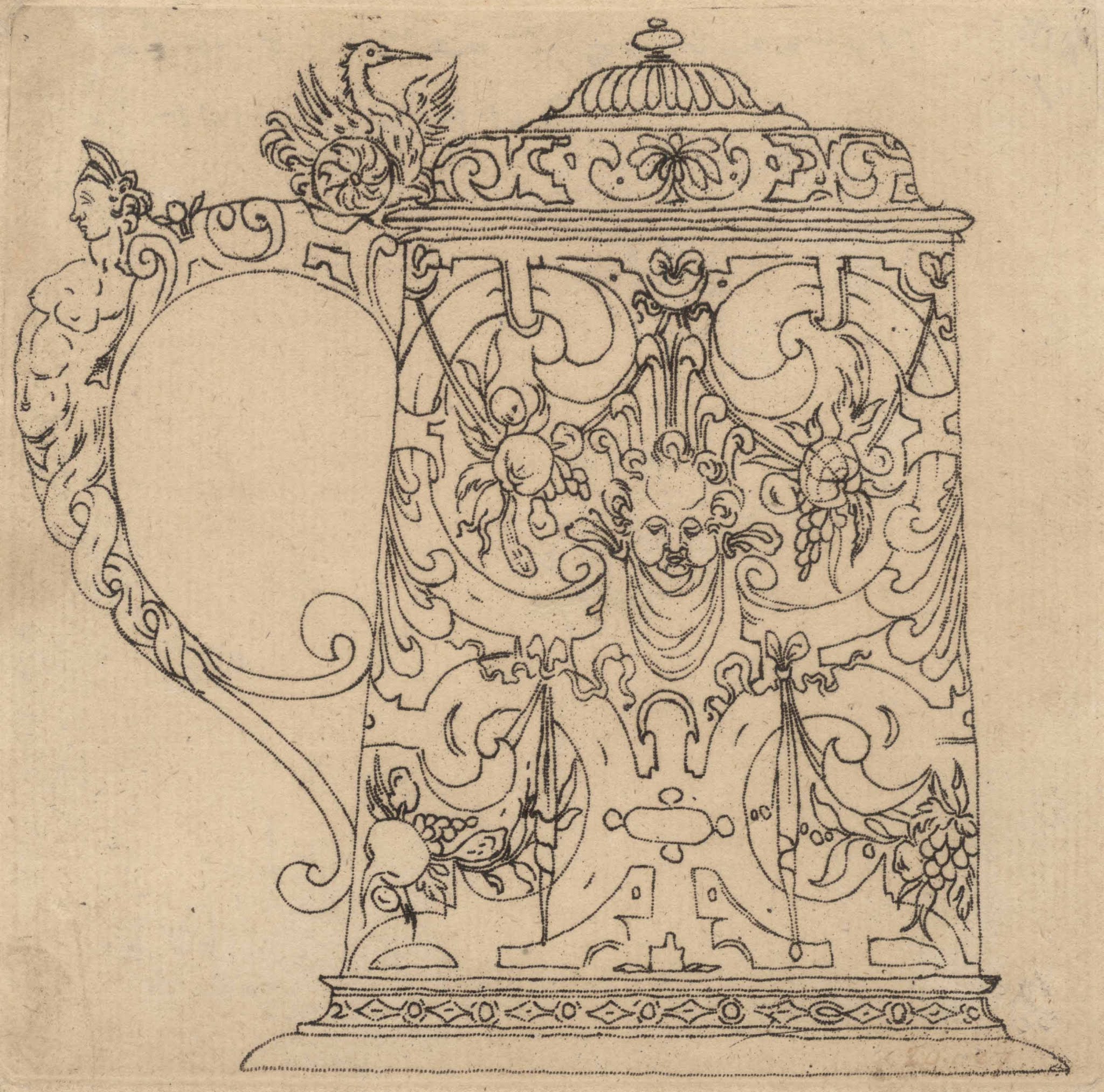
(Attrib.) Paul Flindt the Younger’s punched stipple engraving, “Covered Tankard”, late 1500s

(Attrib.) Paul Flindt the Younger (aka Paul Flynt; Paul Vlindt; Paul Flint; Paul Flynth; Paul Vlindt the Younger) (bapt.1567–1631; fl.1592–1618)

“Covered Tankard with 16th Century Ornament” (MET title), late 1500s, illustration from Flindt’s pattern books designed for the goldsmith trade. According to Jeffrey Chipps Smith (2014) in “Nuremberg, a Renaissance City, 1500-1618”, two of these books were published in Viennia (1592–93) and the third book was published in Nuremberg in 1594. Based on a faint pencil inscription verso, I believe that this plate is from the Nuremberg edition, “Veel schoene stvcken om te dryven den govdt smeden dienelyck” and, based on a title plate for the series (see http://hdl.handle.net/10934/RM0001.COLLECT.387321), the engraving was published by the Amsterdam publisher, Ahasuerus van Londerseel (aka Assuerus Londerssel) (1572–1635).

Punched stipple engraving on laid paper trimmed with a narrow margin around the platemark and backed with a support sheet.

Size: (sheet) 12 x 12.1 cm; (plate) 11.5 x 11.7 cm

The Metropolitan Museum of Art offers a description of this print: https://www.metmuseum.org/art/collection/search/751306.

Condition: a well-printed impression showing no sign of wear to the printing plate in an excellent condition with no tears, holes, abrasions, significant stains or foxing. The sheet has been laid upon an archival support sheet of millennium quality washi paper.

I am selling this remarkable stipple engraving inscribed with a goldsmiths’ hand-punch rather than a burin—a Punzenstecher’s (stamp engraver) technique arising from the practice of goldsmiths in the late 1500s to initially score dotted line guides before the formal engraving process and (sometimes) taking impression from the scored dot patterns (termed niello prints)—for the total cost of AU$234 (currently US$180.57/EUR150.20/GBP130.65 at the time of this listing) including Express Mail (EMS) postage and handling to anywhere in the world, but not (of course) any import duties/taxes imposed by some countries.

If you are interested in purchasing this early pattern design for ornamentation featuring a phoenix, mascaron, ribbons, pierced strapwork and fruit bunches, please contact me (oz_jim@printsandprinciples.com) and I will send you a PayPal invoice to make the payment easy.

This print has been sold


Saturday, 26 September 2020

Unidentified printmaker from the circle of Nicolaes de Bruyn, “Five Birds Including Spoonbill”, c1594

Unidentified printmaker from the circle of Nicolaas de Bruyn (aka Nicolaes de Bruyn; Nicolaas de Bruin) (1571–1656)

“Five Birds Including Spoonbill” (aka “Vijf vogels waaronder lepelaar”), c1594, plate 5 after the series of engravings by De Bruyn—the British Museum advises that there are 13 plates in the series [Z,1.95] whereas the Rijksmuseum proposes that there are 12 plates [RP-P-1898-A-20003])—“Birds and Insects” (aka “Vogels en insecten”), possibly published following the different editions of De Bruyn’s plates by Francoys van Beusecom (aka Francoys van Beusekom) (fl.1642–1665), Ahasuerus van Londerseel (aka Assuerus Londerssel) (1572–1635) and Carel Allard (aka Carolus Allard; Carel Allardt; Carel Allart) (1648–1709).

Engraving on laid paper trimmed with a thread margin around the image borderline.

Size: (sheet) 8.3 x 12.6 cm.

Inscribed on plate: (lower right) [ligature monogram] “NB. in.”; (right edge) “5”.

References to De Bruyn’s engraving: Hollstein Dutch 228 (F.W.H. Hollstein 1951, “Dutch and Flemish Etchings, Engravings and Woodcuts ca. 1450–1700: Brun–Coques”, vol. 4, Amsterdam, Menno Hertzberger, p. 24, cat. no. 228); Orn Cat I 37-A.2 (Irene Margaretha de Groot 1988, “Ornamentprenten in het Rijksprentenkabinet”, Den Haag, Rijksprentenkabinet, Rijksmuseum Staatsuitgeverij).

The British Museum offers the following description of De Bruyn’s engraving:

“Landscape with several birds on a river-bank, such as cranes, small sailing boats in background; from a series of thirteen prints showing birds and insects. 1594”

(https://www.britishmuseum.org/collection/object/P_Z-1-95).

See also the description of De Bruyn’s engraving offered by the Rijksmuseum with reference to another series:

(Transl.) “Print from a series of twelve prints with birds and insects. Sheets from another series of prints are depicted at Hollstein, see De Groot 1988, p. 37.”

(http://hdl.handle.net/10934/RM0001.collect.89139).

Condition: near faultless early impression showing no sign of wear to the printing plate, trimmed with a thread margin around the image borderline in excellent/near pristine condition.

I am selling this superb engraving by an unidentified printmaker after Nicolaes de Bruyn’s engraving, for the total cost of AU$208 (currently US$146.23/EUR125.64/GBP114.74 at the time of this listing) including Express Mail (EMS) postage and handling to anywhere in the world, but not (of course) any import duties/taxes imposed by some countries.

If you are interested in purchasing this marvellous jewel of early engraving showing water birds, please contact me (oz_jim@printsandprinciples.com) and I will send you a PayPal invoice to make the payment easy.

This print has been sold


Thursday, 12 September 2019

Nicolaas de Bruyn's engraving, “Julius Caesar”, 1594


Nicolaas de Bruyn (aka Nicolaas de Bruin; Nicolaes de Bruyn) (1571–1656)

“Julius Caesar”, 1594, plate 3 from the series of nine engravings, “Ornament Designs with Portraits of Kings and Heroes”, originally published by Ahasuerus van Londerseel (aka Assuerus Londerssel) (1572–1635) in Antwerp. (Note that this impression has Van Londerseel’s publication details partly erased.)

Engraving on fine laid paper trimmed along the platemark and backed with a support sheet.
Size: (sheet) 12.4 x 9.2 cm; (image borderline) 11.7 x 9.1 cm.
Inscribed on plate: (within the cartouche) “Julius caesar”; (below the image borderline) “3 Nicola de Br fe … [partly erased “Assuwerus van Londerseel”] excudit.”
State ii (of iii) with the publisher’s name burnished but before the number “3” is repositioned to the lower right (see the Rijksmuseum’s copy of state i [http://hdl.handle.net/10934/RM0001.collect.89015] and state iii [http://hdl.handle.net/10934/RM0001.collect.89017]).   

Hollstein Dutch 157–2; Berlin 1939 237.1 (P Jessen 1939, “Katalog der Ornamentstichsammlung der Staatlichen Kunstbibliothek Berlin”, Berlin); New Hollstein (Dutch & Flemish) 265.I (Nicolaes de Bruyn); Orn Cat I 33–2 (Irene Margaretha de Groot 1988, “Ornamentprenten in het Rijksprentenkabinet”, Amsterdam, Rijksprentenkabinet, Rijksmuseum Staatsuitgeverij, p. 33, cat. no. 33.2).

The British Museum offers the following description of this print:
“Roundel containing the portrait of the Roman Emperor Julius Ceasar [sic] surrounded by decorative elements, including two monkeys holding flags and swords and above two winged cherubs blowing into horns.”

See also the description of this print offered by the Rijksmuseum:
(transl.) “Portrait of Julius Caesar as a general of antiquity in a medallion within a rectangular frame with ornaments in the form of monkeys, fantasy creatures and butterflies”.

Condition: richly inked early impression with stains and restorations of the corners, trimmed along the platemark and laid upon an archival support sheet of millennium quality washi paper.

I am selling this gorgeous jewel of an engraving glowing with strong contrasts for AU$340 in total (currently US$234.01/EUR212.16/GBP189.90 at the time of posting this print) including postage and handling to anywhere in the world (but not, of course, any import duties/taxes imposed by some countries).

If you are interested in purchasing this very fine engraving with a fascinating range of animals and insects worthy of close examination—see the two beautifully drawn mice that are only slightly larger than grape seeds and trumpet blowing zephyrs sporting the best hair ponytails ever created—please contact me (oz_jim@printsandprinciples.com) and I will send you a PayPal invoice to make the payment easy.

This print has been sold