Showing posts with label Sandrart (Johann Jacob von). Show all posts

Sunday, 20 April 2025

Johann Jacob von Sandrart, “Candlestick with Two Caryatids”, 1675, after Enea Vico

Johann Jacob von Sandrart (aka Johann Jakob von Sandrart) (1655–1698)

“Candlestick with Two Caryatids” (aka “Chandelier, don’t le manche offre deux caryatides” [Bartsch title]), 1675, after Enea Vico (1523–1567) (TIB 30.491) with the design of the caryatid figures possibly based on the design by Marcantonio Raimondi (1470/1482–1527/1534) after Giulio Romano (c.1499–1546), after Raphael (1483–1520) (see https://www.britishmuseum.org/collection/object/P_1868-0822-56 [inv. 1868,0822.56]), published in 1675 in Nuremberg by Jacob von Sandrart and in Frankfurt am Main by Matthäus Merian II (1621–1687) as an illustration to Joachim von Sandrart’s “Teutsche Academie der Edlen Bau- Bild- und Mahlerey-Künste …” (German Academy of the Noble Arts of Architecture, Sculpture and Painting…), with impressions of this print on page 65 (see https://archive.org/details/gri_33125008279545/page/n237/mode/2up) and page 376 (see https://archive.org/details/gri_33125008279545/page/n737/mode/2up).

Engraving on fine laid paper with letterpress text verso, trimmed with a small margin and backed with a support sheet.

Size: (sheet) 20.8 x 16.8 cm; (plate) 20.1 x 15.8 cm; (image borderline) 20.1 x 15.6 cm.

Inscribed in plate in six lines of German in two columns (upper edge): “Hier, Iugend, geh zur Schule,/ und mit der Musa buhle,/ die sich Antike nennt./ Was Neues man erfindet,/ sich in dem Alten gründet:/ die Kunst man so erkennt.// Wan soll ein Künstler sehen:/ diss Liecht muss ihm aufgehen,/ sonst ist u. bleibt er blind./ Der Leuchter ist gestellet:/ wer sich zu ihm gesellet,/ und ämsig sucht, der findt.”

([Google transl.] “Here, youth, go to school,/ and woo Musa,/ who calls herself antiquity./ Whatever new is invented,/ is founded on the old:/ thus one recognizes art.// When should an artist see:/ this light must dawn on him,/ otherwise he is and remains blind./ The lampstand is set:/ whoever joins it,/ and diligently seeks, will find.”)

Condition: a strong and well-printed impression. The sheet is in an excellent condition with no tears, holes, abrasions or significant stains—there is however, minor toning from the text printed verso—and is laid onto a support of millennium quality washi paper providing wide margins.

I am selling this marvellous engraving executed in 1675 of a candlestick holder featuring classical motifs (viz. classically draped women posed as caryatids standing on a pedestal decorated with festoons hanging from bucrania) for AU$263 (equivalent to approximately US$169.06, EUR 146.55, or GBP 126.21 at the time of listing) and includes Express Mail Service (EMS) postage and handling to any worldwide destination. Please note that any import duties or taxes levied by the destination country are the responsibility of the buyer and are not included in the purchase price. Payment is requested in Australian dollars (AU$263).

If you are interested in purchasing this very beautiful engraving, please contact me (oz_jim@printsandprinciples.com) and I will send you a PayPal invoice to make the payment easy.

This print has been sold


Thursday, 2 June 2022

Wolfgang Kilian’s engraving, “Melancholy”, c1608

Wolfgang Kilian (1581–1662)

Note that Wolfgang Kilian often used his full name on his prints, but also used the initials, “W.G.K.”, as can be seen in this print; see, for example, the inscription in Kilian’s “The Ascension of Christ”, 1600–1662 (https://www.metmuseum.org/art/collection/search/775605).

“Melancholy” (aka “Melancholie”; “Haec tormenta frahit”; “Misfortune Overtakes), 1603–1608, published as plate 11 in the series of 15 plates (including the title plate) to “Nimbus Calamitatum Humani Generis Lapsi” (A Cloud of Calamities of the Fallen Human Race”, possibly after the design by Nicolas de Hoey (aka. Dhoey) (fl.1590–1611) and published by Jacob von Sandrart (1630-1708) (see the images of all the plates and descriptions offered by the Herzog Anton Ulrich-Museum Braunschweig: https://nat.museum-digital.de/objects?persinst_id=137103).

Engraving with etching on laid paper, trimmed around the image borderline on top and sides and text lines below the image, backed with a support sheet.

Size: (support sheet) 28.3 x 33.4 cm; (sheet) 25.2 x 30.3 cm; (image borderline) 22.7 x 30.3 cm.

Inscribed in plate within the image borderline: (lower left corner) “W.G.K.”; (lower centre) “XI.”

Lettered below the image borderline in three columns of Latin and German text: {note that there may be errors in my reading of the text) “Hæc tormenta frahit longo fecum aginine Bilis/ Atra, Melancholicis tatara dira Viris,/ Aspidibus macerat se Desperatio: curis/ Tristitia et luctus conficit exanimes.// …// …űberfekt.”

Hollstein XVIII.760–774 (771)

See also the description of this print by the Herzog Anton Ulrich-Museum Braunschweig: https://nat.museum-digital.de/object/856913

Condition: a strong early impression trimmed around the image borderline, but retaining the text lines. Beyond a flattened centrefold (with minor break), the sheet is in a very good condition for its age with no significant stains, or foxing and has been laid onto a support sheet of archival (millennium quality) washi paper.

I am selling this amazing engraving full of symbolism relating to melancholy—note that the Latin text in the left column refers to the symptoms of Melancholy as “tristitia” (sadness) and “luctus” (anguish) and proposes that (transl.) “Despair wears itself with Vipers”—for AU$277 (currently US$198.99/EUR186.14/GBP158.81 at the time of posting this print) including postage and handling to anywhere in the world, but not (of course) any import duties/taxes imposed by some countries.

If you are interested in purchasing this seldom seen engraving on the art market and one which perfectly exemplifies the period style of Mannerism—note the elongation of the figures, the theatrical lighting and dramatic gestures—please contact me (oz_jim@printsandprinciples.com) and I will send you a PayPal invoice to make the payment easy.

This print has been sold 


Wednesday, 18 May 2022

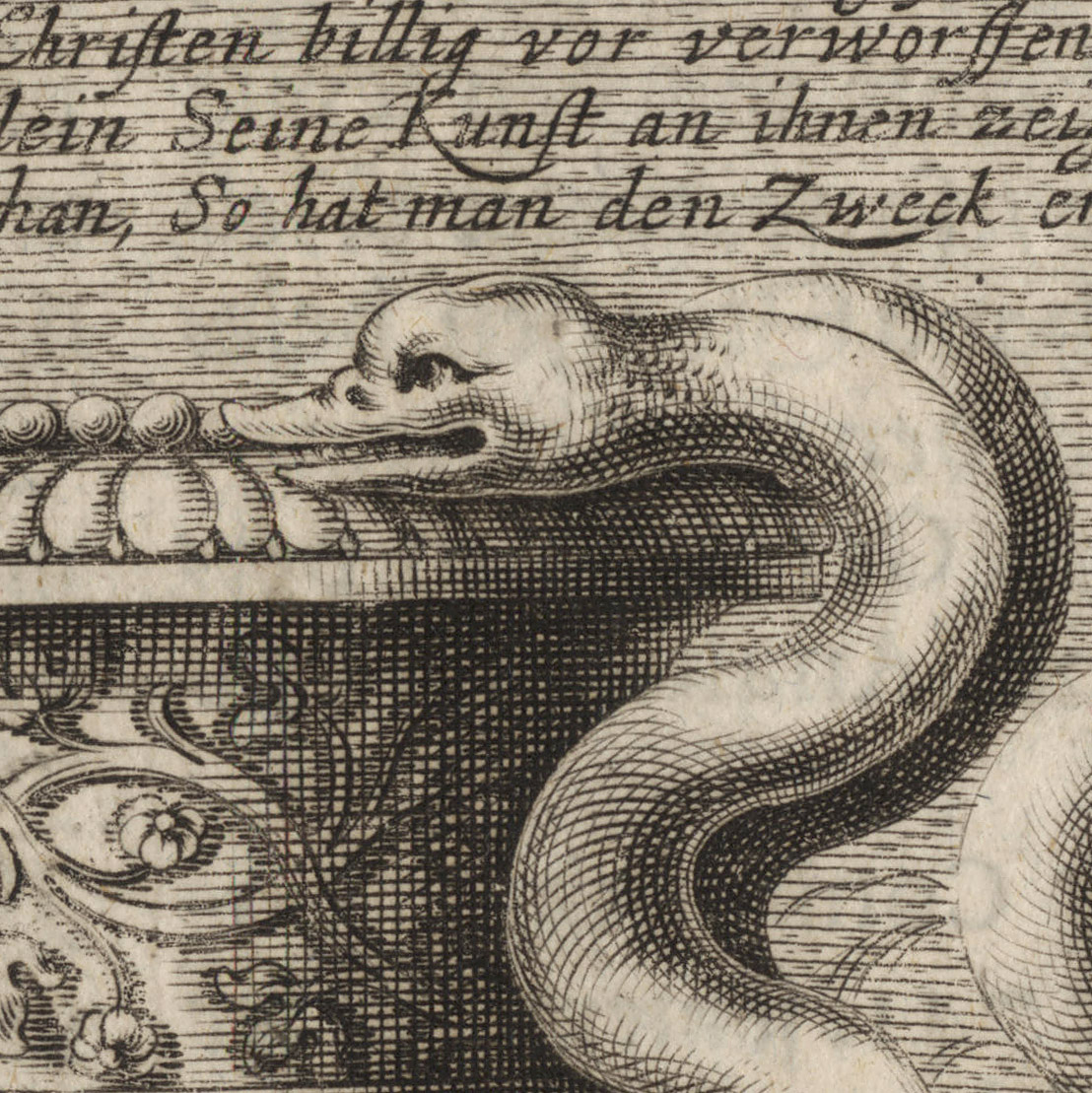
(attrib.) Johann Jacob von Sandrart’s engraving, “Amphora with Serpents as Handles”, 1675, after Agostino Veneziano


(attrib.) Johann Jacob von Sandrart (aka Johann Jakob von Sandrart) (1655–1698), or his father, Jacob von Sandrart (1630-1708)

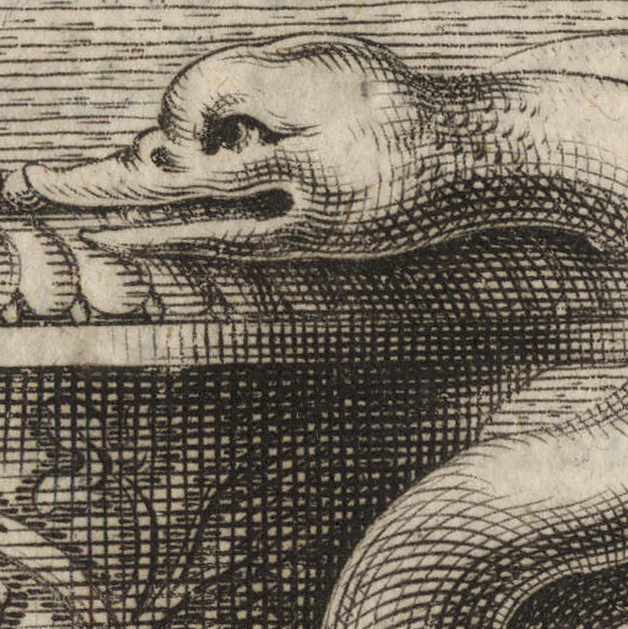
Amphora with Serpents as Handles” (aka “Antique Vessel”; “Antikes Prachtgefäß”), 1675, engraving in reverse after Agostino Veneziano’s (aka Agostino dei Musi) (fl.1509–1536) engraving, 1530 (see https://www.britishmuseum.org/collection/object/P_1873-1213-258), published in 1675 in Nuremberg by Jacob von Sandrart (1630–1708) and in Frankfurt am Main by Matthäus Merian II (1621–1687) as an illustration to Joachim von Sandrart’s (1606–1688), “Teutsche Academie der Edlen Bau- Bild- und Mahlerey-Künste …” (German Academy of the Noble Arts of Architecture, Sculpture and Painting)  (see https://archive.org/details/gri_33125008279545/page/n365/mode/2up).

Engraving on laid paper with letterpress text verso as published, trimmed around the image borderline and backed with a support sheet.

Size: (support sheet) 34.6 x 27.1 cm; (sheet) 19.9 x 15.4 cm.

Inscribed in plate: (upper centre) “Götter, so die blinden Heyden zum anbeten vorgestellt,/ Man von allen rechten Christen billig vor verworffen hält./ Wan man aber nur allein Seine Kunst an ihnen zeiget,/ So ist es gar wol gethan, So hat man den Zweck erreichet.” (Gods, so presented to the blind heathen to worship,/ All true Christians justly hold them to be rejected./ But if one only shows one's art on them, then/ it is well done, then one has achieved the purpose.)

Regarding the inscription, Sandrart.net offers the following explanation: (transl.) “The verse of the vignette … contains two aspects of the relationship to antiquity. On the one hand, Sandrart addresses the overcoming of ‘pagan practice’ by Christianity and, on the other hand, he warns against orienting oneself only to the ancient art form and not to the pagan content (cf.Klemm 1994 , p. 13)” (http://ta.sandrart.net/de/artwork/view/372).  

Condition: a strong, well-inked and well-printed impression backed with a support sheet of archival (millennium quality) washi paper. The sheet is in an excellent condition with no tears, holes, folds, abrasions, significant stains or foxing.

I am selling this very beautiful engraving of an antique amphora with coiled serpent handles and featuring four dancing figures with a putto holding up an Oenochoe (wine jug), for the total cost of AU$239 (currently US$167.50/EUR159.22/GBP134.89 at the time of posting this print) including postage and handling to anywhere in the world (but not, of course, any import duties/taxes imposed by some countries).

If you are interested in purchasing this curiously interesting engraving of a Baroque designed antique amphora, please contact me (oz_jim@printsandprinciples.com) and I will send you a PayPal invoice to make the payment easy.


Wednesday, 27 June 2018

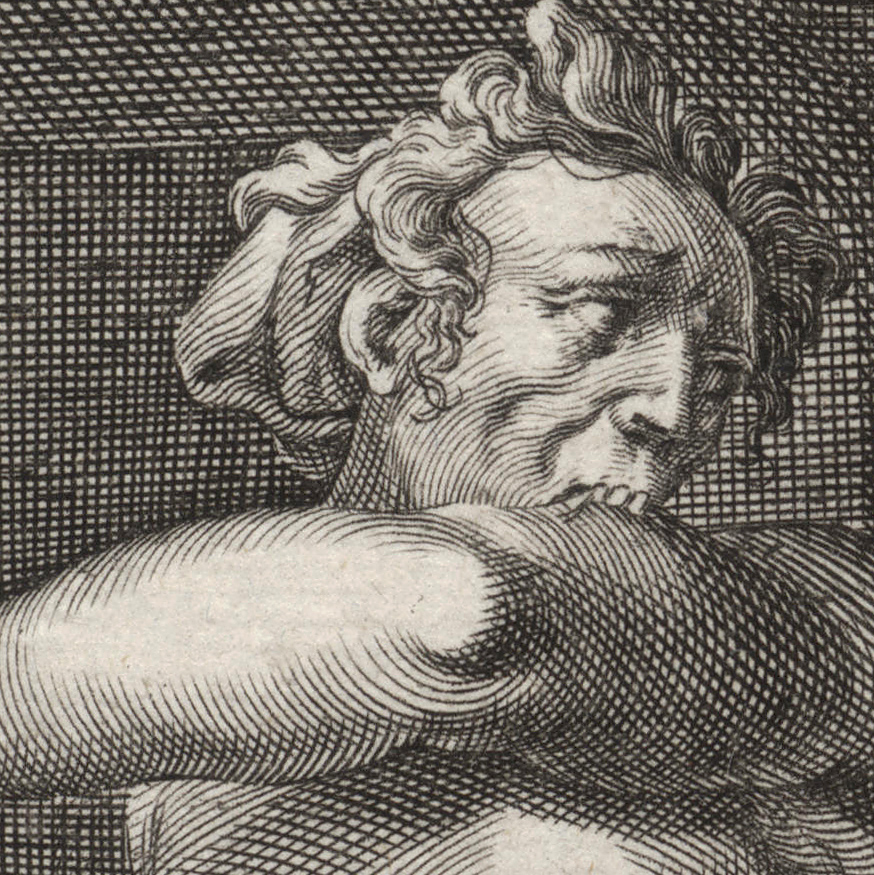
Johann Jacob von Sandrart’s etching, “The Fire in the Borgo”, 1682, after Raphael


Johann Jacob von Sandrart (aka Johann Jakob von Sandrart) (1655–1698)

“The Fire in the Borgo”, 1682, published by Joachim von Sandrart (1606–1688) as Plate 0 (as numbered at upper right) to “Academia Nobilissimae Artis Pictoriae”, printed by Christian Frober (aka Christian Froberger) (fl.c.1675–1700) in 1683, in Nuremberg, after a detail of Raphael’s (aka Raffaello Sanzio da Urbino) (1483–1520) design for the fresco of the same name executed in 1514 that is argued to be painted by Raphael’s assistant, Giulio Romano (aka Giulio Pippi) (c1499–1546) in the Stanza dell'Incendio di Borgo, Palazzi Pontifici, Vatican.

(Note: I may be wrong, but based on a copy of the publication in which this etching features that was auctioned by Christie’s (30 April 2008, London), I believe that there are 47 plates with 3 double-page illustrations—this print being one of these larger plates as there is a centrefold that is now flattened.)

Etching on heavy laid paper with full margins as published. The print consists of two plates abutted: a plate with the image and a plate with the lettered text below it.
Size: (sheet) 50.3 x 39 cm; (abutted plates) 46.8 x 32.7 cm; (image borderline) 41.1 x 31.6 cm
Numbered on plate above the image borderline: (right corner) “0”.
Inscribed on plate below the image borderline: (left) “Raphael d'Urbino pinxit.”; (right) “Joh. Jac: de Sandrart delineavit et sculpsit Norimb. 1682”
Lettered on plate in five lines of Latin text on a separate abutted plate: “Sereniffimo … / … / … / … / … / … confecratq”; (left of centre) “Sereniffimæ Celfitudinis Veftra”; (right) “cultor demiffiffimus / Ioh. Iacobus a Sandrart.” (My apologies if there are errors in my reading of the letters).

Hollstein 350.II

The British Museum offers the following description of this print:
“The fire in the Borgo; after Raphael; with various figures fleeing through an archway and over a wall to right in foreground; in left background the burning city …”

Condition: an almost faultless—well-inked and well-printed—impression that is in near pristine condition (i.e. there are no tears, holes, creases—beyond the now flattened centrefold of publication—abrasions, stains or foxing) for the considerable age of the print. The sheet is backed with a support sheet of archival (millennium quality) washi paper.

I am selling this large etching of exceptional quality and very rare—note that the Rijksmuseum does not hold a copy—for the total cost of AU$246 (currently US$181.50/EUR156.41/GBP137.96 at the time of posting this print) including postage and handling to anywhere in the world (but not, of course, any import duties/taxes imposed by some countries).

If you are interested in purchasing this marvellously intriguing image executed by one of the major oldmaster German printmakers of the 17th century, please contact me (oz_jim@printsandprinciples.com) and I will send you a PayPal invoice to make the payment easy.

This print has been sold


This scene of tumultuous chaos shows fleeing naked Romans with Michelangelesque physiques escaping the AD 847 fire in the Borgo—an area near the Basilica of St Peter in Rome. For sensitive folk that shudder on seeing other folk in distress, you may relax as I can confirm that Pope Leo IV interceded with his faith to extinguish the blaze … but his prayers were sadly ineffective in stopping the old Basillica of St Peter—which may be seen through the gap in the broken wall—from being reduced to rubble (see the Web Gallery of Art for a thorough explanation about the fire and Raphael’s painting: https://www.wga.hu/html_m/r/raphael/4stanze/3borgo/1borgo.html)