Showing posts with label Robaut (Alfred). Show all posts

Saturday, 27 November 2021

Alfred Robaut’s lithograph, “Hercules Throwing King Diomedes to his Man-eating Horses”, c1865, after Eugène Delacroix

Alfred Robaut (aka Alfred-Ernest Robaut) (1830-1909)

“Hercules Throwing King Diomedes to his Man-eating Horses”, c1865, after a study (c1852) by Eugène Delacroix (aka Ferdinand Victor Eugène Delacroix) (1798-1863) (see https://commons.wikimedia.org/wiki/File:Delacroix_-_Hercules_Throwing_King_Diomedes_to_his_Man-eating_Horses.jpg), possibly a design study for the decoration of the Salon de la Paix in the newly expanded Hôtel de Ville (Paris City Hall) (see the discussion of a related pencil study in the collection of the MET: https://www.metmuseum.org/art/collection/search/355649), printed in Douai by Alfred Robaut and published in Paris in 1865 by Dusacq & Cie (with the blind-stamp of the series) as plate 70 to the second volume of “Eugène Delacroix: Fac-Simile de Dessins et Croquis Originale par Alfred Robaut.”

Lithograph printed in sanguine coloured ink on grey chine collé (China) with full margins as published and backed with a support sheet.

Size: (sheet) 37.7 x 47.9 cm; (chine collé) 27.9 x 34.7 cm.

Numbered in plate above the image borderline: (left) “No. 70.”

Lettered in plate below the image borderline: (left) “Eug. Delacroix.”; (right) “Imp. Alf. Robaut, Douai”.

Blind-stamped below the image borderline: (in an oval at centre) “EUGÈNE DELACROIX/ FAC-SIMILE/ DE DESSINS et CROQUIS ORIGINALE/ PAR ALFRED ROBAUT”.

Condition: a near faultless impression laid onto a support sheet of archival (millennium quality) washi paper. The sheet is in a near pristine condition with no tears, holes, folds, abrasions, stains, foxing or signs of handling.

I am selling this lithograph from the late 1800s designed to showcase Eugène Delacroix’s consummate skill as a draftsman—note how the lithograph not only captures the subtle variations of Delacroix’s  strokes but how it also simulates the grainy texture of his chalk lines—for the total cost of AU$198 (currently US$141.14/EUR124.65/GBP105.79 at the time of posting this listing) including postage and handling to anywhere in the world, but not (of course) any import duties/taxes imposed by some countries.

If you are interested in purchasing this visually arresting lithograph—note that Robaut has chosen to print the sanguine colour of Delacroix’s lines onto a light grey chine collé paper to give vibrant depth to the colour—please contact me (oz_jim@printsandprinciples.com) and I will send you a PayPal invoice to make the payment easy.


Saturday, 1 August 2020

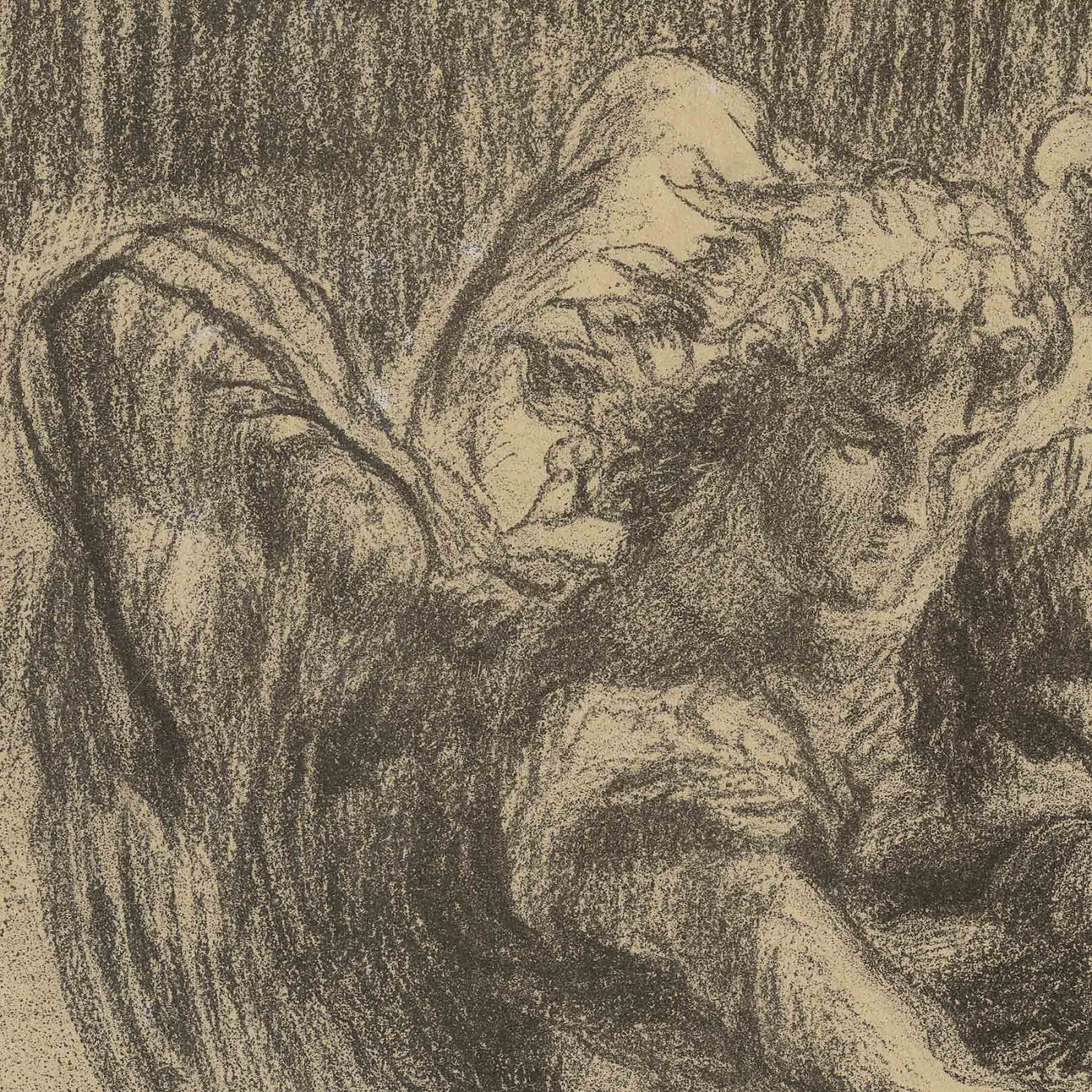
Alfred Robaut’s lithograph, “Jacob Wrestling with the Angel,” 1864, after Eugène Delacroix


Alfred Robaut (1830–1909)

“Jacob Wrestling with the Angel,” 1864, published in Paris by Dusacq & Cie (fl.c1864–1869) after Eugène Delacroix’s (aka Ferdinand Victor Eugène Delacroix) (1798–1863) 1850 chalk on tracing paper  study (see https://www.themorgan.org/drawings/item/109711) for Delacroix’s oil and wax on plaster, “Jacob Wrestling with the Angel,” completed in 1861, in the Saints-Anges' chapel of the Church of Saint-Sulpice, Paris.

Lithograph (possibly a transfer lithograph [autographie]) printed in black ink on ochre coloured chine collé (China) paper laid onto a support sheet after the removal from the original (but damaged) backing sheet. Note that Alfred Robaut encouraged artists such as Delacroix and Corot to use the transfer process of lithography, as this technique gave artists the freedom to draw on paper that could later be transferred to lithographic stones, rather than the artists having to work directly on problematically heavy limestone plates.

Size: (irregular sheet) 55.8 x 37.9 cm.
The Rijksmuseum offers a description of this print:

Ashley Dunn, Assistant Curator in the Department of Drawings and Prints at the Met offers the following description of the Delacroix’s design underpinning this lithograph:
“In Delacroix's design, Jacob and the angel appear in the shallow foreground locked in combat at lower left. A grove of tall trees rises dramatically behind them; the thick, overlapping trunks echo their intertwined bodies. Through a clearing on the lower right, a cluster of figures suggests the flock of sheep and caravan that Jacob accompanied before his encounter with the angel”

For those unfamiliar with the subject portrayed in this lithograph, the following account of Genesis (32:22–28) may be helpful:
“That night Jacob got up and took his two wives, his two female servants and his eleven sons and crossed the ford of the Jabbok. After he had sent them across the stream, he sent over all his possessions. So Jacob was left alone, and a man wrestled with him till daybreak. When the man saw that he could not overpower him, he touched the socket of Jacob’s hip so that his hip was wrenched as he wrestled with the man. Then the man said, “Let me go, for it is daybreak.” But Jacob replied, “I will not let you go unless you bless me.” The man asked him, “What is your name?” “Jacob,” he answered. Then the man said, “Your name will no longer be Jacob, but Israel, because you have struggled with God and with humans and have overcome.”

Condition: very good impression but with many small restorations (e.g. there is watercolour infilling along a break in the centrefold and other hairline fractures) and the whole tissue-thin sheet has been removed from its damaged original support sheet and is relined with a support of archival (millennium quality) washi paper.

I am selling this graphically impressive and very large lithograph of Delacroix’s chalk study of one of his most famous compositions, for AU$292 in total (currently US$1208.63/EUR177.17/GBP159.46 at the time of posting this print) including postage and handling to anywhere in the world (but not, of course, any import duties/taxes imposed by some countries).

If you are interested in purchasing this rare lithograph—so rare that I have found only a single copy of it in any of the major museum repositories (viz. the Rijksmuseum)!—please contact me (oz_jim@printsandprinciples.com) and I will send you a PayPal invoice to make the payment easy.

This print has been sold


Thursday, 29 August 2019

Camille Corot's transfer lithograph, “The Isolated Tower”, 1871


Camille Corot (aka Jean Baptiste Camille Corot) (1796–1875)

“The Isolated Tower” (La Tour Isolée), 1871, published by Alfred-Ernest Robaut (1830–1909) and printed in an edition of 50 impressions by Lemercier & Cie (fl.1827–1899) in Paris in an unbound suite of twelve autolithographs, “Douze croquis et dessins originaux sur papier autographique par Corot” (Twelve Sketches and Designs by Corot) (1871).

Regarding the small number (50) of impressions in the edition of this print, The Art Gallery of New South Wales, offers the following insight:
“The decision to cap the number of impressions was innovative since at this date the ‘limited edition’ was still far from being a standard practice in the marketing of graphic art. The lithographs – in various tones of black, sepia and reddish brown – were printed on thin, tinted paper bonded to a heavier wove-paper support.”

Transfer lithograph/autolithograph (i.e. a lithograph where the original design is drawn with greasy crayon onto paper which is then transferred to the printing stone) printed in black ink on buff coloured China paper appliqué which has been separated from its original support sheet and is laid upon archival washi paper.

Regarding the lithographic process employed for this print, The Art Gallery of NSW advises:
“Robaut procured sheets of lithographic transfer paper and encouraged Corot to make sketches of the countryside on them. By rendering his impressions on special paper, Corot’s original drawings could be transferred to a lithographic stone by a professional printer at a later date. Transfer lithography (or autographie in French) was ideally suited to Corot’s disposition: it saved him the difficulty of having to work on a heavy and cumbersome limestone block and it afforded him the freedom to sketch in a free- flowing style with a soft crayon, in the studio or in the open air as he pleased” (AGNSW, op.cit.).

Size: (sheet) 22 x 27.8 cm.
Signed in the plate by the artist at lower left.
State i (of i) lifetime impression.

Melot 1981 C 20 (Michel Melot 1981, "Graphic Art of the Pre-Impressionists”, New York, Harry N. Abrams, p. 261, cat. no. 20); Delteil 20 (Loys Delteil Le peintre-graveur illustré (XIX et XX siècles) Corot. privately printed, 5, Paris, 1910, cat. no. 20).

Condition: excellent impression but in poor condition with stains (mainly on the right side) and with many tears and holes/losses to the sheet (mainly in the sky) that have been restored with watercolour infilling. The sheet is laid on a support of archival (millennium quality) washi paper.

I am selling this exceptionally rare lithograph—only fifty were printed—by one of the most famous artists of the nineteenth century for the total cost of AU$680 (currently US$458.41/EUR414.12/GBP375.98 at the time of this listing) including postage and handling to anywhere in the world (but not, of course, any import duties/taxes imposed by some countries).

If you are interested in purchasing this remarkable lithograph from the suite of twelve prints described by the AGNSW as being “among the most fleeting and atmospheric renditions of landscape ever committed to stone” (op.cit.), please contact me (oz_jim@printsandprinciples.com) and I will send you a PayPal invoice to make the payment easy.
This print has been sold


Tuesday, 20 December 2016

Robaut’s lithograph, “The Education of Achilles”, after Delacroix’s pastel drawing


Alfred-Ernest Robaut (aka Alfred Robaut) (1830–1909)
 “The Education of Achilles”, 1879, printed by Lemercier & Cie in Paris, after the pastel drawing by Eugène Delacroix (1798–1863) in the J. Paul Getty Museum collection (http://www.getty.edu/art/collection/objects/197/eugene-delacroix-the-education-of-achilles-french-1862/). This subject is also featured in Delacroix’s painting on a pendentive supporting the cupola dedicated to Poetry in the library of the Chambre des Députés at the Assemblée Nationale in Paris. There are also other drawings of this subject, no doubt preparatory studies for the painting; see, for example, Delacroix’s ink study (1845) at Sotheby’s auction (06 February 2011]): http://www.sothebys.com/en/auctions/ecatalogue/2014/impressionist-modern-art-day-sale-l14004/lot.114.html.

Lithograph of heavy wove paper with wide margins.
Size: (sheet) 53.5 x 63.7 cm; (image borderline) 37.1 x 45.7 cm
Inscribed within the image (lower centre) “Eng. Delacroix. 1862”
Lettered outside the image borderline: (upper centre) “EUGENE DELACROIX”; (lower left) “Lithographié par Alfred Robaut (Salon de 1879)”; (lower right in two lines) “Grandur de l’original, qui appartient à Mr. Petit / Imp. Lemercier & Cie. Paris”

Condition: this is a large and very rare print (note: that this print is not in the collection of four major museums [viz. The British Museum, Rijksmuseum, The Met, or even The J. Paul Getty Museum that hold the original pastel on which this print is based). The impression is crisp and well-printed. There are a few minor dot-size abrasions (restored) and the sheet has a vertical mark (a rub of dust?) in the margin near the lower-left corner. There are also a few other minor handling marks, but overall the print is in very good condition for its large size and considerable age (i.e. there are no tears, holes, folds, stains or foxing). 

I am selling this magnificent and very large lithograph after Delacroix for the total cost of AU$228 (currently US$164.87/EUR158.67/GBP133.59 at the time of this listing) including postage and handling to anywhere in the world.
If you are interested in purchasing this amazing image of a Centaur teaching the young Achilles how to hunt, please contact me (oz_jim@printsandprinciples.com) and I will send you a PayPal invoice to make the payment easy. 

This print has been sold


For those with a romantic leaning, few images could be more satisfying than this one from the mythological realm of a centaur giving hunting tips to the young Achilles astride his back.

Certainly the romantic appeal of this scene was not lost on the novelist, George Sand, as Robaut’s lithograph is a graphic translation of a pastel drawing by Delacroix (shown above with permission by The J. Paul Getty Museum’s open content program) given as a gift by Delacroix to the very famous novelist who wrote:  “It is beautiful, even more beautiful, I believe, than the painting. [The painting is featured on a pendentive supporting the cupola dedicated to Poetry in the library of the Chambre des Députés at the Assemblée Nationale in Paris.] I am enraptured, dear friend" (see more information about Delacroix’s gift of the pastel to George Sand and details about the pastel at: http://www.getty.edu/art/collection/objects/197/eugene-delacroix-the-education-of-achilles-french-1862/?dz=0.5000,0.3654,0.77)

Beyond the attraction of seeing Chiron in action with a very naked Achilles—a reliable source tells me that Chiron is the smartest of all the centaurs—what I love about this print is the painterly handling of the image. What I mean by the term, “painterly”, is that Robaut has applied the waxy lithographic crayon in his original drawing onto the limestone printing plate in a soft manner so that the strokes resemble loosely laid brushstrokes. Robaut could have used washes of tusche (a greasy ink) to achieve a similar result but he used crayon as the graininess of the crayon is a better match for simulating the gritty appearance of Delacroix’s pastel drawing that he copied.