Thursday, 26 March 2020

Cornelis Galle I’s engraving, “The Four Fathers of the Latin Church”, c.1636


Cornelis Galle I (1576–1650)

“The Four Fathers of the Latin Church” (aka “The Four Fathers of the Church Disputing”; “De vier kerkvaders” [The Four Church Fathers]), c.1636 (c.1630–1642), commissioned by Herman de Neyt, published by Gillis Hendricx (aka Gilles Hendrikx) (fl.1640–77) in Antwerp with a dedication to Willem van Hamme, after a painting formerly attributed to Peter Paul Rubens (aka Petrus Paulus Rubenius) (1577–1640) and now attributed to Jacob Jordaens (1593–1678), in the Nationalmuseum, Stockholm, inv.no.595 (see http://collection.nationalmuseum.se/eMP/eMuseumPlus?service=ExternalInterface&module=collection&objectId=17598&viewType=detailView).

Engraving on laid paper with second state enlargement of the image by the addition of two side panels backed with a support sheet.
Size: (sheet) 37.4 x 48.6 cm; (plate) 37 x 48.1 cm; (image borderline) 34.7 x 47.5 cm.

Lettered on plate below the image borderline: (lower left) “P. Paulus Rubens inuentor.”; (center) “REVERENDO ADMODVM, NOBILI DOCTISSIMOQ VIRO DOMINO DNO […] GVILLIELMO VAN HAMME PBRO, IVRIS VTRISQ, LICENTIATO,/ PROTONOTARIO APOSTOLICO, NEC NON CATHEDRALIS ECCLIÆ B. […] MARIÆ ANTVERP: ET COLLEGIATÆ S. CATHARINÆ IN HOOCH-/ STRATEN CANONICO DIGNISSIMO, PICTORIÆ ARTIS ADMIRATORI […] ET AMATORI SVMMO, DD. C. HERMANVS DE NEYT ANTVERP./ Cum […] priulegio.”; (lower right) “Corn. Galle sculpsit./ Gillis Hendricx Excudit.”

State iii (of iii) “with two strips of plates added on either side” (see BM inv.no. R,3.94) and a small increase in the size of the side panel showing two lines at lower left outside text box image borderline (cf. Rijksmuseum state ii [inv. no. RP-PHO-60] and state iii [inv. no. RP-P-1939-156]). Note that Hollstein proposes only two states in which case this impression is state ii (of ii).

Hollstein Dutch 69-2 (2) (F W H Hollstein 1952, “Dutch and Flemish Etchings, Engravings and Woodcuts ca.1450–1700: Fouceel–Gole”, vol. 7, Amsterdam, Menno Hertzberger, p. 53, cat. no. 69); Corpus Rubenianum VIII 60 (copy 3) (Hans Vlieghe 1972, “Saints”, VIII, Brussels, Phaidon); Schneevoogt 1873 64.2 (S J Schneevoogt & C G Voorhelm 1873,
“Catalogue des estampes gravées d'après P.P. Rubens, avec l'indication des collections où se trouvent les tableaux et les gravures”, Haarlem).

The British Museum offers the following description of this print:
“The four Latin Doctors of the Church; St Ambrose at left, holding a crook and wearing a mitre, behind him a putto holds a beehive (symbol of the sweetness of his words); St Gregory seated at centre, wearing papal tiara; at right St Augustine with two angels above holding his attributes (a burning heart and a crook); St Jerome seated at far right, his hat lying at his feet, a lion asleep at his side; the Holy Spirit above; second state with two strips of plates added on either side”

See also the description offered by the Rijksmuseum which holds the three states of this print (note that Hollstein proposes only two states):

Condition: richly inked early impression trimmed with a narrow margin around the platemark and laid onto a support sheet of millennium quality washi paper. Beyond replenished chips around the margin the sheet is in excellent condition (i.e. there are no tears, holes, folds, abrasions, significant stains or foxing).

I am selling this large masterpiece from the early 17th century exemplifying the attributes of the Baroque period with its breadth of compostion (note that this impression shows the extension of the image on the centre plate with two additional side plates to enlarge the scope of the portrayed scene), the love of flowing rich fabrics and theatrically dramatic lighting and body gestures, for the total cost of AU$560 (currently US$331.72/EUR303.89/GBP280.28 at the time of this listing) including postage and handling to anywhere in the world (but not, of course, any import duties/taxes imposed by some countries).

If you are interested in purchasing this stunningly beautiful engraving showing the four Church Fathers in animated discussion about the Bible—(from left) Pope Gregory Ambrose with his attribute of a beehive (because he was a sweet talker!); St Gregory with the dove of the Holy Spirit above him; St Augustine with the burning heart held above him;  St Jerome with his lion attribute sleeping peacefully beside him—please contact me (oz_jim@printsandprinciples.com) and I will send you a PayPal invoice to make the payment easy.


This print has been sold


What was a perplexing conundrum for me has been solved … thank goodness!

After deep navel gazing, and comparing once again the Rijksmuseum’s impressions of states ii and iii of this print, I’ve decided that the Rijksmuseum may be in error and the impression proposed as state ii is actually state iii and vice versa. The reason is simple: the plate has been reduced in size from 47.5 cm to 47.1 cm in width which means that the large plate is the earlier state and the smaller plate is the later state. Mindful of this logic, the listed impression is now from the second state (of three) and shows the larger margin around the image borderline with overdrawn marks of horizontal shading that are trimmed off in the later state.

Wednesday, 25 March 2020

Léopold Flameng’s etching, “The Blue Boy”, 1862, after Gainsborough


Léopold Flameng (aka Léopold Joseph Flameng) (1831–1911)

“The Blue Boy” (aka “L'enfant bleu”), 1862, after Thomas Gainsborough’s (1727 - 1788) famous portrait of the same name (c.1770) in the Huntington Library, San Marino (California), first published in “La Gazette des Beaux Arts”, 1867, vol. 13, p. 113 (see https://archive.org/details/gazettedesbeauxa13pari/page/112/) and republished in c.1890 by Imprimerie Charaire et Cie and printed by Chardon-Wittmann (fl.c.1884–1890) in Paris, in Teodor de Wyzewa’s “Les chefs-d'oeuvre de l'art au XIXe siècle”, p. 120 (see https://archive.org/details/leschefsdoeuvred04michuoft/page/120/). This impression is from the later edition.

The fame of Gainsborough’s painting, reputed to be a portrait of Jonathan Buttall (1752–1805) dressed in a manner similar to Van Dyck's portrait of Charles II as a boy in “The Children of King Charles I of England”, 1637, rests to a large part on it representing a refutal of advice (shown below) advocated by his rival Sir Joshua Reynolds (1723–1792)—founder and first president of the Royal Academy of Arts:

“It ought, in my opinion, to be indispensably observed, that the masses of light in a picture be always of a warm, mellow colour, yellow, red, or a yellowish white, and that the blue, the grey, or the green colours be kept almost entirely out of these masses, and be used only to support or set off these warm colours; and for this purpose, a small proportion of cold colour will be sufficient. Let this conduct be reversed; let the light be cold, and the surrounding colour warm, as we often see in the works of the Roman and Florentine painters, and it will be out of the power of art, even in the hands of Rubens and Titian, to make a picture splendid and harmonious” (see Ronald Sutherland Gower 1903, “Thomas Gainsborough”, G. Bell and Sons. pp. 77–78).

Etching on buff coloured chine collé (China) on heavy wove paper with margins as published.
Size: (sheet) 31.5 x 20.9 cm; (plate) 22.8 x 11.9 cm; (chine collé) 22.4 x 11.7 cm; (image borderline) 19.5 x 11.1 cm.
Inscribed on plate within the image borderline: (lower right) “Flameng. S.”
Lettered on plate below the image borderline: (left) “Gainsboroug[h] pinx./ Les chefs-d’œuvre _ 75”; (centre) “THE BLUE BOY”; (right) "L. Flameng sc./ “Imp. Chardon-Wittmann.”

Beraldi 102 (Henri Beraldi 1885, “Les Graveurs du dix-neuvième siècle”, vol. 11, p. 162, cat. no. 102); IFF 104 (“Inventaire du Fonds Français: Bibliothèque Nationale, Département des Estampes”, Paris, 1930).


Condition: richly inked and well-printed impression with margins as published. The sheet is in excellent condition but the are faint marks verso.

I am selling this etching by one of the major printmakers of the 19th century of one of Gainsborough’s most famous portraits for [deleted] including postage and handling to anywhere in the world.

If you are interested in purchasing this superbly executed black and white etching of Gainsborough’s famously blue painting—note how Flameng has shaded the boy’s further back leg with horizontal strokes to set it into shadow—please contact me (oz_jim@printsandprinciples.com) and I will send you a PayPal invoice to make the payment easy.

This print has been sold


Tuesday, 24 March 2020

Valentine Green’s mezzotint, “Roman Charity”, 1783, after Adriaen van der Werff


Valentine Green (1739–1813)

“Roman Charity”, 1783, after the painting in the (Museum: Royal Collection) by Adriaen van der Werff (aka Adrien Vanderwerff) (1659–1722), “Cimon and Pero” (aka “Caritas Romana” [Roman Charity]), c.1695, in the Royal Collection Trust (London), published in London by Torre & Co (fl.1760–99)—in collaboration with Valentine Green and his son, Rupert Green (1767/8–1804).

Mezzotint with a small margin around the platemark backed with a support sheet.
Size: (sheet) 64.9 x 47 cm; (plate) 63.9 x 46 cm; (image borderline) 61 x 45.8 cm.
Lettered on plate below the image borderline: (left) “Painted by Chev.r A.Vanderwerff.”; (centre) “ROMAN CHARITY./ From the Original Picture in the Possession of Edmund Antrobus Esq.r/ Publish'd June 20th. 1783, by V. Green & Son No,, 29, Newman Street, Oxford Street, London./ Se vend chez les Freres Torrè, Marchands des Estampes.”; (right) “Engrav'd by V Green Mezzotinto Engraver to his Majesty & to the Elector Palatine.”

Whitman 280 (Alfred Whitman 1902, “Valentine Green”, London, A H Bullen, p. 173, cat. no. 280 [see this catalogue online:

The British Museum offers the following description of this print:
“Pero visiting her father in prison, standing on the right and offering him her breast, while he languishes chained to the wall; Pero's baby lying behind her, and two Roman soldiers …[watching] from the window above”

Condition: well-printed impression with restored abrasions and tears, trimmed with a small margin around the platemark and laid onto a support sheet of millennium quality washi paper.

I am selling large and spectacular mezzotint by one of the most famous mezzotinters of his time illustrating the slightly bizarre account from the Roman historian, Valerius Maximus, about a chained prisoner left to starve, but kept alive by his daughter’s milk, for the total cost of AU$544 (currently US$323.49/EUR297.90/GBP274.85 at the time of this listing) including postage and handling to anywhere in the world (but not, of course, any import duties/taxes imposed by some countries).

If you are interested in purchasing this darkly beautiful mezzotint from the 18th century, please contact me (oz_jim@printsandprinciples.com) and I will send you a PayPal invoice to make the payment easy.


Monday, 23 March 2020

Hieronymus Wierix’s engraving, “Mater Dolorosa”, c.1585, after Jan Gossaert


Hieronymus Wierix (aka Hieronymus Wierx; Jerome Wierix) (1553–1619)

“Mater Dolorosa” (Mother of Sorrows) (aka “Our Lady of Sorrows”), c.1585, after Jan Gossaert (aka Mabuse; Jan Gossart; Johannes Malbodius) (1478–1532), published by Hans van Luyck (fl.1580s) in Antwerp.

Engraving on fine laid paper trimmed significantly within the image borderline, with tears, replenished losses and backed with a support sheet.
Size: (sheet) 29.6 x 23.5 cm.
Inscribed on plate: (lower left) “Jeron. Wierix cec.”; (lower right) “H. Van Luyck.”

Mauquoy-Hendrickx 785 (Marie Mauquoy-Hendrickx 1978, “Les Estampes des Wierix ... Catalogue Raisonné, Premièe partie [Part I], Brussels, Bibliotheque Royale Albert, p. 139, cat. no. 785, ill. p. 110); Alvin 566 (L Alvin 1866, “Catalogue raisonné de l'oeuvre des trois frères Jan, Jérome et Antoine Wierix”, Brussels);  Hollstein 930 (Wierix).

The British Museum offers the following description of this print: 
“Mater Dolorosa; the Virgin Mary seated at the foot of the Cross with her hands clasped and impaled by a sword, with a cityscape beyond; after Jan Gossaert Engraving”

Condition: richly inked strong impression trimmed well within the image borderline with stains, restored tears and infilled losses (e.g. the drapery beneath beneath the Virgin’s arm at left). The sheet is laid onto a support sheet of millennium quality washi paper.

I am selling this damaged but lovingly restored masterpiece of 16th century engraving by one of the most famous of the Flemish old masters, showing the Virgin Mary seated at the foot of the cross with deep grief symbolised by a sword in her chest with a view of Jerusalem in the distance, for the total cost of AU$489 (currently US$282.30/EUR263.64/GBP242.54 at the time of this listing) including postage and handling to anywhere in the world (but not, of course, any import duties/taxes imposed by some countries).

If you are interested in purchasing this large and very beautiful engraving—even in its very restored state—please contact me (oz_jim@printsandprinciples.com) and I will send you a PayPal invoice to make the payment easy.

This print has been sold


Sunday, 22 March 2020

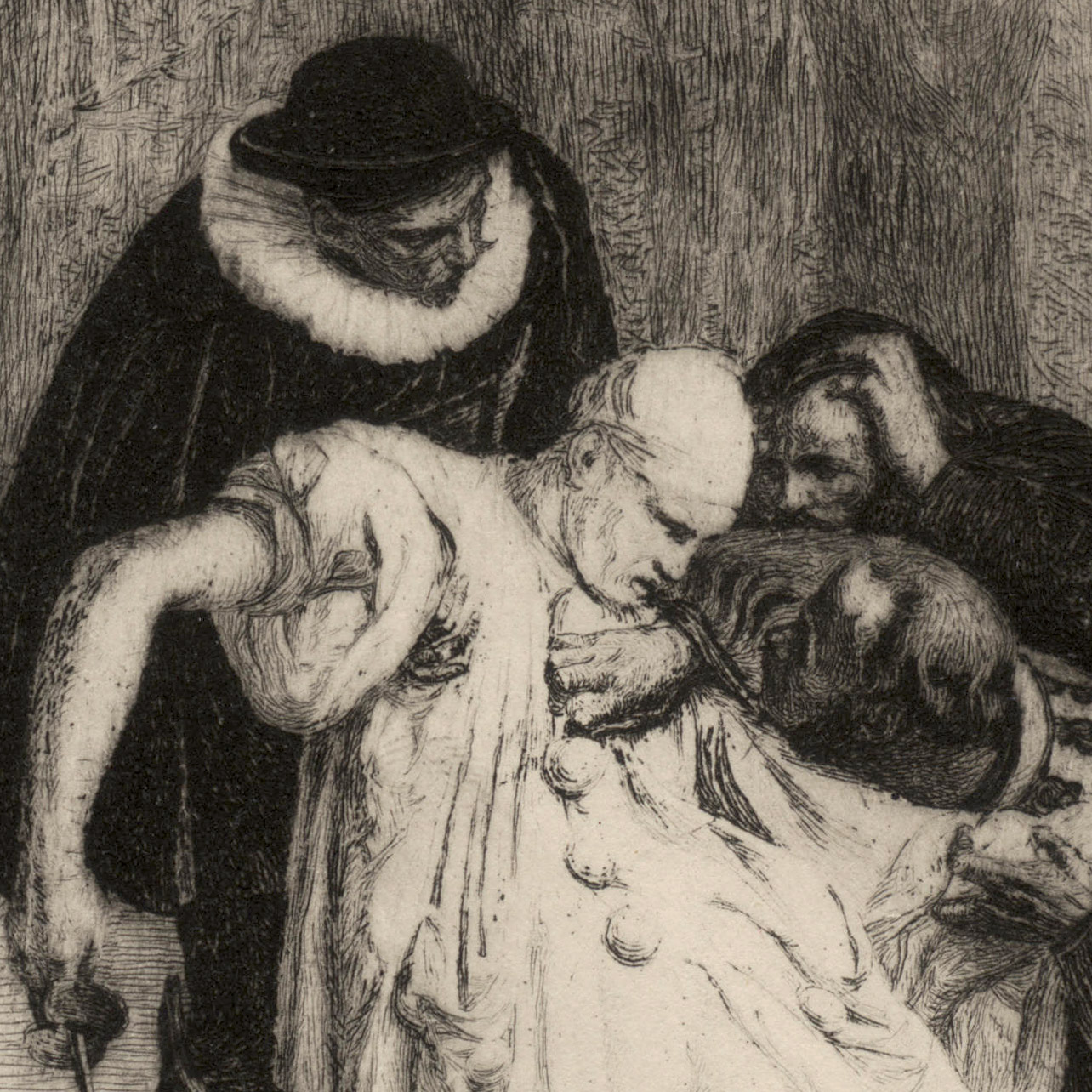
Paul Rajon’s etching, “After the Masquerade”, c.1884, after Gérôme


Paul Rajon (aka Paul Adolphe Rajon) (1843–1888)

“After the Masquerade”, c.1884, after Jean-Léon Gérôme’s (1824–1904) painting, “Suite d'un bal masqué”, 1857, in the Musée Condé in Chantilly (France), published in “The Art Journal”, vol. 46, p. 333, by J S Virtue & Co (1820s–1908) in 1884 in London.

Archive.org offers this volume for online viewing and free-of-charge dowloading (see page 333 for this print in its context):

Etching on cream coloured wove paper with full margins (as published).
Size: (sheet) 24.2 x 33.8 cm; (image borderline) 15.7 x 22.6 cm; note that the plate is larger than the published page).
Inscribed on plate within the image borderline: (lower left) “JL GEROME PINXT”; (lower right) “Rajon scl”.
Lettered on plate below the image borderline: (left) “PAINTED BY J. L. GERÔME. H.R.A.”; (centre) “AFTER THE MASQUERADE./ LONDON: J. S. VIRTUE & Co. LIMITED.”; (right) “ETCHED BY PAUL RAJON”.

 Beraldi 7 (Henri Beraldi 1885–92, “Les graveurs du 19e siècle; guide de l'amateur d'estampes modernes”, vol. 11, Paris, L Conquet, p, 158, cat. no. 7).

The Walters Art Museum offers the following description of Gérôme’s painting—mindful that Gérôme made copies of the original painting in the Musée Condé:
 “In this painting, showing the outcome of a duel after a costume ball, Gérôme replicates, with slight variations, a composition he had executed for the Duc d'Aumale in 1857. It is dawn on a wintry day in the Bois de Boulogne, Paris, and Pierrot succumbs in the arms of the Duc de Guise. A Venetian doge examines Pierrot's wound while Domino clasps his head in despair. To the right, the victorious American Indian departs, accompanied by Harlequin” (https://art.thewalters.org/detail/12697/the-duel-after-the-masquerade/).

See also the description of this print from a different edition offered by the British Museum:

Condition: well-printed, near faultless impression with full margins as published. The sheet is in near pristine condition for its considerable age (i.e. there are no tears, holes, losses, creases, abrasions, stains, foxing or signs of use).

I am selling this sensitively executed original etching often reproduced in books as it exemplifies the leaning to romantic images in the 19th century by showing the grim aftermath of a duel following what must have been an altercation with bruised pride at masquerade ball, for the total cost of AU$190 (currently US$110.22/EUR102.95/GBP94.64 at the time of posting this listing) including postage and handling to anywhere in the world (but not, of course, any import duties/taxes imposed by some countries).

If you are interested in purchasing this visually arresting scene that (to my eyes) captures perfectly the silvery dull light of a winter’s dawn in the Bois de Boulogne—a large park in the 16th arrondissement of Paris—please contact me (oz_jim@printsandprinciples.com) and I will send you a PayPal invoice to make the payment easy.