Monday, 25 May 2020

Hendrik Goltzius’ (workshop) engraving, “The Silver Age”, 1598


(Workshop of) Hendrick Goltzius (1558–1617) based on Goltzius’ design,
possibly engraved by Goltzius’ pupil Robert de Baudous (1574/5–after 1659) or by Goltzius himself.

“The Age of Silver”, 1598, plate four in the series of fifty-two plates, “The Creation of the Four Elements”, illustration to Ovid’s (43 BC–17/18 AD) “Metamorphoses Book I” with Latin verses by Franco Estius (fl.1580s–1594) below the image borderline, published by Claes Jansz. Visscher (1587–1652) in Haarlem.

The Rijksmuseum offers the following information regarding the series in which this print features:
(transl.) “This print is part of a series of 52 prints that depict stories from Ovid's Metamorphoses. This series is divided into three numbered series: two of 20 prints and one of 12 prints. This print belongs to the first series”

Engraving on fine laid paper, trimmed along the platemark with text lines below the image and backed with an edging strip with an ink borderline.
Size: (sheet with edge border) 18.5 x 26.2 cm; (sheet) 17.4 x 25.1 cm; (image borderline) 16.7 x 25.1 cm.
Numbered twice on plate below the image borderline: (at left and right) “4”.
Lettered on plate below the image borderline in four lines of Latin in two columns by Franco Estius: "Sub Joue deterior .../ ...//…/ … luxit humus."

State i (of ii) Lifetime impression before the plate numbers are erased/burnished.

TIB 3 (3) 34 (104) (After Goltzius) (Walter L Strauss [ed.] 1980, “The Illustrated Bartsch: Netherlandish Artists: Hendrik Goltzius”, vol. 3, Abaris Books, New York, p. 314); New Hollstein Dutch 535–1(2) (Marjolein Leesberg [comp.] 2012, “Dutch and Flemish Etchings, Engravings and Woodcuts c.1450–1700: Hendrick Goltzius”, vol. 3, Ouderkerk aan den Ijssel, Sound & Vision, p. 227, cat. no. 535).

The British Museum offers the following description of this print in its second state (the listed impression is from the first state):
“Plate 4: The Silver Age; allegorical scene with a man ploughing with a single ox in foreground, distant figures sowing seeds and gathering crops beyond, a spinster in lower left, on the right a female figure proffers a cornucopia, Jupiter on a cloud at top centre; later state with numbers burnished; after Hendrik Goltzius. 1589 Engraving”

Condition: a strong, well-printed impression trimmed to the platemark and edged with a margin strip with ruled ink border lines. Beyond the added border (which seems to be removable if necessary), the sheet is in a near faultless condition (i.e. there are no tears, holes, folds, losses, abrasions, stains or foxing).

I am selling this important allegorical print showing Goltzius’ vision of an imaginary scene representing life in the Silver Age where abundantly muscled near-naked men, plough and sow crops overseen by a bare-breasted lady holding a distaff (i.e. a spindle—no doubt symbolising womanly work in the agricultural age, but arguably also control over men as the distaff was a handy weapon of choice in arguments) for a total cost of AU$342 (currently US$224.90/EUR205.92/GBP184.05 at the time of posting this print) including postage and handling to anywhere in the world.

If you are interested in purchasing this strong, near faultless, lifetime impression, please contact me (oz_jim@printsandprinciples.com) and I will send you a PayPal invoice to make the payment easy.

This print has been sold


Sunday, 24 May 2020

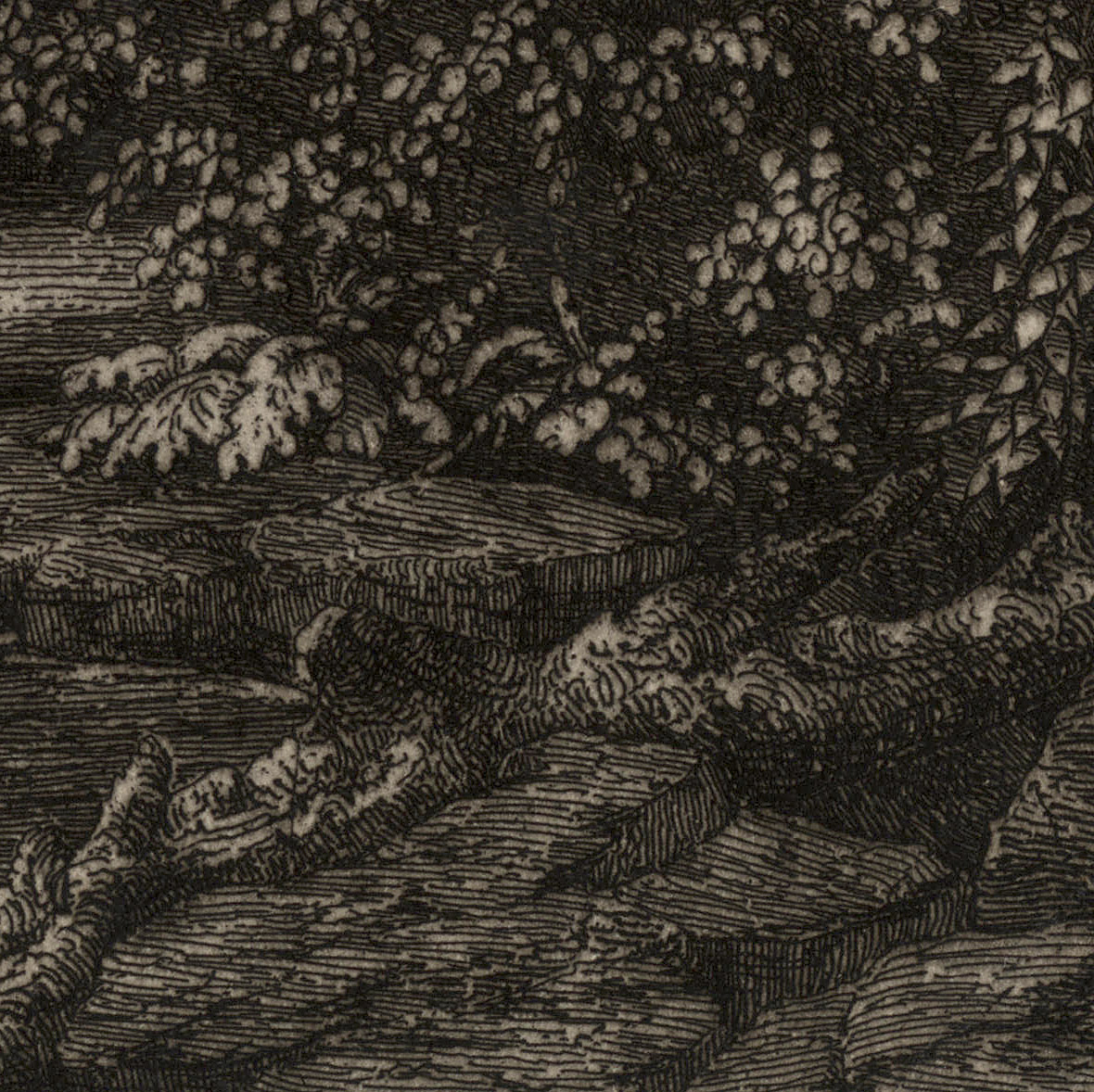
André Malardot’s etching, “Environs de Metz”, 1867


André Malardot (aka Charles-André Malardot) (1817–1879)

“Environs de Metz”, 1867, plate 282 from the fifth volume of prints produced by the Société des Aquafortistes, “Eaux-Fortes Modernes” (Modern Etchings), published in 1867 by Cadart & Luquet (fl.1863–1867) and printed by Auguste Delâtre (aka Auguste Marie Delâtre) (1822–1907) in Paris.

Etching with plate tone on chine collé (China) on ivory laid paper.
Size: (sheet) 33.7 x 24.2 cm; (plate) 24.5 x 17 cm; (image borderline/chine collé) 23.2 x 16 cm.
Numbered on plate within the image borderline: (upper-right corner) “282”.
Lettered on plate below the image borderline: (left) “Malardo sculp./ Paris, CADART & LUQUET, Editeurs.”; (centre) “ENVIRONS DE METZ.”; (right) “Imp.Delâtre,Rue St. Jacques,303,Paris.”

IFF 31 (Inventaire du Fonds Français: Bibliothèque Nationale, Département des Estampes); Beraldi 8 (Henri Beraldi 1885, “Les Graveurs du dix-neuvième siècle”, 12 vols, Paris).

See also the description of this print offered by the British Museum:
the Art Institute Chicago:
and the National Gallery of Australia:

Condition: richly inked and well-printed impression in excellent condition (i.e. there are no tears, holes, folds, losses, abrasions or significant stains).

I am selling this deeply romantic etching of a shadowy rock-walled pathway leading into bright sunlight—note the artist’s subtle skill in leaving a trace of plate-tone to render the dark foreground and removing any residue plate tone to the area of intense light in the middle distance—for a total cost of AU$273 (currently US$178.26/EUR163.52/GBP146.32 at the time of this listing) including postage and handling to anywhere in the world (but not, of course, any import duties/taxes imposed by some countries). 

If you are interested in purchasing very beautiful etching showing the artist’s shared vision of landscape with Rodolphe Bresdin (1822–1885)—summed up marvellously by Joris-Karl Huysmans in “Against the Grain” (Dover, 1969) as searching for “the rarest perfumes of visual splendours”—please contact me (oz_jim@printsandprinciples.com) and I will send you a PayPal invoice to make the payment easy.


Robert Boissard’s engravings, “Adamus Lonicerus”; “Heinricus Cornelius Agrippa”; “Franciscus Modius”, 1595–99


Robert Boissard (c.1570–c.1601)
“Adamus Lonicerus”; “Heinricus Cornelius Agrippa”; “Franciscus Modius”, 1595–99, from a series of fifty portraits of luminaries after intermediary drawings by Jean Jacques Boissard (1528/33–1598/1602), published in Frankfurt by Johann Theodor de Bry (1561–1623) and Johann Israel de Bry (1565–1609), printed by Matthaeus Beckerus (fl.1573–1606) in “Icones Virorum Illustrium” (aka “Icones quinquaginta virorum illustrium doctrina & eruditione praestantium ad vivum effictae, cum eorum vitis descriptis a Ian Iac. Boisardo Vesunti” (1597–99).
__________
LEFT
Adamus Lonicerus— (1528–1586) a German physician and botanist (see https://en.wikipedia.org/wiki/Adam_Lonicer).
Engraving on fine laid paper.
Size (sheet) 19.2 x 13.5 cm; (plate) 14.2 x 10.8 cm; (image borderline) 14 x 10.4 cm.
Signed on plate with monogram (R and B intertwined).
Inscribed on plate: (upper arch) “ADAMVS LONICERVS Med. Phijsic’ Francs ad Moenum.”; (tablet) “Nasc. Marpurg. 10 Octob./ Ao. 1528./ Obijt Francs ad Moen’/19 Maÿ, Ao, 1586.”; (text box) “Hebarum Scribis Solerti indagine vires, Nn 4/ est labor, est multæ cognitionis opous, fabr.”
Condition: strong impression with margins. There is a chip to the lower left of the sheet and there is a pencil notation recto and verso otherwise the sheet is in excellent condition.
The engraving in its published context may be viewed on page 304 (text); page 939 (online):
CENTRE
“Heinricus Cornelius Agrippa”— (1486–1535) a German polymath, physician, legal scholar, soldier, theologian, and occult writer (see https://en.wikipedia.org/wiki/Heinrich_Cornelius_Agrippa).
Engraving on fine laid paper.
Size (sheet) 19 x 12.2 cm; (plate) 13.5 x 9.3 cm.
Inscribed on plate: (upper arch) “HEINRICUS CORNELIUS AGRIPPA Med, & IC.EQU.”; (tablet) “Nascitur Colon,/ Agrip,/ Obijt Anno 1538.”; (text box) “Stemmate natus Eques, Medicus Magus atq[ue] Peritus/ Juris et Imperij consul Agrippa fuj. Oo 4”.
Condition: strong impression with margins in excellent condition—there is a pencil note recto and verso from a previous collector.
The engraving in its published context may be viewed on page 196 (text); page 613 (online):
__________
RIGHT
“Franciscus Modius” — (1556–1597) a Bruges Lawyer, humanist, philologist and poet (see https://kalliope-verbund.info/de/eac?eac.id=119064227).
Engraving on fine laid paper.
Size (sheet) 19.1 x 13.7 cm; (plate) 14.4 x 10.8 cm; (image borderline) 14.1 x 10.6 cm.
Inscribed on plate: (upper arch) “FRANCISCUS MODIUS Brugenfis IC. & Pocta”; (tablet) “Nafc Brugs in/ Ao/ Obyt/Ao.”; (text box) “MODIUS hic modium Juris compleverat omnem,/ Quam Vitc modius plenior ante forct./ Kk.3”.
Condition: strong impression with margins in excellent condition—there are pencil notes recto and verso from a previous collector and a spot visible verso only.
The engraving in its published context may be viewed on page 6 (text); page 986 (online):
__________

I am selling this engraved set of three illustrious German men from the 1500s for a total cost of AU$360 (currently US$235.37/EUR215.81/GBP193.47 at the time of this listing) including postage and handling to anywhere in the world.

If you are interested in purchasing these early portrait engravings rarely seen on the art market, please contact me (oz_jim@printsandprinciples.com) and I will send you a PayPal invoice to make the payment easy.

This set of prints has been sold


Saturday, 23 May 2020

Herman van Swanevelt’s etching, “Landscape with Sunset”, c.1655


Herman van Swanevelt (aka Herman Swaneveld) (c.1603–1655)

“Landscape with Sunset” (aka “Landschap met zonsondergang”; “Sunset Landscape”; “Le soir”), 1653–55, from the series, “Hill landscapes” (aka “Heuvellandschappen”), a lifetime impression published by Swanevelt (as inscribed on the plate) before the later edition published by Louis Joseph Mondhare (fl.1760–1792) in Paris.

Etching and engraving on laid paper (watermark featuring a crowned escutcheon with six balls), trimmed along/close to the platemark.
Size: (sheet) 18.3 x 28.6 cm; (image borderline) 17.3 x 27.7 cm.
Lettered on plate below the image borderline: (left) “HS fe et ex. pr Re”.

State ii (of iv) with the addition of Swanevelt’s initials and publication details, but before the addition of the publication details of publisher, Louis-Joseph Mondhare (see Rijksmuseum’s copy of state iii with Mondhare’s address: http://hdl.handle.net/10934/RM0001.COLLECT.181909).

TIB 81 (294); (Mark Carter Leach & Peter Morse [eds.] 1978, “The Illustrated Bartsch: Netherlandish Artists”, vol. 2, New York, Abaris Books, p. 285 cat. no. 81 [294]); Hollstein Dutch 107-2(4) (Dieuwke de Hoop Scheffer [comp.] 1984, “Dutch and Flemish Etchings, Engravings and Woodcuts c.1450–1700: Samuel de Swaef to Jan Thesing”, vol. 29, Blaricum, A.L. van Gendt, p. 96, cat. no. 107); Nagler 81.

The Rijksmuseum offers the following description of this print:
(Transl.) “Some hikers walk on a path along the river. A hiker crosses the river and in the distance is a building on a hill. At the building, a shepherd is herding a flock of sheep”

Condition: richly inked and well-printed lifetime impression from the second state (of vi) still retaining the inscribed guide lines for the lettered publication details, trimmed along or close to the plate mark. Beyond a flattened centre fold (not visible recto), the sheet is in an excellent condition for its considerable age (i.e. there are no tears, holes, losses, abrasions, significant stains of foxing).

I am selling this superb early impression of this remarkably beautiful landscape with the raking light of sunset and many travellers—I found nine but there may be more—making their way to a hill top villa at upper left, for a total cost of AU$360 (currently US$235.37/EUR215.81/GBP193.47 at the time of this listing) including postage and handling to anywhere in the world.

If you are interested in purchasing this marvellous landscape showcasing Swanevelt’s skill in creating the illusion of spatial depth by using rich blacks of etched lines in the foreground to delicately fine engraved strokes rendering the far distance, please contact me (oz_jim@printsandprinciples.com) and I will send you a PayPal invoice to make the payment easy.

This print has been sold


Friday, 22 May 2020

Crispijn de Passe the Elder’s engraving, “The Apulian Shepherd Transformed into an Olive Tree”, 1602


Crispijn de Passe I (aka Crispin Van de Passe; Crispin De Passe) (1564–1637)

“The Apulian Shepherd Transformed into an Olive Tree” (aka “Apulische herder in een olijfboom veranderd”), 1602, illustration to Ovid's (43BC–AD17) “The Metamorphoses”, Book XIV: 521, with four lines of Latin text in two columns by Johannes Posthius (1537–1597).

The subject of this print features ten nymphs holding hands in a ring around a tree while dancing to the music played on the lute and trumpet by two female musicians in the foreground at left. In the near distance on the right, an Apulian shepherd transforms into an olive tree (oleaster) as punishment for scorning the dancing nymphs.

Engraving on fine laid paper, trimmed with a narrow margin around the platemark.
Size: (sheet) 9.1x 13.5 cm; (plate) 8.7 x 13.3 cm; (image borderline) 7.5 x 13 cm.
Lettered on plate below the image borderline in two lines of Latin text in two columns:
"Apulus …/ …// …/ …habet.”

Franken 1338-124 (Daniel Franken 1975, “Scripta artis monographia: L'oeuvre gravé des Van de Passe”, vol. 19, Amsterdam, p. 254, cat. no. 1338/124); Hollstein Dutch 852 (Karel Gerard Boon 1964, “Dutch and Flemish Etchings, Engravings and Woodcuts c.1450–1700: Van Ostade–De Passe”, vol. 15, Amsterdam, Menno Hertzberger en Co, p. 287, cat. no. 852).
Ilja M Veldman 2001, “Profit and pleasure: print books by Crispijn de Passe”, Rotterdam, Sounds & Vision, pp. 73-84, 236, 379 (Fig. 239).

See also the description of this print offered by the Rijksmuseum:

Condition: well-inked and well-printed impression (possibly a lifetime impression as there are no signs of wear to the printing plate), trimmed with a narrow margin around the platemark. The sheet is in excellent condition (i.e. there are no tears, holes, folds, losses, abrasions, stains or foxing).

I am selling this very beautiful engraving illustrating an episode from Ovid’s “Metamorphoses” where a shepherd who mocked a group of dancing nymphs is punished by being turned into an olive tree, for AU$238 in total (currently US$155.42/EUR142.15/GBP127.28 at the time of posting this listing) including postage and handling to anywhere in the world (but not, of course, any import duties/taxes imposed by some countries).

If you are interested in purchasing this fascinating engraving from 1602 inviting a viewer by visual cues to hear music and see dancing, please contact me (oz_jim@printsandprinciples.com) and I will send you a PayPal invoice to make the payment easy.

This print has been sold