Saturday, 25 June 2022

Claude Lorrain’s etching, “Coast Scene with an Artist”, c1638–41


Claude Lorrain (aka Claude Gellée, Claude; Claude Le Lorrain; Claudio di Lorena) (1600–1682)

“Coast Scene with an Artist” (aka “Le Dessinateur”), c1638/39–41. This impression is from McCreery’s 1816 edition of “200 Etchings” printed from the original plate.

Etching on wove paper, trimmed with a narrow margin around the image borderline and with a section of an engraving from the 1784 Paris edition of “Stirpes Novae” (documented as a feature of the state v impressions; see Mannocci [1988] p. 28).

Size: (sheet) 13 x 17.9 cm; (image borderline) 12.5 x 17.5 cm.

State v (of v)

Mannocci 35 (Lino Mannocci 1988, “The Etchings of Claude Lorrain”, New Haven, Yale University Press, pp. 217–223, cat. no. 35, fifth state); Blum 14; Robert-Dumesnil 9; Duplessis 9; Russell 45.

The British Museum offers the following description of this print: “Coast scene with an artist; an artist sitting and drawing near a bridge crossed by a woman riding a donkey; fortified city and ships in the background. c.1638/41/ Etching” (https://www.britishmuseum.org/collection/object/P_1868-0822-902).

Regarding the subject portrayed in this print, H Dianne Russell in “Claude Lorrain 1600–1682 (1982, National Gallery of Art, Washington, Exh. cat.) offers the following insights: “This etching reproduces in reverse a painting by Claude, LV 44, signed and dated 1639 and now in the Cincinnati Art Museum […]. The print probably dates from the same year. The motif of an artist drawing out-of-doors is found in several of Claude’s paintings, a number of drawings, and another etching, […’Landscape with Artist Drawing’]. The earliest known example is a drawing depicting an artist sitting in front of a sculpture and sketching it […]. Sandrart recorded that Claude himself frequently drew out-of-doors” (p. 394).

Condition: a richly inked and well-printed impression trimmed with a narrow margin around the image borderline in an excellent/near pristine condition with no tears, folds, holes, abrasions, significant stains, foxing or signs of handling. Note that the verso shows a section of an engraving from the 1784 Paris edition of “Stirpes Novae” (documented as a feature of the state v impressions).

I am selling this curiously interesting etching by the one of the most famous artists of the 17th century, featuring an artist at work—mindful that Lino Mannocci (1988) advises: “The theme of the artist drawing from nature recurs frequently in Claude’s work” (p. 223)—for the total cost of AU$398 (currently US$276.68/EUR262.04/GBP225.49 at the time of this listing) including postage and handling to anywhere in the world, but not (of course) any import duties/taxes imposed by some countries).

If you are interested in purchasing this superb impression of a very beautiful etching with the verso showing a fragment of an engraving from the 1784 Paris edition of “Stirpes Novae” (as discussed by Mannocci [1988] p. 28 and by H Diane Russell [1982] in “Claude Lorrain 1600–1682”, p. 300), please contact me (oz_jim@printsandprinciples.com) and I will send you a PayPal invoice to make the payment easy.

This print has been sold


Thursday, 23 June 2022

Unidentified master from the circle of Nicolaas de Bruyn’s engraving, “The Golden Age”, c1605, after Abraham Bloemaert


Unidentified master from the circle of Nicolaas de Bruyn (1571–1656)

“The Golden Age”, c1605 (or possibly much later following the active date of the publisher [c1763]), published in Paris by Jacques Chéreau (aka le jeune Chéreau) (1688–1776), in reverse to the composition of Nicolaas de Bruyn’s engraving (1604) (see https://www.britishmuseum.org/collection/object/P_1907-1121-4) and in the same direction to the circular composition by Johann Theodor de Bry (aka Jan Dirk de Bry) (1561–1623) (see https://www.britishmuseum.org/collection/object/P_D-7-178) after the preparatory drawing (1603) by Abraham Bloemaert (1564–1651) in the Städelsches Kunstinstitut, Frankfurt (inv.no. 2887) (see https://sammlung.staedelmuseum.de/en/work/the-golden-age).

Engraving on laid paper, trimmed around the platemark (with many small restorations) and backed with a support sheet

Size: (sheet) 48 x 68.9 cm; (image borderline) 44.2 x 68.6 cm.

Lettered in plate within the image borderline: (lower left) “Blomart inuent. Jac Chereau exc.”; (lower right tablet with four lines of Latin text) “Auria Saturno … ferebat opes.”

Lettered in plate below the image borderline in six columns of French text: “Lors que la forte voix …”.

Condition: a strong and well-printed impression, but in a poor condition with age-toning, a flattened centrefold, numerous restored minor tears, replenished small losses and scattered stains. The sheet has been laid upon a support of archival (millennium quality) washi paper.

I am selling this huge masterwork of engraving showing an Arcadian paradise—what the Greek poet, Hesiod, calls “The Golden Age”—where thinly clad folk rest, dance, make music, engage in romance and eat grapes, while children blow bubbles to amuse cats, for AU$688 (currently US$474.58/EUR448.89/GBP387.19 at the time of posting this print) including postage and handling to anywhere in the world, but not (of course) any import duties/taxes imposed by some countries.

If you are interested in purchasing this gigantic engraving of exceptional rarity and incredible beauty, please contact me (oz_jim@printsandprinciples.com) and I will send you a PayPal invoice to make the payment easy.

This print has been sold 


Wednesday, 22 June 2022

Jean-Louis Delignon’s engraving with etching, “Vue de Sphinx”, c1799, after Louis-François Cassas

Jean-Louis Delignon (aka Jean Louis de Lignon) (1755–c1804)

“Vue de Sphinx”, c1799, after the intermediary design by Louis-François Cassas (1756–1827) (see BnF https://catalogue.bnf.fr/ark:/12148/cb16867019q), an impression before lettering with title and publication details possibly as illustration to Louis-François Cassas’ “Voyage pittoresque de la Syrie, de la Phoenicie, de la Palestine et de la Basse Égypte” (Picturesque journey through Syria, Phoenicia, Palaestine and Lower Egypt), 1799, published by the Imprimerie de la République/Dugour et Durand in Paris.

Regarding Louis-François Cassas’ publication, I understand that it consists of three volumes containing about three hundred and thirty plates (see the description of another etching from the same publication held by the Museum of Fine Arts Boston: https://collections.mfa.org/objects/629650/plate-from-voyage-pittoresque-de-la-syrie-de-la-phoenicie?ctx=b23cc01f-69fd-469a-95a7-476f1997fe58&idx=45). The description of the publication by the auction house, Piasa, showcased a single volume divided into three parts separated by white pages, featuring (in transl.) “…a total of 180 plates drawn by Cassas and etched by Berthault, Duparc, Legrand, Malapeau, Picquenot, Racine, Tilliard,… including 3 double pages and 24 foldouts” (see https://www.piasa.fr/en/products/louis-fran-ois-c-a-s-s-a-s-voyage-pittoresque-de-la-syrie-de-la-phoenicie-de-la-palestine-et-de-la-basse-gypte_1516626284_5a65e16cba82a).

Engraving with etching on chine collé on wove paper trimmed with small margins and backed with a support sheet.

Size: (support sheet) 35.9 x 43.8 cm; (sheet) 21.5 x 29.5 cm; (plate) 19.5 x 27.4 cm; (chine collé) 18 x 26.8 cm; (image borderline) 14 x 22.6 cm.

Inscribed in plate below the image borderline: (left) “Cassas.”

Lifetime impression before lettering with title and publication details.

IFF145 (see BnF https://catalogue.bnf.fr/ark:/12148/cb44546711r)

Condition: a strong impression with small margins laid upon a support of archival (millennium quality) washi paper. There are handling marks around the image and a minor mark in the sky, otherwise the sheet is in a good condition with no tears, holes, folds, significant stains or foxing.

I am selling this historically important engraving showing the famous Sphinx in an early state of restoration—note the trench behind the head—around the time that Napoleon's troops purportedly (but now believe to be an incorrect allegation) shot off the statue's nose with a cannon, for AU$244 (currently US$168.25/EUR160.19/GBP137.95 at the time of posting this print) including postage and handling to anywhere in the world, but not (of course) any import duties/taxes imposed by some countries.

If you are interested in purchasing this rare engraving—note that I have been unable to find a copy of it in any of the major museum collections—please contact me (oz_jim@printsandprinciples.com) and I will send you a PayPal invoice to make the payment easy.

This print has been sold 


Tuesday, 21 June 2022

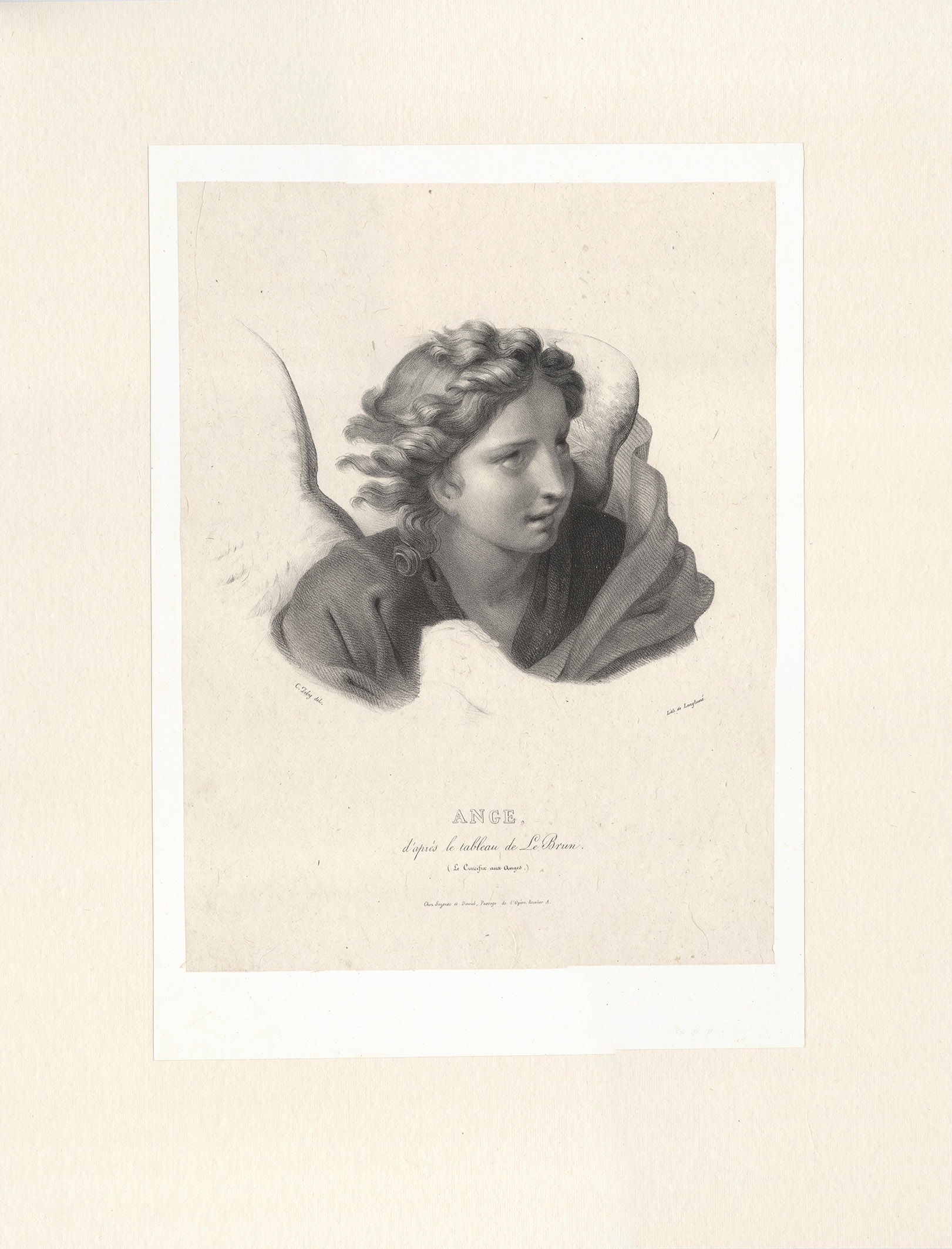
Pierre Langlumé’s lithograph, “Ange”, 1825, after Charles Le Brun

(From the circle of, or by) Pierre Langlumé (1790–? [fl.1818–1830])

“La Magdeleine”, 1825, lithograph printed by Pierre Langlumé and published in Paris by Sazerac & Duval (fl.c1824–1827) after an intermediary drawing by C. Deby of a detail in reverse of Charles Le Brun’s (aka Charles Lebrun) (1619–1690) painting, “Le Crucifix aux Anges” (1661–1686), now in Versailles and in the collection of the Louvre (INV 2886 ; MR 1922) (see https://collections.louvre.fr/en/ark:/53355/cl010060604).

Lithograph in the crayon manner printed in black on chine collé  on wove paper with the publisher’s blind-stamp at lower centre.

Size: (support sheet) 54.4 x 41.8 cm; (sheet) 39.2 x 28.5 cm; (chine collé) 33.9 x 26 cm.

Lettered in the stone below the image: (left) “C. Deby del.”; (centre) “Ange,/ d’après le tableau de Le Brun./ (Le Crucifix aux Anges)/ Chez Sazerac et Duval, Passage de l'Opéra, Escalier A.”; (right) “Lith. de Langlumé”.

Blind-stamped with the publisher’s seal at lower centre.

Condition: a near faultless impression laid upon a support of archival (millennium quality) washi paper. The sheet is in an excellent (near pristine) condition with no tears, holes, folds, abrasions, significant stains or foxing.

I am selling this sensitively executed and very beautiful crayon-manner lithograph showing a detail of a angel from Charles Le Brun’s painting, “Le Crucifix aux Anges”, for AU$234 (currently US$163.36/EUR154.63/GBP132.88 at the time of posting this print) including postage and handling to anywhere in the world, but not (of course) any import duties/taxes imposed by some countries.

If you are interested in purchasing this very rare lithograph—note that I have been unable to find a copy of it in any of the major museum collections—please contact me (oz_jim@printsandprinciples.com) and I will send you a PayPal invoice to make the payment easy.


Monday, 20 June 2022

Germaine Garcin’s etching, “The Flock”, 1920

Germaine Garcin (1897–1900s)

“The Flock”, 1920, published by the Societé des Aquafortistes exclusively for the Society’s members as an annual print for 1920 and exhibited at the Salon des Artists Français. Monogramed in plate and hand-signed in ink by the artist at lower right.

Etching printed in a warm black on heavy cream wove paper with small margins (as published?).

Size: (sheet) 28.1 x 38.2 cm; (plate) 24.4 x 32.4 cm; (image borderline) 23.5 x 31.4 cm.

Monogramed with the artist’s initials in plate within the image borderline: (lower right) (ligature monogram) “GG”.

Signed on plate on the lower right. Published by the Societé des Aquafortistes, and exhibited at the Salon des Artists Français.

Lettered in plate below the image borderline: (left) “Planche annuelle publiée par la Societé des Aquafortistes Français pour l’année 1920 et exclusivement réservée à ses Societaires.” (Annual print published by the Society of French Aquafortists for the year 1920 and exclusively reserved for its members.)

Hand inscribed in ink below the image borderline: (left) “183”; (right) “Germanie Garcin”.

Condition: a richly inked and well-printed impression with small margins. There are minor stains verso, otherwise the sheet is in an excellent condition with no tears, holes, folds, losses, abrasions, significant stains or foxing.

I am selling this hand-signed and superbly executed etching—note how the flowing lines describing the tree at left lend a feeling of animation and how the lightly curving lines behind the herdsman suggest his movement—for the total cost of AU$238 (currently US$166.24/EUR157.96/GBP135.85 at the time of this listing) including postage and handling to anywhere in the world (but not, of course, any import duties/taxes imposed by some countries).

If you are interested in purchasing this very romantic scene of a herdsman and his flock of sheep, please contact me (oz_jim@printsandprinciples.com) and I will send you a PayPal invoice to make the payment easy.